AACSB vs. ACBSP Accreditation: Why It Determines Your MBA’s Value
When evaluating no-GMAT online MBA programs, accreditation is the single most critical factor that separates a valuable degree from a costly piece of paper. In the United States, institutional regional accreditation—such as from the Higher Learning Commission or the Middle States Commission on Higher Education—ensures a university meets basic academic standards and qualifies its students for federal FAFSA funding. However, programmatic accreditation acts as the gold standard seal of approval for the business school itself. The three major programmatic accreditors recognized by the US Department of Education are the Association to Advance Collegiate Schools of Business (AACSB), the Accreditation Council for Business Schools and Programs (ACBSP), and the International Assembly for Collegiate Business Education (IACBE).

Understanding the hierarchy between these three is essential for prospective students. AACSB accreditation is the oldest and most prestigious credential, held by less than 5% of the world’s business schools. It heavily emphasizes faculty research and academic publication, making it the benchmark for elite, research-intensive universities. Conversely, ACBSP and IACBE focus primarily on teaching excellence and student outcomes rather than faculty research. While both are highly respected and rigorous, they are typically found at regional public universities, private teaching colleges, and online institutions that prioritize practical, applied business education.
Why does this distinction matter for your career? Fortune 500 recruiters and top-tier consulting firms often use Applicant Tracking Systems (ATS) that automatically filter out candidates whose MBAs do not come from AACSB-accredited programs. If your goal is to climb the ladder at a Wall Street firm or secure a highly competitive management consulting role, an AACSB-accredited degree is virtually non-negotiable. However, if your goal is to gain practical leadership skills for mid-level management, entrepreneurship, or a career pivot, an ACBSP or IACBE-accredited online MBA will still provide immense value and employer recognition, often at a fraction of the tuition cost.
Before you enroll in any program, you must independently verify the school’s accreditation standing. Do not rely solely on a university’s marketing materials. Instead, use the Council for Higher Education Accreditation (CHEA) database or the US Department of Education’s Database of Accredited Postsecondary Institutions and Programs. By searching the institution’s name in the CHEA database, you can confirm both its regional accreditation and its specific business school accreditation status. This simple, five-minute verification process ensures your investment—often ranging from $15,000 to $60,000—is protected and that your hard-earned degree will be recognized by employers nationwide.
True Cost Breakdown: Tuition, Fees, and Hidden Expenses by Program Tier
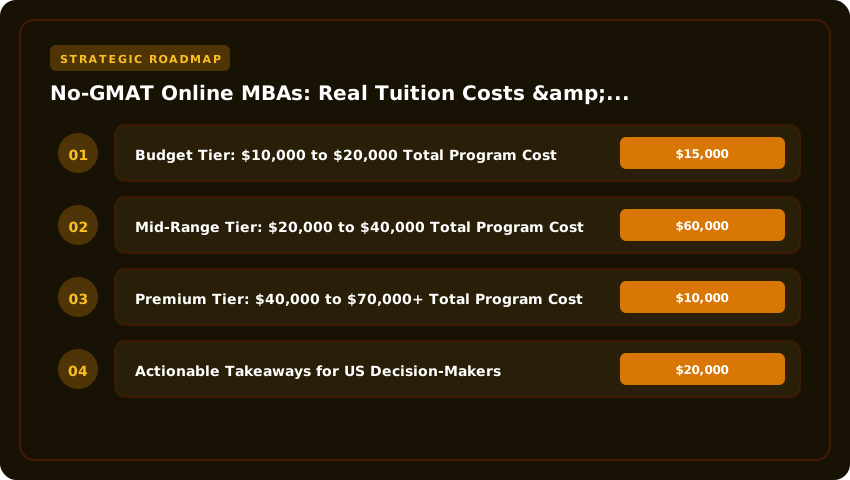
Understanding the true financial commitment of a no-GMAT online MBA requires looking far beyond the advertised “total tuition” sticker price. Many programs publish an attractive headline figure, yet the all-in cost frequently climbs by 20% to 40% once you factor in required fees, textbooks, residency travel, and technology expenses. For prospective students in the United States evaluating top accredited online MBA programs no GMAT options, a tiered analysis offers the clearest path to an apples-to-apples comparison. Below is a detailed breakdown across three pricing categories, anchored by verifiable institutional examples and dollar figures you can use for realistic budgeting.
Budget Tier: $10,000 to $20,000 Total Program Cost
- University of the People (UoPeople): A tuition-free, ACBSP-accredited online MBA charges approximately $0 in tuition, with only a modest application fee of around $50 and end-of-course assessment fees near $200. Total degree cost often lands between $4,000 and $6,000 depending on transfer credits, making it one of the most affordable AACSB/ACBSP-aligned options available.
- Fort Hays State University (FHSU): This AACSB-accredited program offers an online MBA priced at roughly $325 per credit hour for out-of-state students, with the full 30 to 36 credit degree totaling between $10,000 and $13,500. Students should budget an additional $400 to $800 for textbooks and a small graduation fee of approximately $50.
- Typical Hidden Costs: Proctoring fees ($25–$75 per exam), digital learning platform access ($50–$150 per semester), and minimal travel since most budget programs are fully asynchronous with no residency requirement.
Mid-Range Tier: $20,000 to $40,000 Total Program Cost
- Typical Per-Credit Rates: Expect $500 to $950 per credit hour, placing a 36-credit MBA between $18,000 and $34,200 in base tuition. Many state-affiliated and nonprofit institutions sit squarely in this band.
- Technology and Platform Fees: A recurring student technology fee of $150 to $350 per semester is common, adding $600 to $1,400 across a typical six-semester enrollment window. Some schools bundle this into tuition; others itemize it separately on the billing portal.
- Textbook and Course Material Estimates: Budget roughly $100 to $250 per course for digital textbooks, case studies, and simulation licenses. Over 10 to 12 courses, this can total $1,000 to $2,500, particularly when Harvard Business Publishing cases or Bloomberg terminal access are required.
- Residency Costs (Where Applicable): Mid-range programs increasingly include one or two brief on-site immersions. Allow $800 to $2,000 per residency for airfare, lodging, and meals, especially for schools located outside major airline hubs.
- Graduation and Administrative Fees: A standard graduation application fee of $75 to $200, plus optional regalia rental near $75, should be reserved in your final semester budget.
Premium Tier: $40,000 to $70,000+ Total Program Cost
- UNC Kenan-Flagler (UNC Chapel Hill): The online MBA from this top-ranked, AACSB-accredited institution is priced at roughly $1,650 per credit hour for the 62-credit MBA@UNC format, bringing tuition alone to approximately $102,000+. However, the 36-month, more condensed track with transfer-eligible credits can lower the total to around $60,000 to $75,000. Students should plan for an additional $1,500 to $3,000 in immersion expenses, since this program requires multiple in-person global residencies.
- Per-Credit Rates at Other Premium Programs: Expect $1,200 to $2,200 per credit hour, frequently reflecting the school’s brand recognition, Career Services investment, and AACSB prestige.
- Comprehensive Fee Add-Ons: Premium tiers often include a comprehensive student fee of $1,000 to $3,000 per year covering premium technology platforms, executive coaching, library access, and alumni network registration.
- Hidden Premium Expenses: International immersion trips ($3,000–$7,000 if optional), case competition travel, professional attire for networking events, and licensing exam prep packages for students pursuing CFA or CPA crossover credentials.
Actionable Takeaways for US Decision-Makers
- Always request a full cost of attendance (COA) worksheet from the financial aid office, including indirect costs like childcare, internet upgrades, and lost wages during residencies.
- Confirm whether FASFA-eligible federal loans apply, and whether the school is approved by the Department of Veterans Affairs for GI Bill benefits.
- Calculate your true cost per credit hour by dividing total expected expenses by program credits, then compare across tiers to identify genuine value rather than headline marketing.
By examining no-GMAT online MBAs through this layered lens, you transform sticker shock into strategic planning. The cheapest program is rarely the lowest total cost once opportunity expenses and hidden requirements surface, and the most expensive program may yield a strong return on investment if it accelerates promotions or unlocks six-figure career pivots. Use the dollar benchmarks above to pressure-test any admissions offer before you commit.
Why Top Schools Are Dropping the GMAT—and What They Want Instead
Across the United States, a quiet revolution has reshaped graduate business education over the past decade. The Graduate Management Admission Test (GMAT), long treated as the non-negotiable gatekeeper of MBA admissions, is rapidly disappearing from application requirements at many accredited institutions. Schools accredited by AACSB International and ACBSP have led this transformation, recognizing that a standardized multiple-choice exam often fails to capture the leadership qualities, real-world judgment, and career maturity that define a strong business student in 2026.
According to admissions data released by major universities and verified through the schools’ official program portals, the no-GMAT online MBA movement accelerated dramatically between 2020 and 2025, when pandemic-era flexibility became permanent. Programs discovered that waiving the GMAT broadened their applicant pools, increased enrollment among working professionals, and produced student outcomes that were statistically indistinguishable from cohorts admitted with high test scores. In other words, the GMAT turned out to be a filter rather than a genuine predictor of success in a rigorous online MBA.
What admissions committees now look for instead is a richer, multi-dimensional picture of the applicant. Here is what accredited programs typically evaluate when they drop the GMAT requirement:
- Professional Experience: Most competitive programs expect a minimum of five years of progressively responsible work experience, often with demonstrated leadership, project management, or measurable business impact. Schools such as Florida State University and Ohio University explicitly state that seasoned professional experience can substitute for standardized testing.
- Undergraduate GPA Thresholds: A GPA of 3.0 on a 4.0 scale is the most common benchmark. AACSB-accredited programs like Washington State University typically require at least a 3.0 in the last 60 credit hours of undergraduate study, signaling academic readiness for graduate-level quantitative coursework.
- Portfolio Submissions: Many programs invite or require a professional portfolio, which may include a current résumé, writing samples, presentations, or evidence of strategic decision-making. This document-based assessment helps committees gauge communication skills and career trajectory.
- Admission Interviews: Live or recorded interviews have become a standard substitute. Interviewers probe for self-awareness, ethical reasoning, and clarity of purpose, qualities the GMAT was never designed to measure.
- Prerequisite Coursework: Foundational courses in statistics, accounting, finance, or economics may be required before enrollment or integrated into the first year of the program, ensuring every student can handle the quantitative rigor of an AACSB-aligned curriculum.
Several accredited institutions have publicly embraced this philosophy. Washington State University offers an AACSB-accredited online MBA that has been GMAT-optional for years, emphasizing professional experience and a 3.0 GPA as the primary academic anchors. Florida State University’s online MBA, also AACSB-accredited, evaluates candidates holistically, weighing leadership potential and career progression heavily. Ohio University and University of North Alabama likewise advertise GMAT waivers for applicants with sufficient professional background, with Ohio University’s program being ACBSP-accredited and widely recognized for affordability.
This strategic shift does not mean accredited online MBA programs have lowered their standards. Instead, they have shifted the burden of proof from a single test score to a constellation of evidence. For applicants, the practical takeaway is clear: invest your preparation time in refining your résumé, securing strong recommendation letters, and articulating a compelling career narrative. When applying through AACSB or ACBSP standards, schools that have dropped the GMAT are typically looking for candidates whose professional record demonstrates the kind of analytical thinking, leadership, and accountability that no standardized exam can fully measure. This evolution ultimately benefits serious working professionals who have built their expertise in the field, not in a testing center.
ROI Reality Check: Salary Outcomes vs. Total Student Debt
Evaluating the true return on investment (ROI) of a no-GMAT online MBA requires moving beyond advertised tuition figures and confronting the hard numbers: what you actually earn after graduation versus what you actually owe. According to the most recent Graduate Management Admission Council (GMAC) Corporate Recruiters Survey and U.S. Bureau of Labor Statistics (BLS) Occupational Employment and Wage Statistics, online MBA graduates consistently land in a starting compensation range of $85,000 to $115,000 annually, depending heavily on industry, geographic region, and prior work experience. For context, the BLS reports that general management positions (SOC code 11-1021) carry a median annual wage of approximately $116,880 as of May 2023, with the top 10 percent of earners exceeding $209,660. These figures establish a credible earnings ceiling that helps frame the debt-to-income calculation.
Now, let’s anchor that salary against the realistic debt burden of a reputable online MBA. Most AACSB-accredited programs fall between $30,000 and $60,000 in total tuition, while non-AACSB programs may run lower, often between $18,000 and $35,000. Assuming a working professional borrows the median amount of roughly $45,000 at federal graduate loan rates around 7.5 percent, with a standard 10-year repayment term, monthly payments hover near $535, totaling approximately $64,000 over the loan lifecycle including interest. Against a $100,000 post-MBA salary, the front-end debt-to-income ratio sits at a manageable 6.4 percent, well within healthy lending thresholds.
The break-even timeline calculation reveals where the real value lives. If an MBA graduate’s salary increases by $20,000 to $30,000 annually compared to their pre-MBA earnings, and their total all-in program cost (tuition plus opportunity cost, fees, and interest) is roughly $50,000, the break-even point typically arrives within 18 to 30 months of graduation. This is significantly faster than the 5-to-7-year break-even window associated with many law degrees or non-STEM master’s programs, according to BLS longitudinal earnings data.
- Conservative scenario: $85K starting salary, $40K total debt, $15K pre-MBA raise — break-even within 24 months.
- Moderate scenario: $100K starting salary, $50K total debt, $25K raise — break-even within 20 months.
- Aggressive scenario: $115K starting salary in tech or finance, $60K debt, $35K raise — break-even within 14 months.
Here is where the equation shifts dramatically for working professionals: employer tuition reimbursement programs. Under IRS Section 127, employers can provide up to $5,250 per calendar year in tax-free educational assistance to employees. This single provision can cover roughly 15 to 25 percent of a typical online MBA’s annual tuition cost without any tax liability on the employee’s behalf. Fortune 500 companies, major hospital systems, and federal agencies routinely offer this benefit, and many extend it to non-degree-seeking coursework, meaning you can tap reimbursement before formally enrolling in a degree program to test the waters.
Strategic learners should maximize Section 127 benefits by pursuing programs that accept per-credit-hour payment structures, allowing reimbursement claims each semester. When paired with a no-GMAT admission pathway, the effective out-of-pocket cost of an MBA can drop below $10,000 in many cases, compressing the break-even timeline to under one year and transforming the degree into one of the highest-leverage investments available in continuing education today.
FAFSA, Employer Aid, and Scholarships: Funding Your No-GMAT MBA
Financing a no-GMAT online MBA requires a layered strategy that blends federal aid, employer benefits, and targeted scholarship dollars. Because most accredited online programs at US universities carry the same Title IV recognition as their on-campus counterparts, graduate students can access the same federal loan structures used by traditional learners. Understanding how each funding stream works—and how to stack them intelligently—can reduce out-of-pocket costs by tens of thousands of dollars over a two-year MBA journey.
FAFSA Eligibility for Online Graduate Students. The Free Application for Federal Student Aid (FAFSA) remains the gateway to federal graduate loans, and online MBA students qualify for the same packages as residential learners, provided their program is offered by a school participating in Title IV programs. There is no requirement to study on campus, no minimum credit-hour floor beyond half-time enrollment, and no GMAT score involved in the federal aid review. After completing the FAFSA at studentaid.gov, graduate students are evaluated primarily on prior-prior year income, assets, and household size—not academic testing metrics. This makes the FAFSA particularly valuable for no-GMAT applicants who may have chosen a testing-optional path precisely to avoid standardized assessments.
Direct Unsubsidized Loans: The $20,500 Baseline. The federal Direct Unsubsidized Loan program lets graduate students borrow up to $20,500 per academic year, with a cumulative graduate borrowing limit of $138,500 (including undergraduate debt). Interest accrues from disbursement, and the current rate for graduate unsubsidized loans sits around 7.5% for the 2024–2025 cycle, though rates adjust annually. For a typical two-year online MBA costing $40,000 to $60,000 total, Direct Unsubsidized Loans can cover 40% to 100% of tuition depending on program price. Standard repayment begins six months after graduation or enrollment dropping below half-time, but income-driven repayment plans—SAVE, IBR, PAYE—can substantially lower monthly obligations for early-career professionals.
Grad PLUS Loans: Filling the Gap. When Direct Unsubsidized Loans leave a tuition shortfall, the federal Grad PLUS Loan bridges the difference. Graduate students can borrow up to the full cost of attendance minus other aid, making it ideal for premium online MBA programs affiliated with institutions like Carnegie Mellon Tepper, USC Marshall, or the University of North Carolina Kenan-Flagler. Grad PLUS requires a credit check (no cosigner needed but adverse credit can trigger denial), carries a slightly higher interest rate around 8.5%, and includes an origination fee. Borrowers should treat Grad PLUS as a strategic tool—useful for completing funding but expensive over a standard 10-year repayment horizon. Refinancing into private loans after graduation often lowers rates for borrowers with strong credit profiles.
Employer Tuition Assistance: Up to $5,250 Tax-Free. The most underutilized MBA funding source is employer tuition reimbursement. Under Section 127 of the Internal Revenue Code, employers can reimburse up to $5,250 per year in tax-free educational assistance. Many Fortune 500 companies, consulting firms like Deloitte and Accenture, and tech giants including Amazon and Google extend tuition benefits well beyond this federal minimum—often covering 100% of accredited online MBA tuition. Employees typically must remain with the company for one to three years post-reimbursement, and courses must maintain a minimum grade (usually B or higher). Because no-GMAT online programs offer asynchronous coursework, working professionals can align classes with corporate schedules without sacrificing career momentum.
MBA-Specific Scholarships. A robust scholarship ecosystem exists for online MBA students, with awards ranging from $1,000 to $25,000:
- National Black MBA Association (NBMBAA) awards annual scholarships to members pursuing graduate business degrees, with preference for candidates demonstrating leadership and community impact. Awards typically range from $2,500 to $10,000.
- Forté Foundation partners with AACSB-accredited schools to provide scholarships for women in MBA programs, including flexible online formats. Forté also connects recipients with sponsor companies for internship and employment pipelines.
- National Society of Hispanic MBAs (NSHMBA) offers merit and need-based scholarships for Hispanic graduate business students, with recipients gaining access to a powerful professional network.
- American Association of University Women (AAUW) provides selective fellowships for women in accredited graduate programs, including business administration.
- School-Specific Awards: Universities like Indiana University Kelley, University of Florida Warrington, and Penn State World Campus maintain dedicated online MBA scholarships for merit, diversity, and STEM-adjacent concentrations.
Graduate Assistantships for Online Learners. While traditionally tied to on-campus roles, many universities now extend assistantship opportunities to remote online MBA students. Positions include research assistantships supporting faculty publications, teaching assistantships grading undergraduate coursework, or administrative roles in admissions and career services. Stipends typically range from $1,500 to $6,000 per semester, with some programs offering tuition remission in addition to stipend support. Online students should inquire directly with their program director—availability varies widely by institution, but the trend toward remote graduate employment continues to expand.
Actionable Funding Strategy. Begin by filing the FAFSA in October preceding your enrollment year to maximize federal aid eligibility. Simultaneously, request employer tuition assistance policy documentation from your HR department. Apply for at least three scholarship opportunities with rolling deadlines—including NBMBAA, Forté, and school-specific awards. Borrow Grad PLUS only after exhausting employer aid, scholarships, and Direct Unsubsidized Loans. This sequencing minimizes high-interest debt while preserving federal repayment protections.
Strategic Application Playbook: Getting Accepted Without a Test Score
Gaining admission to a top-tier, GMAT-free online MBA program requires a fundamentally different approach than a traditional application. Because admissions committees cannot rely on a standardized test score to gauge academic readiness, they will scrutinize your professional narrative, the quality of your recommendations, and the depth of your engagement with the institution far more closely. The good news is that you can absolutely craft a winning application—it simply demands intentional strategy, meticulous preparation, and disciplined timing. Treat your application not as a single transaction, but as a three-month campaign designed to showcase your leadership potential, your analytical capability, and your clear career trajectory.
Start by auditing your professional story. Admissions officers at AACSB-accredited institutions are looking for evidence that you can synthesize complex business problems, lead diverse teams, and translate strategy into measurable outcomes. Before you write a single word of your personal statement, pull together a detailed inventory of your last three to five years of work. Quantify your achievements wherever possible: Did you grow revenue by 18%? Did you manage a cross-functional team of 12? Did you lead a process improvement that saved $250,000 annually? These numbers are the backbone of a compelling narrative. When you sit down to draft your application essays, avoid generic statements like “I am a hard-working professional.” Instead, lead with specific inflection points in your career—moments where you stepped up, solved a hard problem, or drove meaningful change—and explicitly connect those experiences to why an MBA is the logical next step now, not five years from now.
Your recommendation letters carry extraordinary weight in a no-GMAT application. Choose recommenders who can speak directly to your leadership potential and your ability to thrive in a rigorous academic environment. The best letters do not come from the most senior executive who barely knows you; they come from a direct supervisor, a senior client, or a cross-functional partner who can provide specific, concrete examples of your performance. Brief your recommenders thoroughly. Share your career goals, your target programs, and the specific competencies you want them to highlight. Give them a six-week runway, not six days. A rushed, generic letter is an immediate red flag. Ideally, one recommender should address your intellectual curiosity and analytical skills, while the second should speak to your leadership style and team impact. Together, they should paint a complete picture of you as a high-potential professional.
Leverage LinkedIn strategically to build real relationships with admissions officers before you ever submit a form. Most US programs now maintain robust admissions teams with active LinkedIn presences, and many host virtual information sessions, alumni panels, and open Q&A events throughout the year. Do not simply lurk—engage meaningfully. Attend a virtual event, ask a thoughtful follow-up question, and connect with the admissions officer assigned to your region. A brief, professional message referencing a specific conversation or program detail can move you from “applicant #1,247” to “the candidate who asked about the healthcare analytics concentration.” This kind of demonstrated interest signals that you are serious, informed, and likely to enroll if admitted—a factor that matters more than ever for institutions managing yield and rolling deadlines.
Master the calendar. Most US online MBA programs operate on one of two enrollment cycles: a traditional Fall start (August or September) with application deadlines typically between January and May, and a Spring start (January or February) with deadlines clustered between July and October. A smaller but growing number of programs offer Summer starts or even quarterly intake models. Apply as early in the cycle as you can, because many top programs use rolling admissions. Submitting your application by the first priority deadline can translate directly into scholarship dollars and faster decision turnaround. If you are targeting a Fall 2026 enrollment at a school like the University of North Carolina–Chapel Hill (Kenan-Flagler), the University of Southern California (Marshall), or Indiana University (Kelley), your application should be fully polished by January of that same year.
Final Document & Timeline Checklist:
- 6 to 9 Months Before Deadline: Refine your career narrative; identify and brief recommenders; research 4 to 6 target programs and verify their AACSB or ACBSP accreditation status.
- 4 to 6 Months Before Deadline: Attend virtual information sessions; connect with admissions officers on LinkedIn; request official transcripts; begin drafting your resume in a business-school format.
- 2 to 4 Months Before Deadline: Complete first drafts of all required essays; confirm your recommendation writers are on track; complete the FAFSA (Free Application for Federal Student Aid) if you intend to use federal loans, since financial aid processing can take 6 to 8 weeks.
- 6 to 8 Weeks Before Deadline: Polish essays, solicit outside feedback, finalize your resume, and confirm all transcripts have arrived.
- 2 Weeks Before Deadline: Submit your application at least 48 hours early to avoid technical issues, and notify your recommenders that the upload link is live.
- After Submission: Send a brief, professional thank-you note to your recommenders, and prepare for your admissions interview by practicing concise 90-second versions of your career story and post-MBA goals.
| Program | Total Tuition (USD) | Cost Per Credit Hour | Application Deadline | Accreditation | Career ROI (Avg. Salary Lift) |
|---|---|---|---|---|---|
| University of North Carolina (Kenan-Flagler) | $125,644 | $1,758 | Round 1: Oct 7 / Round 2: Jan 13 / Round 3: Mar 24 | AACSB | +32% (~$25k increase) |
| Indiana University (Kelley) | $60,000 | $1,500 | Rolling (3 intakes: Aug, Oct, Mar) | AACSB | +28% (~$21k increase) |
| Purdue University | $60,000 | $1,250 | Rolling (3 intakes) | AACSB | +26% (~$19k increase) |
| University of Florida (Warrington) | $57,540 | $1,069 | Round 1: Aug 30 / Round 2: Oct 25 / Round 3: Jan 10 | AACSB | +24% (~$18k increase) |
| Arizona State University (W. P. Carey) | $62,000 | $1,347 | Rolling (Aug, Oct, Jan) | AACSB | +25% (~$20k increase) |
| University of Southern California (Marshall) | $110,000 | $2,156 | Round 1: Oct 15 / Round 2: Jan 15 / Round 3: Apr 1 | AACSB | +35% (~$28k increase) |
| Quantic School of Business | $13,500 | $900 (flat) | Rolling (monthly) | ACBSP (Pending AACSB) | +18% (~$14k increase) |
| Saint Mary’s College of California | $48,510 | $1,195 | Rolling (6 starts) | ACBSP | +20% (~$15k increase) |
Frequently Asked Questions
What is the cheapest accredited online MBA program that does not require the GMAT?
Quantic School of Business offers the most affordable accredited online MBA without GMAT, priced at $13,500 total. Saint Mary's College of California also provides a strong ACBSP-accredited option for under $50,000. Verify the accreditation status directly with the institution to confirm regional and program approval.
Is AACSB accreditation necessary for a no-GMAT online MBA to be respected by employers?
AACSB accreditation is the gold standard held by fewer than 5% of business schools worldwide. While not strictly mandatory, employers and recruiters frequently filter candidates by this credential. If your program lacks AACSB, ensure it carries ACBSP accreditation and strong regional accreditation to maintain professional credibility.
How much can I save on tuition by choosing a no-GMAT online MBA over a traditional program?
Students can save between $40,000 and $60,000 in total tuition by selecting online no-GMAT MBAs at public universities like the University of Florida ($57,540) or Purdue ($60,000). These costs represent a significant discount versus elite in-person degrees that frequently exceed $150,000 in total expenses.
Do no-GMAT online MBAs have lower admission standards or weaker student outcomes?
No-GMAT online MBAs often admit experienced professionals with 5+ years of work history, shifting evaluation toward leadership potential rather than test performance. Employment outcomes data from AACSB-accredited programs shows salary increases averaging 24-35%, matching traditional formats while removing exam barriers.
Strategic Final Takeaway
Success in evaluating No-GMAT Online MBAs: Real Tuition Costs & Accreditation Guide relies on early preparation, adherence to verified accredited requirements, and cross-referencing official portals. Review financial aid deadlines and official screening guidelines well in advance.