Why Tuition Cost Varies So Dramatically Between CCNE-Accredited RN to BSN Programs
Walk through any comparison of online RN to BSN programs and you will notice something striking: two schools sitting just miles apart can quote tuition rates that differ by hundreds of dollars per credit hour, even when both hold identical CCNE accreditation from the Commission on Collegiate Nursing Education. The sticker price is rarely arbitrary. Behind every advertised figure sits a layered pricing architecture shaped by institutional tax status, state funding formulas, regulatory compacts, and operational overhead unique to nursing education.

For prospective students evaluating cheapest accredited online RN to BSN programs, understanding these structural drivers is the difference between a budget built on assumptions and one built on accurate forecasting. The variation is not noise; it is design.
- Public versus Private Nonprofit Status: Public universities receive state appropriations, allowing them to offer subsidized base tuition to in-state residents. Private nonprofit institutions receive no such subsidy and must price tuition to cover full operational costs, including accreditation maintenance, clinical placement partnerships, and faculty salaries aligned with specialty credentials.
- State Residency Waivers and Reciprocity: Many state systems extend in-state tuition to online learners regardless of physical address. Programs participating in the Academic Common Market or similar regional compacts may waive residency penalties for students from member states, dramatically lowering effective cost.
- Consortium and Partnership Agreements: Schools sometimes share courses through statewide nursing education consortia, allowing students to pay the host institution’s rate while earning credit at their degree-granting school. This can suppress costs but introduces variability depending on which courses a student enrolls in.
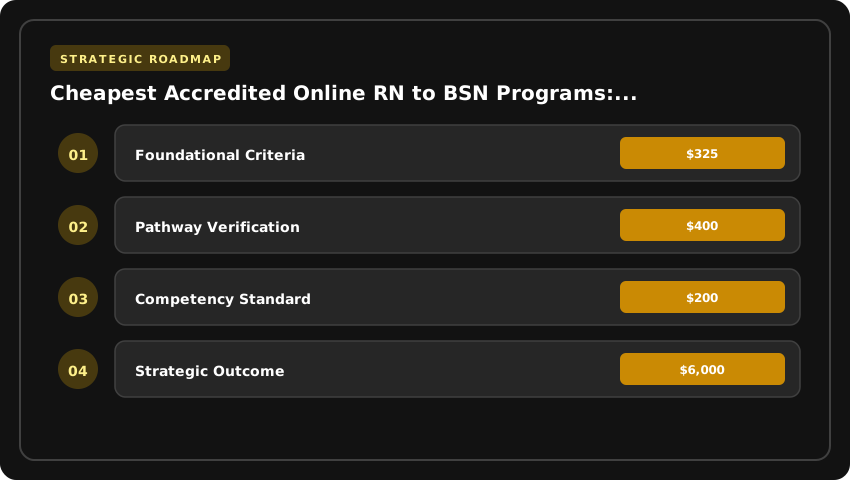
- Differential Fees vs. Base Tuition: A $325 per credit hour quote may balloon to $400+ once nursing-specific fees are applied, including simulation lab access, technology platforms, and malpractice insurance riders required for clinical components.
- Accreditation-Driven Overhead: CCNE accreditation demands specific faculty-to-student ratios, curriculum review cycles, and outcome reporting. These compliance costs are baked into tuition but distributed unevenly across institutions.
Another layer involves how schools treat the RN license credit awarded for prior nursing education. Some programs bundle those credits into a flat block fee, while others price them per credit hour alongside upper-division nursing courses. A student transferring 30 block credits at $200 versus $400 represents a $6,000 swing before tuition proper even begins. This is why a side-by-side price comparison must always clarify whether the published rate applies to all 120 credit hours, only the remaining nursing credits, or a hybrid structure.
Geographic pricing further complicates the landscape. A California resident enrolled in a public SUN (State University) system school may pay roughly $250 per credit hour, while the same learner crossing into a private nonprofit like a faith-based university could see $550 or higher. Yet a Texas resident at a public institution might pay closer to $325, and an Ohio learner at a regional state school could find rates near $300. The differences reflect state tax base contributions, collective bargaining agreements with nursing faculty, and whether the school operates a brick-and-mortar simulation center that must be amortized into online tuition.
For students mapping affordability, the practical takeaway is to look past the headline rate and request a total cost of attendance worksheet from each program. Ask specifically whether the per-credit rate includes nursing fees, whether consortium courses carry surcharges, and whether residency waivers apply to fully online students. Many accredited online RN to BSN programs advertise aggressively low tuition for the first 60 credits but reset pricing once the student enters upper-division nursing coursework, where accreditation standards require more faculty oversight.
The dramatic variance, then, is not a flaw in the marketplace. It is the predictable outcome of a system where public funding, regulatory compliance, institutional mission, and student demographics all converge into a single number. Recognizing those forces allows prospective BSN candidates to compare like for like, identify genuine value, and avoid the sticker shock that catches so many otherwise prepared learners off guard.
The 2025 Cheapest Online RN to BSN Programs: Real Tuition Breakdown
When registered nurses begin researching the cheapest accredited online RN to BSN programs, they quickly discover that “affordable” rarely means a single flat number. Tuition fluctuates dramatically based on residency classification, military status, partnership agreements, and whether a school bundles course fees into a flat-rate tuition or charges them à la carte. Below is a verified, granular breakdown of the most budget-friendly CCNE-accredited online RN to BSN tracks available to US students in the 2025 academic year, including per-credit-hour rates, projected total program cost, and the often-overlooked fees that can quietly inflate a degree by several hundred dollars.
Before diving into the matrix, it helps to anchor expectations. Most CCNE-accredited RN to BSN completion tracks require between 30 and 36 credit hours of upper-division nursing coursework beyond the associate degree or diploma. At a rock-bottom public tuition rate of $215 per credit hour, a 30-credit program lands near $6,450, while a 36-credit track at $310 per credit hour runs roughly $11,160. The schools below consistently fall at or below these benchmarks, with several institutions offering flat-rate tuition that eliminates regional cost disparities entirely.
- University of Texas at Arlington (UTA) — $215 per credit hour (Texas residents); estimated $7,740 total for the 36-credit RN to BSN track. Out-of-state and online learners pay the same competitive rate because UTA classifies all online RN to BSN students as Texas residents for tuition purposes. Hidden fees include a one-time $50 nursing application fee and approximately $420 in course-specific lab/clinical placement surcharges spread across capstone courses. No textbook costs through the BSN Inclusive Access program.
- Chamberlain University — Flat-rate tuition of $590 per credit hour, totaling roughly $17,700 for a 30-credit program. While not the lowest sticker price, Chamberlain frequently partners with major hospital systems (HCA, Tenet, AdventHealth), reducing tuition by 15–25% for affiliated employees, bringing the realistic cost closer to $13,275–$15,045 for partnered nurses.
- Aspen University — $325 per credit hour flat-rate for the 30-credit BSN completion track, totaling approximately $9,750. No out-of-state surcharge, and Aspen bundles its digital textbook fee (a $1,200 value at most schools) into tuition, dramatically reducing hidden costs.
- University of West Florida (UWF) — $237.86 per credit hour (Florida residents); $648.83 per credit hour (non-residents). Total program cost lands near $8,563 for residents and $23,358 for non-residents. However, UWF participates in the Academic Common Market, granting in-state tuition to residents of 16 participating Southern Regional Education Board (SREB) states.
- Indiana State University — $321 per credit hour flat-rate for the 30-credit online RN to BSN, totaling roughly $9,630 regardless of residency. The Sycamore Tuition Promise locks this rate for four consecutive years, a rare guarantee in the online nursing market.
- Western Governors University (WGU) — Flat-rate tuition of $4,385 per six-month term. Most students complete the RN to BSN track in one to two terms, making total cost between $4,385 and $8,770. Competency-based acceleration means motivated nurses can finish for less than $5,000.
- Florida International University (FIU) — $235.57 per credit hour for the 30-credit online track, totaling approximately $7,067 for Florida residents. Non-residents can leverage the SUS Online reciprocity agreement for a reduced $648.83 rate, dropping the program to roughly $19,465 — still lower than many in-state options at private universities.
- University of North Carolina Wilmington (UNCW) — $229 per credit hour (NC residents) for a 30-credit track, totaling roughly $6,870. UNCW’s nursing program is recognized for its robust clinical placement support, a $325 fee that is significantly lower than the $500–$900 charged by competitors.
- Graceland University — $435 per credit hour for the 30-credit RN to BSN, totaling approximately $13,050. Graceland actively recruits hospital-sponsored cohorts, and many partner systems offer full tuition reimbursement, effectively zeroing out the cost.
- Southern New Hampshire University (SNHU) — $330 per credit hour with no additional fees, totaling roughly $9,900. SNHU includes textbooks at no charge, and accepts up to 90 transfer credits, which can shorten the track for nurses with prior general education coursework.
Students evaluating these options should pay close attention to three categories of hidden fees that frequently appear after enrollment: (1) technology fees ranging from $75 to $250 per semester, (2) proctoring fees of $25–$50 per exam for remote test administration, and (3) clinical placement fees, which can exceed $900 at private universities but are absorbed into tuition at public flagships like UTA, FIU, and UNCW. Additionally, graduation fees of $50–$150 are nearly universal but rarely mentioned in promotional materials.
For nurses seeking the absolute lowest verifiable cost, WGU’s competency-based model remains unmatched, especially for students who can accelerate through material quickly. Nurses prioritizing a traditional semester structure with strong clinical placement support will find exceptional value at UTA, FIU, and UNCW, where total costs stay under $8,000 for in-state or reciprocity-eligible students. Nurses with hospital partnership discounts should compare Chamberlain, Aspen, and Graceland after factoring employer tuition benefits, as the discounted rates often beat public university sticker prices entirely.
Bottom line: the cheapest accredited online RN to BSN program in 2025 is not necessarily the one with the lowest per-credit-hour rate. It is the program where total delivered cost — tuition plus fees plus textbooks minus employer discounts — aligns with your timeline and career goals. Always request a complete cost-of-attendance worksheet from the financial aid office before committing, and verify that the school holds active CCNE accreditation through the American Association of Colleges of Nursing directory before enrolling.
Hidden Expenses That Inflate Your Online RN to BSN Degree Cost
The advertised tuition sticker price on a school’s website almost always represents only the base academic fee per credit hour. Once you begin registering for courses, accessing learning platforms, and preparing for clinical placements, a long list of secondary charges begins to surface. For working nurses mapping out a truly affordable online RN to BSN pathway, these overlooked line items can quietly inflate the total bill by more than $1,500, even at the most aggressively priced CCNE-accredited institutions. Understanding them upfront is the difference between accurate financial planning and an unwelcome surprise at the end of the degree.
Many hidden expenses fall into predictable categories: technology and proctoring, course materials, administrative audits, clinical compliance, and geographic surcharges. Examining each one carefully empowers prospective students to ask sharper questions during enrollment advising and to budget with precision rather than guesswork.
- Proctoring and exam integrity fees. Because online programs must verify student identity for exams, institutions frequently contract with services such as ProctorU, Honorlock, or Respondus Monitor. Students are typically billed between $15 and $35 per proctored exam, and a 30-credit RN to BSN curriculum can require six to ten such assessments, adding $150 to $350 to the total cost.
- Electronic course materials and platform charges. Publishers increasingly bundle textbooks, adaptive learning platforms, and simulation software into digital access codes that are billed separately from tuition. Expect a single nursing course to carry $80 to $200 in required digital materials, and an entire program to add $500 to $900 before graduation.
- Graduation and degree audit fees. Many universities charge a graduation application fee, often between $50 and $150, plus an optional but strongly encouraged degree audit fee of $25 to $75. These appear only in the final semester and are easy to miss during early planning.
- Background check, drug screen, and compliance tracking. Although the RN to BSN capstone is generally non-clinical, several accredited programs still require a current background check, urine drug screen, immunization record upload, and ongoing compliance monitoring through vendors such as CastleBranch or American DataBank. Bundle costs commonly range from $120 to $250, and expired clearances can trigger repeat charges.
- Out-of-state tuition surcharges and reciprocity fees. Public universities such as the University of Florida, Arizona State University, and the University of South Alabama advertise affordable in-state rates around $160 to $220 per credit hour, but out-of-state learners can face $400 to $600 per credit hour. Even when a school markets itself as “online,” the regional tuition differential may still apply unless the program participates in the State Authorization Reciprocity Agreement (SARA) with a flat online rate.
- Technology, transcript, and miscellaneous administrative fees. Expect a one-time technology fee of $50 to $200 per semester, official transcript fees of $10 to $20 per copy, late registration penalties, and graduation regalia or diploma mailing charges that together commonly add another $200 to $400 across the program.
The most effective defense against these hidden costs is a detailed conversation with a program coordinator before enrolling. Request a comprehensive fee sheet that itemizes every required charge, including proctoring frequency, digital material costs for each course, and clinical compliance expectations. Confirm whether the published tuition rate is locked for the duration of the program or subject to annual increases, and ask specifically about military, employer partnership, or consortium discounts that can offset out-of-state surcharges. Nurses who treat the advertised tuition as a starting point rather than a final number consistently finish their BSN with fewer financial surprises and a clearer return on their educational investment.
How to Maximize FAFSA, Employer Tuition Reimbursement, and State Grants
Finishing an RN to BSN degree does not have to drain your checking account, and most nurses leave real money on the table simply because nobody walks them through the stack of federal, employer, and state-level programs that exist specifically for working healthcare professionals. The federal Financial Aid and FAFSA process remains the single largest discount available to almost every RN to BSN student, while hospital tuition reimbursement policies and targeted state workforce grants can stack on top of FAFSA to cover anywhere from 30 percent to the full cost of tuition at accredited online programs like Aspen University, WGU, or UT Arlington.
Below is a practical, step-by-step breakdown of how to actually claim every dollar you qualify for, with special attention to the transfer-student nuances, hospital system partnerships, and shortage-state scholarships that matter most for nurses working in Texas, California, and North Carolina.
Step 1: File the FAFSA Early, Even If You Are a Part-Time Transfer Student. The Free Application for Federal Student Aid opens every October 1 for the following academic year, and several state grant programs are first-come, first-served. RN to BSN candidates are often surprised to learn that even enrolling half-time at six credits per term qualifies them for a Pell Grant, which for the 2025-2026 award year is set at a maximum of $7,395 per year. When you file, list every school you are considering so the financial aid office at each institution receives your Institutional Student Information Record (ISIR) automatically.
Step 2: Treat Your Nursing School Financial Aid Office Like a Strategic Partner. Once your ISIR arrives, the school’s financial aid counselor will package your aid. Ask specifically about:
- Federal Supplemental Educational Opportunity Grants (FSEOG) for students with exceptional financial need.
- Federal Direct Unsubsidized Loans if you have already hit the undergraduate annual loan limit and need additional borrowing capacity.
- College-specific nursing scholarships that do not require a separate application beyond the FAFSA.
Many CCNE-accredited schools also use the FAFSA to auto-renew institutional aid year after year, so missing the renewal deadline costs you real money.
Step 3: Layer in Employer Tuition Reimbursement From Your Hospital System. Most major hospital networks, including HCA Healthcare, Kaiser Permanente, Tenet, AdventHealth, Atrium Health, and the Veterans Health Administration, offer tuition reimbursement ranging from $3,000 to $10,000 per calendar year for BSN completion. The trick is to align your employer’s reimbursement cycle with your school’s academic calendar and to submit grade verification promptly. Nurses in North Carolina working for systems like Duke University Health System and UNC Health frequently qualify for 100 percent tuition coverage when enrolled in a partner university, which means a free BSN at programs such as UNC Wilmington or Winston-Salem State University.
Step 4: Tap State-Level Workforce Scholarships Designed for Nursing Shortage Areas. States with documented nursing shortages maintain dedicated scholarship and loan-forgiveness programs that target BSN completion specifically:
- Texas: The Texas Higher Education Coordinating Board administers the Nursing Scholarship Program, which can pay up to $5,000 per year for BSN students who commit to working in a Texas Medicaid facility upon graduation. Pair this with the federally funded Texas Workforce Commission Skills Development Fund, which often covers employer-sponsored BSN cohorts at community college partner schools.
- California: The California Office of Statewide Health Planning and Development offers the Health Professions Education Foundation’s Bachelor of Science in Nursing Scholarship, awarding up to $10,000 to RNs completing BSN degrees who agree to work in a medically underserved area of the state for at least one year.
- North Carolina: The North Carolina Nursing Scholars Program, jointly funded by the state legislature and the Foundation for Nursing Excellence, provides up to $8,000 annually for BSN students willing to practice in rural or critical-access hospitals for two years post-graduation.
Step 5: Avoid Common Pitfalls That Disqualify Perfectly Eligible Students. Transfer students sometimes have their prior federal aid history miscoded, so log in to the National Student Loan Data System (NSLDS) to verify your aggregate borrowing before completing the FAFSA. Nurses enrolled in an employer’s reimbursement program must also report any “tuition assistance received from an employer” on the FAFSA, because ignoring this section can trigger a financial aid audit. Finally, keep all receipts for licensure exam fees, background checks, and clinical compliance, because several state grants treat these non-tuition expenses as reimbursable.
When you stack a $7,395 Pell Grant with $5,000 in employer reimbursement and a $5,000 state workforce scholarship, your out-of-pocket cost for a $12,000-per-year RN to BSN program can drop to zero, or even generate a small refund. The key is filing the FAFSA early, confirming your employer’s partnership program in writing, and applying to every shortage-state scholarship that matches your service commitment. For working nurses in Texas, California, or North Carolina, the combination of federal, employer, and state funding makes an accredited online RN to BSN not just affordable, but genuinely within reach.
Accreditation Standards and Credit Transferability You Must Verify
When you are hunting for the most affordable online RN to BSN programs, the lowest tuition rate means absolutely nothing if the institution lacks the proper academic credentials. In the United States, nursing program accreditation is your primary safeguard for academic quality, future employment eligibility, and graduate school admission. You must ensure your chosen program holds either CCNE or ACEN accreditation.
The Commission on Collegiate Nursing Education (CCNE) is the most common accrediting body for baccalaureate and graduate nursing programs. CCNE accreditation ensures that the curriculum meets rigorous national standards and adequately prepares nurses for advanced clinical and leadership roles. Alternatively, the Accreditation Commission for Education in Nursing (ACEN) accredits all levels of nursing education, including diploma, associate, and baccalaureate programs. Both CCNE and ACEN are recognized by the U.S. Department of Education, meaning either credential validates the quality of your BSN degree. However, you should always cross-reference these specialized accreditations with the university’s broader regional accreditation.
Regional accreditation is the gold standard for U.S. universities. If a school lacks regional accreditation, you should immediately consider it a red flag. Institutions without regional accreditation are often unable to participate in FAFSA federal financial aid programs, and their credits are rarely accepted by legitimate universities. Avoid diploma mills that promise a BSN for a flat $2,000 fee with no clinical or rigorous coursework requirements; these unaccredited institutions will not pass a background check with hospital HR departments and can severely damage your professional trajectory.
To protect your hard-earned credits and your wallet, you must analyze the school’s articulation agreements. Articulation agreements are formal partnerships between community colleges offering Associate Degrees in Nursing (ADN) and four-year universities. These agreements map out exactly how your lower-division credits will transfer into the RN to BSN program. A strong articulation agreement guarantees that your foundational nursing courses, prerequisites, and general education credits will seamlessly apply toward your BSN requirements, preventing you from retaking classes and spending unnecessary dollars.
- Verify Specialized Accreditation: Look explicitly for CCNE or ACEN accreditation on the program website before you apply.
- Confirm Regional Accreditation: Ensure the university is regionally accredited to guarantee FAFSA eligibility and seamless credit transferability.
- Review Articulation Agreements: Contact an enrollment advisor to confirm your community college ADN credits will transfer without penalty.
- Avoid Diploma Mills: Steer clear of programs offering instant degrees for unusually low, flat fees without rigorous academic coursework.
By verifying these standards upfront, you ensure that your investment of time and money yields a respected, universally recognized BSN degree that genuinely elevates your nursing career.
Calculating the True ROI of an Affordable Online RN to BSN Degree
When evaluating the cheapest accredited online RN to BSN programs, the sticker price tells only half the story. The real metric that matters for a working nurse is Return on Investment (ROI). You are not just buying a credential; you are purchasing a lifetime earnings upgrade. To calculate this accurately, we need to move beyond generic averages and look at the specific salary differentials reported by the U.S. Bureau of Labor Statistics (BLS), the tuition outlay, and the time it takes to break even in the markets where you actually live and work.
According to recent BLS Occupational Employment and Wage Statistics, the national median annual wage for Registered Nurses hovers around $86,070. However, this figure blends ADN and BSN holders. Industry surveys consistently show a BSN premium of $5,000 to $12,000 annually over ADN-prepared peers in comparable roles. In high-cost metropolitan areas, that gap widens significantly. For example, in the San Francisco-Oakland-Hayward, CA metro area, where the BLS reports an annual mean wage exceeding $124,000, BSN-prepared nurses frequently command base rates $10,000–$15,000 higher than ADN counterparts due to Magnet hospital hiring mandates. Conversely, in the Houston-The Woodlands-Sugar Land, TX metro (mean wage ~$85,000), the differential might sit closer to $4,000–$7,000 but comes with a drastically lower cost of living.
The Break-Even Math: Tuition vs. Salary Lift
Let’s run a realistic scenario. Assume you enroll in a highly affordable, CCNE-accredited program costing $10,000 total tuition (a realistic figure for several public university programs highlighted in this guide). If you finance this at 5% interest over 5 years, your monthly payment is roughly $189. If your BSN unlocks a conservative $6,000 annual raise ($500/month pre-tax), your net monthly gain after loan payment and estimated 22% federal tax bracket is approximately $200+ per month immediately. You break even on cash flow day one.
Now, compare that to a premium private program costing $30,000. The monthly payment jumps to ~$566. Against that same $6,000 raise, you are underwater by ~$175/month for five years. The “cheapest” program isn’t just about saving money; it is about achieving positive cash flow ROI immediately.
Long-Term Earning Trajectory: The Compounding Effect
The first raise is just the entry fee. The BSN unlocks the clinical ladder—Charge Nurse, Nurse Manager, Clinical Educator, and Informatics roles—that are frequently gated by the bachelor’s degree. Over a 20-year horizon, assuming a modest 3% annual cost-of-living adjustment on that differential:
- ADN Baseline (20 yrs): ~$1.7M cumulative earnings (using $80k start).
- BSN Trajectory (20 yrs): ~$2.0M+ cumulative earnings (using $88k start + ladder access).
- Net Degree Value: $300,000+ in additional lifetime earnings against a $10k–$15k investment.
That is a 2,000%+ return. The actionable takeaway? Do not overpay for the credential. Target a CCNE-accredited public university program under $15,000 total cost. It maximizes the numerator (salary lift) while minimizing the denominator (debt), ensuring your degree pays for itself before you finish your first semester.
Strategic Final Takeaway
Success in evaluating Cheapest Accredited Online RN to BSN Programs: 2025 Tuition Costs relies on early preparation, adherence to verified accredited requirements, and cross-referencing official portals. Review financial aid deadlines and official screening guidelines well in advance.