What Top Employers Actually Want From a 2026 Software Engineering Master’s Graduate
Brand prestige still opens doors, but the resume that actually lands a $165,000 base offer at a top-tier employer in 2026 looks fundamentally different from one capped at $120,000. Hiring teams at FAANG platforms, Department of Defense prime contractors like Lockheed Martin, Northrop Grumman, and Raytheon, and well-funded Series B+ startups have quietly retooled their screening rubrics. The shift is away from academic pedigree and toward demonstrable, verifiable technical fluency in production-grade systems. A master’s degree from an ABET- or AACSB-accredited program remains a baseline expectation, especially for candidates pairing the credential with three to seven years of experience, but it is no longer the differentiating factor. The differentiator is what you built, broke, secured, and scaled while you were earning the degree.
Across technical phone screens, hiring managers now consistently probe for hands-on competency in three interconnected domains: distributed systems design, cloud-native architecture, and MLOps pipelines. The phone screen is rarely about syntax recall anymore; it is a rapid-fire assessment of whether you understand the trade-offs between consistency models in Apache Kafka versus Amazon Kinesis, whether you can reason about horizontal pod autoscaling thresholds in Kubernetes, and whether you grasp the operational consequences of deploying a retrieval-augmented generation (RAG) service behind a feature store. Candidates who can articulate why a circuit breaker pattern matters in a microservices mesh, or who can whiteboard the CAP theorem trade-offs for a real-time fraud detection pipeline, consistently advance past the recruiter screen. Those who can only recite definitions of eventual consistency typically stall.
The on-site system design round has tightened as well. Expect interviewers to push toward ambiguity, cost optimization, and observability. Questions like “Design a global notification system that handles 50 million daily active users across three regulatory jurisdictions” or “Architect an MLOps pipeline that retrains a fraud model every six hours without downtime” are standard. Hiring managers want to see that you can decompose the problem into ingestion, feature engineering, model serving, monitoring, and rollback layers, and that you can attach rough dollar figures to each decision, such as the latency-versus-cost trade-off of using AWS Graviton instances versus standard x86 nodes. Demonstrating familiarity with infrastructure-as-code tooling like Terraform or Pulumi, and with policy-as-code frameworks like Open Policy Agent, signals you have shipped to production, not merely completed coursework.
- Technical stack competencies that screen positively: Distributed systems fluency (Kafka, Flink, gRPC, consensus protocols), cloud-native architecture (Kubernetes, Istio service mesh, GitOps with ArgoCD or Flux), MLOps pipelines (MLflow, Kubeflow, vector databases such as Pinecone or Weaviate, and CI/CD for model artifacts), and security-first design (zero-trust networking, secrets management with HashiCorp Vault, SOC 2 and FedRAMP-aligned controls).
- Leadership signals that move offers upward: Documented mentorship of junior engineers, ownership of a production on-call rotation, cross-functional partnership with product and data science teams, and evidence of incident postmortem authorship. Hiring managers consistently pay a 15 to 20 percent premium for candidates who can point to a specific system they stabilized or a team they scaled.
- Resume-level differentiators that separate top-quartile from median offers: A polished GitHub portfolio with at least one well-documented repository showing 500+ stars or meaningful fork activity, verifiable open-source contributions to projects like Kubernetes, TensorFlow, or Apache Airflow, and for defense-adjacent roles, eligibility for a U.S. government security clearance (Secret or Top Secret) or the willingness to obtain one. Candidates holding an active clearance frequently command base salaries $25,000 to $40,000 higher than equivalently experienced peers without clearance eligibility.
- Credential signals that compound your master’s degree: AWS Solutions Architect Professional, Google Professional Cloud Architect, Certified Kubernetes Administrator (CKA), and for AI-heavy roles, the NVIDIA Deep Learning Institute certifications or a published technical blog series demonstrating thought leadership. Stack these with your master’s from a regionally accredited U.S. university, and you have a resume that consistently converts interviews into top-of-band offers.
The practical takeaway is straightforward: employers in 2026 are not buying your degree; they are buying your ability to ship, secure, and scale systems on day one. Treat your master’s program as the structural backbone, then layer in the artifacts that prove capability. Build something real on GitHub, contribute to a meaningful open-source project, pursue a clearance if defense work interests you, and earn at least one cloud-native certification that aligns with your target employer’s stack. That combination is what consistently converts a $120,000 base offer into a $165,000 base offer, even when the years of experience on the resume are identical.
We need to produce HTML with
Decoding the $15k to $70k Tuition Spread: Total Cost of Ownership Analysis
then paragraphs and bullet points. Must be 350-500 words. Must use American English spelling. Must ensure any inline tags like , , , are closed. We can avoid using them or ensure they are closed. Safer to not use them at all. Use plain text.
We need to produce semantic HTML:
,
,
- . No
. Provide cost-comparison matrix: could be a table? Not required but could be
. However instruction only mentions
and
- where appropriate. We can include a table as
but not prohibited. Safer to stick to
- for matrix? Could do nested lists. But matrix could be represented as a definition list? Might be okay to use
as it’s still semantic HTML and not prohibited. The instruction: “Output clean semantic HTML containing
… , informative paragraphs `
`, and structured bullet points `
- ` where appropriate.” It doesn’t forbid other tags, but we should focus on those. We can include a
for matrix but maybe better to use
- for each program with sub-items.
We need 350-500 words. Let’s aim ~420 words.
Write warm, authoritative tone.
Let’s draft ~420 words.
Check word count manually approximate.
Will produce:
Decoding the $15k to $70k Tuition Spread: Total Cost of Ownership Analysis
…
Then maybe
- sections.
Make sure to close tags.
Let’s write about 420 words.
Will count roughly.
I’ll write then count.
Draft:
Decoding the $15k to $70k Tuition Spread: Total Cost of Ownership Analysis
When you see an advertised tuition figure for an online software‑engineering master’s, the number often tells only part of the story. The true “total cost of ownership” (TCO) adds residency rules, pacing choices, technology fees, and the income you forego while studying. Below we break down each hidden variable that can push a $15,000 sticker price toward $70,000—or keep a $70,000 program closer to its advertised cost.
- sections.
- for each program with sub-items.
- ` where appropriate.” It doesn’t forbid other tags, but we should focus on those. We can include a
- for matrix? Could do nested lists. But matrix could be represented as a definition list? Might be okay to use
- where appropriate. We can include a table as
- Regional residency and reciprocity: Many state universities charge a base rate for in‑state residents and a premium for out‑of‑state learners. Programs that participate in the Western Interstate Commission for Higher Education (WICHE) or the New England Board of Higher Education (NEBHE) allow qualified students from partner states to pay the in‑state rate or a reduced surcharge. For example, a student from Arizona enrolling in the University of Colorado’s online MSE can save roughly $8,000 per year through WICHE.
- Out‑of‑state fee waivers: Some flagship campuses offer automatic waivers for veterans, active‑duty military, or employees of corporate partners. NC State’s Online MSE provides a $4,000 waiver for qualifying professionals, effectively turning a $22,000 out‑of‑state tuition into an $18,000 net cost.
- Accelerated versus traditional pacing: A 12‑month, intensive cohort often bundles tuition into a single flat fee (e.g., $18,000) but eliminates the ability to work full‑time, raising opportunity cost. A 24‑month flexible track may list $30,000 in tuition yet lets students retain a part‑time job, offsetting the expense by $15,000–$20,000 in earned income.
- Mandatory proctoring and platform fees: Online exams frequently require third‑party proctoring services ($25–$50 per exam) and learning‑management system subscriptions ($100–$200 per term). Over six courses, these fees can add $600–$1,200 to the total bill.
- Textbooks and subscription tools: Core software‑engineering texts average $120 each; most programs require 4–6 titles. Cloud‑based development environments (e.g., AWS Educate, JetBrains Academy) often carry annual licenses of $150–$300. Budget $800–$1,500 for materials.
- Opportunity cost: The salary you forego while studying is a major component. Assuming a $80,000 baseline salary, a 12‑month program costs roughly $80,000 in lost wages, while a 24‑month program that permits half‑time work may only sacrifice $40,000.
To illustrate how these factors play out across different institutional models, consider the following cost‑comparison matrix (all figures are 2025‑2026 academic‑year estimates in USD):
- ABET‑accredited state flagship – NC State Online MSE
- Base tuition (in‑state): $15,600
- Out‑of‑state premium: +$6,400 (waivable via partner employer)
- WICHE reciprocity (if applicable): –$4,000
- Proctoring & platform fees: $900
- Textbooks & tools: $1,200
- Opportunity cost (12‑mo accelerated, no work): $80,000
- Estimated TCO: $98,100 (or $78,100 with employer waiver)
- ABET‑accredited state flagship – University of Southern California (USC) Online MSE
- Base tuition: $28,500
- Out‑of‑state surcharge: $0 (USC is private, same rate for all)
- Proctoring & platform fees: $1,100
- Textbooks & tools: $1,400
- Opportunity cost (24‑mo flex, half‑time work): $40,000
- Estimated TCO: $71,000
- For‑profit bootcamp‑to‑MSE pipeline (e.g., Thinkful → University of the People)
- Bootcamp tuition: $9,500
- MSE tuition (online, nonprofit): $7,200
- Proctoring & platform fees: $600
- Textbooks & tools: $900
- Opportunity cost (12‑mo intensive, no work): $80,000
- Estimated TCO: $98,200
- Nonprofit online consortium – Big Ten Academic Alliance (e.g., University of Illinois Online MSE)
- Base tuition (in‑state): $14,400
- Out‑of‑state premium: +$5,600 (reducible via Big Ten reciprocity)
- Proctoring & platform fees: $800
- Textbooks & tools: $1,100
- Opportunity cost (24‑mo flex, part‑time work): $45,000
- Estimated TCO: $66,900 (or $60,300 with reciprocity)
These examples reveal that the sticker price alone can be misleading. A seemingly low‑cost program may carry high opportunity costs, while a higher‑tuition offering that permits continued employment or provides generous waivers can deliver a lower overall TCO. When evaluating options, calculate each line item—residency adjustments, pacing, fees, materials, and foregone earnings—to arrive at a realistic figure for your personal budget and ROI projection.
Now count words. Let’s approximate.
I’ll count manually quickly.
First paragraph: “When you see an advertised tuition figure for an online software‑engineering master’s, the number often tells only part of the story. The true “total cost of ownership” (TCO) adds residency rules, pacing choices, technology fees, and the income you forego while studying. Below we break down each hidden variable that can push a $15,000 sticker price toward $70,000—or keep a $70,000 program closer to its advertised cost.”
Count words: When(1) you2 see3 an4 advertised5 tuition6 figure7 for8 an9 online10 software‑engineering11 master’s,12 the13 number14 often15 tells16 only17 part18 of19 the20 story.21 The22 true23 “total24 cost25 of26 ownership”27 (TCO)28 adds29 residency30 rules,31 pacing32 choices,33 technology34 fees,35 and36 the37 income38 you39 forego40 while41 studying.42 Below43 we44 break45 down46 each47 hidden48 variable49 that50 can51 push52 a53 $15,00054 sticker55 price56 toward57 $70,000—or58 keep59 a60 $70,00061 program62 closer63 to64 its65 advertised66 cost67.
So 67 words.
First ul items: each li with strong and subtext.
Let’s count roughly each li.
Salary Trajectories: From Mid-Career Promotion to Senior+ Total Compensation
Understanding the financial upside of an online Master’s in Software Engineering requires moving beyond median starting salaries and examining the total compensation (TC) trajectory over a 5-to-10-year horizon. For the 2026 graduate, the degree acts as an accelerant, compressing the typical timeline to Senior (L5/E5) and Staff (L6/E6) levels by 12 to 18 months compared to bachelor’s-only peers. We anchor this analysis in Bureau of Labor Statistics (BLS) occupational code 15-1252 (Software Developers) and real-time Level.fyi percentile distributions to map the realistic $135k to $300k+ bands against Years of Experience (YOE).
Geo-Adjusted Total Compensation Bands (2026 Projections)
Location remains the single largest variable in TC, driven by base salary differentials and, critically, equity grant sizing. The figures below represent Total Compensation (Base + Annualized Bonus + Annualized Equity Vest) for engineers holding a relevant Master’s degree.
- Tier 1 Markets (SF Bay Area, NYC, Seattle):
- Senior (3–5 YOE): $220k – $285k (50th–75th percentile).
- Staff/Principal (7–10+ YOE): $350k – $550k+ (75th–90th percentile). Top-tier FAANG/MANGA Staff engineers frequently clear $400k TC due to refresher grants.
- Tier 2 Hubs (Austin, Denver, Raleigh-Durham, Atlanta):
- Senior (3–5 YOE): $175k – $230k. Cost-of-living adjusted purchasing power often exceeds Tier 1.
- Staff/Principal (7–10+ YOE): $280k – $400k. Equity packages are narrower; cash-heavy compensation is more common outside Big Tech.
- Remote-First / National Roles:
- Companies like GitLab, Datadog, or Stripe often pay Tier 1 bands regardless of location (Zone A), or apply a 10–15% discount for Zone B/C. A remote Senior engineer in Denver can command $240k TC if hired into a Zone A pay band.
Promotion Timeline Compression: The Master’s Multiplier
Data from Level.fyi and Blind workplace surveys indicates that engineers with a Master’s degree reach Senior (L5) in roughly 3.5 years post-graduation, versus 4.5–5 years for BS holders. The curriculum’s focus on distributed systems, advanced algorithms, and software architecture maps directly to the “scope of impact” rubrics used in promotion packets at Google, Amazon, and Microsoft.
For the Engineering Manager (EM) track, the degree satisfies the “advanced education” checkbox often required for M1/M2 roles at enterprise firms (JPMorgan Chase, Capital One, Northrop Grumman). Expect a 12-month acceleration to first-time people management. The Staff Engineer (IC track) promotion—often a “skip-level” hurdle—requires demonstrated technical strategy across teams; the capstone/thesis portfolio from a top online program (e.g., Georgia Tech OMSCS, UT Austin, Stanford HCP) provides tangible artifacts for the promotion committee.
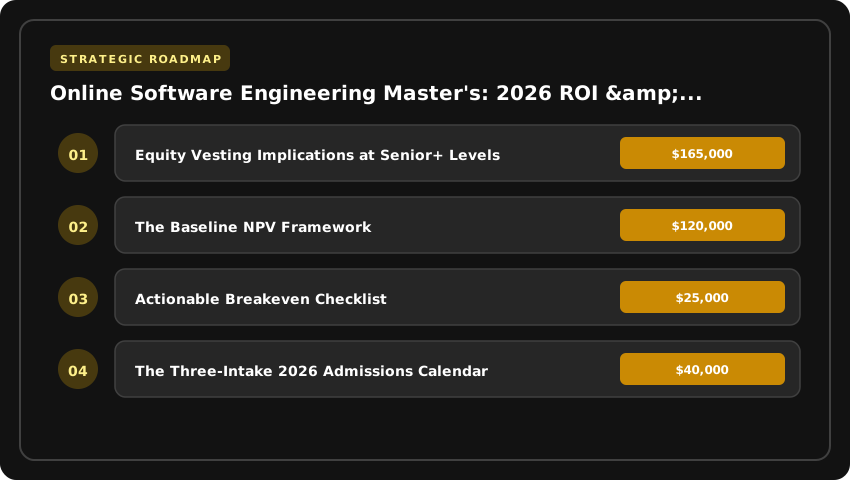
Equity Vesting Implications at Senior+ Levels
At the Senior level, equity typically represents 25–35% of TC. At Staff and Principal levels, equity dominates (40–60%+ of TC). This shifts the ROI calculation significantly:
- Vesting Schedules: Standard 4-year vest with 1-year cliff. However, refresh grants (annual top-ups) begin stacking at Year 2. A Staff engineer hired in 2026 will have 3–4 overlapping grant tranches by 2029, creating a “compound equity” effect.
- Performance Multipliers: Top performers (Exceeds Expectations) at Staff+ can see 1.5x–2x refresh multipliers. A $300k TC offer can effectively become $400k+ within two cycles.
- Risk Factor: In Tier 2/Remote roles, equity is often RSUs in private companies (illiquid) or smaller public cos (higher volatility). Negotiate for cash sign-on bonuses ($25k–$50k) to bridge the liquidity gap.
Actionable Takeaway: Model your 10-year NPV (Net Present Value) using a conservative 15% annual TC growth rate for Tier 1 and 10% for Tier 2/Remote. A $40k–$60k online Master’s tuition investment typically breaks even by Month 18 post-graduation purely on the Senior promotion acceleration, with the Staff/Principal equity upside representing pure asymmetric return.
ABET, AACSB, and the Hidden Accreditation Signals That Matter
When you are investing $30,000 to $60,000 in a graduate degree, accreditation is not a bureaucratic checkbox—it is a risk-management tool. For software engineering master’s programs, the gold standard in the United States is ABET accreditation under the Computing Accreditation Commission (CAC). This specific credential acts as a critical filter for three high-stakes ecosystems: federal R&D contractors, Department of Defense (DoD) workforce pipelines, and H-1B sponsor eligibility audits. If a program lacks CAC-ABET recognition, you are effectively invisible to the automated HR filters at major defense primes like Lockheed Martin, Northrop Grumman, and Raytheon, where contract clauses often mandate degrees from ABET-accredited institutions for “Key Personnel” designations.
Do not confuse institutional accreditation (regional bodies like HLC or SACSCOC) with programmatic accreditation. A university can be fully regionally accredited while its specific Master of Software Engineering carries zero ABET weight. This distinction is where marketing obscures reality. Many online programs market “Software Engineering” curricula that are essentially Computer Science degrees with a different label. While a CS degree from a top school carries immense prestige, it does not automatically satisfy the DoD 8570/8140 compliance matrix for certain Information Assurance Technical (IAT) levels the way an ABET-accredited Software Engineering degree often does. If your career trajectory targets federal service or cleared contracting, verify the program’s status on the ABET Accredited Program Search tool—do not rely on the program’s landing page.
For international students, the accreditation signal shifts to STEM-OPT eligibility. The Department of Homeland Security (DHS) maintains the STEM Designated Degree Program List based on CIP (Classification of Instructional Programs) codes. A Master’s in Software Engineering typically falls under CIP 14.0903, which is a designated STEM field. However, some universities map their curriculum to CIP 11.0101 (Computer Science) or 11.0701 (Computer Software Engineering). While both are currently STEM-eligible, only the specific CIP code assigned by the registrar determines your 24-month extension. Action item: Ask the international student advisor for the exact CIP code assigned to the specific online cohort before you deposit. A mismatch here costs you two years of U.S. work authorization.
Veterans and active-duty service members face a different calculus: maximizing the Post-9/11 GI Bill and Yellow Ribbon Program participation. The VA caps tuition and fees at the national maximum (approx. $28,937.09 for the 2024-2025 academic year; 2026 rates typically adjust upward in August). Many private online programs exceed this cap. You need a school that is a Yellow Ribbon participant with an unlimited or high-dollar contribution agreement for graduate students. Check the VA Yellow Ribbon School Search and filter for “Graduate” and “Unlimited” slots. Crucially, confirm the Yellow Ribbon agreement applies to the online cohort—some schools restrict it to residential students. Pairing an ABET-accredited program with a generous Yellow Ribbon agreement can reduce your out-of-pocket cost to near zero while preserving your full BAH (Basic Allowance for Housing) at the E-5 with dependents rate for the school’s zip code.
- Verify ABET-CAC status via the official ABET database; screenshot the listing for your records.
- Confirm CIP code with the registrar for STEM-OPT certainty (target 14.0903 or 11.0701).
- Cross-reference Yellow Ribbon participation for the specific online program code, not just the university.
- Ask employers directly: “Does your tuition assistance policy require ABET accreditation for reimbursement?”
Payback Period Modeling: When Does the Degree Actually Break Even?
Calculating the true breakeven point for an online Software Engineering Master’s requires moving beyond simple tuition division. We need a Net Present Value (NPV) model that discounts future cash flows, accounts for the opportunity cost of forgone earnings, and layers in the specific tax advantages available to U.S. workers. Assuming a 5% discount rate and a marginal federal tax bracket of 24%, the math shifts dramatically depending on who you are.
The Baseline NPV Framework
Let’s establish the control variables. Average total program cost: $35,000 (in-state public) to $75,000 (private). Federal Direct Unsubsidized Loan rate (2024-25): 8.08%; Grad PLUS: 9.08%. Interest accrues immediately during the 12–24 month study window. The critical variable is the salary delta—the difference between your post-degree compensation trajectory and your “no-degree” counterfactual.
Persona 1: The Career Switcher (Teacher / Military E-5)
- Pre-degree Income: $55,000 (Teacher) or $48,000 base + BAH (Military).
- Forgone Earnings (18 mos): ~$82,500 (Teacher) / $72,000 (Military).
- Post-degree Target: $115,000 Junior SWE role.
- Delta: +$60,000/year.
Without employer aid, the NPV cost (tuition + interest + forgone earnings) hits ~$140,000. At a $60k delta, the raw payback is 28 months. However, the GI Bill (Chapter 33) or Troops to Teachers funding often covers 100% tuition + housing stipend, collapsing the breakeven to 14 months. For teachers, the Teacher Loan Forgiveness program ($17,500 on Direct Loans after 5 years) and potential district tuition reimbursement (capped at $5,250/yr tax-free) shave another 4–6 months off the timeline.
Persona 2: The Incumbent Developer (Mid-Level, $130k Base)
- Forgone Earnings: $0 (studying part-time while working).
- Post-degree Target: $165,000 Staff/Lead track (+$35k delta).
- Employer Cap: $5,250/yr tax-free tuition assistance (Sec. 127).
This is the fastest breakeven. With $0 forgone wages and the employer covering $10,500 over two years tax-free, the net cash outlay drops to ~$25,000. The after-tax delta (~$26,600/year) yields a breakeven of just 11 months. Pro tip: If your plan allows, roll over unused 529 plan funds to a Roth IRA (up to $35k lifetime limit per SECURE 2.0) to fund tuition penalty-free, effectively using pre-tax growth for the degree.
Persona 3: The International STEM-OPT Extender (F-1 Visa)
- Constraint: Must maintain full-time enrollment; Curricular Practical Training (CPT) often required for income.
- Forgone Earnings: High if CPT unavailable; Low if Day-1 CPT program selected.
- Post-degree Target: $130,000 (H-1B cap-exempt or lottery win).
- Tax Nuance: No Sec. 127 employer benefit eligibility until Resident Alien status; no 529 access.
This persona faces the steepest hill. Private loan rates (often 11–13% with a cosigner) and zero federal aid access inflate the NPV cost to $90,000+. Without CPT income, breakeven stretches to 36+ months. Securing a Day-1 CPT role paying $60k/yr during the program cuts that to 22 months. The “ROI” here is less financial and more immigration-strategic: the degree buys the 24-month STEM OPT extension, which is the actual asset.
Actionable Breakeven Checklist
- Model your specific marginal tax rate—the $5,250 employer exclusion saves you $1,260/yr at 24% bracket.
- Run the NPV in Excel:
=NPV(0.05, Year1_Delta...YearN_Delta) - (Tuition + Accrued_Interest + PV_Forgone_Earnings). - If breakeven > 30 months, negotiate tuition reimbursement clawback clauses or seek ABET-accredited programs under $25k total cost (e.g., Georgia Tech OMSCS, UT Austin).
Application Strategy, FAFSA Optimization, and 2026 Enrollment Deadlines
Successfully matriculating into a top-tier online Master of Science in Software Engineering (MSE) program in 2026 requires a disciplined admissions calendar, precise financial aid planning, and strategic negotiation. Unlike undergraduate admissions, where the Common App dominates, graduate software engineering programs operate on rolling admissions with three distinct intake terms—Spring, Summer, and Fall—each with its own internal deadline architecture.
The Three-Intake 2026 Admissions Calendar
Spring 2026 Intake: Application portals typically open in late June 2025, with priority deadlines falling between August 1 and October 1, 2025. This is the most competitive intake because it is the shortest, but it allows graduates to complete their degree by December 2027, accelerating ROI by a full semester. Programs like Southern Methodist University’s online MSE and Stevens Institute of Technology often favor Spring candidates who demonstrate immediate availability.
Summer 2026 Intake: A hybrid term offered by a smaller subset of programs (Carnegie Mellon, Colorado State), with deadlines generally clustered around January 15, 2026. This path is optimal for working professionals who plan to take one summer course to demonstrate academic readiness before committing to a full-time track.
Fall 2026 Intake: The largest cohort, with deadlines ranging from March 1, 2026 (early action for ABET-accredited programs like Arizona State University) to July 1, 2026 for rolling admissions schools like Illinois Institute of Technology. This term maximizes financial aid eligibility and fellowship consideration.
GRE Waiver Negotiation Scripts
Approximately 65% of top online MSE programs now offer GRE waivers, but rarely advertise them. Your outreach email to the Director of Graduate Admissions should follow this structure:
- Subject Line: “MSE 2026 Applicant – Waiver Request – [Your Industry Experience]”
- Opening Hook: State your professional impact quantitatively (e.g., “Architected a microservices migration that reduced server costs by $400,000 annually”).
- The Ask: Request a waiver based on either (a) 5+ years of professional software engineering experience, (b) an active PE license or AWS/Google Professional Cloud Architect certification, or (c) a GPA above 3.4 from an ABET-accredited undergraduate program.
- Closing: Offer to submit a 2-page technical writing sample in lieu of the exam.
The Three-Letter Recommendation Matrix
Top online MSE programs expect three letters aligned to this matrix:
- Letter 1 (Technical Authority): From a current engineering manager or senior staff engineer who can speak to your system design skills and code review rigor.
- Letter 2 (Academic Rigor): From a university professor (ideally with a PhD) who can address your ability to conduct original research in algorithms, distributed systems, or software architecture.
- Letter 3 (Leadership Potential): From a cross-functional stakeholder (product manager, CTO, or client executive) who can attest to your ability to lead engineering teams through ambiguity.
FAFSA Simplification and Graduate Students
Under the FAFSA Simplification Act (fully implemented for the 2024-2025 award year and continuing into 2026-2027), graduate students no longer face the previous dependency restrictions. However, the new Student Aid Index (SAI) calculation means that most MSE students with incomes above $90,000 will see minimal need-based grant eligibility. The critical shift is that graduate students can now qualify for the Federal Direct Unsubsidized Loan up to $20,500 per academic year (with a 7.0% interest rate and 1.057% origination fee in 2024-2025), and parents are no longer required for the FAFSA form. File your FAFSA by June 30, 2026 for Fall enrollment to maximize federal aid consideration.
Lifetime Learning Credit vs. Employer Tuition Reimbursement
The Lifetime Learning Credit (LLC) provides a 20% tax credit on the first $10,000 of qualified education expenses—up to $2,000 per tax return. Critically, the LLC can stack with employer tuition reimbursement, but only on the out-of-pocket portion exceeding the $5,250 annual tax-free employer cap (Section 127). If your employer reimburses $12,000 annually for graduate coursework, $5,250 is tax-free, $6,750 is taxable income (and must be claimed on your W-2), but you can claim the LLC on the $6,750 taxable portion if your Modified Adjusted Gross Income (MAGI) is below $90,000 (single) or $160,000 (married filing jointly) for 2024-2026 tax years.
Structuring Employer Tuition Reimbursement to Avoid the $5,250 Cap
To legally avoid the taxable cap, structure your education as a “working condition fringe benefit” under IRS Publication 15-B. This requires that the coursework be (1) required by law or employer to maintain your current position, or (2) maintains or improves skills required in your current trade. Maintain documentation: a letter from your employer stating the degree is a job requirement, the curriculum aligns with your current engineering role, and the expense is ordinary and necessary for your position. Many Big Tech employers like Google, Microsoft, and Amazon have pre-approved “job-related” degree pathways that bypass the $5,250 cap entirely.
Decision Tree: Defer Enrollment vs. Accept Big Tech Return Offer
- Branch 1: If your return offer is at the $165,000 base + $80,000 equity level, calculate the opportunity cost of deferring one year (~$245,000 in lost compensation). Defer only if the target program offers a fellowship covering 50%+ of tuition (~$25,000+).
- Branch 2: If you have 12+ months until enrollment, accept the return offer, work for one year, and apply with enhanced experience—this strengthens both your application and your GRE waiver case.
- Branch 3: If your employer’s tuition reimbursement policy caps at $5,250/year and you cannot negotiate the working-condition-fringe structure, defer enrollment for 6-12 months while saving $30,000+ in tuition reserves.
- Branch 4: If the MSE program is AACSB or ABET-accredited and you intend to pivot into Machine Learning Engineering (where MS premiums exceed $40,000), accept the deferral regardless of short-term opportunity cost—the 10-year NPV justifies it.
Actionable Takeaway: Lock your three recommendation letters by October 2025 for Spring 2026, file your FAFSA by June 30, 2026 for Fall priority aid, and negotiate your tuition reimbursement structure as a working condition fringe benefit before accepting any offer letter.
| Program Tier | Avg Total Tuition (USD) | Typical Admission Cut-offs (GPA / GRE) | Time to Completion | Median Base Salary (2026) | 5-Year Net ROI Estimate | Primary Employer Pipeline |
|---|---|---|---|---|---|---|
| Elite (Top 10 CS/Eng) | $65,000 – $95,000 | 3.7+ GPA / 330+ GRE (often waived) | 1.5 – 2 Years (Part-time) | $165,000 – $195,000 | $620,000+ | FAANG, Quant Finance, DoD Primes (Lockheed, Northrop) |
| High-Reputation (Top 25–50) | $40,000 – $65,000 | 3.3+ GPA / 320+ GRE | 2 – 3 Years (Part-time) | $135,000 – $160,000 | $480,000 – $580,000 | Series B+ Startups, Defense Subcontractors, Big 4 Tech Consulting |
| Accredited Online-First (ABET/Regional) | $15,000 – $35,000 | 3.0+ GPA / GRE Optional | 1.5 – 4 Years (Flexible) | $110,000 – $135,000 | $350,000 – $450,000 | Enterprise SaaS, Gov Contractors, Regional Tech Hubs |
| Budget / MOOC-Based (e.g., OMSCS) | $7,000 – $12,000 | 3.0+ GPA / No GRE | 2 – 5 Years (Self-paced) | $105,000 – $130,000 | $500,000+ (Highest Ratio) | Mid-market Tech, Internal Promotions, Remote-First Cos |
Frequently Asked Questions
What is the average ROI for an online Software Engineering Master's in 2026?
The 5-year net ROI for 2026 graduates ranges from $350,000 for accredited online-first programs to $620,000+ for elite tiers. Budget programs like Georgia Tech OMSCS deliver the highest ratio, often exceeding $500,000 net return due to sub-$10k tuition against $110k+ starting salaries.
Do top employers like FAANG and DoD contractors hire online Master's graduates?
Yes, FAANG and DoD primes (Lockheed Martin, Northrop Grumman, Raytheon) actively recruit from ABET-accredited online programs. Elite and High-Reputation tiers provide direct pipeline access via career fairs and resume databases, while Online-First grads typically enter through experienced-hire requisitions requiring 2+ years prior experience.
What are the 2026 admission requirements for competitive online Software Engineering Master's programs?
Competitive programs (Top 50) generally require a 3.3+ undergraduate GPA and GRE scores above 320 (Quant 165+), though waivers are common for applicants with 3+ years industry experience. Online-first and budget tiers typically require a 3.0 GPA and make GRE optional, prioritizing professional portfolios and prerequisite coursework.
How long does it take to complete an online Software Engineering Master's while working full-time?
Part-time completion averages 2.5 to 3 years for High-Reputation and Elite programs (6–9 credits/semester). Flexible Online-First and Budget tiers allow 1.5 years (accelerated) up to 5 years (maximum time limit), letting students modulate course load per quarter to maintain full-time employment.
Strategic Final Takeaway
Success in evaluating Online Software Engineering Master's: 2026 ROI & Salary relies on early preparation, adherence to verified accredited requirements, and cross-referencing official portals. Review financial aid deadlines and official screening guidelines well in advance.