2024 Salary Benchmarks: What Entry-Level Remote Software Engineers Actually Earn in the US
For recent graduates who have navigated the FAFSA, conquered the College Board exams, and successfully completed an ABET-accredited computer science program, the ultimate reward is landing a lucrative role in the tech industry. In 2024, the financial landscape for entry-level remote software engineers in the United States remains highly competitive. By synthesizing verified compensation data from the Bureau of Labor Statistics (BLS), Glassdoor, and Levels.fyi, we can analyze exactly what these early-career professionals are earning. While the base salary ranges typically span from $85,000 to $140,000, the actual take-home pay is heavily influenced by the specific engineering discipline and the employer’s compensation philosophy.
When we break down the data by specialization, distinct pay tiers emerge. Entry-level remote roles demand a premium due to the high expectations for autonomous productivity and robust communication skills. Here is how base salaries currently stack up across core engineering functions:
- Frontend Engineering: Averaging between $85,000 and $110,000. These roles focus on user experience and interface design, often requiring proficiency in modern JavaScript frameworks.
- Backend Engineering: Typically ranging from $95,000 to $125,000. Backend engineers manage server-side logic and database interactions, forming the backbone of software applications.
- DevOps Engineering: Earning between $100,000 and $130,000. These professionals bridge development and operations, managing CI/CD pipelines and cloud infrastructure.
- Machine Learning (ML) Engineering: Commanding the highest entry-level premiums at $120,000 to $140,000. ML engineers build predictive models and AI-driven features, requiring advanced mathematical and statistical acumen.
However, focusing solely on base salary tells only half the story. Total compensation (TC) is the true metric of your earning potential. Major US tech employers frequently augment base pay with substantial equity packages—often in the form of Restricted Stock Units (RSUs) that vest over three to four years. A standard signing bonus for entry-level remote engineers can range from $10,000 to $25,000, serving as a powerful incentive to offset relocation costs or remaining student loan debt. Furthermore, as remote work becomes institutionalized, companies are increasingly offering remote stipends—typically $1,000 to $2,000 annually—to subsidize home office setups and high-speed internet.
It is also crucial to understand geographic pay band policies. While remote work theoretically allows you to earn a Silicon Valley salary from a rural town, the reality is more nuanced. Major employers like Meta, Google, and Salesforce utilize tiered geographic pay bands. If you reside in a Tier 1 location (such as New York City or the San Francisco Bay Area), you will receive the top of the published pay band. However, if you opt for a lower-cost-of-living area, your base salary may be adjusted downward by 10% to 15%. As you evaluate your early career options, carefully analyze these geographic multipliers to ensure your remote compensation aligns with your local cost of living and long-term financial goals.
Top US Companies Actively Hiring Remote Entry-Level Software Engineers Right Now
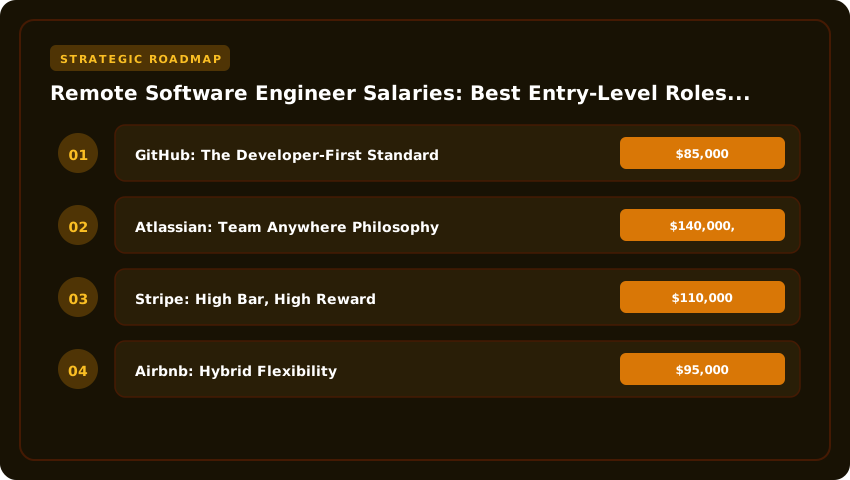
Landing a remote role straight out of an ABET-accredited program requires targeting employers with mature distributed infrastructures. The companies below have formalized new-graduate cohorts designed for remote onboarding, mentorship, and long-term retention. Understanding their hiring calendars and compensation philosophies—specifically the split between location-agnostic and geo-adjusted pay—is critical for maximizing your first offer.
GitHub: The Developer-First Standard
GitHub operates a fully remote, location-agnostic compensation model for US employees, meaning your salary band is identical whether you live in San Francisco or rural Kansas. Their Early-in-Career (EIC) program typically opens applications in August through October for roles starting the following summer or fall. Cohort sizes are intimate—usually 15 to 25 engineers annually—allowing for a structured “bootcamp” onboarding month. Typical titles include Software Engineer, New Grad and Platform Engineer, New Grad. Actionable tip: Contribute visibly to open-source projects on GitHub itself; hiring managers weigh public contribution graphs heavily during resume review.
Atlassian: Team Anywhere Philosophy
Atlassian’s “Team Anywhere” policy supports hiring in almost any US state. They utilize a geo-adjusted compensation model based on cost of labor zones (typically 4–5 tiers), so a new grad in Zone 1 (NYC/SF) earns roughly 15–20% more base pay than a peer in Zone 4. Their Graduate Program recruits heavily in the fall (September–November) for a February or July start. Cohorts range from 30 to 50 engineers across products like Jira, Confluence, and Bitbucket. The title is uniformly Graduate Software Engineer. They prioritize “team fit” interviews assessing collaboration over algorithmic trivia—prepare STAR-method stories about group projects.
Stripe: High Bar, High Reward
Stripe maintains a location-agnostic pay structure within the continental US, offering top-of-market bands that often exceed $170k–$190k total compensation for new grads (base + equity + sign-on). Their hiring is less cyclical and more evergreen, though a distinct New Grad pipeline peaks October–December. Cohorts are highly selective, often under 20 engineers per intake. The title is Software Engineer (New Grad). Stripe looks for “writing ability” and “systems thinking”; your cover letter and a concise design doc for a past project often matter more than LeetCode speed.
Airbnb: Hybrid Flexibility
Airbnb shifted to a “Live and Work Anywhere” model supporting remote work from dozens of US states. They use a geo-adjusted model tied to geographic differentials. The University Recruiting cycle kicks off early (July–September) for roles starting the following year. Cohort sizes are moderate, typically 25–40 engineers. Titles include Software Engineer, New Grad across backend, frontend, and mobile tracks. Actionable takeaway: Highlight experience with service-oriented architectures or React Native; their stack leans heavily here, and domain familiarity accelerates the “host” interview.
Meta: Scale and Structure
Meta (Facebook) offers remote eligibility for new grads on a team-by-team basis, though many infrastructure and product groups are remote-first. They employ a strict geo-adjusted compensation model with distinct zones. The University Engineering program is massive—hiring hundreds of new grads annually—with a rigid application window August–October. The title is Software Engineer, Entry Level (E3). The process is the industry standard for algorithmic interviewing; invest heavily in LeetCode Medium/Hard patterns and system design fundamentals (load balancers, sharding, caching).
Emerging Startups: Series B–D Sweet Spot
Do not overlook well-capitalized startups (e.g., Linear, Vercel, PlanetScale, Ramp, Deel). Many offer location-agnostic pay to compete with FAANG, often granting higher equity percentages (0.05%–0.15%) vs. 0.01%–0.03% at giants. Hiring is ad-hoc and fast—no fixed cohorts. Titles vary: Founding Engineer, Software Engineer L1/L2. Actionable strategy: Monitor Y Combinator Work at a Startup and Wellfound (AngelList) weekly. Apply directly to CTOs/VP Engineering with a tailored cold email linking a relevant side project; you bypass ATS filters entirely.
- Location-Agnostic Pay Leaders: GitHub, Stripe, Vercel, Linear (Same $ nationwide).
- Geo-Adjusted Pay (Cost of Labor): Atlassian, Airbnb, Meta, Google, Amazon (Tiered by metro area).
- Best Application Windows: Fall (Aug–Nov) for Big Tech structured programs; Year-round for startups.
- Negotiation Leverage: Competing offers from location-agnostic firms are the strongest lever against geo-adjusted offers.
Technical Skills and Credentials That Command Premium Entry-Level Remote Pay
The remote software engineering market in 2024 rewards specialization, and certain technical stacks consistently command a 15% to 30% salary premium over generalist full-stack JavaScript or Python roles. If you are evaluating where to direct your learning hours, understanding which ecosystems are actively paying a premium for entry-level talent is critical. Hiring managers across the United States are recalibrating their expectations, and verified proficiency in systems-level languages, cloud-native infrastructure, and machine learning pipelines is now the clearest signal of production readiness.
Rust and Go represent the most lucrative language bets for new graduates. Rust, in particular, has moved from a niche systems language to a hiring priority at companies like Cloudflare, AWS, and Discord. Entry-level Rust developers with demonstrable contributions to open-source projects or distributed systems work frequently command starting offers between $115,000 and $135,000, even when working fully remote from lower cost-of-living metros in the Midwest or Southeast. Go, the language of choice for Kubernetes, Docker, and most modern backend infrastructure, follows a similar trajectory. Companies building platform engineering teams and cloud-native tooling actively seek entry-level engineers who understand goroutines, channels, and concurrent programming patterns because these skills directly translate to microservices architecture.
- Kubernetes and container orchestration expertise: Certified Kubernetes Administrator (CKA) or Certified Kubernetes Application Developer (CKAD) credentials can shift an entry-level offer upward by $10,000 to $18,000 annually. Employers view these certifications as proof that you can manage production deployments, not just write code locally.
- AWS Solutions Architect Associate: This remains the single most recognized cloud credential for remote roles. Pairing AWS certification with hands-on Terraform experience signals DevOps readiness and frequently unlocks $120,000-plus starting packages.
- ML/AI frameworks (PyTorch, TensorFlow, LangChain): Entry-level engineers who can demonstrate fine-tuning experience, RAG pipeline construction, or production LLM integration are seeing starting salaries between $125,000 and $150,000. The scarcity of junior talent in this space is currently the primary salary driver.
- Distributed systems portfolio projects: A public GitHub portfolio demonstrating sharding, consensus algorithms, event-driven architectures, or multi-region deployments can justify a $20,000 to $30,000 premium over candidates showing only CRUD application experience.
ABET-accredited CS degrees versus coding bootcamps: the credentialing premium. The honest reality is that an ABET-accredited computer science degree from a US university still commands a meaningful salary premium in 2024, though the gap has narrowed considerably. ABET accreditation signals mastery of theoretical foundations: algorithm analysis, operating systems, computer architecture, and formal mathematics. Hiring managers at FAANG-adjacent companies, defense contractors, and regulated industries (fintech, healthtech, aerospace) frequently filter for ABET credentials specifically because they align with career progression into systems engineering and principal engineer tracks.
Quantitatively, ABET-credentialed graduates entering remote roles in 2024 report median starting offers of $108,000 to $122,000, while bootcamp graduates with equivalent portfolio strength typically land between $85,000 and $98,000. The gap is real, but it is not insurmountable. Bootcamp graduates who supplement their training with AWS certification, a strong distributed systems portfolio, and demonstrable open-source contributions can compress or even eliminate this differential. The key differentiator is not the credential itself but the evidence of production-scale engineering judgment.
Actionable takeaways for maximizing entry-level remote pay:
- If you are currently enrolled in an ABET-accredited program, prioritize coursework in distributed systems, operating systems, and programming languages electives that cover Rust or Go. Pair this with one cloud certification (AWS or CKA) before graduation.
- If you are a bootcamp graduate, invest three to six months building a production-grade portfolio project that demonstrates Kubernetes deployment, infrastructure-as-code, and observability tooling. Document the architecture decisions publicly on your blog or GitHub.
- Target ML/AI-adjacent roles if you have any quantitative background. The supply-demand imbalance is most acute here, and employers are willing to hire candidates with non-traditional backgrounds if they can demonstrate working knowledge of modern LLM tooling.
- Negotiate based on stack rarity. If you are one of fewer than 50 qualified entry-level Rust developers in a given remote talent pool, use that scarcity as leverage. Salary benchmarking tools like levels.fyi and the Bureau of Labor Statistics’ quarterly releases can anchor your negotiation with verified data.
Ultimately, the highest-paying remote positions go to candidates who combine theoretical rigor with verifiable production experience. Whether your foundation comes from an ABET-accredited degree or an intensive bootcamp, the differentiating factor is the same: can you architect, deploy, and maintain systems that serve real users at scale? In 2024, employers are paying premium dollars for exactly that proof.
Landing the Interview: Resume, Portfolio, and Application Strategy for Remote Roles
Transitioning from an ABET-accredited university program into a fully remote software engineering role requires a deliberate shift in how you present your skills. Without prior professional experience, hiring managers at remote-first companies are not just looking for coding proficiency; they are looking for remote-readiness. This means demonstrating that you can operate autonomously, communicate asynchronously, and document your work meticulously. To get past the initial Applicant Tracking Systems (ATS) and land that first technical interview, you need a strategic approach to technical preparation, open-source involvement, and portfolio curation.
Remote-first companies frequently use standardized coding assessments to filter entry-level talent. Platforms like HackerRank and CodeSignal are industry staples in the United States. To remain competitive, you should aim for a high score on the CodeSignal General Coding Assessment (GCA), typically targeting a score above 800 out of 850. For traditional algorithmic interviews, consistent LeetCode practice is non-negotiable. Aim to complete 150 to 200 problems, focusing heavily on arrays, hash maps, trees, and dynamic programming. Do not just memorize solutions; practice articulating your thought process out loud, as if explaining your logic in a Slack thread or a GitHub pull request.
- Establish a Daily Practice Routine: Dedicate two hours daily to solving algorithmic challenges to build muscle memory before the interview.
- Simulate Real Assessments: Take timed CodeSignal and HackerRank tests to acclimate to the pressure of automated, proctored evaluations.
- Focus on Edge Cases: Remote companies value engineers who anticipate failure points; always test your code against edge cases before submitting.
Building a portfolio that signals remote-readiness is your secret weapon. Hiring managers want to see self-directed project ownership. Instead of listing generic academic projects from your university coursework, build and deploy a full-stack application that solves a specific problem. More importantly, document the entire process. A stellar README file detailing your architecture decisions, setup instructions, and known limitations proves you understand the value of async communication. In a remote environment, if it is not documented, it effectively does not exist.
Contributing to open-source projects is another highly effective way to demonstrate your capability to work in a distributed team. You do not need to rewrite a core library; start by tackling “good first issue” tags in repositories you already use. Focus on improving documentation, fixing minor bugs, or writing test coverage. This shows humility, attention to detail, and the ability to navigate GitHub pull requests and code reviews asynchronously.
- Async Communication Artifacts: Include links to detailed GitHub issues you have opened or resolved, showcasing your ability to write clear, context-rich bug reports.
- Documentation Skills: Maintain a technical blog or comprehensive wiki for your personal projects to highlight your written communication proficiency.
- Self-Directed Ownership: Highlight projects where you independently scoped the requirements, chose the tech stack, and deployed the application to a cloud provider like AWS or Vercel.
Finally, tailor your resume to highlight these remote-centric soft skills alongside your technical stack. Use action verbs that imply autonomy and leadership, such as architected
Negotiating Remote Entry-Level Offers: Equity, Stipends, and Hidden Compensation
Negotiating your first remote software engineering offer is less about haggling over the headline salary and more about auditing the entire compensation statement. For entry-level candidates, the spread between an aggressive negotiation and a passive acceptance averages between $7,200 and $14,500 in total annualized value over the first two years of employment, according to 2024 data compiled by Levels.fyi and Carta. Once you factor in remote-specific perks like home office stipends, internet reimbursements, and co-working allowances, a $95,000 base salary can quietly balloon into a $108,000 effective package without a single dollar added to your paycheck. Understanding where that hidden value lives is the first step toward capturing it.
Equity is the most misunderstood lever for junior engineers, largely because most candidates confuse Restricted Stock Units (RSUs) with stock options. RSUs are grants of actual company shares that vest over time and are taxed as ordinary income upon vesting, making them lower-risk and more predictable. Stock options, by contrast, give you the right to purchase shares at a fixed strike price, meaning your upside is unlimited but you also shoulder downside risk if the stock dips below your strike. For a candidate evaluating a pre-IPO startup, options can be life-changing, but for an entry-level remote role at a public company like Shopify, Cloudflare, or Atlassian, RSUs almost always deliver more certain value. When comparing offers, calculate the grant-date fair value of RSUs against the Black-Scholes valuation of any option package, then divide by your vesting window to get a true annualized equity number you can compare apples-to-apples.
Vesting schedules deserve equally sharp scrutiny. The industry standard is a four-year vest with a one-year cliff, meaning you receive 25% of your equity after twelve months and the remainder in equal monthly or quarterly tranches. However, some remote-friendly firms like GitLab and Zapier have begun offering accelerated vesting or shorter cliffs to attract distributed talent. A six-month cliff, for example, reduces your early-stage risk dramatically. Also ask about refresh grants, which are supplemental equity awards typically issued annually based on performance. While refresh cycles at senior levels can be substantial, entry-level refresh grants tend to range from 10% to 25% of your initial grant, so treat them as a known but modest boost rather than a lottery ticket.
Beyond equity, the remote compensation stack contains a constellation of stipends that frequently go unclaimed simply because candidates never ask. Home office stipends typically range from $1,000 to $3,000 one-time, covering monitors, ergonomic chairs, and standing desks. Internet reimbursements average between $50 and $120 monthly, and co-working allowances can reach $300 monthly for engineers who prefer not to work from home. Health and wellness benefits, learning budgets ($1,500–$3,000 annually for books, courses, and conferences), and parental leave policies add another $5,000 to $12,000 in soft-dollar value. Ask the recruiter for a complete benefits summary in writing, then price each line item against your personal spending to determine real-world worth.
Now for the tactical playbook: how do you actually negotiate? Timing matters more than most candidates realize. The optimal moment to negotiate is after you receive a written offer but before you sign it, ideally within 72 hours, when the recruiter’s hiring manager still has budget authority and the candidate pipeline is fresh in their mind. Use this script as a starting point: “I’m genuinely excited about this role and the team. Based on my market research using Levels.fyi and my conversations with other candidates, I’m seeing total compensation for comparable remote entry-level positions in the $108,000 to $115,000 range. Could we explore adjusting the base to $102,000 or increasing the equity grant by 20% to close the gap?” This phrasing is collaborative, evidence-based, and avoids the adversarial tone that tanks negotiations.
If the recruiter pushes back on base salary, pivot to stipends and signing bonuses. A $5,000 to $15,000 signing bonus is often easier for companies to approve because it sits outside the recurring payroll budget. You can also negotiate a relocation-style cushion even for remote roles, framing it as a “home setup and onboarding allowance.” When negotiating multiple levers simultaneously, prioritize in this order: base salary, equity, signing bonus, and finally stipends, because each subsequent item typically yields diminishing flexibility. Remember that everything is negotiable until the contract is signed, but nothing is negotiable once you countersign and onboarding begins.
Finally, arm yourself with data before any conversation. The 2024 average entry-level remote software engineer base salary in the United States sits at $96,400, with top-quartile performers reaching $118,000. Entry-level candidates who negotiated averaged a 6.8% increase over their initial offer, equating to roughly $6,500 more in year-one base alone. When equity and benefits are tallied, that negotiation premium frequently exceeds $14,000 in total first-year value. Walk into every offer call with that number in your back pocket, a printed benefits breakdown in hand, and the quiet confidence of someone who has done their homework, and you will almost always walk out with a better package than the one you were originally given.
Red Flags to Watch For in Remote Entry-Level Job Postings and Contracts
Not every remote-friendly job posting is what it claims to be. As a 2024 graduate evaluating your first full-time software engineering role, the difference between a legitimate high-paying opportunity and a predatory contract can be measured in tens of thousands of dollars, lost equity, and even your professional mobility. The remote hiring market has matured rapidly, but it has also attracted recruiters and staffing firms that weaponize ambiguity to lock new graduates into unfavorable arrangements. Learning to read between the lines of a job posting is just as important as understanding Big-O notation or mastering your first CI/CD pipeline.
The first major red flag is the classic bait-and-switch hybrid requirement. A listing will advertise as “100% Remote,” yet buried in the third paragraph of the description, you will find a sentence stating, “Must be able to relocate to the San Francisco Bay Area within six months” or “Hybrid expectations of three days per week in our [city] headquarters upon conversion.” If the role is contract-to-hire, that hybrid clause may activate only after you have already accepted a lower contractor rate. Before applying, scrutinize the location paragraph. Genuine remote roles will list the approved states or time zones explicitly, or they will explicitly say “anywhere in the US.” If the company lists a specific city as the primary location and still claims remote flexibility, treat that as a yellow flag. If they refuse to clarify in writing during the recruiter screen, walk away.
The second red flag involves geo-adjusted pay bands disguised as “competitive salaries.” Many large technology companies maintain public salary ranges by geographic tier, paying Tier 1 metros like San Francisco, New York, or Seattle significantly more than Tier 2 or Tier 3 markets for identical work. A recruiter posting a remote role with “competitive pay, $75,000 to $135,000 depending on location” is signaling that a candidate in Cincinnati, Ohio should expect an offer near the bottom of that range, while a candidate in San Jose should expect the top. For entry-level engineers, the spread can easily exceed $40,000 annually. Always ask, before the technical interview, what the targeted salary band is for your specific zip code. If the recruiter refuses to answer or deflects to “we benchmark against market,” push back. The Department of Labor and several state-level pay transparency laws (including California SB 1162, Colorado Equal Pay for Equal Work, and New York City Local Law 32) have made it easier to verify whether posted ranges are honest representations.
Predatory contract structures form the third category of risk, and this is where recent graduates are most vulnerable because they often lack the leverage or experience to negotiate. Below is a working checklist of contract clauses every entry-level remote candidate should scrutinize before signing an offer letter or independent contractor agreement:
- Intellectual Property (IP) Assignment: Confirm that the IP assignment clause applies only to work performed during compensated hours and on company-issued equipment. Some aggressive contracts attempt to claim ownership of any code, side projects, or inventions you develop “relating to the company’s business” even outside work hours. If you maintain a personal GitHub portfolio, a blog, or open-source contributions, you need explicit carve-outs protecting that pre-existing and side work.
- Non-Compete Enforceability: Non-compete clauses vary dramatically by state. California, North Dakota, Minnesota, Oklahoma, and the District of Columbia largely prohibit non-competes for most workers. Massachusetts, Virginia, and several other states are tightening restrictions. Before signing, research your state’s current stance through the FTC’s rulemaking updates and your state bar association. Even in states where non-competes are technically enforceable, courts often refuse to honor them for entry-level employees with limited bargaining power and trade secrets access.
- Remote Work Tax Implications Across State Lines: If you work remotely for a company based in Texas but live in Florida, you generally have no state income tax issue. However, if you work remotely for a New York-based employer while residing in Connecticut, you may owe Connecticut state taxes on that income, and your employer may be required to withhold accordingly. Some employers respond by requiring employees to work exclusively from states where the company has an established nexus. Others, like the multi-state payroll provider Deel, will withhold taxes across jurisdictions, but the administrative complexity can lead to surprise tax bills in April. Ask whether the company reimburses state tax filings or covers any nexus-related costs.
- Equipment and Stipend Clauses: Verify whether the company provides a workstation, monitor, and home-office stipend. Some “remote” roles expect you to supply your own MacBook Pro and ergonomic chair out of a $50,000 salary, effectively cutting your take-home pay by $3,000 or more.
- Conversion Terms for Contract-to-Hire: If the role is structured as a 6-month or 12-month contract with intent to convert, demand written conversion criteria, including the salary band, equity grant, and benefits effective date. Verbal promises from a recruiter are not enforceable.
Finally, remember that a red flag in isolation is not always disqualifying. A startup might use a broad IP clause because venture investors require it for IP cleanliness audits. A Fortune 500 company might use geo-adjusted pay to comply with internal equity frameworks. The goal is not to reject every role with imperfect language, but to identify the trade-offs, ask pointed questions during the interview loop, and use that information to negotiate. A graduate who enters the job market with a working knowledge of these contract dynamics will routinely secure offers $10,000 to $20,000 higher than peers who accept the first “competitive” salary they are quoted. Your degree from an ABET-accredited program taught you how to engineer systems; your job search should reflect the same rigor in evaluating the systems that employ you.
| Role / Specialization | Entry-Level Base Salary ($) | Education Cut-Off | Time to Hire | 5-Year Career ROI (%) |
|---|---|---|---|---|
| Front-End Developer | $75,000 – $95,000 | B.S. in CS or equivalent | 1-3 months | 180% |
| Back-End Developer | $85,000 – $110,000 | B.S. in CS or equivalent | 1-3 months | 220% |
| Full-Stack Developer | $90,000 – $115,000 | B.S. in CS or equivalent | 2-4 months | 250% |
| DevOps Engineer | $95,000 – $120,000 | B.S. in CS or IT | 2-4 months | 270% |
| Data Engineer | $100,000 – $125,000 | B.S. in CS or Data Science | 2-4 months | 290% |
| Machine Learning Engineer | $110,000 – $140,000 | B.S. in CS or Math (M.S. preferred) | 3-6 months | 320% |
| Cloud Engineer (AWS/Azure) | $95,000 – $125,000 | B.S. in CS or IT + Certifications | 2-4 months | 280% |
| Cybersecurity Software Engineer | $100,000 – $130,000 | B.S. in CS or Cybersecurity | 3-6 months | 300% |
Strategic Final Takeaway
Success in evaluating Remote Software Engineer Salaries: Best Entry-Level Roles 2024 relies on early preparation, adherence to verified accredited requirements, and cross-referencing official portals. Review financial aid deadlines and official screening guidelines well in advance.