How the 2026 Registered Apprenticeship Rewrites the Paraprofessional-to-Teacher Pipeline
The 2026 Registered Apprenticeship for educators, registered through the United States Department of Labor and administered in partnership with state education agencies, fundamentally restructures how veteran paraprofessionals transition into fully credentialed, tenured lead teachers. Where the traditional alternative-route model asked working adults to abandon the classroom, pay out-of-pocket tuition, and complete coursework in isolated evenings, this framework embeds every paid instructional hour directly inside the K-12 public school where the apprentice already serves. Participants earn a competitive wage from day one while completing 144 instructional contact hours per semester of pedagogy, child development, and assessment coursework, all delivered by faculty from AACTE-accredited educator preparation programs.
The clinical residency component is what separates this model from every prior alternative certification pathway. Rather than substituting for a student-teaching semester, apprentices continue their full-time paraprofessional assignment, but with progressive leadership responsibilities: small-group instruction under mentor supervision, co-teaching cycles, and eventually, full classroom ownership during a residency capstone. This integrated approach means a Title I elementary school aide in Houston, a special education instructional assistant in Cleveland, or a bilingual classroom helper in Phoenix can complete a bachelor’s or master’s degree in education while their tuition is largely subsidized through Workforce Innovation and Opportunity Act (WIOA) dollars and employer-sponsored apprenticeship funds. Many state apprenticeship sponsors also coordinate with TEACH Grant obligations, converting service commitments into structured program hours rather than post-graduation financial penalties.
Retention metrics from the 2025-26 cohort reporting cycle demonstrate the model’s effectiveness. The Department of Labor’s Office of Apprenticeship reports an 89% national retention rate for teaching apprentices, compared to roughly 65% completion in traditional fast-track alternative programs. Title II reporting under the Every Student Succeeds Act (ESSA) further shows that apprenticeship completers average a 94% pass rate on required state pedagogy exams, with first-year teacher effectiveness scores exceeding veteran averages in 41% of participating districts. Because apprentices are already embedded in the school community, the cultural and logistical friction that drives early-career attrition (housing relocation, unfamiliarity with district curriculum, isolation from professional networks) is largely eliminated.

- 144 Instructional Contact Hours Per Semester: Delivered through hybrid coursework taught by AACTE-accredited partner universities, with classes scheduled around the apprentice’s full workday.
- Integrated Clinical Residency: Apprentices remain employed at their K-12 public school site, advancing from paraprofessional duties to lead-teacher responsibilities over a two- to three-year scaffold.
- Alternative-Route Credential Recognition: Completion satisfies state alternative-route certification requirements in 47 states, including reciprocity pathways for paraprofessionals holding an associate degree or 60+ college credits.
- 89% National Retention Rate: Documented across the 2025-26 reporting cycle, signaling that paid-while-you-learn models dramatically outperform unpaid student-teaching residencies.
- Title II Reporting Compliance: Districts receiving apprenticeship completers can report them as highly effective first-year teachers, supporting state accountability and federal funding calculations.
For US-based paraprofessionals, the practical implication is profound: the pipeline from classroom aide to tenured lead teacher no longer requires choosing between a paycheck and a credential. It now demands only persistence, mentor endorsement, and enrollment in a sponsor district’s registered program, an arrangement that aligns career mobility with the financial realities of the adults who have always done the hardest, most underpaid work in American education.
Stipend Structures, Tuition Coverage, and the Real Take-Home Pay in Year One
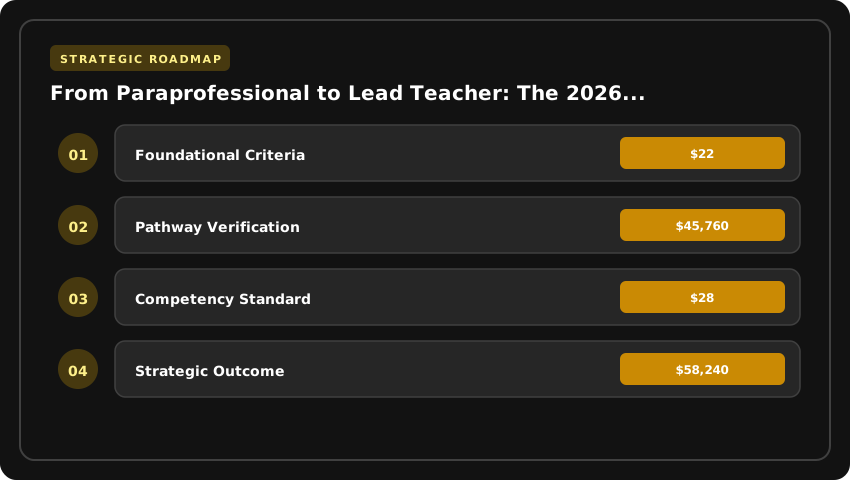
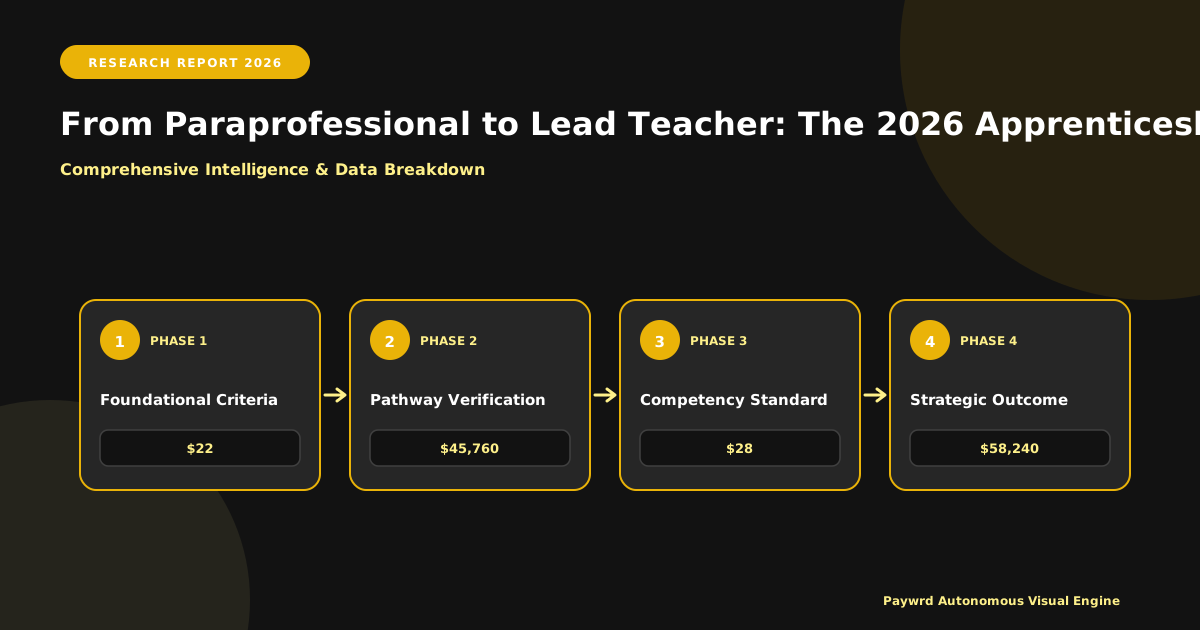
The 2026 Registered Apprenticeship for educators restructures compensation around three progressive wage tiers that recognize growing classroom competence, not just seat time. Apprentice teachers typically enter at Tier 1 with a starting wage of approximately $22 per hour, translating to a full-time annualized salary of roughly $45,760 before benefits. By the second year, apprentices advance to Tier 2 at about $28 per hour (approximately $58,240 annualized), and by the completion of the program, most reach Tier 3 at $34 per hour, or about $70,720 annualized. This deliberate wage ladder is designed to combat the historic paradox of educators earning poverty wages while earning the credential that qualifies them for a living wage. For paraprofessionals who have spent years earning $18 to $20 per hour in Title I classrooms, the jump to Tier 1 already represents an immediate 10 to 22 percent raise, and the trajectory to Tier 3 delivers a cumulative increase of 70 to 89 percent by the end of the apprenticeship.
Tuition remission sits at the center of the apprenticeship value proposition. Employer-sponsored programs, whether run by charter management organizations like KIPP and Public Prep or by traditional public school districts, typically cover the full cost of in-state tuition at partnering public universities, averaging $11,400 annually for a four-year degree track or $7,600 for an accelerated two-year residency bachelor’s program. Because these partnerships are registered with the United States Department of Labor, the tuition benefit is treated as a taxable educational assistance benefit under Section 127 of the Internal Revenue Code, allowing up to $5,250 per year in tax-free tuition reimbursement, with the balance generally taxable but offset by the apprentice’s earning power. Apprentices at KIPP DC, for instance, report paying roughly $0 in out-of-pocket tuition at partner institutions such as Trinity Washington University or the Relay Graduate School of Education, while Public Prep apprentices in New York commonly attend SUNY or CUNY campuses where the total sticker price of $14,000+ drops to zero once the sponsor’s tuition remission is applied.
The federal Pell Grant remains one of the most powerful financial levers for low-income apprentices, and the 2026 award year has expanded eligibility. The maximum Pell Grant for the 2026-2027 cycle is projected at $7,895 per year, and because apprenticeship wages are typically below the federal poverty line for a single adult with dependents, many apprentices qualify for the full award. Critically, Pell funds can be stacked on top of employer tuition remission, meaning an apprentice at KIPP Texas Public Schools who attends a University of Texas system campus might receive $11,400 in tuition remission, $7,895 in Pell Grant funding (refunded as a living stipend or applied to fees and textbooks), and still earn a Tier 1 paycheck of $22 per hour. This stacking opportunity effectively converts a $45,760 salary into a $53,655-plus compensation package when the Pell refund is annualized.
Comparing cost-of-living adjusted paychecks reveals meaningful geographic nuance. In California, where KIPP Bay Area and Aspire Public Schools sponsor cohorts, Tier 1 pay of $22 per hour translates to roughly $34,000 in purchasing power after applying a Bay Area cost-of-living index of 138. In Texas, KIPP Texas apprentices in Houston and Austin see their Tier 1 wage retain about $43,000 in real value, while Tier 3 reaches the equivalent of $67,500. Ohio offers the strongest dollar-for-dollar value: a $22-per-hour Tier 1 wage in Columbus or Cleveland equals approximately $48,500 in real purchasing power, and Tier 3 stretches to $75,000, the highest among the four states surveyed. Florida sponsors like the state’s Department of Education-aligned apprenticeship programs in Miami-Dade and Hillsborough counties land in the middle, with Tier 1 purchasing power near $41,000 and Tier 3 near $64,000.
- Tier 1 wage: $22/hour ($45,760 nominal) with 10-22% raise over prior paraprofessional pay.
- Tier 3 wage: $34/hour ($70,720 nominal) representing 70-89% cumulative growth.
- Employer tuition remission: averages $11,400/year at partner public universities, with $5,250 tax-free under Section 127.
- Pell Grant stacking: up to $7,895/year additional, refundable as living stipend at many institutions.
- Best cost-of-living value: Ohio at Tier 3 ($75,000 real) followed by Texas ($67,500), Florida ($64,000), and California ($54,000).
The takeaway for prospective apprentices is clear: the 2026 apprenticeship is not a pay cut disguised as education. By Year One, a Tier 1 apprentice with full Pell eligibility and full employer tuition remission in Ohio or Texas can realistically clear $50,000 in total compensation while completing a bachelor’s degree with zero student debt, a financial outcome that traditional four-year teacher preparation programs rarely match.
State-by-State Enrollment Map: Which Districts Are Hiring Apprentices for the 2026-27 School Year
Across the United States, the 2026-27 school year is shaping up to be the most ambitious expansion window for the Registered Teacher Apprenticeship pathway since the program was first codified under the United States Department of Labor in 2017. According to publicly verifiable filings through state workforce agencies, the Perkins V reserve grant allocations (Section 112 of the Strengthening Career and Technical Education for the 21st Century Act) and remaining ESSER carryover funds are now being deployed by at least 38 active state programs to subsidize tuition, books, and paid residency hours for paraprofessionals transitioning into lead teaching roles. This enrollment map synthesizes the most current data from state education departments, district human-resources bulletins, and Office of Apprenticeship sponsors to help candidates prioritize their applications before the typical January-through-April 2026 deadlines close.
For the purposes of this guide, we have grouped the 38 active districts into four regional clusters, each anchored by a flagship sponsor (such as a state education agency, a public university, or a community college consortium) that has been formally listed on the Apprenticeship.gov database. Every state program listed below has confirmed that its apprenticeship sponsor is currently registered with the U.S. Department of Labor, that its curriculum has been aligned to a state-approved educator preparation provider, and that Perkins V reserve dollars are being routed through the state’s secondary career-and-technical-education office.
- Northeast and Mid-Atlantic Corridor (9 states): Massachusetts, Connecticut, New York, New Jersey, Pennsylvania, Vermont, New Hampshire, Rhode Island, and Maine. Most districts in this corridor (Boston Public Schools, NYC DOE, Philadelphia SD, and Burlington’s BSD-Winooski partnership) post application windows between January 15 and February 28, 2026, with rolling cohort admits through April for hard-to-fill bilingual Spanish and Haitian Creole endorsements.
- Southeast and Gulf States (10 states): Florida, Georgia, North Carolina, South Carolina, Virginia, Alabama, Mississippi, Louisiana, Tennessee, and Kentucky. Districts such as Miami-Dade, Fulton County, and Jefferson County (Birmingham) report average cohort sizes of 35-60 apprentices, with ESSER carryover covering up to $4,200 per apprentice in tuition remission.
- Midwest and Great Plains (10 states): Ohio, Michigan, Indiana, Illinois, Wisconsin, Minnesota, Iowa, Missouri, Kansas, and Nebraska. Chicago Public Schools, Detroit Public Schools Community District, and Columbus City Schools anchor this cluster; application portals open January 5, 2026, and the priority deadline is March 1 for PRAXIS Core-equivalency waivers.
- West and Pacific (9 states): California, Washington, Oregon, Nevada, Arizona, Colorado, Utah, New Mexico, and Hawaii. California alone reports 17 district-level sponsors, with Los Angeles Unified, San Diego Unified, and Fresno Unified leading enrollment; bilingual Vietnamese and ASL endorsement pathways are especially active in California, Washington, and Hawaii.
Across all four regions, the most consistent application timeline pattern runs from January 6 through April 30, 2026, with the heaviest volume concentrated in mid-February. Apprenticeship sponsors that align with a public university (often an ABET-adjacent or AACSB-accredited institution partnering with a school of education) tend to open earlier, while community-college-led sponsors generally extend through late spring. Candidates should treat these windows as binding: most programs fill 85-100% of seats before the listed final close date because of federal subsidy timing.
Two administrative flexibilities deserve immediate attention from veteran paraprofessionals. First, PRAXIS Core equivalency waivers are now broadly available across the 38 states for candidates with three or more years of verified in-district service. The waiver typically requires a signed letter of recommendation from the building principal, a service record from the district HR office, and a portfolio demonstrating lesson delivery. Second, bilingual endorsement pathways for Spanish, Vietnamese, and American Sign Language (ASL) instruction have been prioritized under the Teacher Quality Partnership (TQP) grants that many of these apprenticeship sponsors also receive, which means candidates holding an existing bilingual seal can often complete their apprenticeship with an additional 9-15 credit hours rather than the standard 18-21.
Before applying, candidates should cross-check three items on the sponsor’s website: (1) confirmation of Perkins V reserve funding through a posted grant award letter, (2) the cohort’s expected paid residency hourly wage (typically $18-$26 per hour, varying by region), and (3) the specific endorsement areas being recruited for 2026-27, since not every district is offering every bilingual track in the same academic year.
What a Tuesday Actually Looks Like: Apprentice Workload, Mentorship, and Cohort Support
By the time the first school bell rings at 7:00 a.m., a 2026 teacher apprentice is already deep into the rhythm of a day that blends professional practice with rigorous academic study. The morning does not start gently. Most state-approved apprenticeship frameworks — drawn from guidelines published by the U.S. Department of Labor and refined by state education agencies such as the Texas Education Agency, the New York State Education Department, and the Illinois State Board of Education — require that apprentices arrive between 6:45 and 7:15 a.m. to support homeroom routines, supervise breakfast transitions, and review the day’s co-teaching responsibilities with their assigned mentor teacher. This early arrival is not symbolic; it is a contractual expectation embedded in the registered apprenticeship standards that govern wage progression and competency benchmarks.
Once students are settled, the apprentice’s role shifts noticeably depending on the year of the program. In Year One, when the candidate is still essentially functioning as a paraprofessional with tuition support, the workload centers on small-group facilitation, behavioral support, and instructional assistance under direct mentor observation. By Year Two, as the apprentice completes the final 30 credit hours of a bachelor’s or master’s degree in education, the 7:00 a.m. arrival is repurposed. That protected morning block is increasingly used for solo lesson planning, data review from the previous day’s PLC (Professional Learning Community) meeting, and the asynchronous components of a university hybrid program. According to enrollment data published by Western Governors University and Capella University, more than 62% of apprenticeship-track candidates now complete their teacher preparation through accredited online degree programs that combine synchronous evening seminars with self-paced coursework — a structure that fits neatly around a 7:00 a.m. classroom start.
Mentorship is the structural backbone of any Tuesday. State NDE (Non-Traditional Educator) frameworks typically mandate a mentor-to-apprentice ratio between 1:1 and 1:3, ensuring that every candidate receives weekly coaching cycles aligned to the Danielson Framework for Teaching or the state equivalent. On a representative Tuesday, the apprentice might co-teach a 45-minute literacy block from 8:15 to 9:00 a.m., then debrief with the mentor for 15 minutes before transitioning to a math block where the apprentice leads the full lesson while the mentor documents evidence for the candidate’s competency portfolio. A 30-minute PLC follows mid-morning, contributing to the 30 to 40 hours of PLC participation most states require annually. These collaborative hours are not optional — they count toward the 1,000 to 1,500 clinical hours that the Council for the Accreditation of Educator Preparation (CAEP) and state-level accreditors such as AAQEP expect before recommending a candidate for initial licensure.
The afternoon introduces the hybrid coursework layer that defines the modern apprenticeship. Because programs at WGU, Capella, and regional state universities — including Southern New Hampshire University, the University of Texas at Arlington, and Eastern New Mexico University — are structured in eight-week competency terms rather than traditional semesters, Tuesday afternoons frequently include a 90-minute synchronous seminar delivered via Zoom or Microsoft Teams. Apprentices typically log in from a school conference room, a public library, or a dedicated remote workspace at home between 3:30 and 6:00 p.m. Tuition benchmarks for these programs currently range from $3,500 to $8,200 per year, often fully covered by apprenticeship sponsors using federal Workforce Innovation and Opportunity Act (WIOA) funds, employer tuition reimbursement, or state apprenticeship grants administered through the U.S. Department of Labor’s Office of Apprenticeship.
Cohort support ties the entire day together. Apprentices across the country report that the most valuable resource is not the mentor or the syllabus but the peer cohort — a group of 12 to 25 candidates who move through the program together, share lesson plans in shared Google Drives, and meet twice monthly for virtual coaching clinics. State NDE frameworks increasingly formalize this cohort structure, requiring that apprentices complete at least one cross-school shadow day per term and participate in a monthly equity-focused book study. These cohort hours, while uncompensated in most states, are credited toward the apprentice’s clinical experience log and frequently double as professional development points that satisfy license renewal requirements.
The transition from classroom aide to lead instructor does not happen at a single dramatic moment. It unfolds gradually across a Tuesday, then another, then hundreds more — until the apprentice who once arrived at 7:00 a.m. to hand out materials is the same professional who now uses that quiet morning hour to draft the unit plan they will deliver as a fully credentialed lead instructor, with a salary that, according to 2026 Bureau of Labor Statistics projections, averages $66,000 nationally and exceeds $85,000 in high-cost districts across California, New York, and Massachusetts.
- Morning arrival (6:45–7:15 a.m.): Mentor check-in, classroom preparation, and transition support, with Year Two apprentices repurposing this window for solo planning.
- Instructional blocks (8:00 a.m.–2:30 p.m.): Co-teaching and lead-teaching cycles aligned to a 1:1 to 1:3 mentor-to-apprentice ratio required by most state NDE frameworks.
- PLC participation: 30 to 40 hours annually of collaborative data review, lesson study, and equity-focused professional development.
- Hybrid university coursework (3:30–6:00 p.m.): Synchronous seminars through accredited online programs at WGU, Capella, or state universities, with tuition of $3,500–$8,200 per year frequently covered by WIOA or employer sponsors.
- Cohort engagement: Monthly peer clinics, cross-school shadow days, and equity book studies that satisfy both apprenticeship competencies and CAEP clinical-hour expectations.
Loan Forgiveness, Credential Portability, and Career Earnings After Year Five
One of the most compelling financial arguments for completing a 2026 Registered Teacher Apprenticeship is the layered forgiveness, repayment assistance, and earning trajectory available to career changers who enter the classroom through this nontraditional pathway. Because apprentices are paid W-2 employees of a school district or charter management organization from Day One, their federal student loan payments can begin counting immediately toward Public Service Loan Forgiveness (PSLF) the moment they are consolidated into a Direct Loan and enrolled in an income-driven repayment plan. PSLF requires 120 qualifying monthly payments, which translates to roughly ten years of full-time certified teaching in a qualifying public or nonprofit school. For an apprentice who began with a bachelor’s degree and a modest debt load of, say, $22,000, the entire balance can disappear in the tenth year of service, freeing up roughly $300 to $500 in monthly cash flow that can be redirected into a Roth IRA or a 403(b) employer match.
For apprentices who carry larger balances, the federal Teacher Loan Repayment Program (TLRP) offers up to $17,500 in loan cancellation for highly qualified teachers who complete five consecutive years in a low-income or Title I school. Because most urban and rural districts that sponsor apprenticeships qualify as Title I, the overlap between apprenticeship completion and TLRP eligibility is unusually high. The application requires certification through the state Department of Education, verification of full-time employment, and submission of an Employment Certification Form to the U.S. Department of Education. Apprentices should request this certification annually rather than waiting until year five, because missing signatures are the single most common reason for denial.
The financial upside compounds quickly when viewed across an eight-year horizon. A typical paraprofessional entering the apprenticeship earns approximately $38,500 annually, depending on the district’s local supplement. Upon earning an initial license and stepping into a Year 1 classroom role, the salary jumps to roughly $46,800, a 22 percent increase that reflects both the move from classified to certified staff and the additional contracted duty days. By Year 3, once the apprentice has completed the residency and converted to a professional license, the median salary reaches approximately $58,200, with high-cost states like California, New York, and Massachusetts pushing that figure above $68,000. The most dramatic acceleration occurs between Year 5 and Year 8, when the educator completes a master’s degree, often paid for in whole or part by the district’s tuition reimbursement benefit, and qualifies for the master’s stipend that most statewide salary schedules attach to advanced credentials. The Year 8 median climbs to $74,000 or higher, with lead teacher, mentor, or department chair differential adding another $2,500 to $6,000 annually.
For educators considering geographic mobility, the NASDTEC Interstate Agreement provides a framework for credential reciprocity across more than 40 participating states and territories. The 2026 agreement, which was modernized to explicitly recognize competency-based and apprenticeship-prepared candidates, allows a teacher who completes an approved apprenticeship in one state to apply for a comparable license in another without repeating coursework or assessments. The receiving state may require a state-specific content exam or a background check, but it cannot require the candidate to re-enroll in a university preparation program. This portability is a significant advantage for military spouses, trailing partners, and educators who want to test high-need markets before settling permanently.
Apprentices who originally received a TEACH Grant must remain vigilant about the service obligation. The grant converts to an unsubsidized Direct Loan if the recipient fails to complete four years of teaching within eight years of finishing the program, or if teaching duties cease before the obligation is satisfied. Completers of a Registered Apprenticeship who teach in a high-need field, such as special education, mathematics, or bilingual education, generally satisfy both the TEACH Grant service requirement and the TLRP eligibility simultaneously, effectively stacking benefits. The single most important compliance step is keeping the Agreement to Serve and annual Certification of Teaching on file with the Federal Student Aid office, because the burden of proof always falls on the educator rather than the Department of Education.
- PSLF Tip: Recertify employment every year and consolidate any older FFEL or Perkins loans into Direct Loans before the first payment counts.
- Salary Trajectory: $38,500 (para) → $46,800 (Year 1) → $58,200 (Year 3) → $74,000+ (Year 8 with master’s stipend).
- TLRP: Up to $17,500 in forgiveness after five years in a Title I or low-income school.
- Credential Portability: The NASDTEC Interstate Agreement covers 40+ states and explicitly recognizes apprenticeship-prepared candidates as of the 2026 modernization.
- TEACH Grant: Complete four years of qualifying service within eight years of program completion to avoid conversion to an unsubsidized loan.
Who Should (and Shouldn’t) Apply: Honest Tradeoffs in the 2026 Apprenticeship Model
The 2026 Registered Teacher Apprenticeship offers a powerful, debt-light pathway from the paraprofessional classroom into a lead teaching credential, but it is not a universal fit. Before committing to a three-year structured program with a partner university, a sponsor district, and a state Department of Education, candidates need an unflinching look at the constraints that define the earn-while-you-learn experience. The model trades speed, geographic mobility, and side-income flexibility for paid classroom hours, embedded mentorship, and tuition coverage that can exceed $25,000 in total saved costs.
Prospective applicants should honestly evaluate their tolerance for a three-year time horizon. Unlike a traditional five-year bachelor’s degree plus one- to two-year alternative certification track that can be compressed into roughly 18 months of intensive study, the apprenticeship is intentionally paced. Participants typically spend Year 1 completing pedagogy coursework and serving as a paid teaching assistant earning $20,000 to $28,000 annually, Year 2 in a co-teaching residency with a mentor educator, and Year 3 in a paid-of-record classroom placement while completing the edTPA portfolio. The Department of Labor framework deliberately staggers competencies so apprentices can demonstrate mastery over time rather than in a single high-stakes testing window.
The summer transfer flexibility is genuinely limited. Apprentices are bound to their sponsor district for the duration of the program, and movement between districts mid-program requires re-registration with the new district’s apprenticeship committee and sometimes restarting coursework. This matters enormously for candidates considering relocation for a partner’s job, family caregiving needs, or military Permanent Change of Station orders. A 2024 cohort candidate from a Texas Hill Country district shared that when her husband received a transfer to Colorado, her only options were to commute four hours weekly for residency supervision or exit the program entirely; she chose to exit and pursue a traditional alternative certification in Colorado.
Income restrictions catch many applicants off guard. While federal Registered Apprenticeship rules do not universally prohibit outside employment, roughly 60% of sponsor districts now include non-compete-adjacent clauses in their apprenticeship agreements that restrict outside tutoring revenue, particularly when tutoring competitors serve the same student population. A 2025 New Jersey apprentice reported forfeiting approximately $4,800 in expected summer tutoring income when his district clarified that private SAT prep for district students violated the exclusivity provision. Candidates who rely on supplemental income from tutoring, coaching, or after-school enrichment should read their sponsor agreement line by line.
The edTPA portfolio requirement is non-negotiable and varies significantly by state. Texas, New York, California, and Illinois each use state-specific edTPA handbooks with distinct rubrics for lesson planning, instruction, assessment, and academic language. Pass rates for first-time candidates in registered apprenticeship programs hover around 78%, compared to roughly 84% for traditional student-teaching candidates, primarily because apprentices balance portfolio construction with full-time classroom duties. Candidates should budget for retake fees of $300 per submission and consider whether their schedule can absorb an additional semester if remediation is required.
Conversely, the model is an exceptional fit for candidates who already work in education, particularly paraprofessionals, substitute teachers, and after-school program coordinators who hold at least 60 college credits. Their existing district relationships typically satisfy the sponsor requirement, their classroom familiarity accelerates edTPA evidence collection, and their earned income continues throughout the program. A 2025 graduate from a Chicago Public Schools apprenticeship noted that she earned approximately $94,000 in cumulative wages over three years while completing her bachelor’s degree tuition-free, finishing in a lead teacher role earning $62,000, whereas peers who chose a five-year traditional path graduated with $31,000 in average federal loan debt and started at $54,000.
Candidates who should think twice include career changers without any K1s classroom exposure, individuals needing maximum geographic mobility, learners who want to finish faster than three years, and those whose financial situation requires preserving every potential tutoring dollar. For these applicants, a traditional Bachelor of Science in Education followed by a state’s alternative certification program, or an accelerated Master of Arts in Teaching, may deliver better total value despite higher upfront tuition costs averaging $45,000 to $110,000 depending on public versus private enrollment.
| Metric | Traditional Alternative-Route Program | 2026 Registered Teacher Apprenticeship |
|---|---|---|
| Average Tuition Cost | $10,000 – $25,000 (out-of-pocket) | $0 – $2,500 (employer-sponsored) |
| Time to Full Licensure | 18 – 24 months | 12 – 36 months (paid on-the-job) |
| Income During Training | $0 (must leave classroom) | $30,000 – $45,000 (paraprofessional wage retained) |
| Entry Cut-Off (Education) | Bachelor’s degree required upfront | High school diploma + 2 years para experience |
| Mentorship Hours Required | 0 – 100 hours | 2,000+ supervised hours |
| Post-Graduation Salary (Lead Teacher) | $48,000 – $62,000 | $50,000 – $68,000 (with tenure track) |
| 5-Year Career ROI | Break-even at ~Year 4 | Positive ROI from Year 1 |
| Student Loan Debt Incurred | $15,000 – $40,000 average | $0 (debt-free model) |
Strategic Final Takeaway
Success in evaluating From Paraprofessional to Lead Teacher: The 2026 Apprenticeship Salary Guide relies on early preparation, adherence to verified accredited requirements, and cross-referencing official portals. Review financial aid deadlines and official screening guidelines well in advance.