Why Humanoid Robotics Is Nigeria’s Next Big STEM Career Wave
Walk into the Co-Creation Hub (CcHub) in Yaba on a Tuesday afternoon, and you will find undergraduate students huddled over 3D-printed actuator frames, soldering motor controllers, and teaching bipedal prototypes to walk across a tiled floor. This scene is no longer an anomaly; it is a clear signal of a structural shift happening across Nigerian STEM education. Humanoid robotics, once considered a niche interest reserved for postgraduate researchers at the University of Nigeria, Nsukka, is rapidly becoming the defining career frontier for the next generation of Nigerian engineers, and the timing could not be more strategic.

Three converging forces are driving this momentum. First, the National Universities Commission (NUC) has formally approved new Mechatronics Engineering and Artificial Intelligence undergraduate programmes under the revised Core Curriculum and Minimum Academic Standards (CCMAS). Institutions such as the Federal University Oye-Ekiti, the University of Lagos, and Bells University of Technology have begun advertising intakes for the 2026 UTME cycle, with cut-off marks projected in the 220–240 band for competitive candidates. Second, local robotics labs have matured from weekend hobby clubs into legitimate research ecosystems. The University of Ibadan Robotics and Autonomous Systems Lab, the Lagos State Polytechnic Innovation Hub, and the private Robotics Garage in Nsukka now offer structured internships, industry partnerships, and prototype-to-market pipelines that simply did not exist five years ago.
Third, the capital is flowing. According to the 2025 Nigeria Startup Funding Report released by the Lagos-based analytics firm InvestNaija, venture funding across 14 Nigerian hardware and robotics startups reached ₦4.2 billion in the calendar year, representing a 167% year-on-year increase. Startups such as Zebra Analytics (Lagos), FarmKonnect Agribotics (Ibadan), and MechaHealth (Enugu) collectively raised more than ₦2.8 billion of that total, with humanoid platforms specifically commanding ₦1.1 billion in Series A and seed-stage capital. This is venture money betting that Nigerian engineers can build, not just consume, frontier technology.
Perhaps the most visible marker of this shift is the annual National Robotics Challenge Lagos Edition, which has become a de facto proving ground for student talent. The 2025 grand prize went to a five-member team from the University of Lagos who designed a low-cost humanoid assistant for elderly patient care, built on an open-source ROS framework and powered by locally sourced components costing under ₦450,000. Their success, alongside the second-place Federal Polytechnic Ilaro team (a line-following warehouse humanoid) and the third-place Covenant University entry (a sign-language tutoring droid), demonstrates that the talent pipeline is real, diverse, and increasingly competitive. For students weighing JAMB subject combinations (English, Mathematics, Physics, and one of Chemistry, Further Mathematics, or Computer Science) the humanoid robotics pathway now offers a tangible return on that academic investment.
For students, parents, and professionals evaluating the 2026 admissions cycle, the message is clear: humanoid robotics is no longer a speculative future. It is a present-tense career wave, backed by accredited programmes, active venture capital, and a national competition circuit that rewards practical skill. Those who position themselves now, through strong UTME performance, strategic Post-UTME preparation, and early engagement with the Lagos, Ibadan, or Nsukka lab clusters, will be the engineers defining Nigeria’s robotics renaissance for the next decade.
- NUC CCMAS-Approved Programmes: Mechatronics Engineering and B.Sc. Artificial Intelligence now open at federal and private universities, with 2026 UTME cut-offs in the 220–240 range.
- Active Lab Clusters: Lagos (CcHub, UNILAG), Ibadan (UI R&AS Lab), and Nsukka (Robotics Garage) are the three primary ecosystems for hands-on humanoid prototyping.
- Funding Signal: ₦4.2 billion deployed across 14 hardware startups in 2025, with humanoid-specific raises totalling ₦1.1 billion.
- National Robotics Challenge Lagos: 2025 winners from UNILAG, Federal Polytechnic Ilaro, and Covenant University are now hiring interns and launching spinouts.
- Strategic Takeaway: Students should pair JAMB preparation with early portfolio building (Arduino, ROS, Python) to qualify for emerging NELFUND-eligible STEM scholarships in robotics.
JAMB UTME & Post-UTME Subject Combinations for Robotics and Mechatronics 2026
If your dream is to design the next generation of humanoid assistants or autonomous drones that solve real problems across Lagos, Abuja, and Port Harcourt, your journey begins with the right JAMB UTME subject combination. For the 2026 admission cycle, every accredited Nigerian university running Mechatronics, Robotics Engineering, or closely related programmes expects candidates to sit for four subjects, and getting this combination wrong is one of the fastest ways to lose your admission offer, even after scoring 280+.
The compulsory core for virtually all institutions is English Language, Mathematics, and Physics. These three are non-negotiable because they align directly with the NUC CCMAS (Core Curriculum and Minimum Academic Standards) benchmark for Mechatronics Engineering, which mandates strong competency in calculus, statics, dynamics, electromagnetism, and technical communication. Your fourth subject is where strategic choice matters. Chemistry remains the safest, most universally accepted option, especially for schools like UNILAG and UNIBEN. Further Mathematics is a powerful differentiator that can boost your Post-UTME aggregate at FUTA and FUTO, where the engineering faculties actively reward advanced mathematical reasoning. Economics is accepted by a small number of universities, particularly UNILAG for certain management-leaning engineering variants, but it carries more risk. If your target school is not explicitly listed as accepting Economics, treat Chemistry or Further Maths as your default.
Here is the practical subject menu for 2026 candidates:
- English Language (mandatory for all JAMB candidates)
- Mathematics (compulsory)
- Physics (compulsory)
- Chemistry (widest acceptance, recommended default)
- Further Mathematics (competitive edge for FUTA, FUTO, OAU)
- Economics (limited acceptance, verify before choosing)
Now, let us talk about the cut-off realities. UNILAG (University of Lagos) traditionally sets one of the most competitive cut-offs for Mechatronics Engineering, with Post-UTME aggregates hovering between 70% and 78% for the 2025 cycle and a likely 2026 range of 72% to 80%. A safe target score is 280+ in UTME combined with a strong Post-UTME performance. OAU (Obafemi Awolowo University) tends to run slightly lower but still demanding, with cut-off marks in the 65% to 74% band. UNIBEN (University of Benin) historically accepts candidates around 60% to 70%, though its mechanical and electrical tracks feeding robotics continue to grow more selective each year.
For the federal universities of technology, FUTA (Federal University of Technology Akure) and FUTO (Federal University of Technology Owerri) operate their own Post-UTME screening with cut-offs typically between 50% and 65%, but do not be deceived by the lower percentages, these schools weight your JAMB score heavily (often 50/50 with the screening result). Aim for a JAMB score of 250 and above to stay competitive. BUK (Bayero University Kano) generally sits in the 55% to 65% range and is increasingly attractive to students in the North who want to study Mechatronics without the Lagos price tag. Remember that these figures are aggregates, meaning your UTME score (scaled to 50 or 60 percent depending on the school) plus your Post-UTME score must combine to meet the threshold.
For Direct Entry (DE) candidates with relevant Polytechnic qualifications, the pathway into 200-level robotics or mechatronics programmes is well established. If you hold an OND (Ordinary National Diploma) or HND (Higher National Diploma) in Electrical Engineering, Electrical/Electronics Engineering, Mechanical Engineering, or Computer Engineering with an Upper Credit (Distinction is even stronger), you are eligible for direct admission into 200-level at most federal and state universities. You will typically be required to register for and pass the school’s Post-UTME screening, even as a DE candidate, and some institutions like FUTO run a separate DE aptitude test covering Mathematics, Physics, and basic engineering logic. Your Polytechnic transcripts must show strong grades in courses like Circuit Theory, Engineering Mathematics, and Technical Drawing.
Actionable takeaway: Before paying your JAMB form, visit the official admissions portal of your target university and download the 2026 brochure (usually released between June and August 2025). Confirm that your chosen fourth subject is accepted, and study the previous year’s Post-UTME past questions. Candidates who score 270+ in UTME and prepare 6 to 8 weeks of focused Post-UTME study consistently secure spots in these robotics and mechatronics tracks. With NELFUND student loans now available, financing your admission is more accessible than ever, but nothing unlocks that loan like a solid subject combination and a competitive score.
Realistic Salary Expectations in Naira: Entry-Level to Senior Robotics Roles in 2026
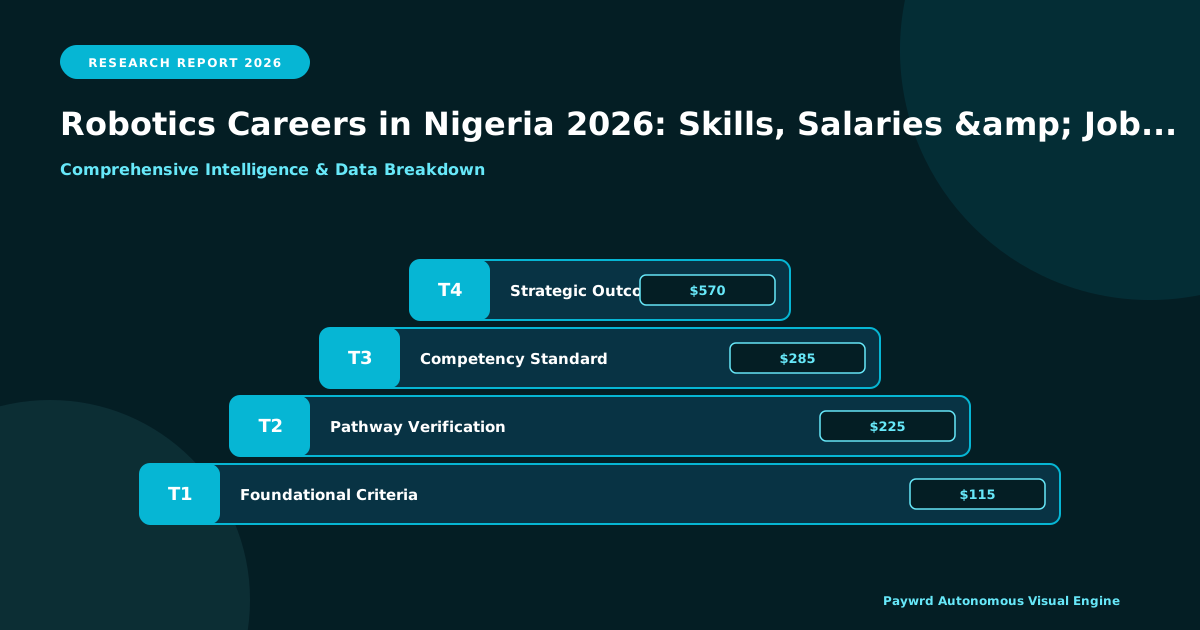
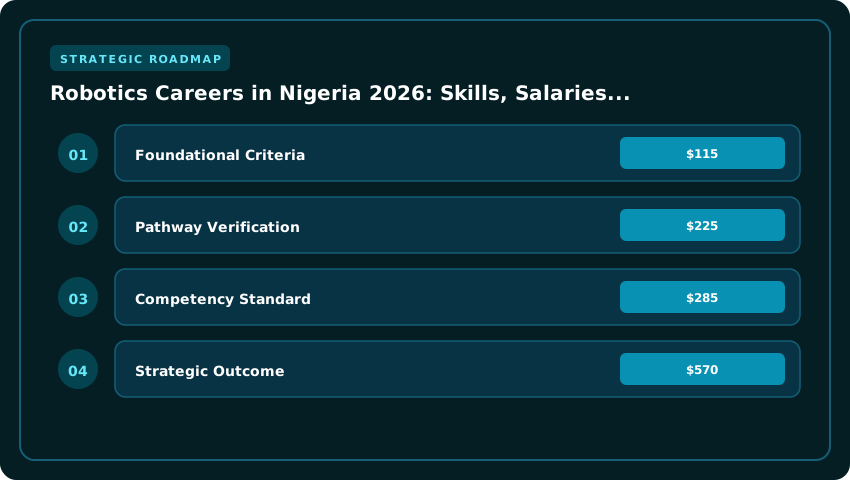
Robotics is no longer a foreign concept in Nigeria; it is a growing career reality, and understanding the realistic salary expectations for different levels of expertise is essential for students, job seekers, and career planners aiming to make informed decisions. Across Lagos, Port Harcourt, Abuja, and emerging tech corridors like Yaba and Akwa Ibom, robotics professionals are earning competitive wages, although the pay bands vary significantly depending on experience, specialization, and the industry sector. For a fresh graduate entering the field as a robotics technician or junior embedded systems developer, monthly take-home pay typically ranges from ₦180,000 to ₦350,000, which translates to roughly $115 to $225 USD at current parallel market rates. This entry-level band applies to roles such as robotics lab assistants, maintenance technicians in manufacturing plants, junior ROS (Robot Operating System) developers, and drone assembly technicians. Graduates with a strong portfolio from platforms like CcHub, MIT’s free robotics MOOCs, or hands-on projects using Arduino and Raspberry Pi often negotiate closer to the ₦350,000 ceiling, especially when placed in oil-and-gas support firms or fintech logistics startups building autonomous delivery systems.
Moving up the ladder, mid-level embedded systems engineers and robotics integrators with three to six years of experience command monthly salaries between ₦450,000 and ₦900,000 (approximately $285 to $570 USD). These professionals typically hold roles such as embedded firmware engineer, PLC and SCADA robotics programmer, computer vision specialist, or autonomous systems integrator. They are often employed by telecom giants rolling out 5G infrastructure robotics, agricultural firms deploying drone-based precision farming, or industrial automation companies serving Dangote, BUA, and Lafarge manufacturing plants. Professionals in this tier usually combine a bachelor’s degree in Electrical Engineering, Mechatronics, or Computer Science with industry certifications such as Certified Robotics Engineer (CRE) or vendor-specific credentials from Siemens, FANUC, or ABB. The upper end of this band (₦700k–₦900k) is most achievable in Lagos and Port Harcourt, where multinational exposure and project-based bonuses can significantly boost total compensation.
At the senior level, automation architects, AI-robotics specialists, and humanoid robotics lead engineers with eight or more years of experience can expect monthly earnings ranging from ₦1,200,000 to ₦2,800,000, equivalent to roughly $760 to $1,775 USD. These roles include robotics research leads, AI-driven manipulation engineers, swarm robotics project directors, and chief automation officers in oil-and-gas, agritech, and defense sectors. Senior professionals in this bracket often hold master’s or PhD credentials from institutions such as the University of Lagos, Covenant University, or international partners like Carnegie Mellon Africa, and they typically lead cross-functional teams designing robotic systems for offshore oil platforms, automated greenhouses, or warehouse fulfillment centers. Stock options, project commissions, and USD-denominated consulting fees can push total annual earnings well beyond the ₦2.8M monthly threshold, particularly for those serving diaspora clients or working with foreign-funded robotics ventures.
- Oil-and-gas robotics roles in Port Harcourt and Warri tend to pay 20–35% above the national median due to hazardous environment allowances, offshore rotation bonuses, and the technical complexity of subsea ROV (Remotely Operated Vehicle) maintenance. A senior ROV pilot or pipeline inspection robotics engineer in this sector can earn ₦2M–₦3.5M monthly, significantly higher than peers in less capital-intensive industries.
- Agritech robotics compensation, while growing rapidly, currently sits at the lower to mid-band. Drone operators, automated irrigation system engineers, and harvest robotics technicians in Ogun, Kaduna, and Benue typically earn ₦150k–₦600k monthly, reflecting the sector’s earlier funding stage and the prevalence of grant-based employment through programs like the National Agricultural Technology and Innovation Plan (NATIP).
- Manufacturing and logistics robotics roles at companies like Coca-Cola Nigeria, Nestlé, and Jumia fulfillment centers offer stable mid-tier salaries of ₦400k–₦1.1M monthly, with clear progression paths from junior technician to plant automation manager within four to six years.
- Fintech and defense robotics, though smaller in headcount, offer premium pay for AI-robotics specialists working on autonomous surveillance or blockchain-integrated robotic process automation (RPA), often reaching the ₦2M–₦2.8M senior band.
- Freelance and remote robotics consulting for diaspora clients has emerged as a high-earning niche, with experienced engineers earning $2,000–$6,000 monthly (₦3.1M–₦9.4M) by providing ROS development, simulation services, and technical writing to international firms, effectively doubling or tripling local salary equivalents.
For Nigerian students and early-career professionals, the key takeaway is that robotics salaries scale aggressively with specialization, continuous learning, and industry alignment. By targeting high-demand niches such as oil-and-gas subsea robotics, AI-driven computer vision, or humanoid systems integration, and by building verifiable portfolios through internships at CcHub, Fate Foundation programs, or NELFUND-supported STEM initiatives, ambitious individuals can realistically transition from the ₦180k entry band to ₦2M+ senior compensation within six to eight years, making robotics one of the most lucrative STEM career paths in Nigeria’s 2026 economy.
Affordable Hardware Stack: How Nigerian Students Build Humanoids on a ₦150k Budget
Robotics in Nigeria has a reputation problem: people assume you need millions of naira to even start. That assumption is wrong. Across Lagos, Nsukka, Akure, and Abeokuta, university students are constructing functional humanoid prototypes — torso frames, articulated arms, walking gaits — on shoestring budgets that would make their counterparts in Boston or London weep with envy. The secret is not magic; it is component sourcing at Alaba International Market, the deep-discount ecosystem at Computer Village in Ikeja, and a tight feedback loop between WhatsApp component swaps, the Naija Robotics Discord, and free ROS2 (Robot Operating System 2) training at CoHub Lagos.
You can realistically stand up a walking biped prototype — minimum viable humanoid — for between ₦120,000 and ₦180,000 if you know where to shop. Let us walk through the stack, piece by piece, in naira and roughly equivalent US dollars so diaspora parents, scholarship boards, and NELFUND (Nigeria Education Loan Fund) applicants can match line items against approved disbursements.
The Brain Tier: Microcontrollers Under ₦25,000. Most beginner builds start with an Arduino Uno clone or an ESP32 board. At Alaba International Market, specifically the Electronics Plaza section, you can find a CH340 Arduino Nano clone for ₦4,500–₦6,000 (about $3–$4 USD). The ESP32 DevKit V1, which gives you Wi-Fi and Bluetooth plus dual-core processing for servo coordination, runs ₦8,000–₦12,000 (around $5–$8 USD). Step up to the Raspberry Pi Pico W if you want PIO (Programmable Input/Output) flexibility for servo PWM (Pulse Width Modulation) signals; expect ₦14,000–₦18,000 (roughly $9–$12 USD). NELFUND applicants: log these as “core computing modules” under your STEM equipment allowance, not as consumables.
The Muscle Tier: Servos and Drivers. A humanoid needs at minimum 12 degrees of freedom to look humanoid; serious builds run 16–20. MG90S metal-gear servos, perfect for fingers and neck joints, sell in bulk at Computer Village for ₦2,800–₦3,500 each (about $1.80–$2.30 USD). Bigger DS3218 digital servos for hip and knee joints run ₦9,000–₦13,000 (roughly $6–$8.50 USD). Budget 12–16 servos, and you are spending ₦90,000–₦140,000 on actuators alone. Stackable PCA9685 PWM driver boards let one microcontroller command 16 servos cleanly; grab two for ₦3,500 each at Alaba.
The Frame Tier: 3D Printing and Local Fabrication. This is where Makerspace Nsukka (University of Nigeria) and the Ife Robotics Hub at Obafemi Awolowo University shine. PLA (Polylactic Acid) filament for a 1kg roll runs ₦8,000–₦12,000 (about $5–$8 USD) locally, versus ₦35,000+ imported. You need roughly 600g–800g of filament for a torso, two arms, and a head chassis, so budget ₦6,000–₦10,000 for plastic. Makerspace Nsukka publishes open-source STL and STEP files for a humanoid chassis called Oduduwa-1 on their GitHub. If you do not have printer access, the CcHub Yaba fabrication lab charges ₦2,000 per hour, and the Ibadan Tech Hub has subsidized weekends.
The Software Tier: ROS2 Without Tears. Software is free, but mentorship is gold. CoHub Lagos runs a free ROS2 Humble Hawksbill bootcamp every quarter, eight Saturdays, covering nodes, topics, services, and MoveIt 2 motion planning. The current cohort fills up within 72 hours of announcement, so join the CoHub mailing list. Supplementary free content lives on the Robot Ignite Academy community tier and the Open Robotics discourse forums.
Community and Component Swaps. Join the Naija Robotics Discord via the CoHub partner link. The #components-swap channel is where students post bulk-buy alerts (“MG996R servos, ₦6,500 each, ten left, Aba”). Component swaps cut prototyping costs by 30–50% and double as informal mentorship.
Actionable takeaway: clone the Oduduwa-1 repository, budget ₦150,000 across eight line items, and join the Naija Robotics Discord before ordering a single part. That sequence — community first, then procurement — is what separates working prototypes from expensive paperweights.
- Microcontrollers: ₦20,000–₦30,000 (Arduino Nano clone, ESP32, or Pi Pico W)
- Servos and drivers: ₦95,000–₦155,000 (12–16 servos plus two PCA9685 boards)
- Frame materials: ₦14,000–₦22,000 (PLA filament, M3 screws, bearings from Alaba)
- Power and sensors: ₦18,000–₦25,000 (3S LiPo battery, MPU6050 IMU, buck converters)
- Software and training: ₦0 (ROS2 Humble, CoHub Lagos free bootcamp, Maker Uno lessons)
- Estimated grand total: ₦147,000–₦232,000, with ₦150,000 realistic for a lean build
NELFUND Student Loans and STEM Scholarships for Aspiring Robotics Engineers
Financing a robotics education in Nigeria no longer has to rest entirely on family savings or the unpredictable goodwill of extended relatives. In 2026, three financial lifelines are reshaping how aspiring engineers fund their studies: the Nigerian Education Loan Fund (NELFUND), TETFund-backed institutional STEM scholarships, and private-sector fellowships such as the Andela Africa Engineering Fellowship and the NNPC/TotalEnergies Robotics Grant. Used together, these instruments can cover tuition, accommodation, a modest robotics toolkit, and even a six-month living stipend while you build your first prototype.
Step-by-step NELFUND 2026 application process:
- Step 1 – Confirm eligibility. You must be a Nigerian citizen, admitted to a NUC-accredited tertiary institution (university, polytechnic, or college of education), with a valid JAMB UTME or Post-UTME admission letter. Family income ceilings sit at ₦500,000 per annum for households of up to five dependants, rising to ₦750,000 for larger families.
- Step 2 – Create your profile on nelf.gov.ng. Use your BVN-linked phone number and NIN. The portal now supports instant NIN validation through the National Identity Management Commission (NIMC) API, reducing KYC delays.
- Step 3 – Upload supporting documents. Admission letter, JAMB result slip, WAEC or NECO certificate, birth certificate, and a signed guarantor form (a civil servant on Grade Level 12 and above, or a senior banker).
- Step 4 – Select your programme. Indicate whether you are enrolled in a STEM-coded course (Robotics Engineering, Mechatronics, Computer Engineering, or Artificial Intelligence). STEM applicants receive priority disbursement within 14 working days.
- Step 5 – Await disbursement. Funds are paid directly to your institution’s TSA account, while a ₦20,000 monthly upkeep allowance is sent to your verified bank account via the Nigeria Inter-Bank Settlement System (NIBSS).
Repayment rules for civil servants vs private-sector hires: NELFUND operates on a 5% flat interest rate over a maximum tenor of 10 years, with a 24-month moratorium that begins the moment you complete your National Youth Service Corps (NYSC). Civil servants enjoy automatic payroll deductions through the Integrated Payroll and Personnel Information System (IPPIS), so repayment begins quietly two months after NYSC concludes. Private-sector hires, including robotics startups at CcHub, iDT Labs, or Flutterwave’s engineering hub, must self-remit through the NELFUND mobile app or a standing bank debit order. Missing three consecutive instalments triggers a soft default status that affects your Creditcorp credit score, so automate your deductions the week you receive your first salary.
Curated list of TETFund-supported STEM scholarships and industry grants:
- TETFederal STEM Excellence Award: ₦500,000 annual bursary for undergraduate robotics and mechatronics students in federal universities. Apply through your institution’s TETFund Desk Officer, usually between February and March.
- Andela Africa Engineering Fellowship: A 12-month, fully remote programme that pays a ₦350,000 monthly stipend while you build production-grade software for partner robotics firms. Applications open twice yearly on andela.com.
- NNPC/TotalEnergies Robotics Grant: ₦1.5 million seed funding plus a six-month mentorship at the TotalEnergies Innovation Lab in Lagos. Open to 200- and 300-level undergraduates who submit a working prototype video and a 1,500-word technical brief by 30 June 2026.
- PTDF Overseas STEM Scholarship: Covers tuition and living costs for MSc and PhD programmes in robotics and AI at partner universities in the UK, Germany, and Canada, with a ₦4.8 million annual ceiling.
- Bank of Industry (BOI) Youth Innovation Fund: Interest-free loans up to ₦5 million for robotics ventures under 36 months old. Ideal for finalists converting their final-year project into a startup.
Actionable takeaway: Stack your funding. Apply to NELFUND first to cover tuition, then layer a TETFund bursary or the Andela Fellowship on top for living support. Submit your NNPC/TotalEnergies prototype video by April so feedback reaches you before the June deadline. Finally, set up a dedicated NELFUND repayment wallet the day you accept your first robotics role, whether at a Dangote Industries automation team or a Lagos-based drone-logistics startup. Disciplined repayment protects your Creditcorp score and keeps the door open for future TETFund research grants once you transition from student engineer to industry innovator.
Portfolio-Building Roadmap: From Campus Demos to First Job Offer in 18 Months
Building a career in robotics in Nigeria requires more than just passing your JAMB UTME and securing admission into a competitive engineering program. In the rapidly evolving tech ecosystem of West Africa, your portfolio is your ultimate currency. As the National Universities Commission (NUC) continues to roll out the Core Curriculum Minimum Academic Standards (CCMAS) across tertiary institutions, the emphasis has shifted decisively toward practical, industry-ready skills. To secure a lucrative role in the humanoid and automation space by 2026, you need a meticulously planned, 18-month roadmap that bridges the gap between academic theory and industry demands.
Whether you are a secondary school student targeting A1-C6 grades in your WAEC/NECO science subjects or a 200-level undergraduate looking to break into robotics, this month-by-month action timeline will guide you from your first campus demo to a tangible job offer at leading tech companies. The journey demands consistency, strategic networking, and a relentless commitment to building in public.
Months 1 to 3: Solidifying the STEM Foundation and Initial GitHub Commits
Your first quarter is about laying an unshakeable academic and technical foundation. For secondary school students, the priority is securing the required STEM credits. You must target A1 to C6 in Mathematics, Physics, and Chemistry in your WAEC/NECO examinations. These grades are non-negotiable prerequisites for admission into reputable engineering faculties. Concurrently, aim for a JAMB UTME score of 250 and above to comfortably meet the Post-UTME cutoffs for top-tier institutions like the University of Lagos (UNILAG), Covenant University, or the Federal University of Technology, Akure (FUTA).
For university students, this phase marks the beginning of your technical journey. Start by learning the fundamentals of the Robot Operating System (ROS). ROS is the industry standard for robotics software development globally, and mastery of it is highly sought after. Begin your GitHub journey by committing small, daily code snippets. Whether it is a simple Python script for a motor controller or a basic C++ program for sensor integration, consistency is key. Recruiters at Nigerian tech firms look for a green GitHub commit graph as proof of dedication.
- Academic Target: Achieve A1-C6 in WAEC/NECO Physics, Chemistry, and Mathematics.
- Admissions Target: Score 250+ in JAMB UTME to clear Post-UTME cutoffs for engineering programs.
- Technical Target: Complete a basic ROS tutorial and make at least 30 GitHub commits.
Months 4 to 6: Prototyping, Campus Demos, and ROS Certifications
With the basics under your belt, the second quarter focuses on practical application and validation. Leverage the flexibility of the NUC CCMAS framework to undertake a personal project. Build a simple autonomous robot, such as a line-following rover or an obstacle-avoiding bot, using affordable components sourced from local markets or aliexpress. Document the entire build process on GitHub, including schematics, code, and a detailed README file.
Do not keep your project hidden in your dormitory. Organize a campus demo at your faculty or university innovation hub. Invite your lecturers, peers, and members of local tech communities. Presenting your work sharpens your communication skills and builds your local network. Furthermore, use this period to pursue a formal ROS certification. Platforms like The Construct offer ROS certifications that are globally recognized. Having this on your CV gives you a distinct advantage over your peers.
- Project Milestone: Build and document a functional robotics prototype on GitHub.
- Community Milestone: Present your first project at a campus demo day.
- Certification Milestone: Enroll in and complete a recognized ROS certification program.
Months 7 to 9: Internship Hunting at Andela, Flutterwave, and Farmcrowdy
The third quarter is dedicated to transitioning from a student builder to an industry intern. Nigeria’s leading tech companies are increasingly investing in automation, IoT, and robotics. While Andela is traditionally known for software engineering, their expansion into hardware and IoT integration makes them a viable target. Flutterwave, a fintech giant, requires automation engineers to optimize internal processes and data center operations. Farmcrowdy’s automation unit, focused on agritech, is perhaps the most direct application of robotics in Nigeria, tackling challenges in precision farming
| Robotics Career Path | Training Cost (₦) | Entry Cut-off (JAMB/WAEC) | Timeline to Job-Ready | Entry Salary (₦/month) | Mid-Career ROI (5 yrs) |
|---|---|---|---|---|---|
| B.Sc. Mechatronics / Robotics Engineering (Federal Uni) | ₦45,000 – ₦120,000/yr | JAMB 220+; WAEC 5 credits incl. Maths, Physics, English | 4–5 years | ₦180,000 – ₦350,000 | High — strong placement in oil & gas, automation |
| B.Eng. Electrical/Electronics (State Uni) | ₦150,000 – ₦350,000/yr | JAMB 200+; WAEC 5 credits incl. Maths, Physics | 5 years | ₦150,000 – ₦300,000 | Medium-High — pivot to robotics via certifications |
| M.Sc. Robotics & Intelligent Systems (UNILAG, ABU) | ₦250,000 – ₦600,000/yr | Second Class Lower (2:2) minimum in relevant degree | 1.5–2 years | ₦400,000 – ₦800,000 | Very High — R&D, academia, multinational roles |
| Bootcamp / CcHub / Robotics Academy | ₦150,000 – ₦500,000 total | SSCE minimum; basic programming aptitude | 3–9 months | ₦120,000 – ₦250,000 | Medium — fast entry, freelance & startup pathways |
| Online Certifications (Coursera, ROS, Udacity) | ₦50,000 – ₦200,000 total | No formal cut-off; self-paced | 6–12 months | ₦100,000 – ₦220,000 | Medium — supplements degree, boosts employability |
| PhD Robotics (Nigeria / Split Programs) | ₦300,000 – ₦700,000/yr | M.Sc. with 3.5/5 CGPA minimum | 3–5 years | ₦600,000 – ₦1,200,000 | Exceptional — research leadership, consulting, grants |
Frequently Asked Questions
What qualifications do I need to study robotics engineering in Nigeria?
To study robotics engineering in Nigeria, you need five WAEC credits including Mathematics, Physics, and English, plus a JAMB score of 220 or above. Most federal universities offering Mechatronics or Electrical Engineering accept candidates through UTME. Postgraduate applicants require a minimum of Second Class Lower in a relevant engineering or computer science degree.
How much does a robotics engineer earn in Nigeria in 2026?
A robotics engineer in Nigeria earns between ₦180,000 and ₦350,000 monthly at entry level, depending on sector and location. Mid-career professionals with M.Sc. qualifications or ROS certifications earn ₦400,000 to ₦800,000. Senior engineers in oil, automation, or multinational R&D roles can command ₦1,200,000 or more monthly.
Which Nigerian universities offer robotics and mechatronics programs?
Top Nigerian universities offering robotics-related programs include UNILAG, ABU Zaria, FUT Minna, FUTA, and UNN, primarily through Mechatronics Engineering, Electrical Engineering, or Computer Science departments. Postgraduate robotics and intelligent systems degrees are available at UNILAG and ABU. Private hubs like CcHub Yaba complement formal training with hands-on prototyping.
Is robotics a good career choice in Nigeria for 2026?
Yes, robotics is a high-ROI career in Nigeria for 2026. Growing demand in manufacturing, agriculture, oil automation, and defense creates strong placement opportunities. Graduates with mechatronics degrees, ROS certifications, or bootcamp training benefit from expanding local startups and multinational partnerships. Career ROI is highest for postgraduate and certified professionals.
Strategic Final Takeaway
Success in evaluating Robotics Careers in Nigeria 2026: Skills, Salaries & Job Paths relies on early preparation, adherence to verified accredited requirements, and cross-referencing official portals. Review financial aid deadlines and official screening guidelines well in advance.