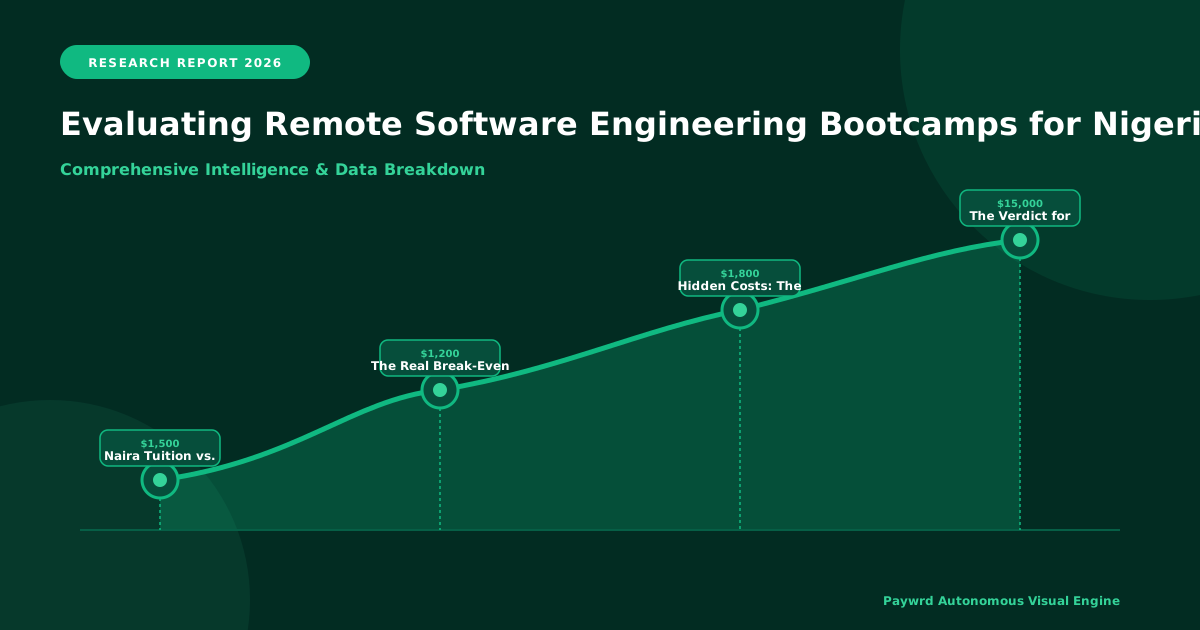
Bottom Line: A ₦1.2M bootcamp investment breaks even in 4–6 months at a $1,500/month remote junior role, but only if you factor in the ₦150k–₦250k monthly “survival tax” for power, data, and hardware that most syllabi ignore.
The 2026 ROI Analysis: Tuition Costs vs. Remote Entry-Level Salaries
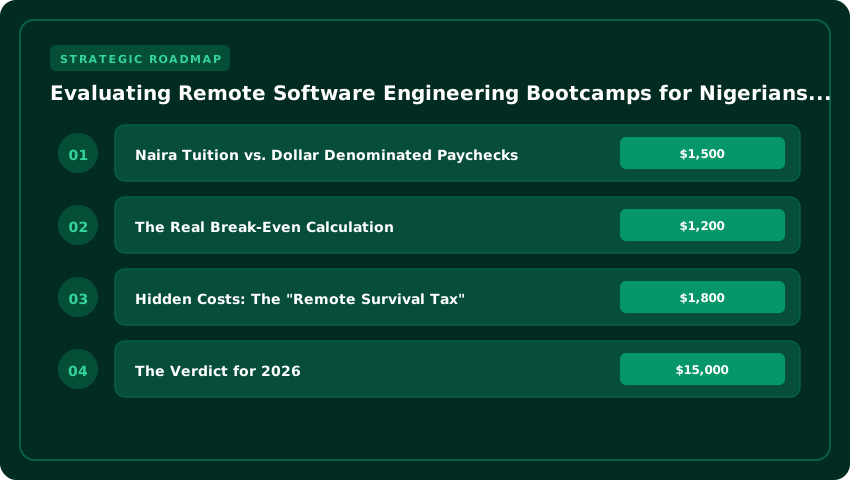
Naira Tuition vs. Dollar Denominated Paychecks
Let’s talk numbers without the fluff. In 2026, reputable remote-first bootcamps targeting Nigerians—think AltSchool Africa, Semicolon, or international players like Microverse and ALX—charge between ₦800,000 and ₦1,800,000 for a 6-to-9-month track. Meanwhile, entry-level remote offers for Nigerian developers have stabilized around $1,200–$1,800/month (₦1.8M–₦2.7M at the prevailing ~₦1,500/$ parallel market rate). On paper, the arbitrage is massive. A single month’s salary at the median $1,500 covers the average tuition. But paper doesn’t pay for diesel.
The Real Break-Even Calculation
Forget the theoretical “Month 1” break-even. In the current economy, your true break-even point shifts to Month 4 or 5. Here is the realistic ledger for a graduate landing a $1,500/month role:
- Gross Monthly Income: ~₦2,250,000
- Less “Remote Survival Tax” (Power, Data, Hardware Amortization): ~₦220,000
- Less Living Expenses (Rent, Food, Transport): ~₦400,000 (conservative Lagos/Abuja baseline)
- Net Disposable for Tuition Repayment: ~₦1,630,000
At that net rate, a ₦1.2M loan or savings depletion is cleared in 3.5 months. If you’re earning the lower band ($1,200) or supporting dependents, stretch that to 6 months. Any bootcamp promising a 30-day ROI is selling dreams, not data.
Hidden Costs: The “Remote Survival Tax”
This is where 2026 budgets bleed. Syllabi teach React and Node; they don’t budget for the Nigerian infrastructure reality.
- Power Backup: A 3.5kVA inverter + 200Ah battery bank setup costs ₦450k–₦600k upfront. Amortized over 2 years, that’s ~₦20k/month. Petrol/diesel for generator top-ups during extended grid failures adds another ₦40k–₦60k/month.
- Data Redundancy: You need primary (Fiber/Spectranet/Starlink) + backup (MTN/Airtel 5G). Budget ₦35k–₦55k/month for truly unbroken uptime—clients fire you for “network issues” twice.
- Hardware Lifecycle: A decent M2 MacBook Air or high-spec Linux laptop (₦1.1M–₦1.4M) lasts ~3 years. That’s a hidden ₦30k–₦40k monthly depreciation cost nobody mentions during onboarding.
The Verdict for 2026
The ROI is real and aggressive—300%+ annual return on tuition is standard for successful grads—but the cash flow gap is dangerous. Do not enroll unless you have 6 months of “Survival Tax” capital (≈₦1.3M) ring-fenced separate from tuition. If you have to choose between buying the inverter and paying the bootcamp, buy the inverter. You can learn GitHub for free; you cannot code in the dark.
Navigating the Shift from Traditional Degrees to AI-Integrated Certifications
The friction between a four-year Computer Science degree from a Nigerian university and a six-month remote bootcamp has never been sharper than it is in 2026. For years, the B.Sc. was the non-negotiable gatekeeper for corporate graduate trainee programmes at banks and telcos. Today, hiring managers at fintechs like Flutterwave, Paystack, and international remote-first companies are optimizing for time-to-productivity, not just transcript grades. The National Universities Commission (NUC) knows this; the Core Curriculum Minimum Academic Standards (CCMAS) rolled out in 2026 mandated 30% local content and industry relevance, but curriculum committees move at academic speed. By the time a senate approves a “Generative AI for Developers” elective, the model architecture has already shifted twice.
Where CCMAS Falls Short for Remote Engineering
CCMAS requires courses like Software Engineering Principles and Data Structures—foundational, yes, but often taught in Java or C++ with limited exposure to the modern TypeScript/React/Node stack that dominates remote job boards. A 2026 graduate from a federal university might capstone a library management system in PHP, while a bootcamp peer ships a production-ready SaaS dashboard with CI/CD pipelines, authentication, and AI-assisted code review on GitHub Copilot. The NUC mandate for “Entrepreneurship Studies” (GST 302) is well-intentioned, but it rarely simulates the reality of invoicing a US client in USD, handling timezone async standups, or debugging a Vercel deployment at 2 AM.
AI Coding Assistants Compress the Junior Ramp
This is where the calculus flips. Large Language Models (LLMs) have collapsed the “syntax tax” that used to punish juniors. A bootcamp graduate using Cursor or GitHub Copilot in 2026 writes boilerplate, writes tests, and refactors legacy code at 3x the speed of a 2026 junior. Employers know this. When a hiring manager sees “ALX Software Engineering 2026” or “AltSchool Africa Cloud Engineering” on a CV, they assume fluency with AI-assisted workflows—prompt engineering, context window management, hallucination detection. That assumption is often safer than assuming a 4-year grad has touched an LLM outside of a plagiarism checker. The “survival tax” of ₦150k–₦250k monthly for power and data buys you the uptime to practice these tools daily; the university ASUU strike calendar buys you uncertainty.
Credential vs. Competence: The 2026 Trade-off
- Immigration & NYSC: A B.Sc. remains mandatory for NYSC mobilization and most foreign skilled-worker visa points (UK Tech Nation, Canada Express Entry). Bootcamps cannot replace this yet.
- Depth vs. Breadth: Degrees win on systems theory—compilers, OS kernels, distributed systems proofs. Bootcamps win on shipping features. If you want to build the next database engine, stay in school. If you want to integrate Supabase into a Next.js app for a US startup next quarter, the bootcamp ROI is mathematically superior.
- Signaling: Top-tier bootcamps (Semicolon, Decagon, Microverse) now run income-share agreements (ISAs) or deferred tuition aligned with your $1,500/month offer letter. Universities charge ₦200k–₦600k/session regardless of outcome.
The smart 2026 play isn’t binary. The highest-leverage Nigerians I see are doing both: using NELFUND loans for the degree (visa/NYSC insurance) while stacking a remote bootcamp during long vacations or ASUU strikes. You graduate with the paper and the GitHub graph. That is the only credential the global market respects without an asterisk.
Funding Your Transition: NELFUND and Global Scholarship Pathways
The math from the previous section is brutal but honest: a ₦1.5M bootcamp plus a ₦200k monthly “survival tax” demands serious capital before your first dollar invoice lands. For most Nigerians, self-funding isn’t an option. The good news? The 2026 funding landscape has shifted materially in your favor—if you know exactly which doors to knock on and which traps to avoid.
Unlocking NELFUND for Vocational Tech Training
The Nigerian Education Loan Fund (NELFUND) is no longer just for university degrees. Following the 2026 Act amendments and the 2026 implementation guidelines, the fund explicitly covers accredited vocational and skills acquisition programs. This is your most interest-free leverage point. To qualify, the bootcamp must be listed on the NUC’s CCMAS-approved vocational register or hold a valid NBTE accreditation code. Programs like AltSchool Africa (via their diploma track) and Semicolon’s certified courses often meet this threshold; pure “certificate-only” international bootcamps usually do not.
Action plan: Log into the NELFUND portal with your NIN and BVN. Search the “Institution Search” tool for your specific bootcamp name. If it appears, apply for the Institutional Fee Loan (capped at tuition) and the Upkeep Loan (currently ₦20,000–₦30,000/month paid directly to your account). This upkeep stipend alone covers 15–20% of that “survival tax” for power and data. Repayment only kicks in two years post-completion or upon securing employment earning above ₦30,000/month—effectively a grace period that aligns with your job hunt.
The ISA Trap: Read the Naira Clause
Income Share Agreements (ISAs) are marketed heavily by global players like Microverse and BloomTech as “pay nothing until you’re hired.” For a Nigerian in 2026, the devil is in the currency conversion clause. Most ISAs define the repayment cap in USD (e.g., $15,000–$25,000) but calculate the monthly deduction as a percentage of your gross dollar income.
- Currency Risk: If you sign an ISA at ₦1,600/$ and the rate hits ₦2,000/$ during repayment, your effective Naira burden skyrockets while your local living costs inflate.
- Tax Gross-Up: Nigerian employers deduct PAYE before you see the cash. An ISA taking 15% of gross $1,500/month ($225) hurts far more when your net Naira paycheck has already been hit by tax, pension, and the parallel market spread.
- Jurisdiction: Dispute resolution is often set in Delaware or UK courts. Enforcing consumer protection via FCCPC (Federal Competition and Consumer Protection Commission) against a foreign entity is practically impossible.
Verdict: Only take an ISA if the cap is denominated in Naira or pegged to the CBN official rate at signing. Otherwise, a NELFUND loan (zero interest, Naira-denominated, local jurisdiction) is mathematically superior.
2026 Global Grants Targeting West African Developers
Free money exists, but the application windows are tight and the eligibility is specific. Prioritize these three for the 2026/2027 cycle:
- Google Africa Developer Scholarship (GADS) 2026: Opens Q2 2026 (typically May). Covers full tuition for Android, Cloud, or Mobile Web tracks at partner bootcamps (often Pluralsight/Andela aligned). Requires a valid GitHub profile and 10+ hours/week commitment. No age limit.
- Mastercard Foundation Scholars Program (Tech Stream): Partnered with ALX, Moringa School, and Knack. Covers tuition + stipend + laptop + data bundle. Targets ages 18–35. Application cycles run Jan–March and Aug–Oct annually. Check the Mastercard Foundation portal for the specific “Digital Economy” partner list.
- GitHub Global Campus / Major League Hacking (MLH) Fellowships: Not a bootcamp payer, but offers $500–$3,000 stipends for open-source contributions during your training. Stack this on top of NELFUND to kill the survival tax. Requires active student status (use your NELFUND admission letter).
Bottom line: Stack NELFUND (tuition + upkeep) + a Targeted Grant (laptop/data) + Part-time Remote Internship (survival cash). That is the 2026 Nigerian playbook for a zero-debt, high-ROI transition.
The ‘Remote-Ready’ Filter: What Employers Actually Demand in 2026
Finishing a bootcamp syllabus is the baseline. Getting hired remotely in 2026 requires a completely different evidence trail. Hiring managers at US and EU startups are not scrolling through your PDF certificate; they are auditing your public activity to answer one question: Can this developer ship code unsupervised across six time zones?
Beyond the Certificate: Building a GitHub Portfolio That Proves Remote Autonomy
Your GitHub profile is your new CV. In 2026, a “green graph” (contribution streak) matters less than the quality of the signal in your pinned repositories. Employers are filtering for three specific artifacts:
- Production-grade READMEs: Documentation that explains architecture decisions, setup instructions for a fresh environment, and API contracts. If a reviewer has to guess how to run your capstone project, you have failed the remote autonomy test.
- CI/CD pipelines attached to every repo: GitHub Actions or GitLab CI configurations running linting, type-checking (TypeScript/Pyright), and unit tests on every push. This proves you understand the “merge and deploy” rhythm without a DevOps engineer holding your hand.
- Meaningful commit history: Atomic commits with conventional messages (
feat:,fix:,refactor:) rather than a single “final commit” dump. It signals you know how to collaborate asynchronously via Pull Requests.
Pro tip: Contribute to an active open-source project used by the bootcamp’s hiring partners. A merged PR in a real codebase carries 10x the weight of a polished tutorial clone.
Essential Soft Skills for West Africans Working in US/EU Time Zones
The “survival tax” we discussed (₦150k–₦250k monthly for power/data) buys you infrastructure, but it doesn’t buy you cultural fluency. The friction point for Nigerian engineers isn’t usually syntax—it is asynchronous communication hygiene.
- Over-communication is the protocol: In Lagos, you tap a colleague on the shoulder. In a distributed team, you write a Loom video or a detailed Slack update before you go offline. Document your blockers, your “definition of done,” and your next steps explicitly.
- Time-zone negotiation, not just overlap: Don’t just promise “4 hours overlap.” Propose a core collaboration window (e.g., 1:00 PM – 5:00 PM WAT / 8:00 AM – 12:00 PM EST) and protect it religiously. Use the remaining hours for deep work, not meetings.
- Power/Internet redundancy as a professional SLA: Employers in 2026 expect a backup plan (solar + inverter, Starlink/spectranet backup, co-working membership). Frame this in your interview: “My primary setup is X, my failover is Y, and I have never missed a stand-up due to infrastructure.”
The Impact of AI-Driven Technical Screenings on Entry-Level Hiring
This is the silent filter eliminating 80% of bootcamp grads before a human sees their resume. Platforms like CodeSignal, HackerRank, and Karat now deploy LLMs to evaluate not just correctness, but code quality, security awareness, and explainability in real-time.
- LeetCode grinding is obsolete: AI graders penalize “clever” one-liners that lack readability. They reward clean architecture, variable naming, and edge-case handling—the exact skills used in daily ticket work.
- The “Explain Your Solution” phase is weighted heavily: You will likely face a voice/AI interviewer asking you to refactor your own code on the spot or defend a trade-off. If you memorized the pattern but don’t understand the Big-O implications, you fail.
- AI-assisted coding evaluation: Some 2026 screenings explicitly allow Copilot/Cursor but grade your prompting strategy and your ability to verify hallucinated logic. Bootcamps teaching “vibe coding” without verification drills are setting you up for rejection.
The bottom line: The bootcamp gets you the interview. Your GitHub hygiene, async discipline, and AI-era problem-solving get you the offer letter.
Red Flags: Spotting Low-Value Programs in the 2026 Tech Landscape
The Nigerian remote tech pipeline is flooded with programs selling the “japa via code” dream, but the gap between marketing decks and hiring reality has widened dangerously in 2026. With entry-level remote roles now demanding AI fluency as a baseline, not a bonus, spotting a low-value bootcamp isn’t just about saving money—it’s about protecting your career trajectory before it starts.
The “Guaranteed Placement” Diploma Mills
Any program promising a “guaranteed remote job” or “100% placement rate” in 2026 is statistically lying to you. The global junior market has contracted; US and EU companies are freezing headcount or hiring seniors who can drive AI toolchains. Legitimate Nigerian-aligned players like AltSchool Africa, Semicolon, or ALX publish verified outcome reports—often showing 60–75% placement within 6–12 months—not instant guarantees. If a syllabus spends more weeks on “soft skills” and LinkedIn optimization than on RAG pipelines, vector databases, or agentic framework orchestration (LangGraph, CrewAI, AutoGen), they are preparing you for a 2026 job market. Check their hiring partners: if the list consists of obscure local dev shops paying ₦150k/month rather than international startups paying $1,500+/month, walk away.
Curricula Stuck in the Pre-LLM Era
In 2026, a “Full Stack” curriculum that treats GitHub Copilot, Cursor, or Claude Dev as optional electives is obsolete. You need to see Agentic Workflow integration baked into the capstone projects. Are you building a standard CRUD app, or are you deploying a multi-agent system that automates code review, writes tests, and handles deployment via GitHub Actions? If the stack stops at React/Node or Django/Postgres without mandatory modules on LLM Ops (LangSmith, Helicone), Prompt Engineering patterns, and Function Calling/Tool Use, the program is selling you a depreciating asset. Ask for the Week 12–16 syllabus explicitly; if “AI Engineering” is a standalone elective rather than the substrate of the final project, the curriculum is low-value.
Mentorship: Local Context vs. Global Standards
This is the silent killer of ROI. Many affordable Nigerian bootcamps (₦600k–₦900k) staff mentorship entirely with recent graduates—often alumni just 3–6 months ahead of you. They understand the NEPA/data struggle intimately, which has value, but they likely lack experience shipping code to production environments serving 100k+ users in Western timezones. Conversely, high-ticket global programs (Microverse, $15k+ ISA models) offer senior engineers from FAANG/Unicorns as mentors, but they often ignore the Nigerian infrastructure reality—expecting you to run heavy Docker containers on 10Mbps MTN 4G. The sweet spot in 2026 is a hybrid model: Global Technical Leads defining architecture and code review standards, paired with Local Technical Assistants (TAs) who debug environment issues, manage power-bank schedules, and translate timezone friction. Ask for the mentor-to-student ratio and the current employer of the Lead Mentor. If they can’t name a Senior Engineer at a Series B+ company actively writing code this quarter, the mentorship signal is weak.
- Verify Outcomes: Demand a CIRR-style (Council on Integrity in Results Reporting) audit or a Notion dashboard of 2026/2027 graduate LinkedIn profiles.
- Audit the Stack: Search the curriculum PDF for “RAG,” “Agents,” “Evals,” “Observability.” Zero hits = hard pass.
- Stress Test Mentorship: Request a 15-min call with a current mentor before paying. Ask: “How do you handle rate-limiting OpenAI APIs on a Nigerian ISP?” The answer reveals everything.
Final Verdict: Decision Matrix for the Aspiring Nigerian Developer
Let’s cut through the noise. You don’t need another generic “it depends” answer. You need a framework that maps to your bank account, your calendar, and the reality of the Nigerian tech ecosystem in 2026. Here is your decision matrix.
The “Buy vs. Build” Threshold: Remote Bootcamp vs. Self-Taught
Choose a Remote Bootcamp (AltSchool, Semicolon, Microverse, ALX) IF:
- You have ₦800k–₦1.8M accessible (or NELFUND eligibility verified) without selling a kidney.
- You lack structured accountability. If you’ve started “JavaScript 101” on freeCodeCamp three times since 2026 and never finished Module 2, you are paying for the cohort pressure and the career services, not the curriculum.
- You need the alumni network signal. In 2026, Nigerian hiring managers at Flutterwave, Paystack, and remote-first global agencies still filter for “AltSchool Graduate” or “Semicolon Fellow” as a proxy for baseline competency. That brand equity shortens your job hunt by 6–8 weeks.
Go Self-Taught (The “Indie” Route) IF:
- You have zero capital but possess high agency and a working laptop + stable power setup (solar/inverter is non-negotiable).
- You can build three production-grade portfolio projects (not todo apps) in public on GitHub within 6 months.
- You are already employed or in university and need asynchronous flexibility that no live cohort provides.
Time-Commitment Audit: The “Survival Tax” Reality Check
Most syllabi lie about hours. A “part-time” 20-hour/week bootcamp in Lagos reality is 30+ hours once you factor in NEPA debugging, MTN/Airtel data roulette, and the mental load of context-switching from a 9–5 or UNILAG lectures.
- Full-Time Worker (₦300k–₦600k/month salary): Do not quit for a bootcamp unless you have 6 months of runway (₦1.5M+ savings). Do a self-paced curriculum (Odin Project, Scrimba) nights/weekends. Target 12–18 months to job-ready.
- NYSC Corper / Final Year Student: This is your golden window. You have stipend (₦33k federal + state allowance) and relative schedule control. Enroll in a full-time immersive (3–6 months). The opportunity cost is near zero.
- Unemployed Graduate: If you can secure a guarantor for NELFUND or a family loan, a full-time bootcamp is a calculated bet. Treat it as a 9–5 job: show up at 8 AM, leave at 5 PM, zero distractions.
The 2027 Outlook: Future-Proofing Against AI Automation
By 2027, “Junior React Developer” is a commoditized target. GitHub Copilot Workspace and Devin-style agents are shipping production code. Your bootcamp certificate proves you know syntax; your portfolio must prove you architect systems.
- Pivot Curriculum Focus: If the 2026 syllabus doesn’t include RAG (Retrieval-Augmented Generation) implementation, Vector DBs (Pinecone/Weaviate), and Agentic Workflows (LangGraph/CrewAI), it is already legacy. Demand this or supplement immediately.
- Specialize Early: “Full Stack Generalist” is the danger zone. Pick a hard constraint: Fintech Backend (Rust/Go compliance), DevOps/Platform Engineering (K8s, Terraform), or AI/ML Engineering (PyTorch, MLOps). Nigerian banks and global remotes pay premiums for depth, not breadth.
- Human-in-the-Loop Skills: Technical writing, stakeholder communication, and debugging business logic (not syntax errors) are your moat. AI writes code; you define the “why” and catch the hallucinations.
Bottom Line: If you have the capital and the 6-month runway → Bootcamp (Yes). If you are broke but disciplined with power/internet → Self-Taught (Yes). If you are broke, undisciplined, and hoping a certificate is a magic wand → Hard No. Save the money; buy solar batteries instead.
| Bootcamp | 2026/2027 Tuition (₦) | Duration | Payment Model | Core Stack Focus | Job Placement Support | Next Cohort Window |
|---|---|---|---|---|---|---|
| AltSchool Africa | ₦1,200,000 – ₦1,500,000 | 9 Months | Income Share Agreement (ISA) or Upfront | Full Stack (Node/React), Cloud, Data | Career services, Hiring partner network | Q1 2026 / Q3 2026 |
| Semicolon Africa | ₦1,500,000 – ₦1,800,000 | 6 Months Intensive | Upfront / Installments | Software Engineering, Product Design | Strong local employer pipeline, Demo Day | Feb 2026 / Aug 2026 |
| Microverse | $0 Upfront (ISA ~$15k cap) | 7 Months + Job Search | Deferred Tuition (ISA) | Full Stack (Rails/React), Algorithms | Global remote job board, Visa guidance | Monthly Rolling Intakes 2026 |
| ALX Africa | ₦0 (Sponsored) / ₦800,000 Self-pay | 6 – 12 Months | Scholarship / Self-pay | Cloud DevOps, Full Stack, Data Science | ROAFRICA job board, Career readiness | Quarterly Cycles 2026/2027 |
| Decagon | ₦1,700,000 (ISA Available) | 6 Months | ISA / Upfront Discount | Full Stack (Java/React), Systems Design | Guaranteed interview partners, Stipend | March 2026 / Sept 2026 |
Frequently Asked Questions
What is the true cost of a remote software engineering bootcamp for Nigerians in 2026 including survival expenses?
In 2026, tuition ranges ₦800,000–₦1,800,000, but you must budget an additional ₦150,000–₦250,000 monthly for power, data, and hardware maintenance. This 'survival tax' adds ₦900,000–₦1,500,000 over a 6-month program, pushing total investment to ₦1.7M–₦3.3M before earning.
How long does it take to break even on a ₦1.2M bootcamp investment with a remote junior developer salary in 2026?
At a median $1,500/month (₦2.25M at ₦1,500/$), net monthly income after the ₦200k survival tax is ~₦2.05M. A ₦1.2M tuition investment breaks even in 3–4 months. Including full living costs, full ROI recovery typically occurs within 4–6 months for 2026 graduates.
Which 2026 bootcamps offer Income Share Agreements (ISA) for Nigerians to defer tuition until employment?
Microverse leads with a $0 upfront ISA capped at ~$15k. AltSchool Africa and Decagon offer ISA options for 2026 cohorts, allowing payment as a percentage of salary post-employment. ALX provides sponsored slots (₦0 tuition) via partner funding, removing upfront cost risk entirely.
What entry-level remote salary can a Nigerian bootcamp graduate expect in 2026?
2026 entry-level remote offers for Nigerian developers have stabilized at $1,200–$1,800/month. At the parallel market rate of ~₦1,500/$, this equals ₦1.8M–₦2.7M monthly. Specialized stacks like Cloud/DevOps or AI integration often command the upper $1,600–$1,800 bracket immediately.
What hardware and internet specs are mandatory for Nigerian students in 2026 remote bootcamps?
2026 curricula require a minimum 16GB RAM laptop (Apple M-series or Intel i7/AMD Ryzen 7), 512GB SSD, and a reliable 20Mbps backup internet connection (e.g., Starlink or Spectranet). Budget ₦600k–₦1.2M for hardware and ₦30k–₦50k monthly for redundant data to avoid missing live coding sessions.
Strategic Final Takeaway
When evaluating Is An Online Remote Software Engineering Jobs Entry Level Program Worth The Cost And Time in 2026 and beyond, base your decisions on accredited institutional standards, verified return on investment (ROI), and up-to-date official guidelines. Always verify specific dates and requirements through official regulatory portals.