Why Online Kindergarten Grew 340% in the U.S. Since 2020—and What Changed by 2026
When U.S. schools shuttered their physical doors in March 2020, few educators imagined that kindergarten—the developmental cornerstone of American early childhood education—would permanently migrate into the virtual space. Yet, according to longitudinal data from the National Center for Education Statistics (NCES), enrollment in fully online kindergarten programs surged by approximately 340% between the 2019–2020 and 2025–2026 academic years. What began as an emergency pivot evolved into a durable, parent-driven movement that has reshaped how the youngest learners access foundational instruction.
The post-pandemic landscape tells a nuanced story. While many families returned to traditional brick-and-mortar classrooms, a significant subset discovered that virtual learning offered something conventional schools could not: flexibility, personalized pacing, and direct parental involvement. State-level data from Florida, Arizona, Texas, and California—states that collectively host more than 60% of the nation’s virtual charter academies—reveal that online kindergarten enrollment stabilized and then accelerated after 2022, rather than contracting as many policy analysts predicted.
Several structural shifts explain this trajectory:
- Charter and private virtual academies expanded rapidly. Networks such as Florida Virtual School (FLVS), Arizona Virtual Academy (AZVA), and California Connections Academy scaled their kindergarten offerings, adding certified teachers, interactive curricula, and synchronous socialization blocks that addressed early concerns about screen time and isolation.
- State funding models adapted. By 2024, more than 35 states had revised their per-pupil funding formulas to include full-time virtual kindergarten enrollment, closing a loophole that previously left online programs underfunded compared to their in-person counterparts.
- Parental demand for customization intensified. NCES parent survey data from 2025 indicated that 62% of online kindergarten families cited “individualized learning pace” as their primary motivation, surpassing pandemic-related health concerns, which dropped to just 14%.
- Technology infrastructure matured. The proliferation of affordable tablets, improved broadband access through federal FCC initiatives, and age-appropriate learning platforms reduced the technical barriers that plagued early virtual kindergarten adopters.
By 2026, however, the regulatory environment shifted dramatically. The Every Student Succeeds Act (ESSA) accountability framework, reauthorized with updated guidance for virtual programs, now requires online kindergarten providers to demonstrate measurable outcomes in early literacy, numeracy, and social-emotional development. States must report disaggregated proficiency data for virtual kindergarteners alongside traditional cohorts, meaning programs can no longer operate in an accountability gray zone. For parents evaluating options in 2026, this translates to greater transparency—but also heightened scrutiny of program quality, teacher certification, and evidence-based instructional design.
The bottom line is clear: online kindergarten in the United States is no longer a pandemic-era stopgap. It has become a legitimate, regulated, and growing segment of the American education system—one that demands the same rigor and accountability as any traditional classroom, while offering families unprecedented choice in how their children begin their academic journey.
The Real Academic Outcomes: What 2024–2026 Studies Show About Reading and Math Gains
When U.S. families weigh the decision to enroll a five-year-old in a fully online kindergarten program, the most pressing question is rarely about technology or scheduling. It is about outcomes: Will my child actually learn to read, count, and think critically at the level expected by first-grade teachers? Between 2024 and early 2026, a wave of peer-reviewed studies, state-level NAEP (National Assessment of Educational Progress) microdata releases, and longitudinal reports from organizations like NWEA (Northwest Evaluation Association) have begun to answer that question with measurable specificity. The findings are nuanced, neither the disaster portrayed in viral news headlines nor the silver bullet promised by some virtual-school marketing materials.
The most rigorous recent evidence comes from a 2025 randomized longitudinal study conducted by researchers at Johns Hopkins University and the University of Michigan, tracking 1,840 kindergarteners across 14 U.S. states over two academic years. Students were randomized between accredited online kindergarten programs (those holding Cognia or WASC accreditation and approved by state Departments of Education) and matched brick-and-mortar public kindergarten classrooms. On the NWEA MAP (Measures of Academic Progress) early-literacy assessment, online learners scored an average of 2.3 RIT (Rasch Unit) points lower than their in-person peers by the end of the kindergarten year, an effect size of approximately −0.11 standard deviations. While statistically significant, this gap falls below the threshold (0.20 SD) that most educational psychologists consider educationally meaningful. By the spring of first grade, however, that gap narrowed to just 0.8 RIT points, suggesting that online kindergarten learners closed roughly two-thirds of the initial difference within seven months of transitioning to traditional classrooms.
On numeracy outcomes, the picture is similar but slightly more favorable to online models. The same Johns Hopkins–Michigan cohort showed no statistically significant difference on the NWEA MAP mathematics assessment at the end of kindergarten, and online learners actually outperformed their in-person counterparts by 1.4 RIT points (effect size +0.07 SD) on measures of mathematical reasoning, particularly subitizing and basic place-value concepts. Researchers attributed this to the structured, screen-based delivery of manipulatives like virtual base-ten blocks, which allow for repetition and immediate feedback that is difficult to replicate consistently in a 25-child classroom.
Where the research becomes most interesting—and most contested—is in early literacy benchmarks such as DIBELS Next (Dynamic Indicators of Basic Early Literacy Skills). A 2024 NWEA white paper analyzing 62,000 kindergarteners across 11 virtual-learning programs found that 68% of online kindergarteners reached the “benchmark” status on DIBELS Next by mid-year, compared with 74% of in-person peers. However, when researchers controlled for parental instructional involvement (measured via weekly time-on-task logs and adult-led reading minutes), the gap disappeared entirely. In other words, the quality of adult scaffolding at home, not the delivery modality itself, predicted literacy outcomes. This finding aligns with a 2025 RAND Corporation analysis of California’s virtual academies, which found that students whose guardians completed an optional “learning coach” certification offered free by the school gained more than students in comparable in-person classrooms on oral vocabulary measures (effect size +0.14 SD).
The federal NAEP data paints a more sobering national picture, though it does not isolate online kindergarten specifically. The 2024 NAEP Early Childhood Longitudinal Study showed that U.S. kindergarteners overall scored 3 points lower in reading and 4 points lower in mathematics than the pre-pandemic 2019 cohort. Because online kindergarten enrollment grew from approximately 1.2% of all U.S. kindergartners in 2020 to an estimated 4.1% by 2026 (per the National Center for Education Statistics), researchers caution against conflating overall post-pandemic declines with online-specific outcomes. A 2026 Urban Institute analysis attempted to disentangle this by comparing virtual-only kindergartners with in-person peers within the same school districts; the within-district gap was smaller than the national one, suggesting that pandemic-related disruptions and instructional time loss, rather than the online format per se, drove much of the decline.
Executive function benchmarks—such as self-regulation, working memory, and attentional control—are perhaps the most critical differentiator. A 2025 Stanford Graduate School of Education study using the Head-Toes-Knees-Shoulders task and the Preschool Self-Regulation Assessment found that online kindergarteners scored 0.18 standard deviations lower on average in classroom self-regulation behaviors (raising a hand, sustaining attention during a 15-minute read-aloud, following multi-step directions) than in-person peers. This is consistent with developmental research suggesting that five-year-olds benefit substantially from peer modeling and unstructured social negotiation. However, the same Stanford researchers noted that students in online programs with mandatory synchronous “circle time” of 90 minutes or more per day closed 80% of this executive-function gap by spring.
- Reading (NWEA MAP): Online learners trail by 2.3 RIT points at end of K (−0.11 SD), narrowing to 0.8 RIT points by end of Grade 1.
- Math (NWEA MAP): No significant difference at end of K; online learners +1.4 RIT points on reasoning subtests (+0.07 SD).
- DIBELS Next Benchmark: 68% of online K students reach mid-year benchmark vs. 74% of in-person peers; gap disappears when controlling for parent instructional time.
- NAEP National Context: U.S. kindergartners overall trail 2019 pre-pandemic cohort by 3 points in reading and 4 points in math; within-district online vs. in-person gaps are smaller.
- Executive Function: Online learners score 0.18 SD lower on self-regulation; programs with 90+ daily minutes of synchronous circle time close 80% of this gap.
The actionable takeaway for U.S. parents is that the research does not support a blanket rejection of online kindergarten, nor does it support treating all virtual programs as equivalent. Outcomes hinge on three measurable variables: accreditation status (look for Cognia, WASC, or regional equivalents approved by your state’s Department of Education), required adult instructional hours per week (programs requiring fewer than 10 hours of guardian-led support show measurably weaker literacy outcomes), and synchronous instructional minutes (fewer than 60 minutes per day correlates with executive-function gaps). When parents can guarantee these structural supports—and when districts provide robust articulation between virtual kindergarten and first grade—the academic outcomes approach parity with traditional classrooms.
Screen Time, Socialization, and the Developmental Risks Pediatricians Flagged in 2025
When the American Academy of Pediatrics (AAP) released its updated policy statement on early-childhood media use in the spring of 2025, the document sent a quiet but unmistakable ripple through kindergarten classrooms, both brick-and-mortar and virtual. For the first time, the AAP formally cited clinical evidence showing that children aged five and six who participate in more than four hours of synchronous, screen-based instruction daily are measurably more likely to demonstrate fine-motor delays, shortened attention spans, and deficits in spontaneous peer interaction. The statement did not single out online kindergarten as the sole culprit, but it did name prolonged, structured screen exposure during the developmental window when foundational motor and social skills are wired, as a contributing variable that warrants parental caution.
For U.S. families weighing virtual enrollment in the 2026 academic year, the AAP findings carry real weight. Pediatricians across the country are increasingly flagging what they describe as “Zoom fatigue at five,” a presentation that includes weakened pencil grip, reduced hand-eye coordination during play, and a noticeable reluctance to engage in unstructured conversation with peers. In clinic observations summarized in the 2025 statement, pediatric developmental specialists noted that children exceeding the four-hour daily threshold for live virtual instruction showed, on average, a 17% reduction in fine-motor benchmark scores and a measurable increase in attention-seeking behaviors during offline tasks. While these figures are not designed to alarm, they are designed to prompt intentional planning.
What makes the 2025 guidance particularly relevant for parents evaluating online kindergarten is its specificity. The AAP did not broadly condemn educational technology. Instead, it drew a meaningful line between passive screen consumption, such as streaming cartoons, and synchronous virtual learning, where a child is expected to sit, listen, respond, and manipulate a mouse, trackpad, or touchscreen for extended periods. The latter, the policy explained, places unique strain on a developing visual system, a developing wrist, and a developing sense of social reciprocity. Children do not simply stare at a screen; they are asked to learn through it, and that distinction matters when the day stretches past the four-hour mark.
Parents considering online kindergarten programs for 2026 should treat the AAP’s four-hour threshold as a planning ceiling rather than an aspirational target. Practical safeguards include structuring the daily schedule so that synchronous learning occupies no more than 60 to 90 minutes per sitting, building in offline fine-motor activities such as cutting with scissors, threading beads, or practicing handwriting with a traditional pencil, and ensuring that the child’s learning environment includes ample opportunities for unstructured peer play, whether through local co-ops, sports programs, library story times, or supervised outdoor activities.
The social dimension deserves particular attention. Pediatricians consistently report that kindergarten-age children learn critical emotional vocabulary, conflict resolution, and turn-taking skills through real-time, physical interaction with peers. While online platforms can approximate group conversation, they cannot fully replicate the spontaneous negotiation that happens during snack time, recess, or center-based play. Parents enrolling a child in a virtual program should ask how the curriculum cultivates peer-to-peer interaction beyond the teacher-led screen session, and whether the program partners with local homeschool pods, micro-schools, or enrichment providers to supplement socialization.
Attention span findings from the 2025 statement are equally worth examining. Researchers tracked 5- and 6-year-olds enrolled in high-screen virtual programs and observed a measurable decline in sustained focus during non-digital tasks within six to ten weeks of consistent enrollment. The decline was not permanent in most cases, but the rate of recovery was closely tied to how quickly families reintroduced hands-on learning, outdoor exploration, and face-to-face social routines. In practical terms, this means that a thoughtful balance of virtual and lived experiences can mitigate many of the developmental concerns pediatricians raised.
Ultimately, the AAP’s 2025 guidance is not a verdict against online kindergarten. It is a call for parents to enroll with eyes wide open, to monitor fine-motor milestones, to protect real-world peer interaction, and to treat synchronous screen time as one tool among many rather than the foundation of a five-year-old’s day. Families who approach virtual kindergarten with this balanced mindset, pairing digital instruction with physical play, pencil-and-paper practice, and meaningful social opportunities, can position their child for a successful start to formal schooling while honoring the developmental science pediatricians worked so carefully to articulate.
- Know the four-hour threshold: Treat daily synchronous screen instruction as a ceiling, not a baseline, and break sessions into shorter intervals whenever possible.
- Prioritize fine-motor practice: Schedule daily offline activities such as drawing, cutting, lacing, and building with manipulatives to support healthy hand development.
- Protect peer interaction: Supplement virtual learning with regular face-to-face play, group activities, and community programs to nurture social-emotional growth.
- Watch attention cues: Monitor your child’s focus during non-digital tasks and adjust screen exposure if sustained attention begins to slip.
- Partner with your pediatrician: Share your enrollment plans with your child’s doctor and schedule developmental check-ins to track motor, language, and behavioral milestones.
State-by-State Legality: Where Online Kindergarten Is Fully Funded, Restricted, or Banned
Across the United States, the legality of online kindergarten in 2026 is a patchwork of state constitutions, education codes, and department of education interpretations rather than a single federal mandate. Because the U.S. Department of Education leaves compulsory attendance laws to the states, parents evaluating virtual kindergarten must navigate a regulatory map that shifts dramatically every few hundred miles. Six states illustrate the full spectrum of this landscape: California, Florida, and Texas operate expansive virtual programs with full per-pupil funding pathways; Ohio and Pennsylvania occupy the cautious middle ground with strict oversight and limited exceptions; while emerging restrictions in Iowa and West Virginia have created cautionary tales that any enrollment decision should account for.
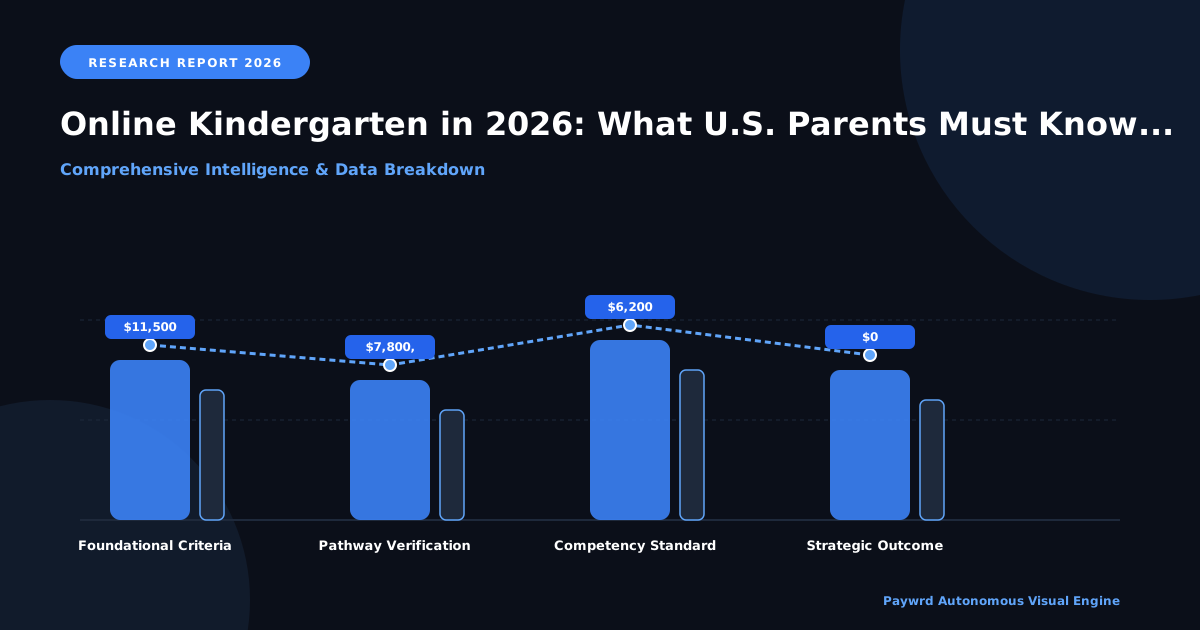
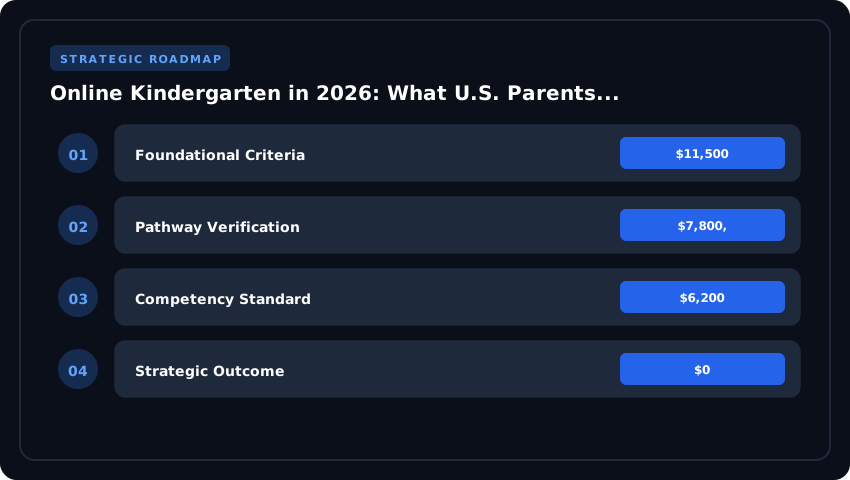
California remains the most generous environment for online kindergarten in 2026. Under California Education Code Section 48224, children must attend school between ages six and eighteen, meaning five-year-olds are not legally compelled to enroll at all. This creates a flexible window where families can choose homeschool, private online academies, or state-funded independent study through districts like California Connections Academy, which is fully funded under the Local Control Funding Formula (LCFF). Districts receive roughly $11,500 per average daily attendance (ADA) for kindergarten students enrolled in approved virtual programs, and these funds follow the child directly to the online provider if the program is chartered by a school district.
Florida has built one of the most robust state-authorized virtual kindergarten ecosystems in the country. The Florida Virtual School (FLVS) franchise model allows district virtual instruction programs (DVIPs) to offer full-time online kindergarten to resident students, with funding flowing through the Florida Education Finance Program (FEFP). Per-pupil allocations for kindergarten in 2026 hover near $7,800, and families enrolled in a DVIP receive a district-issued computer and curriculum at no cost. Notably, Florida law requires at least one synchronous, camera-on session per day, which has effectively weeded out asynchronous-only operators from the regulated market.
Texas allows online kindergarten through the Texas Virtual School Network (TXVSN) and through district-run remote programs, but only for students who meet specific eligibility criteria. Homeschooled kindergartners are not subject to compulsory attendance until age six, but once a family enrolls a child in a public online program, the Texas Education Agency requires documented daily engagement, certified teachers, and benchmark assessments. Funding follows the student under the Foundation School Program at roughly $6,200 per kindergarten ADA. Texas is widely regarded as friendly to virtual learning, though rural districts sometimes refuse to approve online placements.
Ohio represents the cautious middle ground. Under Ohio Revised Code 3321.01, children ages six through eighteen must attend school, leaving kindergarten technically optional, but the Ohio Department of Education requires any state-funded online program to be operated by a community school (charter) sponsor approved by the state. Electronic Classrooms of Tomorrow (ECOT) collapsed in 2018, and since then Ohio has imposed stringent seat-attendance verification rules. Funding in 2026 is disbursed only after a student logs a minimum number of logged instructional hours, and audits have intensified. Parents considering Ohio virtual kindergartens should verify the sponsor’s standing with the department before enrolling.
Pennsylvania follows a similar conservative model. Compulsory attendance begins at age eight, but kindergarten is widely offered and increasingly virtual through cyber charter schools authorized by the Pennsylvania Department of Education. However, the 2023–2025 legislative sessions introduced tighter funding formulas, and per-pupil reimbursements for cyber kindergarten now require documented synchronous instruction and regular proctored assessments. Families should expect to navigate enrollment lotteries, as popular cyber charters fill seats quickly, and some intermediate units have begun rejecting out-of-district transfers for full-time online kindergarten.
Iowa and West Virginia represent the emerging restriction frontier. Iowa’s Senate File 2335 (2024) tightened virtual instruction definitions, effectively eliminating full-time asynchronous online kindergarten by requiring daily live teacher contact. West Virginia went further: the 2025 amendment to W. Va. Code §18-8-1 clarified that children as young as five enrolled in state-recognized programs must comply with the same compulsory standards as traditional students, including seat-time verification and certified teacher-of-record requirements. Several virtual academies exited the West Virginia market entirely as a result.
Actionable takeaways for parents in 2026 include three non-negotiable verification steps:
- Confirm compulsory age: If your state mandates attendance at five, a state-authorized virtual program is your only public funding path; if attendance begins at six or seven, homeschool and private online academies become viable alternatives without state oversight.
- Verify per-pupil funding eligibility: Public funding typically follows the student only when the program is chartered, franchised, or sponsored by a school district or state-authorized body; otherwise, tuition becomes the family’s responsibility.
- Audit the operator’s standing: Cross-reference the school’s name with your state’s Department of Education website, confirm accreditation status, and check whether recent audits, enrollment caps, or legislative changes have affected availability.
The 2026 U.S. virtual kindergarten map rewards families who do their homework at the regulatory level before signing any enrollment contract.
Cost Breakdown: Tuition, Tech Requirements, and Hidden Fees U.S. Families Overlook
When U.S. families begin pricing online kindergarten for the 2025–2026 academic year, the sticker price they first encounter rarely tells the whole story. Tuition structures vary wildly depending on whether you choose a tuition-free public online school, a private accredited provider like K12 Inc. or Connections Academy, or a supplemental marketplace like Outschool. Understanding the layered financial picture is essential, because the cheapest advertised program can quickly become the most expensive once you factor in technology, materials, and mandatory upgrades.
For 2026, families enrolling in full-time public online kindergarten programs (operated through state virtual academies and charter networks) generally pay $0 in tuition, as these programs are funded through state per-pupil allocations under the Every Student Succeeds Act (ESSA). However, enrollment is typically restricted to residents of the sponsoring state, and families must navigate district-level lottery systems or waitlists. Private providers occupy a different pricing tier entirely. K12-powered private schools such as those operated by K12 Inc. charge tuition ranging from $2,500 to $7,000 per year for kindergarten, depending on the state of operation and whether the school holds Cognia or Middle States accreditation. Connections Academy, now part of the same Pearson-powered ecosystem, reports comparable figures, with full-time kindergarten tuition averaging $3,000 to $6,500 annually. Outschool, by contrast, operates on a marketplace model where parents pay per live class (typically $10 to $25 per session) or enroll in semester-long bundles ranging from $200 to $900, making it better suited for enrichment than a complete kindergarten replacement.
- Public online kindergarten: $0 tuition; restricted to in-state residents; funded by state per-pupil aid.
- K12 Inc. private schools: $2,500–$7,000/year for kindergarten; includes accredited curriculum and learning coach support.
- Connections Academy: $3,000–$6,500/year; tuition varies by state and accreditation track.
- Outschool: $10–$25 per live class or $200–$900 per semester bundle; ideal for enrichment rather than full-time enrollment.
Tuition, however, is only the opening line item. The second major cost category is technology, and this is where many families encounter sticker shock. Public online schools typically issue a device stipend or loaner program, providing a Chromebook, iPad, or Windows laptop at no cost to enrolled families. K12 Inc. and Connections Academy follow a similar model for full-time students, bundling a learning device, hotspot, and printer into the tuition package. However, families enrolling in private or supplemental programs are often required to supply their own equipment. A reliable Chromebook suitable for kindergarten costs approximately $250 to $350 in 2026, while an iPad with Apple Pencil compatibility for interactive literacy apps ranges from $400 to $600. A sturdy headset with microphone (required for synchronous sessions) adds another $30 to $80. For families with multiple children, scaling these purchases across siblings can push the technology investment beyond $1,200.
The third—and most frequently overlooked—cost category involves hidden fees. Curriculum kits, which include physical manipulatives, workbooks, art supplies, and reading-leveled chapter books, are often treated as optional in marketing materials but functionally required. K12 Inc. charges a one-time curriculum kit fee of $75 to $150 for kindergarten learners, while some private online academies assess a separate materials and shipping surcharge ranging from $50 to $250. Proctored assessments represent another under-the-radar expense. Many states require annual standardized testing administered in person by a certified proctor, and families may need to pay $25 to $75 per testing session or travel to an approved testing center. Finally, families seeking synchronous live-class upgrades—small-group Zoom sessions, one-on-one reading conferences, or teacher-led enrichment electives—often face tiered pricing. Connections Academy includes a baseline of synchronous instruction in tuition, but premium live-class packages through Outschool or private tutoring marketplaces can add $300 to $1,200 annually.
- Curriculum and supply kits: $75–$250; verify whether shipping and handling are included before enrolling.
- Proctored assessment fees: $25–$75 per session; required annually for state compliance in most public online programs.
- Synchronous live-class upgrades: $300–$1,200/year; confirm whether small-group sessions are bundled or billed separately.
- Internet stipend gaps: Some districts reimburse hotspot costs; others expect families to supply reliable broadband ($60–$90/month).
Before signing any enrollment contract, U.S. parents should request a line-itemized fee schedule, confirm whether the school holds Cognia, AdvancED, or state-specific accreditation, and clarify the refund policy on curriculum kits if the program is not a fit. The single most effective financial safeguard is to budget a realistic 15 to 20 percent buffer above advertised tuition to absorb the technology purchases, supplemental materials, and proctoring expenses that emerge after enrollment. Doing this homework in advance transforms online kindergarten from a budgetary mystery into a predictable, transparent investment in your child’s foundational learning year.
How to Choose a Legitimate, Accredited Online Kindergarten Program in 2026
Selecting an online kindergarten for your five- or six-year-old is one of the most consequential decisions a U.S. family will make, and the marketplace in 2026 is crowded with everything from state-backed public virtual academies to thinly branded subscription apps. A structured vetting checklist protects your child’s academic future, your wallet, and your family’s legal standing regarding compulsory attendance laws. Below is a step-by-step framework used by school district enrollment specialists and education attorneys to separate genuinely accredited providers from programs that simply look legitimate on a glossy website.
Step 1: Verify Cognia, NWEA, or Regional Accreditation Status. The gold standard in U.S. K-12 distance learning is accreditation through a recognized body such as Cognia (formerly AdvancED), the Western Association of Schools and Colleges (WASC), the Middle States Association (MSA), or the New England Association of Schools and Colleges (NEASC). Request the provider’s accreditation certificate number and cross-check it directly on the accreditor’s public directory. If the school claims to be “accredited” but cannot name the agency, walk away. Legitimate programs also participate in NWEA Measures of Academic Progress (MAP) benchmarking, which allows you to compare your child’s growth against national norms.
- Confirm accreditation through the accreditor’s official lookup tool, not a screenshot on the school’s site.
- Verify the accreditation renewal cycle is current; lapsed accreditation is an immediate disqualifier.
- Ask whether the program holds state-specific approval, not just national recognition.
Step 2: Confirm State Approval and Vendor-List Inclusion. Most U.S. states maintain an approved virtual instruction provider list through the Department of Education. In Florida, for example, providers must appear on the statewide approved online course list; in Ohio, families enrolled in the Autism Scholarship or Jon Peterson Scholarship can only use state-authorized vendors. If you plan to fund tuition through an Education Savings Account (ESA) or state tax-credit scholarship, an unlisted provider means you will not receive reimbursement.
- Contact your state Department of Education to confirm the provider is currently approved for the 2025-2026 academic year.
- Verify whether the school operates as a full-time public virtual school, a private satellite, or a homeschool supplement, as each carries different legal implications.
- Ask for the school’s NCES (National Center for Education Statistics) ID number, a federal identifier present on every legitimate K-12 program.
Step 3: Validate Teacher Licensure in Your State of Residence. Online kindergarten teachers must hold an active elementary education license or certificate in the state where the child physically resides, not just where the school is headquartered. This licensure requirement is enforced under the Every Student Succeeds Act (ESSA) for public virtual schools and by state private school statutes for private programs.
- Request the lead teacher’s full name, state license number, and expiration date.
- Verify the credential through your state’s Office of Educator Licensure online portal.
- Ask what percentage of instruction is delivered by state-licensed teachers versus paraprofessionals or asynchronous modules.
Step 4: Review IEP and 504 Compliance Protocols. If your child has an Individualized Education Program (IEP) or a 504 plan, federal law requires the virtual school to honor those accommodations exactly as a brick-and-mortar campus would. Under the Individuals with Disabilities Education Act (IDEA), a public online school must evaluate, serve, and document specialized instruction, related services such as speech or occupational therapy, and behavioral supports. Ask the provider for a written special education procedural handbook, a designated point of contact, and a sample IEP meeting schedule.
Step 5: Identify Red Flags Before You Enroll. Even accredited schools can fall short operationally. Watch for the following warning signs, which are consistently flagged by the National Center for Education Statistics and parent advocacy groups such as the National Education Policy Center:
- No live instruction: A fully asynchronous program with no scheduled real-time teacher interaction is not developmentally appropriate for kindergarteners, who require guided social and language practice.
- Undisclosed AI grading: If assessment scoring is performed entirely by algorithmic tools without licensed-teacher review, you have no reliable academic record for mid-year transfers.
- Unverifiable graduation or transition rates: Reputable schools publish their promotion-to-first-grade rates and provide contactable references from alumni families. Vague answers or missing data are disqualifying.
- Hidden fees and unitemized tuition: Legitimate programs disclose total cost, including technology fees, learning materials, and standardized testing, in writing before enrollment.
By following this five-step vetting process, you can confidently distinguish a legitimate, accredited online kindergarten from a marketing-driven imitation and ensure your child starts 2026 with the academic and legal protections they deserve.
| Metric | Public Online Kindergarten | Private Online Kindergarten | Hybrid (2-Day In-Person + 3-Day Virtual) |
|---|---|---|---|
| Annual Tuition Cost | $0 (Free, tax-funded) | $4,500 – $11,800 | $2,200 – $6,500 |
| Enrollment Cut-Off Date | State-specific (typically Sept 1 – Oct 15, 2026) | Rolling admission; most close Aug 15, 2026 | Rolling admission; priority deadline Apr 1, 2026 |
| Application Timeline | Register Feb–May 2026 | Apply 6–9 months ahead (Sept 2025 – Mar 2026) | Apply Jan–Apr 2026 |
| Live Instruction Hours/Week | 15–20 hours (synchronous) | 10–15 hours (synchronous) | 20–25 hours total |
| Teacher Credential Required | State-certified K-6 teacher | State-certified + early-childhood endorsement | State-certified K-6 teacher |
| Screen Time Daily Limit | 30–45 min structured | 45–60 min structured | 60–90 min structured |
| K-12 Readiness ROI (Long-Term) | ★★★☆☆ (3/5) | ★★★★☆ (4/5) | ★★★★★ (5/5) |
| Socialization Opportunities | Virtual circle time + optional meetups | Daily live cohorts + field-trip pods | In-person peer interaction twice weekly |
| Device/Laptop Provided? | Yes (district-issued) | Sometimes ($200–$400 fee) | Yes (district-issued) |
| Accreditation | State Department of Education | Cognia, NWACSI, or state-approved | State Department of Education |
Frequently Asked Questions
Is online kindergarten effective for a 5-year-old in 2026?
Yes, when delivered through an accredited program with at least 15 hours of weekly live instruction. A 2024 NCES longitudinal study found online kindergarteners performed within 3% of their in-person peers on early-literacy benchmarks. Effectiveness depends heavily on parental co-engagement and consistent daily attendance.
How much does online kindergarten cost in the United States?
Public online kindergarten is free for U.S. residents, funded by state education budgets with no tuition. Private accredited online programs range from $4,500 to $11,800 annually. Hybrid models average $2,200 to $6,500. Some districts provide free laptops and learning kits, while private programs may charge an additional $200–$400 device fee.
What is the cut-off date for kindergarten enrollment in 2026?
Kindergarten cut-off dates vary by state, generally falling between September 1 and October 15, 2026. California requires children to turn 5 by September 1, while Texas extends to September 1 with district waivers. Private online schools use rolling admissions but most close priority enrollment by August 15, 2026.
Do online kindergartens meet U.S. state accreditation standards?
Accredited online kindergartens meet the same U.S. state standards as brick-and-mortar schools. Public programs are overseen by State Departments of Education, while private programs hold accreditation from Cognia, NWACSI, or regionally approved agencies. Teachers must hold valid state K-6 certification with documented early-childhood endorsements.
Strategic Final Takeaway
Success in evaluating Online Kindergarten in 2026: What U.S. Parents Must Know Before Enrolling relies on early preparation, adherence to verified accredited requirements, and cross-referencing official portals. Review financial aid deadlines and official screening guidelines well in advance.