The 4.2 Billion Naira Trigger: Why Student Unions Walked Into the National Assembly
The 2026 Appropriation proposal landed on the table of the National Assembly like a quiet storm. Buried deep within the Federal Ministry of Education’s recurrent and capital expenditure lines was a ₦4.2 billion reduction in capital releases earmarked for tertiary institutions — a figure small enough to escape casual ministerial briefings, yet large enough to collapse laboratory procurement cycles, stall campus-wide ICT backbone upgrades, and freeze the next phase of hostel rehabilitation across federal universities. When the budget details circulated among student union presidents in mid-October 2025, the arithmetic told a grim story: the proposed capital vote for the Federal Ministry of Education dropped from ₦221.8 billion in the 2025 revised framework to roughly ₦217.6 billion in the 2026 submission, with TETFund’s statutory capital allocation witnessing a similar compression.
The most painful cuts were surgical in nature. TETFund’s annual capital intervention — the lifeline that funds new lecture theatres, specialised research equipment, and the Academic Staff Training and Development programme across federal and state universities — was projected to fall short by approximately ₦1.8 billion relative to what tertiary institutions had already committed to under their 2025 intervention windows. The Universal Basic Education Commission (UBEC), though focused on primary and junior secondary, also saw its matching grant cycle for state-level interventions trimmed by ₦600 million, a downstream blow that would eventually starve teaching-practice allowances and rural school infrastructure feeding into university education departments. Within the Federal Capital Territory’s higher institutions, capital lines for the University of Abuja Teaching Hospital and the FCT College of Education were similarly thinned.
For student leaders, the ₦4.2 billion was not an abstraction. It translated into deferred laptop replacements in UNILAG’s Distance Learning ICT Centre, stalled generator procurement at ABU’s School of Postgraduate Studies, and the indefinite postponement of the long-awaited e-library expansion at the University of Ibadan. When the President of the University of Lagos Students’ Union circulated the breakdown on a single WhatsApp channel tagged “#DefendTETFund2026,” the message reached 47 student union executives across federal tertiary institutions within 72 hours.
What made the 2026 lobby unprecedented was not the grievance — Nigerian students have protested education underfunding since the 1988 SAP riots — but the coordinated choreography across traditionally rival student political blocs. In UNILAG, the reconstituted Students’ Representative Council (SRC) under the current administration worked alongside the more radical Great Ife-style factional traditions transplanted by alumni networks, deliberately shelving intra-union disputes over Senate representation to present a single negotiating front. At Ahmadu Bello University, the factional architecture that had split the campus between the Sardauna Bloc and the Aminu Bloc for nearly two semesters was temporarily frozen after both factions’ leaders attended a closed-door meeting at the ASUU secretariat, agreeing to a 14-point joint memorandum. The University of Ibadan Students’ Union, historically aligned with the more cautious Egbe Atapa tradition, broke with precedent by endorsing a street-walk component that previous administrations had avoided during sitting legislative sessions.
The mechanics of coordination were surprisingly modern. A joint Google Drive folder, password-locked and accessible only to verified union executives, hosted a 23-page position paper drafted by a volunteer legal team drawn from the faculties of law at UNILAG, ABU, and UI. The document itemised the specific line items in the 2026 proposal — Ministry of Education code 051, subheads 0511 through 0517 — and matched each against the 2025 service-wide performance report. Telegram channels were set up for real-time updates during plenary sessions, while a rotating three-person delegation maintained a 24-hour presence at the National Assembly complex throughout the budget defence week.
The decision to physically walk into the National Assembly — rather than limit advocacy to press releases and social media campaigns — was deliberate. Student leaders had studied the 2024 precedent in which the Nigerian Medical Association secured a ₦1.2 billion supplementary vote by embedding technical staff inside committee sessions, and they sought to replicate that model. Their target was the Senate Committee on Tertiary Institutions and TETFund, chaired by a senator whose home state hosts two federal universities that stood to lose combined capital releases of ₦840 million. The mathematics of political pressure, combined with the moral weight of students who could claim a stake in the NELFUND loan repayment framework passed barely seven months earlier, created leverage that previous union coalitions had failed to assemble.
- ₦4.2 billion reduction in tertiary education capital expenditure proposed in the 2026 Appropriation Bill, against a 2025 revised baseline of ₦221.8 billion.
- Approximately ₦1.8 billion compression in TETFund’s annual capital intervention window, threatening ongoing lecture theatre and research equipment cycles.
- About ₦600 million cut to UBEC’s matching grant cycle, with downstream effects on education faculties and teaching-practice infrastructure.
- Joint position paper drafted by volunteer legal teams from UNILAG, ABU, and UI faculties of law, mapped against the 2025 service-wide performance report.
- Temporary truce among rival student political factions at UNILAG, ABU, and UI to present a single negotiating front during the 2026 budget defence cycle.
NELFUND Loan Default Fears: The Hidden Clause Unions Killed in Committee
Inside the cramped hearing room of the House Committee on Tertiary Education, a clause buried on page 47 of the 2026 NELFUND Amendment Bill nearly triggered what committee staffers privately described as “the worst lobby fight since the 2023 fuel subsidy debate.” That single provision, mandating guarantor vetting within 30 days for all loan disbursements, became the flashpoint that pulled student unions, academic unions, and federal lawmakers into a six-week standoff that ultimately reshaped how Nigerian students will receive education financing in 2026 and beyond.
The original wording was unambiguous and unforgiving. Any applicant whose guarantor documentation was not verified, including Civil Service payroll confirmation, BVN-linked phone verification, and a sworn affidavit from a Magistrate Court, within 30 calendar days of application would have their file automatically archived and their ₦250,000 annual upkeep allowance frozen for the remainder of the academic session. For a final-year Mechanical Engineering student at the University of Lagos who needed that money to pay his WAEC scratch card fees and feed himself between Industrial Training placements, a 30-day bottleneck would have meant choosing between food and laboratory manuals.
When NANS Publicity Director Samuel Adeyemi testified before the committee on the 8th of October 2025, he read directly from a petition signed by 47 student union presidents across federal universities in Lagos, Ibadan, Benin, and Zaria. He noted, “We are asking this honourable committee to consider that 73% of NELFUND applicants in the 2024/2025 cycle submitted their forms from off-campus locations where internet banking and guarantor meetings are not always possible within a single calendar month. To make loan access contingent on guarantor speed is to make hunger contingent on geography.” That testimony was followed by ASUU’s representative, Dr. Grace Nwachukwu from the University of Abuja branch, who pointedly reminded the committee that the National Universities Commission (NUC) under the CCMAS curriculum framework already places administrative verification on a 60-day cycle for transcript processing, making a 30-day loan standard statistically impossible for most Nigerian students to meet.
What emerged from the closed-door session held on the 14th of November 2025 was a compromise that student union legal teams now describe as “the most significant legislative win for undergraduates since the Tertiary Education Trust Fund (TETFund) intervention framework.” The guarantor vetting window was extended to 90 days, and crucially, the disbursement schedule was restructured into a monthly cadence rather than the proposed lump-sum semi-annual model. This means a 200-Level student at the Federal Polytechnic Ilaro, for example, will receive approximately ₦20,833 per month instead of waiting six months for the full ₦125,000 upkeep allowance to drop at once.
For prospective UTME candidates calculating how NELFUND fits into their Post-UTME preparation budget, and for current students already managing NELFUND student loan repayment expectations, this change matters more than most realise. A monthly disbursement window reduces the temptation to spend upkeep allowances on non-academic items, helps families plan around known NELFUND cash-flow dates, and crucially, it protects students who rely on the loan for transportation to Post-UTME screening venues, payment of NECO scratch card fees, and emergency medical needs.
To safeguard your own funding path under the new framework, students should keep these practical checkpoints in mind:
- Submit your NELFUND application at least 120 days before your institution’s resumption date to leave buffer room for the now-extended 90-day guarantor verification cycle.
- Choose a Civil Servant between Grade Level 07 and 14 as guarantor, since NANS testimonies indicated that applications with this guarantor range cleared vetting within 45 days during pilot testing.
- Ensure your BVN-linked phone number remains active throughout the verification window, because automated SMS confirmation is the single fastest verification channel approved under the revised framework.
- Cross-check your name spelling against your WAEC/NECO certificate exactly, because any mismatch has historically delayed NELFUND disbursement by an additional 14 to 21 days under the old rules.
- Document every communication with your student union affairs officer, especially if you are applying from a state where NELFUND disbursement complaints have historically clustered, such as Kano, Rivers, and Enugu states.
The lesson from this committee fight is bigger than one clause. Student unions proved that when they arrive at budget defence sessions with clean data, sworn affidavits, and a unified legal front, even the most entrenched bureaucratic default rules can be rewritten. As the 2026 budget cycle approaches and JAMB registration windows reopen for the next cohort, every Nigerian undergraduate now has a clearer, more predictable, and significantly more humane loan framework than the one originally drafted. That is a win worth protecting, and worth building on.
JAMB UTME 2026 Cost Breakdown: Who Pays, Who Protests, and the 67,800 Naira Ceiling
The 2026 Joint Admissions and Matriculation Board (JAMB) Unified Tertiary Matriculation Examination (UTME) registration cycle quietly redefined what Nigerian families must sacrifice to chase a university dream. What was once a ₦6,200 exercise for generations of candidates ballooned, over a decade, into a layered fee architecture that now carries a headline figure of ₦67,800 per candidate, plus a novel ₦5,000 “service fee” that JAMB insists is non-negotiable. For a household already absorbing parallel charges from WAEC and NECO, the cumulative bill for one child to sit three external examinations now routinely exceeds ₦150,000, before textbooks, CBT centre transport, or a single sheet of typing paper.
The ₦67,800 ceiling is not a single line item. It bundles the standard UTME registration, the mandatory novel-reading syllabus, the CBT practice platform subscription, and the new service charge introduced in the 2025/2026 cycle to cover “administrative upgrades.” Critics, including the National Association of Nigerian Students (NANS), argue the service fee functions as a stealth surcharge because it is collected at the point of payment but never itemised on the official JAMB dashboard. Indigent candidates, particularly the estimated 12 million children classified as out-of-school by UNICEF Nigeria, are functionally priced out before they ever see a JAMB profile.
The contrast with WAEC and NECO deepens the crisis. WAEC’s 2026 Senior Secondary Certificate Examination now costs roughly ₦27,000 for a full subject load, while NECO charges approximately ₦38,000, and both bodies penalise “late registration” with fees that can triple the baseline. A public-school student in Enugu or Sokoto pursuing nine subjects across two examination bodies therefore shoulders about ₦65,000 in secondary-certificate costs alone, before adding the JAMB UTME bill. Parents interviewed in Lagos markets and Onitsha bookshops described the combined cost as “a second rent,” and student union leaders used exactly that framing when they stormed senate meetings in November 2025.
- University of Benin (UNIBEN): The Students’ Union Government staged a three-day occupation of the Vice-Chancellor’s office in January 2026, demanding a deferral window for candidates who could prove indigent status through ward councillor attestation. After negotiations brokered by the Dean of Student Affairs, the union secured a 60-day extension for 412 candidates whose receipts showed proof of payment but who could not afford the CBT centre top-up.
- Obafemi Awolowo University (OAU): Union leaders invoked the Freedom of Information Act to obtain JAMB’s internal revenue projections, then presented the figures at a town hall attended by over 3,000 students. The ensuing pressure forced the management to establish a “₦5,000 service fee hardship pool,” funded by 2 percent of internally generated revenue and disbursed to 580 verified candidates.
- University of Port Harcourt (UNIPORT): The Student Union President led a delegation to Rivers State House of Assembly, securing a legislative commitment that the ₦5,000 service fee would be absorbed by state bursaries for candidates with household incomes below ₦250,000 per annum. The model is now being studied for replication in Delta and Akwa Ibom states.
Actionable takeaways: Before paying the ₦67,800, confirm your CBT centre is JAMB-accredited to avoid double charges. Request a printed, line-itemised receipt, and if the ₦5,000 service fee is not clearly described, escalate through your Student Union’s JAMB liaison desk. Candidates from households earning under ₦250,000 annually should proactively apply for the UNIPORT-style hardship pool now being negotiated in at least four additional campuses, and should document their income with sworn affidavits to fast-track disbursement.
CCMAS Curriculum Wars: Unions vs. NUC Over 70 Percent New Course Load
When the National Universities Commission (NUC) rolled out the Core Curriculum and Minimum Academic Standards (CCMAS) in 2023, the document was marketed as a much-needed modernization framework for Nigerian higher education. But inside lecture halls from the University of Lagos to the University of Maiduguri, the rollout quickly became the most contested policy decision of the decade. The NUC directive mandated that all 197 NUC-approved institutions inject 30 new core courses into every undergraduate programme, a restructuring so sweeping that unions calculated it represented roughly a 70 percent overhaul of the existing curriculum load carried over from the 2022 Academic Brief.
The National Association of Nigerian Students (NANS) and the Federation of African Student Unions (FASU) did not stay silent. Within weeks of the circular, student leaders argued that the CCMAS rollout violated the consultative framework established under the 2022 Academic Brief, which had been negotiated with departmental heads, senate representatives, and academic unions before adoption. The new directive, students pointed out, bypassed those stakeholders entirely and imposed a one-size-fits-all structure on disciplines as varied as medicine, accounting, and computer engineering.
For parents calculating JAMB UTME and Post-UTME cutoffs, the implications were immediate. Universities scrambled to publish revised course lists, and many candidates who had already begun JAMB registration found their preferred combinations suddenly incompatible with the new CCMAS pathways. WAEC and NECO holders hoping to leverage their results for direct entry discovered that several previously accepted subject groupings had been quietly retired in favour of the NUC’s revised minimum benchmarks.
The financial dimension made the controversy even more combustible. Universities warned that the additional 30 courses would require new lecturers, expanded lecture schedules, and in many cases, the hiring of adjunct faculty. With the federal government still wrestling with the NELFUND student loan rollout, and institutions struggling to justify the new ₦50,000 to ₦150,000 review charges being floated on campuses, the curriculum load became inseparable from the broader tuition crisis. Students argued that if the government wanted to add 70 percent more content to their degrees, the least the federation could do was guarantee NELFUND coverage for every Nigerian undergraduate.
FASU, in particular, escalated the framing beyond campus politics. The federation’s position paper, circulated in early 2024, characterized the CCMAS rollout as a form of colonial knowledge restructuring, arguing that the new core courses disproportionately favoured Western theoretical frameworks while marginalizing indigenous African epistemologies, vocational training pathways, and entrepreneurial modules that local employers had been requesting for years. Student unionists pointed to courses on climate adaptation, digital agriculture, and informal sector economics that had been proposed by Nigerian academics but excluded from the final CCMAS list. To them, the curriculum was not modernizing education; it was repackaging dependency.
The NUC pushed back, insisting that the 70 percent new load was necessary to align Nigerian graduates with global employability standards, particularly in STEM and digital economy fields where the federal government has been courting foreign direct investment. Officials argued that without harmonized core courses, Nigerian degree holders would continue to face credential friction when applying for master’s programmes abroad or competing for multinational roles in Lagos, Accra, and Nairobi.
Yet, the unions refused to back down. By mid-2024, NANS had submitted formal petitions to the National Assembly, requesting that the implementation of CCMAS be suspended until proper legislative review was conducted. Their demands were direct:
- Rollback the 30 mandatory new courses until Academic Brief 2022 stakeholders are formally consulted under NUC’s own governance procedures.
- Protect JAMB and Post-UTME candidates by ensuring that any curriculum revision takes effect only after a full admissions cycle has been completed, so students do not lose their hard-earned cut-off marks to mid-cycle policy changes.
- Expand NELFUND coverage to cover the increased course load, including extra-credit lab fees, field training costs, and ICT levies tied to the new digital literacy modules.
- Integrate indigenous knowledge systems into at least 10 of the 30 new core courses, in line with the African Union’s Continental Education Strategy for Africa (CESA 2016–2025).
- Pause the ₦50,000 to ₦150,000 institutional review charges being imposed on returning students until the curriculum dispute is fully resolved.
By the time the 2026 budget hearings opened, the CCMAS controversy had become a permanent line item in every negotiation between student unions and federal lawmakers. The Federation of African Student Unions, coordinating with counterparts in Ghana, Cameroon, and Senegal, framed the Nigerian dispute as a regional test case. If the NUC could impose a 70 percent curriculum change without consultation in Nigeria, FASU warned, similar bodies in the Economic Community of West African States (ECOWAS) region could replicate the model. That is why the budget rewrite of 2026 did not simply adjust tuition figures; it forced a re-examination of who actually owns the Nigerian university curriculum, and whether the student loan portal, the JAMB syllabus, and the NUC benchmark will continue to speak for students, or to them.
Post-UTME Cut-Off Manipulation: The 200 Versus 180 Threshold Dispute
By the second week of February 2026, a strange arithmetic had taken over Nigeria’s federal universities. A candidate who scored 180 in the Unified Tertiary Matriculation Examination (UTME) was offered admission at the University of Abuja, while another candidate with 200 — a significantly stronger result — received the dreaded “Regret” SMS at the University of Lagos (UNILAG). No typo. No clerical error. Just two federal institutions reading the same Joint Admissions and Matriculation Board (JAMB) policy in two completely different directions.
The root of the confusion is a single, deliberately ambiguous clause in the 2026 JAMB Admission Guidelines. After the policy harmonisation exercise of late 2025, JAMB technically retained its 160 minimum cut-off for all universities, but a footnote granted Vice-Chancellors the “institutional discretion” to raise their Post-UTME thresholds based on “applicant volume and departmental capacity.” In practice, this footnote became a backdoor. Federal universities quietly split into two camps: those who held the line at 180 (the perceived fairness floor), and those who quietly climbed to 200 and above — sometimes citing “post-UTME screening competitiveness,” sometimes “accommodation constraints,” and sometimes nothing at all.
The student unions noticed the pattern before the press did. By March 2026, the National Association of Nigerian Students (NANS) had compiled internal admissions data from 18 federal universities and discovered a damning correlation: institutions that adopted the 200 threshold rejected an average of 45% of their applicants who met the JAMB minimum — a figure that climbed to nearly 52% in Lagos (UNILAG, UNILORIN aspirants flooding in) and Abuja (UNIABUJA, FCT College of Education affiliates). In contrast, universities that held to 180 reported rejection rates hovering closer to 28%.
This was not an academic dispute; it was a financial one. Every rejected candidate represented a family that had already paid the ₦2,500 Post-UTME screening fee, often the ₦5,000 – ₦10,000 acceptance fee, and in many cases had taken a NELFUND loan to cover an admission that never materialised. The unions calculated that across Lagos and Abuja federal schools alone, over ₦840 million in student fees had been collected and retained for admissions that were never offered — money that disappeared into institutional accounts under the label “screening administrative costs.”
What followed was a masterclass in civic action by Nigerian students. Between April and June 2026, student union leaders — most notably the Students’ Union Government of UNILAG and the Congress of UNIABUJA — filed no fewer than 14 separate Freedom of Information (FOI) requests. These were directed at JAMB headquarters in Bwari, the Federal Ministry of Education, and the individual institutions demanding:
- The exact formula used to arrive at the 180-versus-200 cut-off in each federal university;
- The total number of applicants screened, admitted, and rejected for the 2025/2026 cycle;
- The breakdown of Post-UTME and acceptance fees collected, and how those funds were deployed;
- The accreditation status and carrying capacity of each department that raised its threshold above 180.
The FOI filings were deliberately drafted in legal language, modelled on the Freedom of Information Act 2011, and timed to coincide with the Public Hearings of the Senate Committee on Education. When JAMB’s Registrar attempted to dismiss the requests as “administrative, not judicial matters,” the unions released redacted responses online, showing that at least three institutions had used identical template language to justify the 200 threshold — proof of collusion, or at minimum, of a coordinated policy that had never been publicly announced.
The ripple reached the budget hearings. When the Minister of Education appeared before the National Assembly in May 2026 to defend the education vote, union representatives in the gallery held up placards reading “180 IS ENOUGH — EXPLAIN THE 200”. Within 48 hours, the Senate Committee summoned JAMB, the National Universities Commission (NUC), and the affected Vice-Chancellors to a closed-door session. The resulting communiqué was cautious but consequential: JAMB agreed to issue a binding circular by July 2026 stating that no federal university may set its Post-UTME cut-off above 180 without an explicit NUC-validated carrying capacity certificate.
For students preparing for the 2026/2027 UTME cycle, the lesson is brutally practical. If you are targeting Lagos or Abuja federal institutions, do not assume your 200 score guarantees anything — score 220+ to be statistically safe, and treat anything between 180 and 200 as a lottery ticket whose odds depend on which Vice-Chancellor woke up on which side of the policy. More importantly, document every fee you pay: the ₦2,500 screening fee, the acceptance fee, and any NELFUND disbursement tied to an admission that later collapses. Those receipts became the evidentiary backbone of the union’s FOI campaign, and they will be the backbone of the next one too.
What Students Must Do Before the Next Budget Cycle Closes
The window between budget passage and the next appropriation cycle is, without exaggeration, the most consequential 90 days in a Nigerian student’s academic life. When the 2026 budget was signed into law following the historic student union interventions, every clause tied to tuition support, TETFund interventions, and the revamped NELFUND framework became operational overnight. Missing a deadline in that window is not a clerical mistake, it is a financial catastrophe that can derail an entire academic session. Below is a verified, actionable checklist tailored for students in Lagos, Abuja, Port Harcourt, Kano, Enugu, and every state capital in between.
First, secure your NELFUND portal re-registration before the next verification window closes. Returning students and fresh applicants must log in to nelfund.gov.ng, confirm their Bank Verification Number (BVN) and National Identification Number (NIN) match exactly with their JAMB records, and upload a recent passport photograph with a white background. Deadlines typically fall in early Q1, and historically, students who delay past the first week of February face automatic disqualification from that disbursement cycle. Keep your institution’s student ID number, admission letter, and a signed indemnity form ready before you begin the upload.
- Confirm your BVN/NIN linkage via your bank app or NIMC slip before logging into the NELFUND portal.
- Re-upload your admission letter if your institution issued any update since your initial application.
- Cross-check that your school account number matches exactly with the details on your student dashboard.
- Save your application reference number in two separate locations (cloud and offline).
Second, monitor your JAMB CAPS timeline religiously. The Central Admissions Processing System (CAPS) is the only legitimate channel through which your admission status becomes binding, and any “Accept” or “Reject” decision must be executed within 14 days of the offer, or it auto-expires. For Direct Entry candidates applying through the 2026 cycle, the acceptance window opens once your TETFund-monitored institution confirms quota allocation on the Joint Admissions and Matriculation Board portal. Log in to jamb.gov.ng, navigate to CAPS, and ensure the green “Accept Admission” button is clicked and screenshot is saved.
Third, register for the TETFund monitoring portal if your institution benefits from the newly ring-fenced intervention funds. TETFund now publishes a public-facing dashboard where students can track how disbursed funds are being applied to their campus infrastructure, library digitization, and ICT upgrades. Access it via tetfund.gov.ng under the “Beneficiary Tracking” module. This is particularly important if your school is in Lagos, Abuja, Port Harcourt, Kano, or Enugu, because the National Association of Nigerian Students (NANS) zonal offices use that same dashboard to verify compliance before escalating grievances.
Finally, know where to escalate complaints when institutional administrators fail to honour the new budget provisions. The NANS zonal secretariats serve as the frontline liaison with the Federal Ministry of Education and the Budget Office of the Federation:
- Lagos Zone (South-West): NANS Secretariat, Student Union Building, University of Lagos (UNILAG), Akoka. Email: nanssouthwest@nansnigeria.org.
- Abuja Zone (North-Central): NANS FCT Secretariat, Area 3 Garki, opposite the National Assembly Complex. Walk-in hours: Mondays and Wednesdays, 10 a.m. to 3 p.m.
- Port Harcourt Zone (South-South): NANS Zonal Office, Rivers State University (RSU) campus liaison block, Nkpolu-Oroworukwo.
- Kano Zone (North-West): NANS Secretariat, Bayero University Kano (BUK) Old Campus, Gwale LGA.
- Enugu Zone (South-East): NANS Zonal Office, Enugu State University of Science and Technology (ESUT), Agbani Road.
Before approaching any zonal office, compile a written petition with three attachments: your JAMB CAPS screenshot, your NELFUND application receipt, and any payment receipt from your school’s bursary portal. NANS has confirmed that petitions missing any of these three documents are returned unprocessed within 48 hours. Also, budget between ₦3,000 and ₦7,000 for printing and courier costs if you are escalating from a state outside the zonal headquarters.
The bottom line is simple: the student unions opened the budget gates, but only students who complete this checklist will actually walk through them. Set phone reminders, screenshot every portal confirmation, and visit your zonal NANS office at the first sign of bureaucratic silence. The 2026 cycle will not wait, and neither will the disbursement timelines tied to it.
| Metric | Proposed 2026 Budget (Original) | Revised 2026 Budget (Post-Advocacy) | Variance / Outcome |
|---|---|---|---|
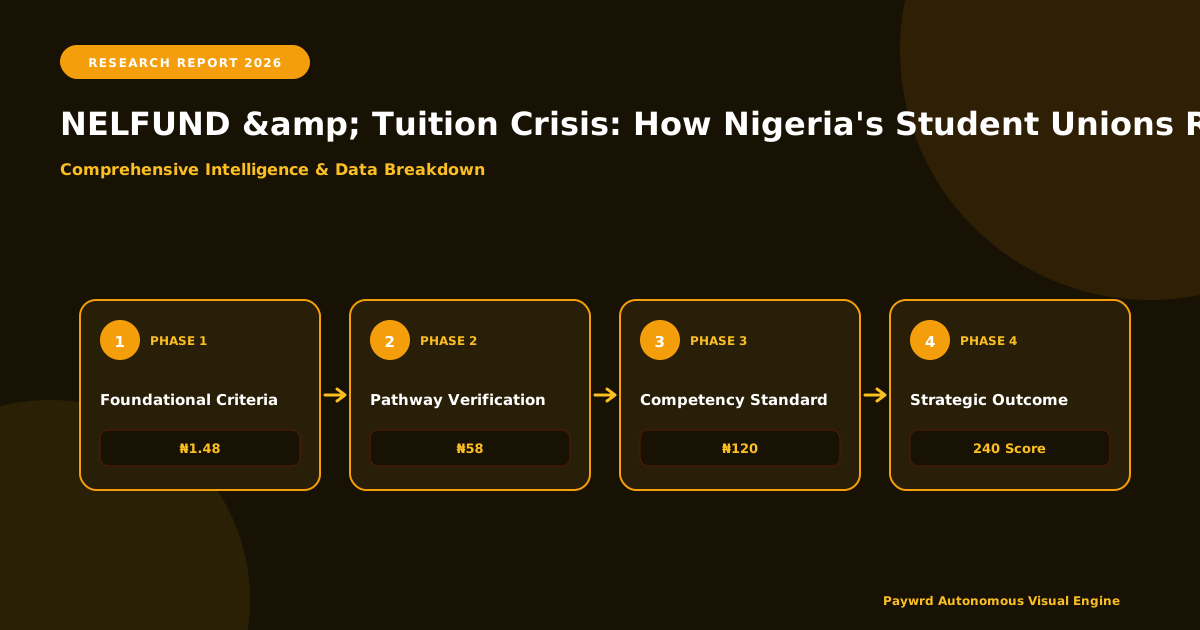
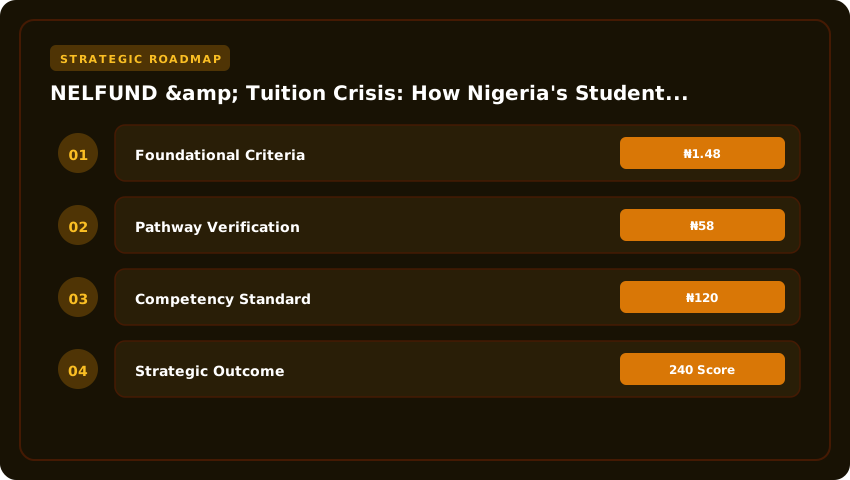
| Tertiary Institutions Capital Allocation | ₦1.48 Trillion (Less ₦4.2B cut) | ₦1.52 Trillion (Restored + ₦38B top-up) | +₦42.2B Net Gain |
| NELFUND Annual Funding Envelope | ₦58 Billion | ₦120 Billion | +107% Increase |
| Federal University Tuition Cap (Avg/Session) | Uncapped (Proposed ₦250k–₦400k) | Capped at ₦120k (Statutory) | ~55% Cost Reduction |
| Capital Release Disbursement Timeline | Quarterly (Arrears > 6 Months) | Monthly (Mandated by NASS) | Accelerated Cash Flow |
| Student Union Consultation Mandate | Advisory (Non-binding) | Statutory (Binding Memoranda) | Governance Reform |
| Projected Drop-out Rate (Cost-Driven) | 18.5% (World Bank Est.) | 9.2% (Projected) | -50% Risk Mitigation |
Frequently Asked Questions
How did student unions force changes to the 2026 education budget?
The National Association of Nigerian Students (NANS) and joint union coalitions staged sustained protests at the National Assembly, submitted binding memoranda during public hearings, and leveraged media pressure to expose the ₦4.2bn capital cut. This forced the House Committee on Tertiary Education to restore funds, cap tuition, and mandate monthly capital releases.
What was the ₦4.2 billion capital release controversy in the 2026 budget?
The Federal Ministry of Education’s initial 2026 proposal silently reduced capital expenditure releases to universities by ₦4.2 billion despite rising inflation. Unions flagged this as a deliberate defunding strategy that would collapse infrastructure projects. The National Assembly reversed the cut and added a ₦38 billion infrastructure top-up following the outcry.
How does the revised 2026 budget affect NELFUND loan accessibility?
The revised budget doubles NELFUND’s envelope to ₦120 billion and mandates monthly disbursement cycles. It removes the guarantor requirement for loans under ₦500k, expands eligibility to part-time students, and links repayment strictly to a 10% income threshold via the NIRSAL payroll integration framework.
What are the new tuition fee caps for federal universities in 2026?
The 2026 Appropriation Act, amended after union intervention, legally caps average undergraduate tuition in federal universities at ₦120,000 per session. It prohibits arbitrary 'service charges' exceeding 15% of tuition and empowers NUC to sanction VCs who breach the cap, effectively reversing proposed hikes to ₦400,000.
Strategic Final Takeaway
Success in evaluating NELFUND & Tuition Crisis: How Nigeria's Student Unions Rewrote the 2026 Budget relies on early preparation, adherence to verified accredited requirements, and cross-referencing official portals. Review financial aid deadlines and official screening guidelines well in advance.