JAMB UTME Subject Combination & Cutoff Marks for Medicine & Surgery in Nigerian Universities
Securing admission to study Medicine and Surgery in any Nigerian university is one of the most competitive academic pursuits an undergraduate can chase. Every year, hundreds of thousands of candidates register for the Joint Admissions and Matriculation Board (JAMB) Unified Tertiary Matriculation Examination (UTME), but only a small percentage of them eventually scale through to the interview stage. The journey starts with choosing the correct subject combination, and for Medicine and Surgery, that combination is non-negotiable: English Language, Biology, Chemistry, and Physics. These four subjects are mandatory across all accredited Nigerian universities offering the MBBS or MBChB degree, and any candidate who sits UTME without this exact combination will be automatically disqualified, regardless of how high their score turns out to be.

English Language is compulsory for every UTME candidate nationwide, and for Medicine, it carries significant weight because medical training involves heavy communication, clinical documentation, and patient interaction. Biology serves as the foundation of the medical sciences, while Chemistry and Physics round off the sciences required to understand pharmacology, biochemistry, anatomy, and physiology. Candidates are strongly advised to register these four subjects in the right order during UTME registration, as changing them after the slip has been printed often leads to costly correction errors that can derail an admission cycle entirely.
The competitive cutoff marks for Medicine and Surgery in Nigerian universities remain among the most demanding across all courses. While JAMB sets a general minimum score of 200 for university admission, candidates should treat that number as irrelevant for Medicine. Most federal and state universities that run Medicine and Surgery demand scores well above 250, with the most competitive institutions pegging their cutoffs at 280 and above. For the 2025/2026 admission cycle, candidates targeting top universities like the University of Ibadan (UI) and Ahmadu Bello University (ABU) Zaiming should target a UTME score of at least 280 to 310 to stand a realistic chance of being shortlisted for Post-UTME. Bayero University Katsina and the University of Maiduguri (UNIMAID) tend to operate slightly lower ranges due to catchment and catchment area advantages, with realistic eligibility scores hovering between 250 and 270 for indigenes and catchment candidates, while non-indigenes should still aim for 270 and above.

- English Language (Compulsory): Required by every UTME candidate. Strong performance here also boosts your Post-UTME aggregate.
- Biology: The core science subject for Medicine. Aim for at least 80% in your WAEC/NECO result.
- Chemistry: Essential for understanding pharmacology and biochemistry. Treat it as a scoring subject.
- Physics: Often underrated by candidates but required for understanding physiology, radiology, and medical equipment.
The 2025/2026 admission cycle is shaping up to be even more competitive than previous years, given the rising number of applicants and the limited accreditation slots available to universities by the National Universities Commission (NUC) and the Medical and Dental Council of Nigeria (MDCN). Several institutions have not been able to admit new medical students in recent cycles because their accreditation status was either denied or under review, which means the available slots in fully accredited universities are even tighter than the raw numbers suggest. For students writing UTME this cycle, the realistic floor for eligibility should be set at 260 for federal universities, 240 for state universities with strong catchment advantages, and 250+ for private universities that charge substantially higher tuition fees.
Candidates must also remember that JAMB UTME score alone does not guarantee admission. Every serious university runs a Post-UTME screening exercise, and in many cases, the Post-UTME score carries equal or even greater weight than the UTME itself in determining who makes the final admission list. The composite aggregate typically follows a 50:50 ratio or a 60:40 weighting in favour of either component, and missing the Post-UTME benchmark can disqualify a candidate who scored 300 in UTME. Practical advice for the 2025/2026 cycle is to register early, prepare deliberately with past questions from at least the last five JAMB years, and treat the Post-UTME as a separate exam that demands its own revision schedule, not an afterthought.
Finally, candidates should verify their preferred university’s specific cutoff on the official JAMB brochure, the school’s admissions portal, and credible student forums before making final decisions. Cutoffs shift yearly based on the performance of applicants, the availability of slots, and prevailing admission policies, so a score that secured Medicine in ABU last year might fall short this cycle if applicant quality rises. Stay informed, prepare thoroughly, and aim beyond the minimum.
Post-UTME Screening Requirements: What Top Medical Schools in Northern Nigeria Actually Expect
If you have scored above 280 in JAMB and you are eyeing Medicine and Surgery in Northern Nigeria, congratulations, you have cleared the first major hurdle. However, the Post-UTME (or what some universities now call the “PUTME Screening Exercise”) is where the real filtering happens. In 2025/2026, every federal and state university in the North has restructured its screening to favour candidates who combine strong UTME scores with excellent O-Level results and demonstrated consistency in the sciences. Understanding how each state handles its screening can make the difference between holding a coveted admission letter and spending another year at home waiting for the next cycle.
Across Katsina, Kaduna, Sokoto, and Borno, the Post-UTME process typically follows three stages: online registration, screening (either computer-based test or credential verification), and finally, the release of the departmental merit list. The aggregate score, which is what determines who gets admitted, is usually calculated as 50% JAMB score, 30% Post-UTME score, and 20% O-Level grades (with five credits in English Language, Mathematics, Biology, Chemistry, and Physics being non-negotiable). A student with JAMB 290 and Post-UTME 70% who also has straight A/A1 in their WAEC or NECO subjects will comfortably beat a candidate with JAMB 310 but weaker screening performance.
Let me break down what each of the leading medical schools in these four states expects in the 2025/2026 cycle:
- Federal University Katsina (FUDUTSINMA) – College of Medicine and Health Sciences: FUDUTSINMA typically sets its Post-UTME cutoff for Medicine between 75% and 82% of the maximum screening score. The school places heavy weight on English and Biology performance at O-Level, and candidates with a “C6” or “D7” in any of the five core subjects are usually screened out automatically. As a relatively new medical programme, the competition is intense but the class size is still smaller, meaning candidates from Katsina and neighbouring Jigawa and Zamfara states get a slight catchment advantage, though merit still dominates.
- Ahmadu Bello University (ABU), Zaria – Kaduna State: ABU remains the gold standard for medical training in Northern Nigeria, and its Post-UTME cutoff for Medicine is consistently the highest in the region, usually around 78% to 85%. The screening test is famously rigorous, with questions drawn from JAMB-level Biology, Chemistry, Physics, and Use of English, plus a heavy dose of general knowledge and current affairs. ABU is known to insist on at most one sittings for O-Level, meaning combining WAEC and NECO results can sometimes be a disadvantage, though official policy treats both equally.
- Usmanu Danfodiyo University Sokoto (UDUS) – College of Health Sciences: UDUS runs its screening through a CBT-based PUTME that combines a written test (50%), O-Level computation (30%), and JAMB score (20%). The departmental cutoff for Medicine usually lands around 70% to 76%. Sokoto is slightly more forgiving than Zaria but still demands the standard five credits in the core science subjects, and candidates who present NABTEB rather than WAEC or NECO are sometimes asked to provide additional verification.
- University of Maiduguri (UNIMAID) – College of Medical Sciences, Borno State: UNIMAID’s Post-UTME is shaped by its location in the Lake Chad region, and the school often adjusts its cutoffs slightly to accommodate candidates from insurgency-affected local government areas. The general cutoff for Medicine in 2024/2025 was around 68% to 74%, and the screening test emphasizes Biology and Chemistry more than Physics. UNIMAID also accepts candidates with two sittings more readily than ABU, which is helpful for many northern candidates who have to balance school with seasonal farm work.
Actionable Takeaway: If you are applying to any of these four schools, treat the Post-UTME as a second UTME, not a formality. Start revising past questions from at least 2021 to 2024, paying special attention to English comprehension and Biology diagrams, and make sure your O-Level results are uploaded on the JAMB CAPS portal before the screening registration closes. Most schools will not consider a candidate whose WAEC or NECO results are still pending at the time of screening, and a single missing credit in Mathematics can take you out of the race even with a JAMB score above 300. Finally, if you are applying to multiple schools in the region, remember that each university calculates its aggregate differently, so aim for the highest possible Post-UTME score rather than the cutoff, because in Medicine and Surgery, every decimal point matters.
Inside the NUC CCMAS Medical Curriculum: What You’ll Study Over Six Years
Once you scale the hurdles of JAMB and Post-UTME, the real work begins. The Nigerian Universities Commission (NUC) has meticulously designed the Core Curriculum and Minimum Academic Standards (CCMAS) to ensure that every MBBS graduate is globally competitive and locally relevant. Over six intensive years, this curriculum transforms eager secondary school leavers into resilient medical doctors equipped to handle Nigeria’s unique healthcare challenges.
The first three years are your pre-clinical phase, heavily focused on the foundational sciences. This is where you build the architectural framework of the human body and its functions. You will spend countless hours in the dissection hall and laboratories mastering the core triad:
- Anatomy: The study of human body structures, including gross anatomy, histology, and embryology. Expect rigorous memorization and cadaver dissections.
- Physiology: Understanding how the body works, from cardiovascular dynamics to neurophysiology. This is the engine room of medical practice.
- Biochemistry: The chemical processes within the human body. You will learn about metabolic pathways and their clinical correlations.
- Community Medicine (Early Exposure): The CCMAS introduces community health early, ensuring you understand the social determinants of health before touching a stethoscope.
As you transition into the clinical years (Years 4 and 5), the textbooks make way for the wards. You will rotate through major departments, applying your pre-clinical knowledge to real patients. This phase is emotionally taxing but deeply rewarding. Your rotations will cover:
- Internal Medicine: Diagnosing and managing non-surgical adult diseases, from malaria to complex cardiovascular conditions.
- Surgery: Mastering pre-operative, intra-operative, and post-operative care, including general surgery and trauma management.
- Paediatrics: Caring for infants and children, a critical skill in a region with high infant mortality rates.
- Obstetrics & Gynaecology: Focusing on maternal health, pregnancy, and female reproductive systems.
The final year culminates in a heavy emphasis on community-based medical training. The NUC CCMAS mandates that students spend significant time in rural or semi-urban postings. This is not just a box-ticking exercise; it is a survival blueprint for Nigeria’s healthcare system. For instance, students posted to underserved states like Katsina learn to manage frontline realities—treating endemic diseases like malaria, cholera, and malnutrition with limited resources. You learn to be a leader, an advocate, and a frontline worker in communities where a doctor is a lifeline.
Actionable takeaway: The MBBS journey is a marathon, not a sprint. If you are relying on the NELFUND student loan to cover your tuition and upkeep, remember that the rigorous demands of the CCMAS curriculum leave little room for part-time jobs. Budget your ₦550,000 annual loan strictly for tuition, essential medical textbooks, and basic survival. Form study groups early in your pre-clinical years, and seek mentorship from senior students to navigate the emotional weight of the clinical rotations.
Financing a medical degree in Nigeria requires careful planning, but the financial burden has become significantly more manageable since the launch of the Nigerian Education Loan Fund (NELFUND) in 2024. Whether you’re aiming for a federal university like the University of Ibadan or a state-owned institution such as Ladoke Akintola University of Technology (LAUTECH), understanding the realistic costs in Naira is the first step toward making informed decisions.
For the 2025/2026 academic session, tuition fees across federal medical schools typically range from ₦45,000 to ₦250,000 per session, depending on the institution. For example, the University of Lagos (UNILAG) College of Medicine charges around ₦190,000, while the University of Maiduguri sits at approximately ₦75,000. State universities are generally more expensive, with tuition ranging from ₦150,000 to ₦500,000 per session, with schools like Lagos State University (LASU) and Ambrose Alli University tending toward the higher end. Private universities charge substantially more, often exceeding ₦2 million annually, though they offer different admission pathways.
Understanding NELFUND: Your Gateway to Affordable Medical Education
- What NELFUND Covers: The loan takes care of tuition fees, accommodation charges, and a small upkeep stipend, which is deposited directly into your account each academic session.
- Eligibility Requirements: You must be a Nigerian citizen with a valid JAMB registration number, enrolled in an accredited public university (federal or state), and come from a household with an annual income below ₦500,000. There is no upper age limit, making it accessible for students who gained admission later in life.
- Application Process: Visit the official NELFUND portal at nelfund.gov.ng, create a student profile, link your JAMB details, upload your admission letter, and provide your bank verification number (BVN). The loan is disbursed after your institution confirms your enrollment and academic status.
- Repayment Terms: Repayment begins two years after completing your National Youth Service Corps (NYSC) or immediately after graduation if you skip service. The loan accrues no interest for students earning below ₦250,000 monthly post-graduation, and the repayment period is capped at 10 years with flexible monthly deductions.
Beyond NELFUND: Scholarship Opportunities for Medical Students
While NELFUND handles tuition, scholarships can cover books, equipment, and living expenses. The Petroleum Technology Development Fund (PTDF) offers undergraduate scholarships for students in STEM fields, including Medicine, particularly those from oil-producing states. Several state governments also run merit-based awards; the Lagos State Scholarship Board and the Ogun State Education Trust Fund are notable examples that can provide ₦100,000 to ₦500,000 annually for indigent medical students.
Private foundations present another viable funding channel. The David Oyedepo Foundation, Agbami Scholarship Scheme, and various diaspora-focused organizations provide partial or full scholarships for medical students with strong academic records. Religious bodies and alumni associations of specific medical colleges also offer bursaries, sometimes covering the cost of professional examinations like the MDCN licensing exam.
Actionable Financial Planning Tips
- Apply Early: Submit your NELFUND application within the first two weeks of resumption to avoid delays in disbursement.
- Document Everything: Keep certified copies of your admission letter, JAMB result, and evidence of fees; institutions require these before approving loan release.
- Combine Funding Sources: You can hold both a NELFUND loan and a merit scholarship, as long as the scholarship is unrestricted and not specifically designated for tuition alone.
- Track CCMAS Compliance: Under the new NUC Core Curriculum and Minimum Academic Standards (CCMAS), your school may adjust fee structures; stay in touch with your bursary department.
- Budget for Hidden Costs: Beyond tuition, budget ₦30,000–₦60,000 annually for textbooks, ₦15,000 for stethoscopes and clinical instruments, and between ₦50,000–₦100,000 for cadaver fees and lab coats during clinical rotations.
The combination of NELFUND loans, merit scholarships, and prudent budgeting means that becoming a doctor in Nigeria is no longer a privilege reserved for the wealthy. With strategic financial planning, your medical degree is genuinely within reach. Start your NELFUND application today and explore at least two scholarship options before resumption; this proactive approach will save you stress and keep your focus firmly on your studies.
Career Pathways After MBBS: NYSC, Residency, and Specialising in Critical Care & Paediatrics
Earning your MBBS degree is a monumental achievement, but for Nigerian medical graduates, the real professional journey truly begins the moment you toss your graduation cap into the air. The years that follow shape whether you become a general-duty doctor in a rural clinic, a consultant physician earning top salaries in Lagos private hospitals, or a specialist surgeon trained in one of the nation’s most demanding fields. Understanding the exact steps, timelines, and strategic choices after medical school is critical, especially in the 2025/2026 cycle where competition for residency slots remains extraordinarily fierce. Let me walk you through the entire pathway, from NYSC deployment realities to MDCN registration, residency matching, and the financial expectations that come with each stage.
Your first step after collecting your MBBS results is obtaining your Provisional Registration Certificate from the Medical and Dental Council of Nigeria (MDCN). This is the legal requirement that allows you to practise medicine anywhere in the country and to enrol for the National Youth Service Corps (NYSC). Without MDCN registration, you cannot be deployed, and no federal or state hospital will process your appointment. The MDCN portal typically opens registration windows in March and September, and you will need your degree certificate, transcript, internship logbook, and a clean police clearance report. Most graduates complete this process within two to four weeks, provided there are no discrepancies in their documentation.
Once registered, you proceed to the one-year mandatory NYSC service, where medical graduates are typically posted to hospitals, clinics, or public health departments across all 36 states and the FCT. Here is the reality many fresh doctors face: medical-related postings are not guaranteed. While the scheme tries to deploy doctors to health facilities, you might find yourself posted to a primary healthcare centre in a rural community or a state general hospital with limited equipment. Your monthly NYSC allowance is ₦33,000, a figure that has remained static since 2020 despite rising living costs. Many corpers rely on moonlighting at private hospitals to make ends meet, though you should verify the legality of locum tenens work in your state before doing so.
After completing NYSC, the next strategic decision involves choosing between immediate residency, House of Officers (HOO) extension, or private practice. Most federal and state tertiary institutions require House Officers for 12 to 24 months before promoting them to Medical Officer Grade I, which is the typical entry point for residency. Salaries during this period range from ₦250,000 to ₦450,000 monthly at federal hospitals, depending on your Consolidated Medical Salary Structure (CONMESS) level. State hospitals typically pay ₦180,000 to ₦350,000, while private hospitals in cities like Lagos, Abuja, and Port Harcourt offer ₦400,000 to ₦800,000 for junior doctors.
Entering a residency programme is where the real specialisation begins. The two main pathways are the National Postgraduate Medical College of Nigeria (NPMCN) and the West African College of Physicians (WACP) or West African College of Surgeons (WACS). Both are rigorous, requiring primary examinations, multiple years of clinical rotations, and exit fellowship examinations. Residency match timelines are not guaranteed to align with your desired city or hospital. You might apply to Lagos University Teaching Hospital (LUTH), University College Hospital (UCH) Ibadan, or Ahmadu Bello University Teaching Hospital (ABUTH) Zaria, and end up matched to Federal Medical Centre (FMC) Keffi or a state teaching hospital. Residency stipends range from ₦550,000 to ₦850,000 monthly at federal centres, with state hospitals offering slightly less.
If you choose to specialise in high-need areas like Paediatrics, Emergency Medicine, or Public Health, you will find these fields both personally rewarding and financially viable. Paediatrics, for instance, has a typical residency duration of six years and remains in constant demand across Nigeria’s tertiary hospitals. Critical Care and Emergency Medicine are emerging as lucrative specialties given the nation’s growing trauma cases, maternal mortality rates, and the impact of insurgency on northern health systems. A consultant in Critical Care can earn between ₦2,500,000 and ₦5,000,000 monthly in federal employment, with locum sessions in private hospitals pushing annual earnings above ₦70 million.
Here are strategic tips to maximise your post-MBBS trajectory:
- Apply for NELFUND student loan repayment incentives if you took the loan during medical school, as residency earnings allow you to clear the debt comfortably within three to four years.
- Target federal teaching hospitals for residency because they offer better equipment, senior registrar mentorship, and faster exam success rates.
- Consider Public Health specialisation if you want to work with international NGOs, WHO, or the Nigeria Centre for Disease Control (NCDC), where salaries often exceed clinical practice.
- Network actively during NYSC because your state coordinator and hospital chief medical director often influence residency recommendations.
- Keep your MDCN registration active through annual licence renewals, or you will be barred from practising legally.
- Plan financially for exam fees, which range from ₦150,000 to ₦400,000 per primary and fellowship attempt.
Ultimately, the path after MBBS is what you make of it. Those who plan early, prepare for primary examinations during House Officership, and remain resilient through the rigorous demands of residency often emerge as highly respected consultants. Whether you choose the adrenaline of Critical Care, the tenderness of Paediatrics, or the broad impact of Public Health, Nigeria needs you, and your earning potential will scale meaningfully as you climb the clinical ladder. Stay focused, keep learning, and remember that every patient you treat is part of the larger journey that started with your JAMB registration years ago.
The Frontline Reality: Why Nigeria Desperately Needs More Doctors in Northern States
If you are considering a career in Medicine and Surgery in Nigeria, you are not just choosing a profession; you are stepping into one of the most urgent humanitarian frontiers of our time. The data tells a story that no prospective doctor should ignore. According to the World Health Organization (WHO), Nigeria operates with a doctor-to-patient ratio of roughly 1:10,000 nationwide, which is already dangerously below the recommended benchmark of 1:600. In Northern states like Katsina, Sokoto, Zamfara, and Kebbi, this figure is even bleaker, with some rural Local Government Areas posting ratios closer to 1:30,000 or even 1:50,000.
Layer onto that the unprecedented scale of medical brain drain. The General Medical Council (GMC) of the United Kingdom registers well over 5,000 Nigerian-trained doctors actively practicing in the UK alone. Thousands more have relocated to Canada, the United States, Saudi Arabia, and Ireland. The Medical and Dental Council of Nigeria (MDCN) estimates that Nigeria loses between 1,000 and 2,000 doctors annually to emigration, a hemorrhage that drains our teaching hospitals of experienced consultants and registrars.
What does this crisis look like on the ground? Visit the Federal Teaching Hospital, Katsina, or the nearest General Hospital in Daura, and the gaps are unmistakable. Newly graduated house officers often manage paediatric casualty points alone, triaging dozens of children suffering from severe malaria, pneumonia, and acute gastroenteritis with limited senior support. Oxygen supply remains intermittent. Functional pulse oximeters are scarce. A single paediatric ward bed may serve three or four critically ill infants. These are not abstract policy problems. They are daily realities that determine whether a child lives or dies before sunrise.
The infrastructure deficit creates something rare and valuable: genuine, frontline clinical exposure for purpose-driven medical graduates from your very first year of housemanship. While many private tertiary facilities in Lagos or Abuja are saturated, a young doctor posted to Katsina, Maiduguri, or Sokoto will likely perform intubations, insert central lines, conduct emergency caesarean sections, and manage trauma cases within months of graduation. This is the kind of clinical acceleration that builds exceptional specialists within a decade.
Programs like The Night the Ward Went Quiet: Inside Katsina’s Frontline Training for a Forgotten Killer exist precisely because of this gap. They prepare young Nigerian doctors to lead, not just to assist. For students who will sit for JAMB UTME 2025/2026, aiming for cutoff marks of 200+ in Use of English, Chemistry, Biology, and Physics, the message is clear: the North is not a hardship posting. It is a calling card.
- Nationwide doctor-to-patient ratio: approximately 1:10,000 (WHO benchmark: 1:600), with Northern rural areas far worse.
- Brain drain scale: over 5,000 Nigerian doctors registered in the UK alone; 1,000–2,000 emigrate every year.
- Frontline skills: early exposure to intubation, central line insertion, emergency obstetrics, paediatric resuscitation, and mass casualty triage.
- Infrastructure gaps: oxygen shortages, under-equipped paediatric wards, single-resuscitator casualty points, and limited senior coverage in shifts.
- Career advantage: faster clinical maturity, stronger procedural competence, and immediate leadership pathways for committed graduates.
- Financial support: NELFUND student loans now cover tuition for many federal and state universities, reducing the cost barrier for indigent students from the North.
| University Tier | Annual Tuition (₦) | JAMB Cut-off Mark | Post-UTME Range | Duration | Internship/Housemanship | Career ROI (Starting ₦/yr) |
|---|---|---|---|---|---|---|
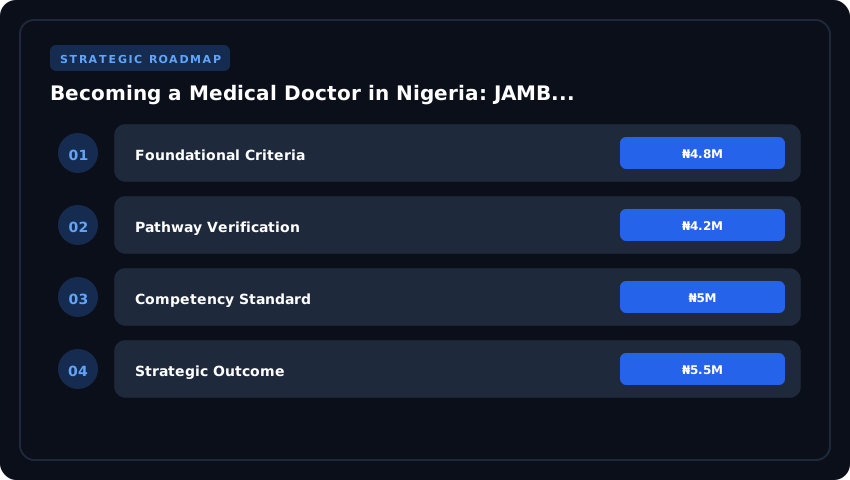
| Federal Universities (e.g., UI, UNILAG, UNN) | ₦100,000 – ₦250,000 | 280 – 320 | 70% – 85% | 6 years (MBBS) | 1 year mandatory | ₦4.8M – ₦7.2M |
| State Universities (e.g., LASU, OOU, UNIOSUN) | ₦300,000 – ₦700,000 | 240 – 270 | 60% – 75% | 6 years (MBBS) | 1 year mandatory | ₦4.2M – ₦6.5M |
| Private Universities (e.g., Babcock, PAMO, Afe Babalola) | ₦2,500,000 – ₦8,000,000 | 200 – 240 | 50% – 70% | 6 years (MBBS) | 1 year mandatory | ₦5M – ₦9M |
| Accredited Private Medical Schools (Newer) | ₦3,000,000 – ₦10,000,000 | 220 – 260 | 55% – 70% | 6 years (MBBS) | 1 year mandatory | ₦5.5M – ₦10M |
| NYSC Service Year (Post-MBBS) | ₦33,000 monthly allowance | N/A | N/A | 1 year | Included | ₦3.6M – ₦5.4M (with primary assignment) |
Frequently Asked Questions
What is the JAMB cut-off mark for Medicine and Surgery in Nigeria for 2025/2026?
The JAMB cut-off mark for Medicine and Surgery in federal universities typically ranges from 280 to 320, while state universities accept 240 to 270, and private universities may admit candidates with scores between 200 and 240. However, meeting the cut-off does not guarantee admission, as post-UTME screening and O'level requirements are also critical factors.
How many years does it take to become a fully qualified medical doctor in Nigeria?
Becoming a fully qualified medical doctor in Nigeria takes a minimum of 10 to 11 years: 6 years for the MBBS degree, 1 year of mandatory housemanship (internship), and 1 year of NYSC service. Additional years may be required for specialization, which can extend training by 4 to 7 years depending on the chosen field of residency.
What is the cheapest federal university to study Medicine and Surgery in Nigeria?
Federal universities like the University of Ibadan (UI), University of Nigeria Nsukka (UNN), and Obafemi Awolowo University (OAU) charge between ₦100,000 and ₦250,000 annually for Medicine and Surgery. These institutions remain the most affordable options for accredited medical training, offering the same MDCN-recognized MBBS degree as costlier alternatives nationwide.
Is studying Medicine and Surgery in a private university worth the high cost in Nigeria?
Private medical schools charge ₦2.5M to ₦8M annually but offer faster admission, smaller class sizes, and modern facilities. Graduates earn comparable starting salaries of ₦5M to ₦9M yearly. The investment is worthwhile for students who can afford it and prioritize guaranteed admission slots over the 5-7 year wait typical in public universities.
Strategic Final Takeaway
Success in evaluating Becoming a Medical Doctor in Nigeria: JAMB Cutoffs & Training Realities 2025/2026 relies on early preparation, adherence to verified accredited requirements, and cross-referencing official portals. Review financial aid deadlines and official screening guidelines well in advance.