Defining Career-Connected Learning: Beyond Traditional CTE Models
For decades, “vocational education” carried a stigma: a separate wing of the building where academic expectations softened the moment a student picked up a wrench. That binary—college prep or job training—is obsolete. High-quality career-connected learning (CCL) in 2026 operates on a “both/and” architecture. Students in top STEM academies now sit for AP Calculus and OSHA 30 certification in the same semester, using the same project-based rubric.
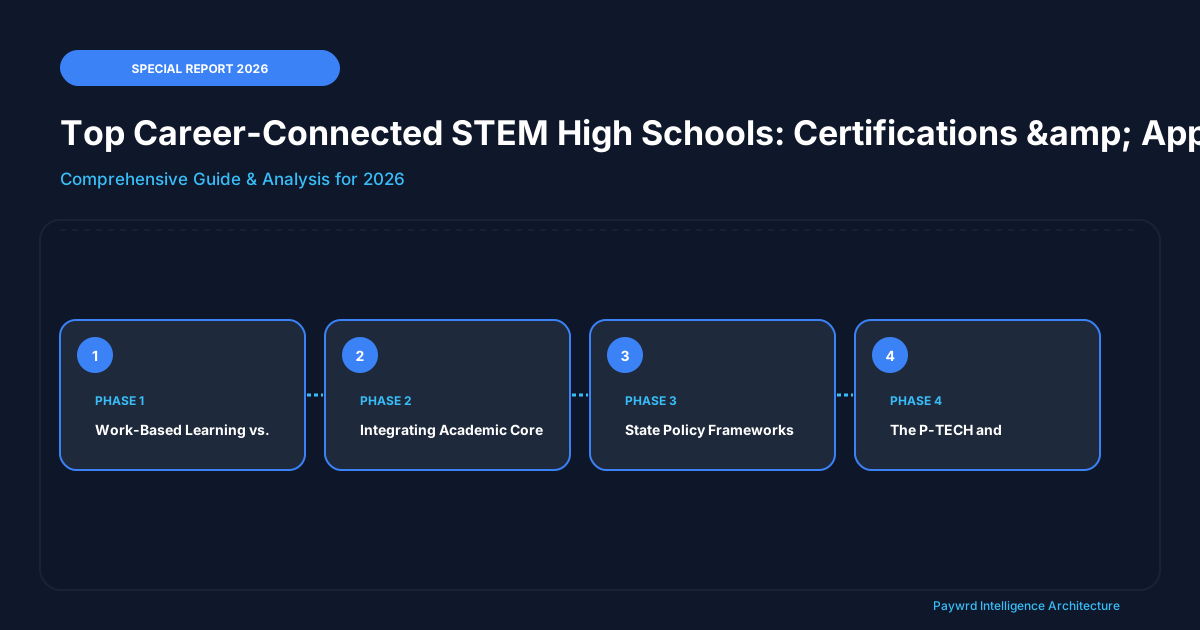
Work-Based Learning vs. Legacy Vocational Tracking
The critical differentiator is portability. Traditional tracking sorted students into terminal endpoints. Modern CCL, as defined by the U.S. Department of Labor’s Registered Apprenticeship standards, demands that every work-based experience (WBE) maps to nationally recognized credentials—think CompTIA Security+, AWS Cloud Practitioner, or NIMS machining credentials—that articulate directly into associate or bachelor’s degree pathways. If a program cannot show you a signed articulation agreement with a community college or a four-year partner like Georgia Tech or Purdue, it’s tracking, not CCL.
Integrating Academic Core with Industry Competencies
Rigor lives in the integration. Under the Perkins V framework (Strengthening Career and Technical Education for the 21st Century Act), states must report on “program quality” indicators that blend academic proficiency with technical skill attainment. Look for these structural markers in a 2026 program:
- Co-teaching models: A certified math teacher and a journeyman electrician co-design the “Electrical Theory” unit, aligning NEC code calculations directly to Algebra II/Trig standards.
- Capstone credentials: Seniors graduate with a minimum of one industry-recognized credential (IRC) valued at $2,000+ in labor market premium (per Burning Glass/Lightcast data) alongside their state diploma seal.
- Credit articulation: Automatic transcripted college credit (not just “advanced standing”) for WBE hours—typically 12–15 credits toward an A.A.S. at the local community college partner.
State Policy Frameworks Driving the 2026 Shift
Perkins V forced states to abandon “seat time” for “competency time.” In 2026, leading states—Colorado, Tennessee, Washington, and Delaware—have moved to competency-based funding. Schools draw down per-pupil dollars only when a student demonstrates mastery of both the state academic standard and the industry competency (e.g., AWS Welding Code D1.1).
Parents evaluating schools should request the Perkins V Local Application (public record). It reveals the exact employer partners, the wage progression schedule for youth apprentices (often starting at 50% of journey wage, ~$18–$22/hr), and the percentage of completers enrolled in postsecondary within 6 months. If the school can’t produce that document, the program isn’t Perkins-compliant—and likely isn’t the rigorous CCL model your student needs.
National Leaders: High Schools Delivering Stackable STEM Credentials 2026
The shift toward “stackable credentials” means students no longer choose between a diploma and a professional license; they acquire both. Across the U.S., a select group of institutions has moved beyond basic Career and Technical Education (CTE) to integrate high-stakes industry certifications directly into the core curriculum. These schools function as talent pipelines, often partnering with global tech giants to ensure students are “job-ready” the day they graduate.
The P-TECH and Early College Powerhouses
The P-TECH (Pathways in Technology Early College High School) model, pioneered by IBM, has become the gold standard for integrating workforce development with academic rigor. These schools allow students to earn a high school diploma and an associate degree from a community college simultaneously, often tuition-free via state funding and FAFSA-aligned grants. Key partnerships with Google and IBM provide students with specialized tracks in Cybersecurity and Data Analytics, leading to certifications that typically command starting salaries between $55,000 and $72,000 for entry-level technicians.
Charter Networks and Rapid Certification
Aggressive charter networks are now bypassing traditional elective structures to embed professional certifications into mandatory STEM blocks. Leading networks are prioritizing “vendor-neutral” and “vendor-specific” credentials that hold immediate market value. Students in these programs typically graduate with a portfolio including:
- CompTIA A+ and Security+: The baseline for IT infrastructure and cybersecurity roles.
- AWS Certified Cloud Practitioner: Validating skills in cloud architecture and deployment.
- SolidWorks Associate (CSWA): A critical credential for mechanical engineering and industrial design.
Magnet Schools and ABET-Aligned Engineering
Elite STEM magnet schools are increasingly aligning their engineering pathways with ABET (Accreditation Board for Engineering and Technology) standards. By doing so, they ensure that the dual-enrollment credits earned in Calculus and Physics are transferable to top-tier engineering universities. These institutions often report dual-enrollment rates exceeding 80%, with students completing 15 to 30 college credits before their senior year. This acceleration significantly reduces the total cost of a four-year degree, potentially saving families $20,000 to $60,000 in undergraduate tuition.
For students in these programs, the goal is a “stack”: a high school diploma, an industry-recognized certification (like PMI’s CAPM for project management), and a head start on a degree. This combination transforms the high school experience from a general education requirement into a strategic professional launchpad.
High-ROI Apprenticeship Pipelines: Cybersecurity, Advanced Mfg & Biotech
The most valuable currency in 2026 isn’t just a diploma—it’s a Registered Apprenticeship Program (RAP) completion certificate backed by the U.S. Department of Labor. These aren’t shadow programs; they are federally validated, wage-earning pipelines that let 16-to-18-year-olds accumulate Department of Labor (DOL) credentials, college credit, and a paycheck simultaneously. For families calculating the ROI of high school, the math is stark: a student graduating with a Cybersecurity RAP under their belt has already knocked out the first year of a community college Associate of Applied Science (AAS) and earned roughly $25,000–$30,000 before their freshman move-in day.
Cybersecurity: The Security+ Fast Track
High schools partnered with the National Initiative for Cybersecurity Education (NICE) framework—like those in the Cybersecurity Youth Apprenticeship Initiative (CYA)—place juniors in SOC (Security Operations Center) analyst roles. Entry typically requires a CompTIA Security+ attempt (or pass) and Algebra II completion. The 2026 wage benchmark starts at $18.50–$22.00/hour with a structured step increase every 650 hours, capping near $28/hour for Year 2 apprentices. The killer feature? Direct articulation agreements with colleges like Northern Virginia Community College (NOVA) or Dallas College guarantee 15–18 credit hours toward an AAS in Cybersecurity, effectively skipping the first semester. Employer sponsors—think Northrop Grumman, Booz Allen, or regional MSPs—often convert apprentices to full-time GS-7/9 equivalent roles ($55k–$65k base) upon degree completion.
Advanced Manufacturing: CNC & Mechatronics Precision
Forget the “shop class” stereotype. Modern Advanced Manufacturing RAPs, aligned with NIMS (National Institute for Metalworking Skills) and SME standards, demand proficiency in Fusion 360, Mastercam, and PLC ladder logic. Programs like the FAME (Federation for Advanced Manufacturing Education) chapters in Kentucky, Texas, and Alabama accept rising seniors with a 2.5 GPA and passing score on the ACT WorkKeys Graphic Literacy assessment. The 2026 earn-and-learn model pays $17–$20/hour for 24 hours/week during the school year, scaling to 40 hours/week summers. The articulation is rigid: completers walk into AMT (Advanced Manufacturing Technician) Associate degrees at partner colleges (e.g., Bluegrass Community & Technical College) with 24–30 credits pre-loaded—half the degree. Total student debt avoided: approximately $8,000–$12,000 in tuition alone.
Biotech & Life Sciences: GLP/GMP Lab Ready
This is the fastest-growing pipeline, driven by the BioMADE and NIIMBL institutes. High schools in the Boston/Cambridge corridor, Research Triangle Park (NC), and San Diego County now offer RAPs for Biomanufacturing Technicians. Entry requires Biology/Chemistry completion and a clean background check (FDA regulated environments). Starting wages for 2026 cohorts hit $19–$23/hour because apprentices work in Current Good Manufacturing Practice (cGMP) suites—real production floors, not simulations. The credit articulation is aggressive: Bunker Hill Community College and Wake Tech accept the DOL RAP completion for 12–16 credits toward an AAS in Biotechnology/Biomanufacturing. Critically, these hours count toward the ASQ Certified Quality Improvement Associate (CQIA) eligibility, a credential usually requiring two years of work experience.
- Action Item: Verify the program’s RAPID code on Apprenticeship.gov—if it’s not in the federal database, it’s not a registered program and won’t guarantee wage protections or credit transfer.
- FAFSA Synergy: Apprenticeship earnings are reported income, but the Student Aid Index (SAI) formula shelters a significant portion of dependent student earnings (~$7,600 for 2025-26), minimizing impact on Pell Grant eligibility.
- Transportation Logistics: Confirm the high school provides transit vouchers or scheduling blocks (e.g., “Senior Year Only Program” 12:00 PM release) before committing; the highest-wage biotech sites are rarely walkable from campus.
Evaluating Program Quality: Accreditation, Advisory Boards & Labor Market Data
A glossy brochure and a shiny makerspace don’t guarantee a return on investment. In 2026, the burden of proof sits squarely on the school to demonstrate that their “career-connected” label translates into portable credentials and family-sustaining wages. Your due-diligence checklist starts with three non-negotiable pillars: institutional accreditation, genuine industry governance, and verifiable labor-market alignment.
Verify the Accreditation Hierarchy
Don’t stop at regional accreditation (like Cognia, formerly AdvancED, or WASC). That’s the baseline for diploma validity. For STEM pathways, you need programmatic accreditation. If the school touts an engineering track, ask if the curriculum aligns with ABET criteria or PLTW (Project Lead The Way) certification standards. For cybersecurity or IT, look for NICE Framework mapping or CompTIA Authorized Partner status. A “Cognia STEM Certification” on the wall is a strong signal—it means an external review team validated interdisciplinary instruction, not just a robotics club meeting after school. Request the most recent accreditation visiting team report; the “required actions” section reveals more about program gaps than the certificate on the wall.
Audit the Industry Advisory Council
Every quality CCL program has an Industry Advisory Council (IAC). The critical question isn’t if one exists, but who sits on it and how often they meet. A council stacked with HR generalists from large local employers is a red flag. You want hiring managers, senior engineers, and certified journeypersons—people who actually define the competency models for the apprenticeships you’re targeting. Ask for the last three meeting minutes. Look for evidence that the council has vetoed outdated curriculum (e.g., removing legacy CAD software in favor of cloud-based Onshape or Fusion 360) or mandated new certifications like the AWS Cloud Practitioner or Siemens Mechatronics credentials. If the council hasn’t met quarterly, the program is flying blind.
Dissect Placement Data: Apprenticeship vs. Internship
Schools love to quote “95% placement rates.” Dig deeper. Demand the denominator: Registered Apprenticeships (RAPs) vs. unpaid or low-wage “internships.” A Tier-1 outcome is a student graduating with a USDOL Registered Apprenticeship number, earning $18–$25/hour with structured on-the-job learning (OJL) and related technical instruction (RTI) that articulates into an Associate’s degree. A Tier-3 outcome is a $15/hour summer gig sweeping a shop floor with no credential attached. Ask for the specific employer sponsors: Are they Joint Apprenticeship Training Committees (JATCs) for the IBEW, UA, or advanced manufacturing consortia like FAME or KY FAME? If the school cannot produce a list of active RAP sponsors with signed articulation agreements, the “pipeline” is theoretical.
Cross-Reference with BLS OES Data
Finally, validate the local labor market yourself using the Bureau of Labor Statistics Occupational Employment and Wage Statistics (OEWS). Don’t trust the school’s “high demand” narrative. Pull the Metropolitan Statistical Area (MSA) data for the specific SOC codes tied to the school’s certifications (e.g., 15-1231 for Computer Network Support Specialists, 17-3024 for Electro-Mechanical Technicians). Compare the 10th percentile entry wage against the local MIT Living Wage Calculator for a single adult. If the school pushes a Medical Assistant certificate (SOC 31-9092) in a metro where the 10th percentile wage is $14.50/hr but the living wage is $22/hr, that program is a poverty trap, not a pathway. Look for Location Quotients > 1.2 indicating genuine local employer concentration. If the data doesn’t support the credential, walk away.
Funding the Pathway: Leveraging Perkins V, ESSER, and State Workforce Grants
The sticker price of a high-quality career-connected program—industry-grade CNC routers, cybersecurity labs, certification exam vouchers—can easily top $15,000 per student annually. Yet families at leading STEM academies rarely see a bill. The financial engineering happens behind the scenes, where district CFOs braid federal, state, and private dollars into a single funding stack that covers tuition, gear, and even student wages.
Braiding Federal Streams: Perkins V Meets ESSER
The Carl D. Perkins Career and Technical Education Act (Perkins V) remains the backbone, delivering roughly $1.4 billion annually to states. But the smartest districts don’t treat it as a standalone check. They layer it with Elementary and Secondary School Emergency Relief (ESSER) funds—specifically the ESSER III allocation—which expires September 30, 2024, for obligation (with a liquidation extension to March 2026).
Here is how the braid works in practice for a program like advanced manufacturing:
- Perkins V (Reserve Fund): Covers the $120–$180 per exam for NIMS (National Institute for Metalworking Skills) or AWS (American Welding Society) certifications, plus curriculum alignment costs.
- ESSER III (Learning Loss/Capital): Funds the $85,000 Haas VF-2 CNC mill and the HVAC upgrades required to run it, framed as “addressing learning loss through hands-on STEM engagement.”
- Title I, Part A: Pays for the certified CTE instructor’s salary supplement and the academic integration coach who maps the machining curriculum to Algebra II standards.
This stacking allows a district to launch a $250,000 lab without touching the general fund. Ask your district’s CTE director for their “Consolidated Local Plan”—it’s a public document detailing exactly which federal code pays for which line item.
State Tuition Waivers: The Dual-Credit Multiplier
Federal money builds the lab; state policy kills the tuition bill. The most aggressive models treat CTE dual-credit courses as a public good, not a revenue stream for community colleges.
- Texas (HB 8 / FAST Program): The Financial Aid for Swift Transfer (FAST) program covers tuition and fees for educationally disadvantaged students taking dual-credit CTE courses at public colleges. For 2024–25, this means $0 out-of-pocket for up to 15 semester credit hours per year in approved pathways like Petroleum Engineering Tech or Health Informatics.
- Colorado (ASCENT / Concurrent Enrollment): The Accelerating Students through Concurrent Enrollment (ASCENT) program funds a “5th year” of high school. Students graduate with a diploma and an Associate of Applied Science (AAS) in fields like Cybersecurity or Aviation Maintenance—tuition covered at the community college rate (approx. $4,500/year value)—while the district retains per-pupil funding.
- Washington (Running Start for CTE): While standard Running Start covers academic transfers, the Career Launch endorsement and State Board for Community and Technical Colleges (SBCTC) workforce funds now waive tuition for high-demand CTE pathways (e.g., Mechatronics, Clean Energy) at 34 colleges, saving families roughly $3,800 per academic year.
Employer Skin in the Game: The 127 Plan Advantage
Registered Apprenticeships unlock the most overlooked funding lever: IRS Section 127 Educational Assistance. Employers can provide up to $5,250 per year, tax-free to the employee and tax-deductible to the business, for tuition, books, and fees—even for high school apprentices enrolled in related technical instruction (RTI) at a community college.
For a supervisor mentoring a youth apprentice in a CompTIA Security+ or PMI CAPM pathway, the company can pay the $3,000–$4,000 community college tuition bill directly. The apprentice avoids income tax on the benefit; the employer avoids FICA (7.65%) on that $5,250. Multiply that across a cohort of ten apprentices, and the employer saves roughly $4,000 annually in payroll taxes while building a certified talent pipeline. Smart districts negotiate this into the Memorandum of Understanding (MOU) before the first student clocks in.
Transition Mechanics: Articulation Agreements & Credit-for-Prior-Learning Policies
Earning a CompTIA Security+ or an AWS Cloud Practitioner badge in eleventh grade feels like a win—until you enroll at a community college and watch those credentials vanish into “elective credit” purgatory. The bridge between a career-connected high school and an Associate of Applied Science (AAS) degree isn’t automatic; it is a negotiated contract called an articulation agreement. In 2026, the most effective programs treat these agreements as living documents, not dusty PDFs buried on a registrar’s website.
Mapping Certifications to the AAS Degree Plan
High-value articulation agreements map specific industry credentials—like the NIMS Machining Level I or the Autodesk Certified Professional—to exact course codes in the college catalog. A student graduating with a FANUC Robotics certification should receive direct credit for MFG 110: Industrial Robotics Operations (3 credits), not a generic “Technical Elective.” Parents and counselors need to demand the crosswalk document: a side-by-side matrix showing the high school competency, the certifying body’s exam blueprint, and the college course learning outcomes. Without this paperwork, you are relying on a department chair’s goodwill during a busy registration week. Top-tier pathways—like those aligned with the Manufacturing Skill Standards Council (MSSC) or Project Lead The Way (PLTW)—often guarantee 12 to 18 semester hours toward a 60-credit AAS, effectively knocking a semester off the degree and saving $3,500 to $5,500 in tuition at average community college rates.
Protecting NCAA Eligibility Amid Technical Credentials
This is where many STEM athletes lose a year of eligibility. The NCAA Eligibility Center requires 16 core courses (English, Math, Science, Social Science, Foreign Language) completed with a minimum 2.3 GPA. A block-scheduled apprenticeship or a double-period CTE lab often displaces a core course, creating a transcript gap the NCAA will flag. The fix is proactive scheduling: the technical credential must sit alongside the core curriculum, not replace it. Schools leading this space—like those in the NCSSS (National Consortium of Secondary STEM Schools) network—build “zero period” or summer intensive options for the apprenticeship hours so the student protects their four years of English and three years of lab science. Always verify the high school’s list of NCAA-approved courses via the High School Portal before committing to a schedule that front-loads shop time.
Portfolio Assessment for Non-Credit Apprenticeship Hours
Registered Apprenticeships (RAPs) logged through the USDOL RAPIDS system translate cleanly to credit via the American Council on Education (ACE) recommendations—typically 30 to 45 credits for a completed program. But what about the high-quality, unregistered pre-apprenticeship or industry-sponsored internship? That requires a Credit for Prior Learning (CPL) portfolio. Do not treat this as a scrapbook. A successful CPL petition includes:
- Competency Narrative: A 500-word statement mapping specific job tasks (e.g., “Configured VLANs on Cisco Catalyst 9000 switches”) to the college course syllabus objectives for NET 205: Switching & Routing.
- Verified Artifacts: Supervisor-signed timesheets, code repositories (GitHub links), safety inspection logs, or project spec sheets—redacted for PII.
- Faculty Evaluator Sign-Off: Most colleges (following CAEL standards) require a subject-matter expert faculty member to grade the portfolio against a rubric. Fee alert: expect a $50–$150 per-credit assessment fee, often capped at $500 per portfolio.
The bottom line: treat the transition like a transfer negotiation. Request the articulation crosswalk, audit the NCAA core-course balance before junior year, and start the CPL portfolio the month the apprenticeship ends—memories and supervisor signatures fade fast.
2026 Application Timelines: Lottery Dates, Aptitude Testing & Industry Interviews
Missing a single deadline in the 2025–2026 cycle doesn’t just delay enrollment—it often means waiting a full year for the next cohort. Because career-connected STEM high schools blend district magnet lotteries with employer-driven apprenticeship hiring, families are juggling two completely different calendars simultaneously. Below is the operational timeline used by admissions officers at schools like Brooklyn STEAM Center, Chicago’s Hancock College Prep, and LA’s STEM Academy of Hollywood.
June–August 2025: Research & Portfolio Assembly
- Map your district’s lottery portal: NYC MySchools opens for exploration in June; Chicago GoCPE and LA Unified’s eChoices typically launch by July. Create accounts now—don’t wait for the application window.
- Audit apprenticeship partners: Pull the current employer roster from each school’s CTE office. If a program lists partners like Northrop Grumman, JPMorgan Chase, or local IBEW/NECA JATCs, note their specific hiring cycles—many corporate sponsors finalize youth apprentice rosters by October.
- Baseline aptitude diagnostics: Have your student take a free CyberStart America practice round and a sample Bennett Mechanical Comprehension Test (BMCT-II). Raw scores dictate which prep resources you buy in September.
September–October 2025: The Application Sprint
- Lottery submission window: NYC MySchools usually closes the first week of December; Chicago GoCPE and LA eChoices typically shut down mid-November. Rank your top 12 programs strategically—place the most competitive apprenticeship-integrated schools (e.g., P-TECH models) in slots 1–3.
- Employer sponsorship letters: This is the hidden gatekeeper. Competitive registered apprenticeships (RA) under the U.S. Department of Labor often require a letter of intent from the employer before the lottery runs. Reach out to HR contacts at partner firms in September; provide a one-pager on the student’s CTE coursework, OSHA 10 status, and availability for a $18–$22/hr starting wage.
- Technical assessments: Many STEM magnets (e.g., Bergen County Academies, Thomas Jefferson HSST) administer the BMCT-II or a custom math/engineering writing sample in October/November. Schedule two weekly 45-minute drill sessions using official practice booklets—not generic SAT prep.
November–January 2026: Interviews & Matching
- Industry interview days: Schools with deep RA pipelines (like GPS Education Partners affiliates in the Midwest) host “Match Days” in January. Treat these like job interviews: business casual, printed résumé highlighting Project Lead The Way (PLTW) capstones, GitHub repos, or FIRST Robotics roles.
- FAFSA & funding alignment: While the FAFSA opens December 1 for college, many dual-enrollment CTE programs require a completed FAFSA on file by January 15 to unlock Perkins V tuition waivers for community college credits. Submit early using 2024 tax data.
February–April 2026: Lottery Results & Commitment
- Results release: NYC results drop mid-March; Chicago and LA follow late March to early April. You typically have 7–10 business days to accept a seat.
- Waitlist strategy: If waitlisted at a top choice, immediately email the CTE director and the employer partner contact. A sponsor advocating for a specific candidate moves the needle faster than a generic district appeal.
- Final registration & onboarding: Accepted students complete drug screens (standard for manufacturing/healthcare RAs), background checks, and OSHA 30 certification over the summer. Budget roughly $150–$300 for these pre-employment requirements.
Pro Tip: Build a shared family Google Sheet with tabs for “Lottery Deadlines,” “Employer Contacts,” “Assessment Scores,” and “Required Docs.” Assign ownership of each row. The families who secure the $18/hr apprenticeship slots aren’t necessarily the smartest—they’re the ones who treated the process like a project management deliverable with hard milestones.
| Pathway Model | Academic Rigor | Industry Credentials | Avg. Entry Pay (Apprenticeship) | Primary ROI Metric |
|---|---|---|---|---|
| Integrated STEM Academy | AP/IB Curriculum | OSHA 30, AWS, CompTIA | $18 – $24 /hr | Dual Diploma + Certification |
| Legacy Vocational Track | Standard Diploma | Trade-Specific Certs | $14 – $17 /hr | Immediate Job Placement |
| Career-Connected Learning (CCL) | Project-Based AP | Industry-Recognized Credentials | $18 – $26 /hr | College Credit + Work Experience |
| Traditional CTE | General Education | Basic Technical Certs | $12 – $16 /hr | Skill Acquisition |
Frequently Asked Questions
What is career-connected learning in STEM high schools?
Career-connected learning (CCL) is a modern educational architecture that integrates rigorous AP/IB academics with industry-recognized certifications. Unlike legacy vocational tracking, CCL allows US students to simultaneously earn a high school diploma and professional credentials, often participating in registered apprenticeships with starting wages around $18/hr before graduation.
How does career-connected learning differ from traditional vocational training?
The primary difference is the 'both/and' approach. Traditional vocational training often separated job skills from academic rigor. Modern CCL integrates them, ensuring students maintain college-prep standards (like AP Calculus) while gaining portable industry certifications, removing the stigma of vocational education and increasing long-term salary potential.
What certifications are most valuable for STEM high school students in 2026?
High-value certifications for 2026 include OSHA 30 for safety, AWS or Azure for cloud computing, and CompTIA for IT infrastructure. These credentials, when paired with a Regents diploma, provide students with immediate portability in the labor market and a competitive edge for both university admissions and high-paying apprenticeships.
Can students in STEM apprenticeships still go to college?
Yes. Career-connected learning is specifically designed to support college trajectories. By earning industry credentials and AP credits concurrently, students enter university with a professional portfolio and practical experience, often reducing their time-to-degree and increasing their ROI through higher-paying internships and specialized STEM scholarships.
What is the average starting pay for high school STEM apprenticeships?
In leading US career-connected STEM programs for 2026, registered apprentices typically earn a starting wage of approximately $18 per hour. This pay scale reflects the integration of high-level technical skills and academic rigor, providing a sustainable financial path while students complete their secondary education.
Strategic Final Takeaway
When evaluating Best Career Connected Learning High Schools STEM Industry Certifications And Apprenticeships 2026, base your decisions on accredited institutional standards, measurable return on investment (ROI), and up-to-date official guidelines. Always verify specific dates and requirements through official regulatory portals.