Why PMI Restructured the PMP Examination Content Outline for January 2026
When the Project Management Institute (PMI) formally announced the January 2026 restructuring of the Project Management Professional (PMP) Examination Content Outline, it signaled the most consequential blueprint change since the credential moved to a competency-based examination in 2021. For nearly a decade, candidates in the United States and abroad had memorized a tidy grid of five process groups (Initiating, Planning, Executing, Monitoring & Controlling, and Closing) cross-mapped against ten knowledge areas derived from the PMBOK Guide 6th Edition. That familiar matrix, however, was engineered for a predominantly predictive waterfall world, where the project manager’s value was measured by how faithfully a plan was executed. By the time PMBOK 7th Edition arrived in 2021, PMI had already begun steering the profession toward principles-based delivery and a domain framework organized around People, Process, Business Environment, and Approaches to Project Management. The January 2026 outline completes that pivot.
PMI’s stated rationale, published in its Examination Content Outline 2026 and echoed in its annual PMI Pulse of the Profession report, centers on three forces reshaping the workplace: hybrid and adaptive delivery models, the integration of artificial intelligence into routine project workflows, and a growing expectation that project professionals operate as strategic business partners rather than plan administrators. The 2021 standards refresh removed process-group language from the front of the book, replacing it with eight project performance domains (Stakeholders, Team, Development Approach, Delivery, Measurement, Uncertainty, Complexity, and Risk & Opportunity) that describe outcomes a project manager must achieve, not merely processes to be executed. The January 2026 exam blueprint aligns item writing to those domains, ensuring that what is measured in a Pearson VUE testing center matches the language found in the standard itself.
Under the previous blueprint, candidates faced 180 scored questions distributed across 200 total items, with the balance drawn from an unscored pre-test bank. The new outline holds the candidate-facing paper at 180 multiple-choice, multiple-response, drag-and-drop, and hotspot items, but it reorganizes them into task statements grouped by domain, weighted to reflect contemporary project realities. People-related work (leading a team, supporting emotional intelligence, building inclusive cultures, and managing stakeholder engagement) now commands roughly 42 percent of the exam. Process-related work (planning, managing scope, schedule, cost, quality, communications, procurement, integration, and risk) accounts for about 33 percent. Business environment (benefits realization, compliance, organizational change, and value delivery) absorbs roughly 15 percent. A final 10 percent slice covers adaptive and AI-augmented delivery, including agile, hybrid, design thinking, and data-driven decision support. This domain weighting reflects what PMI’s industry analysis shows employers actually hiring and rewarding in 2026.
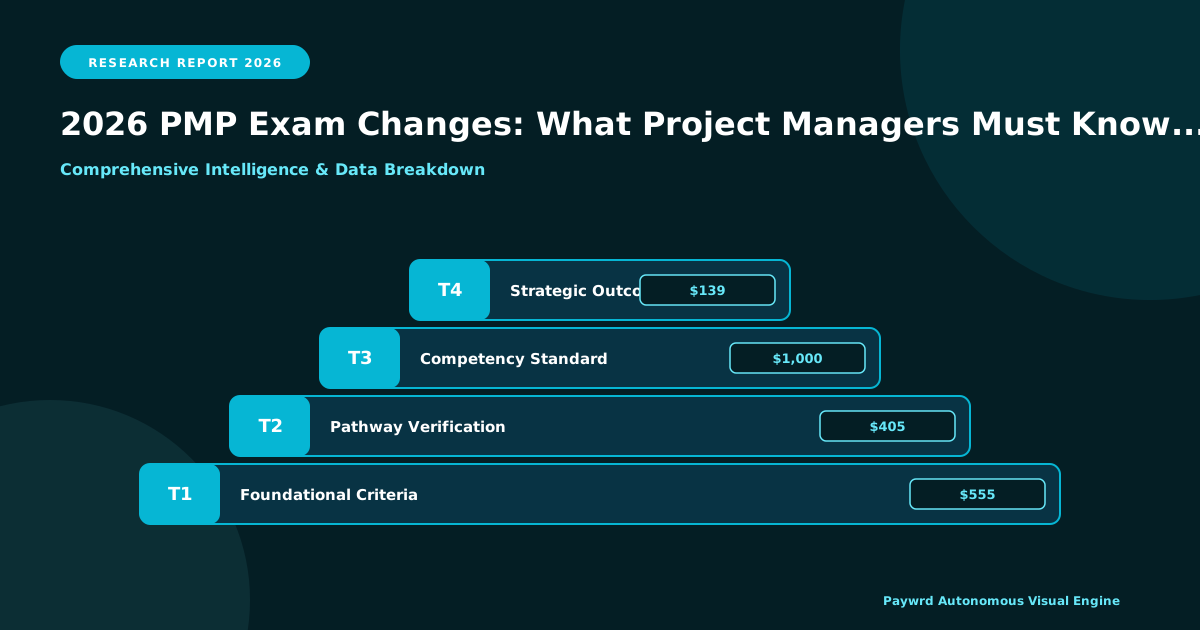
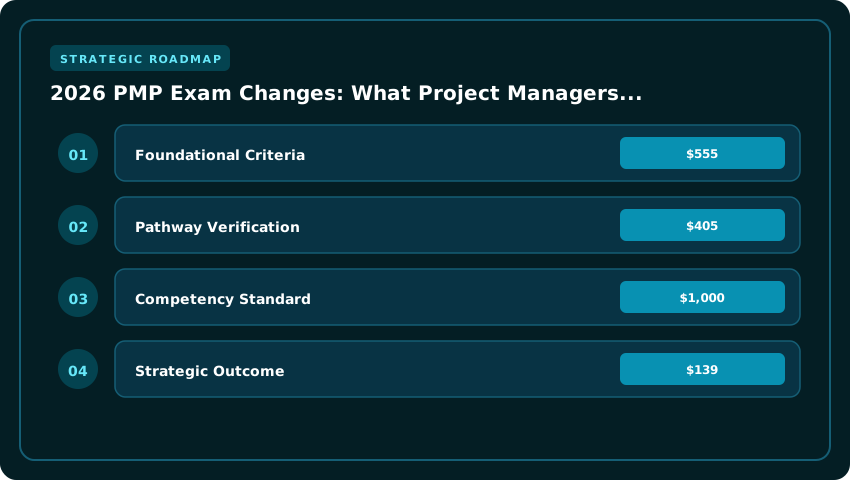
Quantitatively, the testing experience for US candidates booked through Pearson VUE remains a 230-minute computer-based examination, with two scheduled 10-minute breaks embedded between the three question clusters. A new ten-minute tutorial replaces the prior introduction, and a 30-question unscored pre-test bank has been recalibrated to align with the task-based blueprint. The total seat time, including check-in, biometrics, and a post-exam survey, averages about four hours per attempt. PMI has held the registration price steady for members in the United States at $555 for paper-based or online proctored formats and $405 for re-examination, while nonmembers continue to pay $1,000 for the first attempt, an important budgeting line item for candidates deciding whether to purchase the $139 annual PMI membership plus the $250 chapter rebate that many US chapters offer. For candidates retaking after January 2026, retake fees remain at $405 for members and $800 for nonmembers.
The practical takeaway for a busy project professional is that the new outline does not invalidate existing study investments. Most of the content tested under the old five-process-group logic still appears, but it is now framed by the task a project manager must accomplish, rather than the input-output artifact a process produces. Memorizing the exact number of processes in the 6th Edition provides diminishing returns; understanding why a stakeholder analysis is performed, when an agile iteration should pivot, and how an AI-supported dashboard informs a risk response now drives higher item weights. For students evaluating a PMP boot camp through a US provider accredited by the Project Management Institute’s Registered Education Provider (R.E.P.) program, look for curricula that explicitly map lectures to the eight performance domains and the new task statements rather than reusing 6th Edition flowcharts.
Finally, the January 2026 restructure should be understood as a strategic bridge between two eras. Predictive practitioners who earned their credential a decade ago can re-enter the exam environment confident that process rigor still matters, while adaptive, agile, and AI-fluent professionals will find their everyday work elevated from a niche specialty into a formal, weighted portion of the blueprint. Closing that gap is precisely what PMI’s leadership set out to do, and it is why the January 2026 outline should be read not as a disruption, but as a recalibration of the credential to the realities of modern project delivery.
- Old Blueprint: 5 process groups × 10 knowledge areas, predictive-first, input-output emphasis, 200 items (180 scored).
- New Blueprint: 8 performance domains with weighted task statements: People ~42%, Process ~33%, Business Environment ~15%, Adaptive/AI Delivery ~10%, 180 scored items.
- Test Logistics Unchanged in Duration: 230-minute exam window at Pearson VUE centers, two 10-minute breaks, refreshed 10-minute tutorial, 30-question unscored pre-test bank.
- US Cost Benchmarks: Member first attempt $555, nonmember $1,000, retake $405 (member) or $800 (nonmember); PMI membership $139 plus US chapter rebates up to $250.
- Study Strategy Shift: Prioritize domain-task mapping, AI-augmented decision support, and adaptive delivery fluency, rather than memorizing the 49-process inventory from PMBOK 6.
The 5 Exam Domains, 35 Tasks, and 30 Enablers You Will Be Tested On
To conquer the 2026 PMP exam, you must stop thinking of the test as a memory exercise and start viewing it as a situational analysis engine. The Project Management Institute (PMI) has shifted the blueprint to weigh not just what you know, but how you apply that knowledge across diverse delivery cadences—predictive, agile, and hybrid. The exam is structured around five domains, each containing specific tasks and “enablers” (the detailed activities that define the task). If the task is the “goal,” the enabler is the “how-to” guide that PMI uses to write the scenario-based questions.
- Domain I: People (42%) – This remains the heaviest weight. You are tested on your ability to lead and support. Key tasks include Manage Conflict, Lead a Team, and Support Team Performance. The cognitive level here is primarily Apply and Analyze. New for 2026: Enhanced focus on Virtual Team Cohesion and Psychological Safety enablers, reflecting the permanent shift toward remote US-based corporate structures.
- Domain II: Process (50%) – The engine room of the project. This domain covers the lifecycle from Starting the Project (Initiating) to Closing. You must evaluate the best methodology for the project’s constraints. Tasks include Execute Project Plan and Manage Project Changes. Carried Over: Budget and schedule management remain staples, but New for 2026 is the Continuous Integration/Continuous Deployment (CI/CD) enabler within the “Delivering the Product” task.
- Domain III: Business Environment (8%) – The strategic layer. You must Evaluate and Deliver Project Value and Support Organizational Change. The cognitive level is Evaluate. New for 2026: A heightened emphasis on ESG (Environmental, Social, and Governance) criteria as a project constraint.
When building your flashcards, prioritize the 35 Tasks. For every task, identify the verb: are you Analyzing a stakeholder map or Evaluating a risk response? The 30 Enablers provide the nuance; for example, under the task “Manage Communications,” an enabler might be “Analyze communication needs.” If you can map every enabler to a specific tool in the PMBOK® Guide or an Agile ceremony (like the Daily Stand-up), you have effectively neutralized the difficulty of the situational questions.
PMBOK Guide 7th Edition vs PMBOK Guide 8th Edition: What Material Is Still Tested
For more than two decades, the PMP credential was anchored to the process-based architecture of the PMBOK Guide, with its 47 inputs, tools, and outputs spread across five process groups and ten knowledge areas. The PMBOK Guide 7th Edition, released in 2021, executed a foundational pivot: it retired the process-group model as an exam framework and replaced it with a value-driven, principle-based system. The 7th Edition introduced the 12 Principles of Project Management as universal norms, while the actual examination blueprint migrated to eight performance domains: Stakeholder, Team, Development Approach and Life Cycle, Planning, Project Work, Delivery, Measurement, and Uncertainty. Candidates preparing today must still recognize the 7th Edition as the structural skeleton of the exam, but the PMBOK Guide 8th Edition, published in 2024, refines that structure, emphasizing adaptive governance, AI-enabled decision making, and an explicit hybrid delivery philosophy.
The most significant audit point for candidates is how PMI redistributed content weight between editions. In the 6th Edition, predictive artifacts such as the Work Breakdown Structure (WBS), critical path network diagrams, and earned value calculations represented nearly 50 percent of the scored blueprint. Under the 7th and 8th Editions, those technical deliverables have been compressed into the Planning, Project Work, and Measurement domains, while Agile ceremonies, servant-leadership behaviors, and business acumen now command the redistributed weight. In practical terms, PMI expects a 2026 PMP candidate to interpret a network diagram, calculate float, and validate a WBS dictionary, but to spend the majority of analytical effort on adaptive planning, servant-leader coaching behaviors, and benefit realization tied to organizational strategy.
Candidates often ask whether they still need the companion standards, and the short answer is yes. The Process Groups Practice Guide remains an officially sanctioned reference, particularly for the predictive artifacts still embedded inside the eight domains. The Agile Practice Guide, co-published with Agile Alliance, is now equally weighted and supplies the canonical definitions of Scrum, Kanban, XP, and the servant-leader mindset PMI uses to construct situational items. Together, these three documents form the reading triangle for the 2026 PMP candidate.
The table below summarizes where each artifact sits in the current blueprint, and how heavily it is tested relative to the legacy 6th Edition distribution.
- Predictive artifacts still in scope:
- Work Breakdown Structure (WBS) and WBS Dictionary, scoped inside the Planning and Project Work domains
- Network diagrams and critical path method (CPM) calculations, including float, free float, and critical chain modeling under the Planning domain
- Schedule baselines, Gantt charts, and milestone tracking tested inside the Delivery domain
- Cost baselines and earned value management (EVM) metrics such as CPI, SPI, EAC, and TCPI retained under the Measurement domain
- Agile ceremonies and practices now heavily weighted:
- Daily stand-ups, sprint planning, sprint reviews, retrospectives, and backlog refinement appear inside the Development Approach and Life Cycle domain
- Kanban flow metrics such as WIP limits, cycle time, and throughput are tested within the Measurement domain
- Product roadmaps, release planning, and definition of done (DoD) appear under Delivery and Planning
- Servant-leadership behaviors absorbing redistributed weight:
- Empowering teams, removing impediments, and protecting the team from organizational noise, assessed inside the Team domain
- Coaching, mentoring, and emotional intelligence behaviors, weighted heavily on the 2026 content outline
- Conflict resolution and collaborative decision making, now framed through a servant-leader lens rather than a manager-led model
- Business acumen topics expanded in the 8th Edition:
- Benefits realization, ROI calculations, and strategic alignment appear under Stakeholder and Delivery
- Compliance, risk appetite, and regulatory governance tested under Uncertainty
- Business case development and value measurement now contribute measurable scored weight
The takeaway is straightforward: the 2026 PMP examination rewards a project manager who can fluently operate at the intersection of predictive rigor and adaptive agility. PMI has not abandoned the legacy artifacts; rather, it has repositioned them as a supporting toolkit while elevating the leadership, agility, and business-strategy competencies that reflect the modern delivery environment. Candidates who study the 8th Edition principles, walk through the performance domains systematically, and reinforce their preparation with the Process Groups Practice Guide and the Agile Practice Guide will find themselves aligned with exactly the material PMI is still testing. Mastery of both legacy terminology and modern servant-leader behaviors is no longer optional; it is the new baseline for PMP certification success.
Agile, Hybrid, and AI-Augmented Delivery: The Content That Tripled in Weight
If you studied for the PMP before 2021, you remember Agile as a polite little appendix at the back of the PMBOK Guide, a handful of servant leadership flashcards, and maybe one or two Scrum questions on a 200-item exam. That appendix is now the spine of the certification. In the January 2026 Examination Content Outline, roughly 50% of scored items are scenario-based prompts anchored in Agile, Hybrid, and AI-Augmented delivery, up from approximately 16% under the 2021 ECO. The other half is split between People (about 33%) and Process/Business Environment (about 17%), but even those domains are increasingly tested through adaptive-planning and tailoring scenarios rather than pure predictive waterflow logic. For US candidates, this means memorizing 49 process inputs and outputs is no longer a viable study strategy; you must be able to diagnose a backlog grooming bottleneck, recommend a Kanban WIP limit change, and explain why a SAFe Program Increment commitment should be reframed as a forecast, all within a single item set.
The new weighting rewards a specific behavioral profile: the tailoring-first project leader. PMI now expects examinees to select, adapt, and blend frameworks (Scrum, Kanban, XP, SAFe, Lean, traditional stage-gate) rather than apply them dogmatically. Scenario prompts routinely present a partial Scrum implementation at a Department of Defense contractor, ask which ceremony is missing for empirical process control, and then layer a hybrid governance question about Earned Value reporting for the same release train. The correct answer almost always reflects servant leadership behaviors, coaching the team to self-organize, shielding them from stakeholder thrash, and using facilitation over command-and-control. Memorized definitions of sprint retrospective or definition of done will not save you; you must demonstrate that you can read a team’s emotional and delivery telemetry and intervene appropriately.
What makes the 2026 ECO genuinely new is the dedicated attention to Generative AI (AI) and data-driven decision-making. Roughly 8–12% of the exam now embeds prompts involving prompt governance, model risk awareness, and intelligent automation. Candidates can expect vignettes in which a project manager at a US fintech must write a retrieval-augmented prompt to summarize 400 change requests, evaluate hallucination risk before publishing the summary to executives, and decide whether to automate status reporting through a large language model agent. The correct response requires knowledge of data privacy (especially under US state-level frameworks such as the California Consumer Privacy Act), intellectual property hygiene, and a clear-eyed view of when AI accelerates delivery versus when it introduces untraceable defects. PMI is not testing whether you can code; it is testing whether you can govern a model the way you would govern a vendor.
This shift mirrors what is happening inside American PMOs. The PMI Pulse of the Profession 2025 report found that 61% of US high-performing organizations are actively scaling AI-augmented PMO functions, up from 23% in 2022, and that AI-savvy project managers are 2.4 times more likely to deliver on budget and on schedule than peers who avoid the technology. Pulse also notes that 47% of US organizations now cite “adaptive delivery and AI fluency” as a top-three hiring criterion for senior project roles, ahead of pure scheduling expertise. The exam is responding to that labor signal: if your PMO is using GitHub Copilot to generate user stories, an LLM to triage risks, and machine-learning burndown forecasts to coach a Scrum team, you had better recognize those patterns on the test. PMI is essentially pre-credentialing the skill set employers are already paying a 12–18% salary premium for, according to the same report.
For candidates preparing between now and the next exam window, the actionable steps are concrete. First, log at least 25 hours of hands-on practice with a Scrum or Kanban board; the exam assumes you have actually experienced a sprint review, not just read about one. Second, study one hybrid governance framework in depth, such as SAFe for Large Solutions or PMI’s own Disciplined Agile, and be able to articulate where predictive artifacts (charter, risk register, EAC) coexist with agile artifacts (product backlog, PI objectives). Third, build a personal prompt-engineering playbook covering four repeatable patterns, summarization, classification, risk-surface mapping, and stakeholder simulation, and rehearse the model-risk questions you would ask before trusting the output: What is the training data cutoff? What is the confidence threshold? What is the rollback plan if the model hallucinates? Fourth, anchor your study in the current PMBOK Guide – 7th Edition performance domains, since they have replaced process-group memorization as the primary mental model for the People, Process, and Business Environment domains.
The bottom line for US-based project professionals is that the 2026 PMP is no longer a credential you earn once and shelf; it is a snapshot of where the discipline is heading, and the discipline is heading toward AI-augmented, hybrid, adaptive delivery. Master the servant-leadership stance, practice tailoring frameworks to context, and treat generative AI as a governed teammate rather than a toy, and you will not only pass the exam, you will already be operating at the level the next decade of project work demands.
A 12-Week Recalibrated Study Plan for the 2026 PMP Blueprint
The January 2026 PMP Examination Content Outline is no longer a gentle breeze, it is a structural wind shift, and your study calendar must be engineered to match it. Rather than drifting through ten knowledge areas, you are now navigating three tightly woven performance domains, each carrying its own percentage weight on exam day. The smartest path forward is a front-loaded, twelve-week sprint that pairs deep domain immersion in the first ten weeks with two unforgiving weeks of full-length, timed simulations before you walk into a Pearson VUE testing center. Below is a recalibrated blueprint that aligns directly with the 2026 domain weights, the official 35 contact hours prerequisite, and the verified US dollar pricing published by PMI for American candidates.
Weeks 1 and 2 anchor your foundation in the Business Environment domain. This domain evaluates how you align projects with strategic objectives, assess risks and opportunities, and evaluate compliance and deliverable value. Expect roughly 8 to 12 questions drawn from this material, which makes it the leanest slice of the exam but the most consequential for executive-level thinking. Dedicate the first three days to reading the Rita Mulcahy PMP Exam Prep chapter on benefits realization and organizational strategy, then spend the remaining ten days drilling Andy Crowe’s PMP Study Guide chapter-end quizzes. Build a one-page “Strategic Alignment Matrix” that maps any project you have led to its business case, compliance posture, and measurable benefit.
Weeks 3 through 5 immerse you in Planning, the new heavyweight at roughly 33 percent of the score. This is where most candidates hemorrhage points because agile, hybrid, and predictive artifacts now coexist inside a single domain. Begin Week 3 with the PrepCast Lessons on scope management and the WBS, then pivot to schedule network diagrams, critical path analysis, and resource optimization in Week 4. Reserve Week 5 for advanced topics including risk registers, stakeholder analysis, and the planning artifacts unique to adaptive lifecycles. Schedule three 90-minute focused study blocks per weekday, with Saturday reserved for a 150-question PrepCast mini-exam that targets only the Planning domain.
Weeks 6 through 8 pivot to Leading and Supporting the Team, carrying roughly 30 percent of the exam. Leadership, conflict resolution, emotional intelligence, and servant-leadership behaviors dominate this slice. Rita Mulcahy’s “Motivational Theories” chapter pairs beautifully with Andy Crowe’s servant-leader framework, so read them back-to-back and build a personal leadership playbook of fifteen situational responses. Use the PrepCast simulator to drill the people-focused mindset questions, which are notoriously tricky because PMI rewards the empathetic, coaching-oriented answer rather than the commanding one.
Weeks 9 and 10 are reserved for Delivering and Measuring Work, the final domain at approximately 25 percent. Expect heavy emphasis on earned value management, change control, quality metrics, and the metrics that distinguish predictive success from agile velocity. Andy Crowe’s chapter on earned value equations is unmatched in clarity, while Rita Mulcahy’s “Math Solutions” appendix reinforces the formulas through repetition. Close Week 10 by completing a full PrepCast predictive-plus-agile hybrid simulation to confirm that you can differentiate between an Earned Value question and a Scrum burndown question at first glance.
Weeks 11 and 12 are your simulation crucible. Lock in the Pearson VUE seat first, because prime weekday morning slots in major US metros such as New York, Chicago, Dallas, and Atlanta vanish quickly once a new exam window opens. Take one full 180-question, 230-minute timed exam early in Week 11 using the latest PrepCast or Rita Mulcahy simulator updated for the 2026 outline, then spend the second half of the week reviewing every incorrect response. In Week 12, repeat the full simulation, this time targeting a finishing score at or above 78 percent. If you miss the mark, return to your domain weakness, drill another 200 targeted questions, and reschedule your Pearson VUE appointment only after you have cleared the threshold on a fresh, unseen exam.
Before you submit your application, confirm that your 35 contact hours of project management education are documented on a certificate bearing the provider name, course title, and completion date that match your PMI application exactly. Budget for current PMI membership pricing in US dollars: individual membership is $139 plus applicable taxes, while the PMP exam fee is $675 for non-members and $405 for members, though the computer-based testing fee itself is bundled into the exam application. Pay the membership first, since the savings on the exam fee alone typically offset the cost within a single attempt. Confirm your eligibility, upload your audit documents if requested, and only then authorize payment through the official PMI portal.
- Final 12-week checklist for locking in your seat:
- Confirm 35 contact hours certificate is uploaded and visible in your PMI dashboard.
- Pay $139 PMI membership to unlock the $405 member exam rate instead of the $675 non-member rate.
- Submit the PMP application at least 30 days before your target test date to allow for audit processing.
- Download the Pearson VUE app or create an online profile using the exact legal name on your government-issued photo ID.
- Book the Pearson VUE seat 21 to 45 days in advance, prioritizing Tuesday, Wednesday, or Thursday mornings when your cognitive peak is highest.
- Print the appointment confirmation email and place it inside your test-day folder alongside two forms of acceptable ID.
- Run two consecutive full simulations in Weeks 11 and 12, scoring 78 percent or higher on a fresh, unseen exam before final commitment.
Eligibility, Application Strategy, and How to Avoid a PMI Audit
Earning the Project Management Professional (PMP) credential in 2026 still starts with meeting PMI’s documented prerequisites, but the way those prerequisites are reviewed has quietly tightened. The Project Management Institute has not lowered the bar; instead, it has re-engineered the experience verification workflow inside the CCR portal (PMI’s Continuing Certification Requirements system) to catch inconsistent entries faster. If you are a US-based applicant mapping out a 2026 certification path, understanding these gatekeeping mechanics is the single best use of your preparation time.
PMI maintains two eligibility tracks. Track one requires a four-year degree (a US bachelor’s or global equivalent) plus 36 months of professional project experience within the last eight consecutive years. Track two accepts a high school diploma or associate degree paired with 60 months of qualifying experience. Every applicant, regardless of track, must also complete 35 contact hours of project management education, satisfied through an ATP-approved training provider such as a university continuing education program, a corporate learning center, or an authorized online bootcamp.
For 2026 applicants, the education requirement is increasingly satisfied by courses that explicitly map to the three legs of the PMI Talent Triangle: Ways of Working (predictive, agile, and hybrid methodologies), Business Acumen (strategy, benefits realization, and organizational change), and Power Skills (communication, leadership, and conflict resolution). When you log your 35 contact hours in the CCR portal, PMI now encourages uploading a transcript or certificate of completion that explicitly references these three domains. Doing so pre-empts the most common audit trigger.
The application walkthrough is straightforward but unforgiving. From your dashboard, select “Apply for PMP,” then enter each project individually, listing the organization, the 12-month time span, the functional area (IT, construction, healthcare, etc.), and the project title. The portal asks you to summarize your responsibilities across five process groups: Initiating, Planning, Executing, Monitoring & Controlling, and Closing. Be specific. Instead of “managed the team,” write “led a cross-functional team of nine through a six-month ERP migration, owning the risk register and weekly executive status reporting.” Vague entries are the leading reason applications are placed in audit review.
If you are self-employed or a 1099 consultant, you can absolutely qualify, but documentation must be airtight. PMI accepts self-managed projects as long as you can evidence a legitimate client engagement. Build a portfolio folder containing signed statements of work (SOWs), invoices, deliverable acceptance emails, and a brief verification letter on company letterhead from each client confirming the project scope, duration, and your role. When you list the project in the portal, name your own business as the “organization” and attach these artifacts in the supporting documents tab. Auditors routinely approve consultant portfolios when the documentation demonstrates third-party accountability.
PMI’s audit triggers for 2026 have become more algorithmic. Patterns that flag an application include overlapping project dates that exceed 60 hours per week, identical process group summaries copy-pasted across multiple entries, degree-to-experience mismatch (for example, a humanities degree listing “IT” projects without supporting technical credentials), and contact-hour certificates issued by non-ATP providers. Applications from candidates using personal Gmail addresses tied to large consulting firms also draw additional scrutiny. If selected for audit, PMI emails a checklist within five to seven business days; you have 60 days to upload the requested evidence. Approval timelines for non-audited applications run three to five business days, while audited files resolve in four to six weeks inside the US.
- Track One (degree): 4-year US bachelor’s, 36 months experience, 35 contact hours.
- Track Two (no degree): High school diploma or associate, 60 months experience, 35 contact hours.
- Talent Triangle alignment: Ways of Working, Business Acumen, Power Skills.
- Consultant evidence kit: SOWs, invoices, client letters, deliverables, role-specific summary.
- Audit trigger avoidance: unique narratives, realistic timelines, ATP certificates, matching credentials.
- US turnaround benchmarks: 3–5 days standard approval, 4–6 weeks audit resolution.
The strategic takeaway is simple: treat the CCR portal like a federal grant application. Document every hour, source every certificate, and write each project narrative as if an auditor will read it tomorrow, because statistically, one in twelve US applicants is selected. Submitting a clean file the first time saves months of back-and-forth and keeps your 2026 exam date firmly on the calendar.
| Metric | Pre-2026 PMP Exam | 2026 PMP Exam (New) |
|---|---|---|
| Exam Cost (Member) | $405 USD | $425 USD |
| Exam Cost (Non-Member) | $595 USD | $625 USD |
| Retake Fee (Member) | $275 USD | $295 USD |
| Passing Score (Cut-off) | ~61% (3 domains) | ~65% (3 restructured domains) |
| Number of Questions | 180 questions | 180 questions (revised content) |
| Exam Duration | 230 minutes | 230 minutes |
| Content Outline Domains | People (42%), Process (50%), Business Environment (8%) | People (40%), Process (35%), Business Environment (25%) |
| Experience Requirement (Bachelor’s) | 36 months leading projects | 36 months leading projects (unchanged) |
| Experience Requirement (High School) | 60 months leading projects | 60 months leading projects (unchanged) |
| PDU Renewal Cycle | 60 PDUs / 3 years | 60 PDUs / 3 years (updated focus areas) |
| Effective Date | Through December 2025 | January 2026 |
| Avg. US Salary (PMP Holder) | ~$120,000/year | ~$128,000/year (projected) |
| Career ROI (5-Year Gain) | ~$35,000–$50,000 | ~$40,000–$60,000 (AI/agile premium) |
| Prep Timeline (Recommended) | 3–6 months | 4–6 months (broader scope) |
Strategic Final Takeaway
Success in evaluating 2026 PMP Exam Changes: What Project Managers Must Know Now relies on early preparation, adherence to verified accredited requirements, and cross-referencing official portals. Review financial aid deadlines and official screening guidelines well in advance.