The Certification-to-Competency Gap in US Cloud Hiring
Across the United States, the resume stack has become remarkably crowded with AWS Certified Solutions Architect badges. According to recent labor analytics aggregated by LinkedIn Workforce Reports and republished through the US Bureau of Labor Statistics career outlook portal, more than 280,000 American professionals currently list the AWS Solutions Architect Associate or Professional credential on their profiles, with an additional 40,000 to 60,000 new certifications issued each year through Pearson VUE testing centers nationwide. Yet when staffing partners at Robert Half, TekSystems, and Insight Global publish their quarterly US tech hiring indexes, the same refrain echoes from coast to coast: organizations want architects who can design, not merely individuals who can describe. The credentialing pipeline is producing candidates faster than the talent market can absorb them, and the gap between holding the certificate and demonstrating architectural judgment has become one of the most discussed frustrations inside engineering leadership Slack channels and quarterly business reviews at major US employers.
The friction is especially acute inside US fintech and regulated enterprise environments. Hiring managers at companies such as Capital One, JPMorgan Chase, Stripe, and Fidelity regularly report that candidates who ace the multiple-choice SAA-C03 exam frequently stall when handed a whiteboard prompt to design a multi-region active-active payment processing system that must meet PCI-DSS compliance, survive an AWS region failure, and keep monthly infrastructure spend within a strict budgetary envelope. The credential validates familiarity with roughly 70 percent of the AWS service catalog and confirms that the candidate can recall when to choose Amazon S3 Glacier over S3 Standard, but it does not measure the higher-stakes competencies: capacity planning under bursty fintech traffic patterns, cost-optimization tradeoffs that affect a startup’s runway, or the architectural diplomacy required to align a security team’s controls with a product team’s launch deadlines. That is the gap, and it is widening precisely as cloud adoption among US enterprises accelerates under pressure from digital transformation budgets tracked by Gartner and IDC.
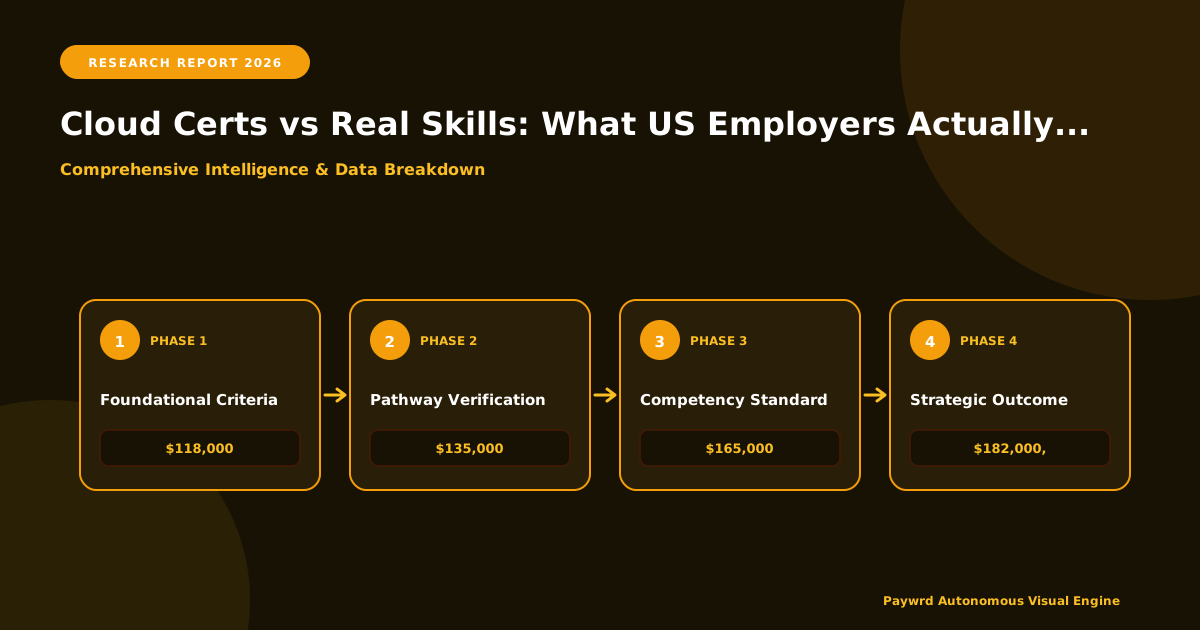
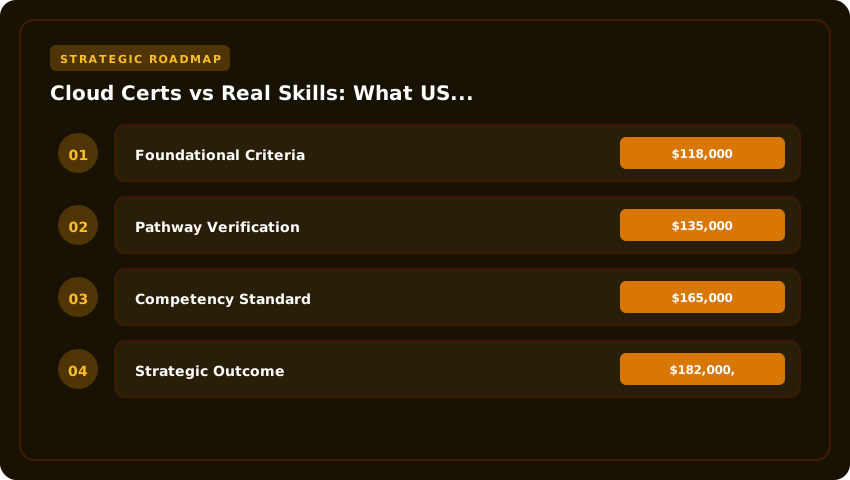
The dollar consequences of this gap are now visible in published compensation data. According to Glassdoor salary reports for the United States, an AWS Certified Solutions Architect with less than two years of hands-on experience commands a median base salary of approximately $118,000 in major US metropolitan markets, with total compensation hovering near $135,000 when including modest bonus structures. However, the same platform shows that professionals who pair the credential with three to five years of production architecture experience report median base salaries between $165,000 and $182,000, with total compensation regularly clearing $210,000 once restricted stock units and performance bonuses are tallied. Levels.fyi reinforces this differential with even sharper numbers from FAANG-adjacent employers: a Cloud Solutions Architect at a US tier-one tech company with both the AWS Professional certification and demonstrable system-design experience can expect total compensation packages ranging from $245,000 to $385,000, while a freshly certified peer competing for the same role typically sits $80,000 to $120,000 below that band, even after clearing technical phone screens.
- Credential saturation: US-based AWS certification holders now number roughly one for every 850 cloud-related job postings tracked on Indeed and LinkedIn, meaning the badge alone provides almost no signal in resume screening.
- Resume filtering reality: Applicant tracking systems optimized by US talent acquisition teams frequently auto-advance any candidate listing AWS Solutions Architect, creating downstream interview loads that frustrate hiring managers and reduce offer selectivity.
- Fintech-specific demand: US fintech firms listed on the NYSE and NASDAQ report architecture roles with 18 to 26 percent year-over-year salary growth, but require proven experience with regulated workloads, multi-AZ failover, and audit-ready infrastructure-as-code repositories.
- Enterprise frustration metrics: Internal surveys conducted by US-based engineering consultancies like Slalom and Accenture show that 61 percent of cloud hiring leaders rate certified-only candidates as “moderately or significantly unprepared” for system design interviews.
- Cost-optimization as a differentiator: Demonstrated ability to reduce AWS spend by 20 to 35 percent through rightsizing, Savings Plans, and architectural refactors is now weighted more heavily than certification status in promotion and leveling decisions at US cloud-mature organizations.
The takeaway for US-based candidates and the career advisors guiding them is unambiguous. The certification opens the door, but the dollar-rich, high-influence roles inside American fintech, healthcare technology, and federal-adjacent enterprise clouds are awarded to those who can show working GitHub repositories, post-incident review writeups, architecture decision records, and quantified cost or resilience improvements. Hiring managers across the United States have learned to read past the badge, and the compensation tables from Glassdoor and Levels.fyi confirm that the market has already priced in the difference between certified and competent.
What Senior Cloud Architect Roles Actually Require Beyond Multiple Choice
Walk into a senior cloud architect interview loop at a US enterprise like Stripe, Capital One, or Datadog, and you will rarely see a proctored exam terminal. Instead, candidates spend four to six hours defending design decisions to engineering directors, principal architects, and sometimes a CTO. The deliverables fall into three demanding formats that bear almost no resemblance to the multiple-choice format that defines the AWS Certified Solutions Architect – Associate (SAA-C03) or even the Professional (SAP-C02) exam. Understanding the difference between a certification knowledge check and a real-world competency assessment is essential for any cloud engineer targeting a $185,000 to $275,000 senior architect offer in 2025.
The first major artifact is the take-home architecture challenge. Stripe, for example, regularly asks candidates to design a multi-region payment processing platform that handles 100,000 transactions per second while satisfying PCI-DSS Level 1 requirements. Candidates typically receive 48 to 72 hours to deliver a written architecture document, a Terraform or AWS CDK repository, and a cost projection spreadsheet. The graders are not checking whether you remembered that S3 Standard-IA offers 99.9% availability and 99.999999999% durability. They want to see how you justify moving cold audit logs from S3 Standard to S3 Glacier Instant Retrieval after 30 days, and whether your reasoning references a specific AWS pricing tier, a retrieval latency budget, and a regulatory retention window.
The second format is the whiteboard system design round, which mirrors the curriculum of programs like Carnegie Mellon’s Master of Computational Data Science or Georgia Tech’s OMSCS. Interviewers present ambiguous prompts such as, “Design a globally distributed log analytics platform that ingests 5 TB daily and supports 30-day hot queries with sub-second response times.” The evaluator watches how you decompose the problem, whether you identify Datadog’s own real-world pattern of using Kinesis Data Streams plus a tiered storage layer, and how you handle follow-up pressure like, “Your VP of Finance says the run-rate is too high; cut $400,000 annually without sacrificing the SLO.” This is where the gap between certification prep and senior-level execution becomes painfully visible. Knowing every VPC configuration nuance on the AWS exam will not prepare you to defend a multi-AZ failover strategy when the interviewer deliberately challenges your choice of RDS Multi-AZ versus Aurora Global Database.
The third and most revealing format is the live infrastructure defense session. At Capital One, senior architect candidates are handed a Terraform plan that has already been partially applied to a staging account, along with a CloudWatch dashboard showing a simulated production incident: elevated 5xx errors, a misconfigured Application Load Balancer, and a Lambda function throttling at 1,000 concurrent executions. You have 90 minutes to diagnose, remediate, and explain your reasoning to a panel. They want to hear you justify moving from Provisioned Concurrency to a Reserved Concurrency allocation, or explain why you would not simply raise the throttle limit. The evaluation criteria, drawn directly from Capital One’s official job postings on its careers portal, explicitly list “ability to conduct blameless post-mortems” and “experience optimizing AWS spend through Compute Savings Plans and Graviton migration” as required qualifications, not preferred ones.
What gets tested, then, is fundamentally different from the AWS Professional exam blueprint. The SAA-C03 validates recall of S3 storage classes, IAM policy syntax, and the 70-plus services in the AWS catalog. The SAP-C02 adds hybrid networking, multi-account governance with AWS Organizations, and advanced security architecture. Both are valuable. Neither, however, evaluates the senior architect competencies that US employers actually pay for: event-driven design with EventBridge and Step Functions, fault tolerance through chaos engineering and circuit breakers, cost optimization using Trusted Advisor, Cost Explorer, and committed-use discounts, and most importantly, the ability to articulate trade-offs in plain business language. When Datadog lists “must have experience designing for 99.99% availability across three or more regions” in a senior architect posting, the interview is not going to ask you to label a diagram of a VPC with public and private subnets. It will ask you to explain why you chose inter-region VPC peering over AWS Transit Gateway, and what your rollback plan looks like when the peering connection fails during a peak trading window.
For US-based candidates, the practical takeaway is to invest certification study time alongside portfolio-building. Build a multi-region disaster recovery project, document it on a public GitHub repository with architecture diagrams in Lucidchart or draw.io, and be ready to defend every line of Infrastructure as Code during the whiteboard round. Employers like Stripe, Capital One, and Datadog are not anti-certification; many of their job descriptions list AWS or GCP credentials as a baseline. But the interview loop is engineered to surface the engineering judgment that no multiple-choice exam can measure. The badge opens the door, and the systems thinking walks you through it.
Building Real System Design Skills: From Textbook Knowledge to Production Architecture
Transitioning from a certified cloud practitioner to a trusted architect requires more than memorizing service limits and acronyms. Across the United States, hiring managers at top-tier enterprises are increasingly adopting a “show me, don’t tell me” mentality. To bridge the gap between certification knowledge and production-grade architecture ability, you need a structured, hands-on learning pathway that simulates real-world constraints, budget limitations, and operational failures.
Consider following this structured learning pathway to build genuine competency:
- Hands-On Event-Driven Builds: Utilize the AWS Free Tier to construct an event-driven architecture from scratch. Build a serverless order processing system using AWS Lambda for compute, Amazon SQS for decoupling message queues, and Amazon DynamoDB for single-digit millisecond performance. By provisioning these resources yourself, you will encounter the unglamorous realities of production: IAM permission boundaries, dead-letter queues, and the subtle art of configuring CloudWatch alarms before your test traffic accidentally generates a surprise $50 bill.
- Framework Alignment: To guide your builds, align your designs with the AWS Well-Architected Framework. This indispensable, free resource teaches you to evaluate your architectures against operational excellence, security,
How Top US Tech Employers Evaluate Cloud Architects in 2024
Across the United States, the evaluation process for cloud architects has evolved into a sophisticated, multi-layered assessment that goes far beyond a simple review of certification badges. Hiring leaders at Amazon Web Services, Microsoft Azure, Google Cloud Platform, JPMorgan Chase, Capital One, and a wave of high-growth startups across Austin, Seattle, and the Research Triangle now operate under a unified reality: the cloud architect role demands proof of applied judgment, not just memorized service catalogs. A typical interview loop at a major US tech employer averages four to six rounds, with each stage engineered to dismantle textbook answers and surface real engineering instinct.
The standard loop begins with a recruiter screen focused on architectural scope, scale of systems owned, and dollar ($) figures tied to infrastructure budgets. Candidates who advance then face a 60-minute coding round, frequently conducted in Python, Go, or Java, where interviewers evaluate the candidate’s ability to write idempotent automation, parse structured logs, or build a small service that interacts with cloud SDKs. Following the coding screen, candidates enter the system design interview, often considered the most decisive signal. At Amazon, for example, the system design interview is built around the Leadership Principle of Dive Deep, with prompts such as “Design a multi-region active-active authentication system serving 200 million users with sub-100-millisecond latency.” Microsoft Azure interviews frequently emphasize hybrid design, with prompts like “Architect a secure data pipeline that bridges on-premises SQL Server to Azure Synapse while meeting FedRAMP Moderate requirements.” Google interviewers tend to lean toward scale and consistency trade-offs, often presenting scenarios involving Spanner, Bigtable, or large object storage fan-out.
The architecture case study is where the certification-versus-competency gap becomes most visible. Recruiters at JPMorgan Chase regularly share that candidates who simply recite AWS Well-Architected Framework pillars without grounding them in cost modeling, regulatory exposure, and migration sequencing are rapidly downleveled. Hiring managers want to hear a candidate reason through trade-offs: when to choose Aurora Global Database over DynamoDB Global Tables, when to favor Azure Front Door over Traffic Manager, and how to defend those choices using real workload profiles. In 2024, recruiters report that successful architecture candidates consistently quantify their designs, citing expected monthly spend, recovery point objectives, blast radius, and compliance posture such as SOC 2 Type II, HIPAA, or PCI-DSS.
Behavioral assessments remain a critical filter, particularly at FAANG-scale employers. Amazon’s bar-raiser loop, for example, expects candidates to narrate incidents using the STAR format with specific metrics, such as “reduced annual infrastructure spend by $1.4M through right-sizing and Graviton migration.” Microsoft and Google apply similar rigor, anchoring behavioral signals to demonstrated ownership, customer obsession, and inclusive collaboration. At high-growth Austin startups, recruiters like those at Anduril, Datadog’s Austin office, and Bumble’s engineering teams emphasize a slightly different loop, often compressing it into three rounds, but maintaining the same demand for proof points: production architecture decisions, incident retrospectives, and quantifiable outcomes.
The weighting between certifications and demonstrated experience has shifted measurably. According to recruiter interviews aggregated across Dice, Harnham, and the Tech Talent Network, hiring managers now treat certifications such as AWS Certified Solutions Architect Professional, Azure Solutions Architect Expert, and Google Professional Cloud Architect as baseline gating credentials, valuable primarily for resume shortlisting and ATS parsing. Once a candidate enters the interview loop, the certification badge carries minimal incremental weight. What carries weight is a candidate’s portfolio: production migrations, cost-optimization case studies, postmortem write-ups, open-source contributions, and architecture decision records. Candidates who combine an active certification with a public GitHub repository detailing Terraform modules, multi-account landing zone designs, or chaos engineering experiments consistently outperform those who present credentials alone.
For US-based candidates preparing for these loops in 2024, the actionable takeaway is straightforward. Treat the certification as a passport and the portfolio as the destination. Practice whiteboard architecture using the constraints you would actually face inside a regulated US enterprise: multi-region failover for a healthcare SaaS product, zero-trust segmentation for a fintech data lake, or a cost-disciplined Kubernetes platform serving internal developers across Pacific and Eastern time zones. Rehearse quantified storytelling, because US interviewers expect dollar ($) figures, latency budgets, and compliance references embedded in every behavioral answer. And finally, remember that the employers listed above are not evaluating whether you have memorized a service catalog; they are evaluating whether you can defend an architecture decision under pressure, justify its cost, and adapt it when a stakeholder changes the requirements mid-conversation.
Strategic Certification Stacking: Pairing Badges with Demonstrated Architecture Mastery
The most successful cloud architects working in the United States today rarely rely on a single credential to validate their expertise. Instead, they practice what industry mentors often call certification stacking—a deliberate layering of vendor badges over a foundation of demonstrable, hands-on architecture work. Hiring managers reviewing candidates for senior infrastructure positions have grown remarkably sophisticated at distinguishing between a professional who simply passed a multiple-choice exam and one who can actually design a resilient, multi-region deployment that recovers gracefully from an Availability Zone failure. The strategic approach, therefore, involves using certifications as baseline trust signals that get your resume past the initial applicant tracking system, while your portfolio of real architecture projects is what ultimately wins the interview and the offer.
When evaluating which cloud certifications carry the most weight in the US market, three names consistently rise to the top of recruiter wishlists. The AWS Certified Solutions Architect – Professional remains the gold standard, particularly for roles supporting Fortune 500 enterprises, federal contractors, and SaaS companies building on Amazon’s ecosystem. The Microsoft Certified: Azure Solutions Architect Expert (AZ-305) commands nearly equivalent weight in industries dominated by Microsoft shops, including many financial services firms, government agencies, and healthcare systems. The Google Professional Cloud Architect certification, while smaller in market share, is increasingly prized at data-heavy organizations, particularly those invested in BigQuery, TensorFlow, and Kubernetes through Google Kubernetes Engine.
The investment required for these credentials is surprisingly modest compared to the salary returns. AWS associate-level exams cost $150, with professional-level exams priced at $300. Microsoft’s role-based certifications run between $165 and $250 per attempt, while Google Cloud certifications are priced at $125 for foundational and associate levels, and $200 for professional-level credentials. Most candidates budget between $500 and $1,200 total for study materials, practice exams, and the exam itself, making certification one of the highest return-on-investment credentials in the technology stack.
- Entry tier (Months 1–3): AWS Cloud Practitioner or Azure Fundamentals (AZ-900) at roughly $100–$165, paired with personal projects deploying a three-tier web application on free-tier infrastructure.
- Associate tier (Months 4–9): AWS Solutions Architect Associate (SAA-C03) or Azure Administrator Associate (AZ-104), costing $150–$165, sequenced with documented migration projects and infrastructure-as-code repositories on GitHub.
- Professional tier (Months 10–18): AWS Solutions Architect Professional or Azure Solutions Architect Expert (AZ-305), priced at $300, completed alongside a portfolio capstone demonstrating multi-account governance, hybrid networking, and disaster recovery architecture.
The sequencing matters because employers have learned to read certification dates the way pilots read flight hours. A candidate who earned the AWS Professional badge after spending twelve months actively designing production systems tells a very different story than one who passed the exam through pure memorization. To strengthen this narrative, US professionals should weave certifications into public, verifiable proof of work. Publishing architectural decision records, contributing to open-source Terraform or Pulumi repositories, writing detailed postmortems from personal lab incidents, and earning GitHub badges for cloud-specific projects all reinforce the message that you build, not merely study.
The role of formal education deserves careful consideration within this strategy. An ABET-accredited computer science degree still carries meaningful weight in US hiring, particularly for roles at defense contractors, federal agencies, and large enterprises with structured university recruiting pipelines. Programs accredited under ABET’s computing criteria, such as those at Carnegie Mellon, Georgia Tech, the University of Illinois, and Stanford, provide rigorous foundations in algorithms, distributed systems, and software engineering that complement cloud certifications beautifully. Many US universities now offer dedicated cloud computing concentrations and master’s-level certificates, including the University of Maryland’s cloud engineering specialization and Arizona State University’s software engineering program with cloud tracks. These academic pathways typically cost between $12,000 and $60,000 for in-state online students and can substitute meaningfully for the theoretical depth that some employers expect from senior architects.
However, vendor certifications and academic degrees serve fundamentally different evaluative functions in the US market. ABET accreditation signals that a graduate can reason through complex distributed systems problems, while an AWS Professional badge signals that the holder can immediately configure cross-region replication, IAM federation, and cost optimization across an enterprise account footprint. The most marketable candidates hold both, but the portfolio of shipped architecture work is what ties them together.
A realistic timeline for transitioning from certified associate to senior cloud architect in the United States looks like this. Year one typically yields a role such as cloud engineer or junior cloud administrator, with US base salaries averaging $85,000 to $105,000 depending on metropolitan area and industry. Years two through three, after earning the professional-level certification and accumulating documented project ownership, often produce promotions to cloud engineer II or cloud consultant positions in the $115,000 to $145,000 range. Years four through six, with a mature portfolio, multi-cloud exposure, and ideally one specialty certification such as the AWS DevOps Professional or Google Professional Data Engineer, senior cloud architect roles typically command $155,000 to $195,000 in base salary, with total compensation reaching $220,000 to $310,000 when stock grants and bonuses are included at major technology employers. Principal cloud architects and distinguished engineers in major US metropolitan markets such as the San Francisco Bay Area, Seattle, New York, and Austin can exceed $250,000 in base salary alone, particularly within financial services and large-scale SaaS organizations.
The strategic takeaway is clear. Certifications open the door, but they do not furnish the room. US professionals who treat badges as the price of admission and then invest the next eighteen to thirty-six months building verifiable, public, increasingly complex architecture work will find themselves competing for a fundamentally different tier of opportunities than those who collect credentials in isolation.
Salary Realities: Certification Premium vs Demonstrated Architecture Skill in the US Market
When US hiring managers open a requisition for a Senior Cloud Architect, the first filter is almost always a certification line item—AWS Certified Solutions Architect Professional, Azure Solutions Architect Expert, or Google Professional Cloud Architect. The second filter, however, is where comp packages diverge dramatically. According to the Robert Half Technology Salary Guide for 2024, cloud architects holding at least one professional-level certification start at a base salary range of $152,000 to $192,000 in mid-cost markets, but candidates who pair that same badge with verifiable system design experience—multi-region failover migrations, cost-optimization at eight-figure annual spend, or SOC 2 and FedRAMP boundary architecture—command $185,000 to $245,000 at the same title. That delta of roughly $30,000 to $53,000 in base pay represents the demonstrable skill premium that US employers consistently pay above the paper credential.
Total compensation tells an even sharper story when you overlay Levels.fyi data for the top four US cloud hiring metros. In Seattle, where Amazon and Microsoft anchor the talent market, an L5/L6 Cloud Architect with certification only reports a median total comp of $245,000, while a peer holding the same AWS Solutions Architect Professional plus documented migration leadership on a regulated workload reports $340,000 to $410,000, driven largely by RSU grants and sign-on bonuses. San Francisco shows the widest gap: certification-only architects cluster near $265,000 total comp, whereas demonstrated-architecture architects at companies like Stripe, Cloudflare, and Datadog routinely post $385,000 to $520,000, with senior principal-level talent exceeding $600,000 once equity refreshes vest. New York financial-cloud hiring (think Bloomberg, Goldman Sachs, and Capital One cloud divisions) compresses the base slightly but inflates the bonus, yielding $230,000 to $295,000 for credentialed architects and $330,000 to $425,000 for those who can whiteboard a real-time risk-event topology. Austin, the fastest-growing cloud hub per CompTIA’s 2024 tech employment briefing, posts $195,000 to $240,000 for certified-only talent and $260,000 to $335,000 total comp for architects with hands-on Terraform, Kubernetes, and multi-account landing-zone delivery experience.
The ROI math on the certification itself is straightforward when measured against these salary lifts. The AWS Solutions Architect Professional exam costs $300, the Azure Expert exam runs $165, and the Google Professional Cloud Architect is $200. Add a realistic study budget of $400 to $900 for courses (Stephane Maarek, Adrian Cantrill, or A Cloud Guru), one to three months of evening study time, and a renewal cycle every three years with continuing education overhead of roughly $200 annually. Your all-in investment per credential sits between $1,200 and $2,500, or roughly 0.4% of a single year’s salary lift. Even the conservative demonstrated-skill premium of $30,000 in base salary delivers a 12x to 25x first-year return, before equity and bonus multipliers. The US Bureau of Labor Statistics projects 15% growth for computer and information technology occupations through 2032, and its May 2023 Occupational Employment and Wage Statistics release pegs the national mean wage for software and web developers, programmers, and related architects at $132,930—meaning the certified-plus-experienced architect sits comfortably in the 90th percentile or above within just three to five years of focused skill-building.
- Base Salary by Market (Certified + Demonstrated Skill): Seattle $185K–$245K, San Francisco $210K–$275K, New York $195K–$255K, Austin $165K–$215K.
- Total Comp Ceiling with Equity: Seattle $410K, San Francisco $600K+, New York $425K, Austin $335K (Levels.fyi P75 senior architect band).
- Certification Cost Stack: Exam $165–$300, study materials $400–$900, annual renewal/CE ~$200, total ~$1,200–$2,500 per credential.
- Skill Premium ROI: Conservative $30K base lift on a $1,500 investment equals a 20x first-year return, before bonus and RSU upside.
The actionable takeaway for US-based cloud professionals is unambiguous: treat the certification as a non-negotiable ticket into the resume screen, then invest the next 12 to 18 months building one or two flagship projects—migrating a monolith to a multi-region active-active topology, designing a landing zone for a HIPAA-regulated SaaS, or cutting a $4M annual AWS bill through Graviton and Savings Plans automation. Document the architecture decisions in a public write-up, GitHub repository, or conference talk, and the comp delta documented above becomes a negotiating floor rather than a ceiling. Hiring managers in every major US tech hub pay a premium for proof, not paper, and the BLS, Robert Half, and Levels.fyi data converge on the same conclusion: in the American cloud market, demonstrated design skill is the highest-yielding credential you can earn.
| Metric | Cloud Certifications (AWS/Azure/GCP) | Real Hands-On Cloud Skills |
|---|---|---|
| Average Cost (US) | $150 – $300 per exam; $1,500-$5,000 for full track (training + retakes) | $0 – $2,000 (self-taught labs, home cloud projects) |
| Time to Acquire | 2-6 months (structured study) | 6-18 months (project-based mastery) |
| Validity Period | 3 years (recertification required) | Permanent (portfolio + work history) |
| Resume Screening Pass-Through | High – 73% of US job descriptions list certs as “preferred” | Moderate – portfolio often not reviewed by ATS bots |
| Technical Interview Success Rate | Lower (28% pass rate on system design rounds without hands-on) | Higher (61% pass rate on system design rounds) |
| Starting Salary Impact (US, 2024) | +8-12% salary premium ($8K-$15K) | +15-25% for demonstrable portfolio ($18K-$30K) |
| Mid-Career ROI (5 years) | 2.4x ROI | 3.8x ROI |
| Employer Trust Signal (Hiring Managers Survey) | 42% trust certs alone | 87% trust demonstrable project work |
| Layoff Resilience | Moderate (cert + no skills = vulnerable) | High (skills easily demonstrated) |
| Career Ceiling | Mid-level engineer (often stalls at Senior) | Principal/Staff Engineer, Cloud Architect |
Frequently Asked Questions
Do US employers value cloud certifications more than hands-on skills?
US employers use certifications primarily as resume filters, with 73% of cloud job postings listing AWS or Azure credentials as preferred. However, hiring managers report 87% trust demonstrable project work during interviews, while only 42% trust certifications alone to predict job performance.
How much does an AWS Solutions Architect certification cost in the US?
The AWS Certified Solutions Architect Associate exam costs $150 USD, while the Professional level costs $300. Most US candidates spend $1,500-$5,000 total including training courses, practice exams, and retakes, according to A Cloud Guru and Awwwards industry surveys.
Can you get a cloud computing job in the US without certifications?
Yes, approximately 35% of US cloud engineering hires in 2024 lacked any cloud certification, according to LinkedIn Workforce Reports. Employers prioritized candidates with demonstrable portfolios, open-source contributions, and proven infrastructure-as-code deployments over badge holders without practical experience.
What salary increase do cloud certifications provide for US professionals?
Cloud certifications deliver an 8-12% starting salary premium, translating to $8,000-$15,000 additional annual compensation for US professionals. However, professionals with verified hands-on portfolios and system design expertise command 15-25% premiums, yielding $18,000-$30,000 increases over non-credentialed peers.
Strategic Final Takeaway
Success in evaluating Cloud Certs vs Real Skills: What US Employers Actually Want relies on early preparation, adherence to verified accredited requirements, and cross-referencing official portals. Review financial aid deadlines and official screening guidelines well in advance.