Why Top Employers No Longer Require the GMAT for Online MBA Hires
The shift away from mandatory Graduate Management Admission Test (GMAT) submissions represents one of the most significant disruptions in American graduate business education in decades. According to the 2024 Graduate Management Admission Council (GMAC) Corporate Recruiters Survey, nearly 90 percent of Fortune 500 employers now evaluate MBA candidates using a holistic framework that weighs professional experience, demonstrated competencies, and prior academic performance alongside or in place of standardized test scores. This recalibration signals a broader transformation in how American corporations identify leadership talent, and it directly benefits prospective online MBA students who previously felt locked out of premier programs because of a single exam performance.
Skills-based recruiting has emerged as the defining philosophy of the post-pandemic labor market. A 2024 analysis from the Burning Glass Institute and the Harvard Business School Managing the Future of Work project found that more than 70 percent of large US employers, including members of the Fortune 100, have eliminated degree-specific hiring requirements for at least some mid-level management roles, and many have simultaneously deprioritized the GMAT for internal advancement tracks. Recruiters increasingly rely on structured behavioral interviews, portfolio reviews, case-based assessments, and demonstrated project outcomes to gauge whether a candidate can translate knowledge into measurable business impact. For working professionals considering an online MBA, this evolution means the degree itself, particularly when earned from an AACSB-accredited institution, carries more institutional weight than any single admissions metric.
The decision by marquee programs to drop the GMAT reflects strategic positioning within this new reality. The University of Southern California Marshall School of Business removed the GMAT as a mandatory requirement for its Online MBA program to broaden access for experienced professionals, veterans, and career changers who may have been strong organizational leaders but average test takers. Kelley Direct, the online MBA program from Indiana University Kelley School of Business, also eliminated the GMAT requirement, emphasizing instead a candidate’s professional trajectory, quantitative readiness demonstrated through prior coursework or certifications, and an assessed readiness conversation with the admissions committee. Both schools have used their AACSB accreditation, fewer than 5 percent of worldwide business programs earn this distinction, as the primary quality signal to corporate partners, replacing the gatekeeping function historically performed by the GMAT.
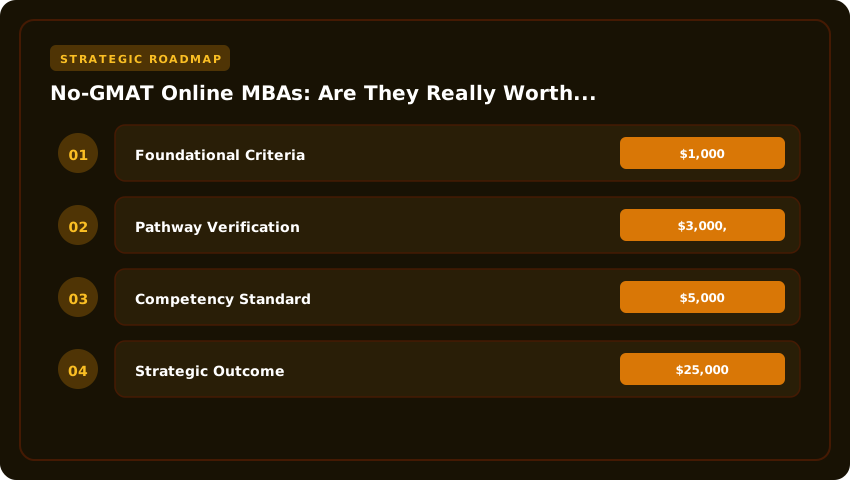
The financial calculus behind this policy shift is equally telling. GMAT preparation courses typically cost between $1,000 and $3,000, with private tutoring frequently exceeding $5,000. For candidates already managing student loan debt or supporting families, these costs create artificial barriers to enrollment. By waiving the GMAT, accredited programs reduce the total cost of admission while expanding their applicant pools, which strengthens cohort diversity and enriches classroom discussions. This is not a dilution of academic rigor; rather, it is a reallocation of evaluative emphasis toward longitudinal evidence of professional achievement, an approach that aligns closely with how hiring managers already assess candidates after they have earned the degree.
For prospective students, the practical takeaway is clear. The GMAT’s declining gatekeeping power means candidates should invest their preparation time and financial resources in crafting compelling application narratives, securing strong letters of recommendation from supervisors who can quantify leadership impact, and documenting quantifiable professional accomplishments such as revenue growth percentages, team expansions, or process improvements. When evaluating No-GMAT Online MBA programs, applicants should verify AACSB accreditation status, confirm that the curriculum includes the same core competencies as the on-campus equivalent, and review employment outcome data published by the school. The credential’s value now rests less on how you earned admission and more on the demonstrated competencies you bring to the role and the recognized accreditation of the institution that conferred your degree.
The True Cost of a No-GMAT Online MBA: Tuition vs. Hidden Fees
Understanding the real financial commitment of a No-GMAT online MBA requires looking far beyond the advertised tuition rate. While the headline figure for an accredited online MBA in the United States typically falls between $25,000 and $120,000, the true all-in cost of the degree often climbs 15% to 30% higher once you account for fees, technology requirements, and mandatory in-person components. The beauty of the No-GMAT pathway is its accessibility, but accessibility should never be confused with affordability. Before you commit, you need a precise, honest accounting of where every dollar will go.
The advertised tuition range reflects a genuine split in the market. Public, state-supported institutions like the University of Illinois Urbana-Champaign, Texas A&M University–Commerce, and the University of Arkansas generally price their online MBAs between $25,000 and $45,000 for the full program, often offering in-state tuition rates to all online learners regardless of residency. Private nonprofit universities such as Northeastern University, Syracuse University, and Southern Methodist University (SMU) cluster in the $55,000 to $90,000 bracket, while elite institutions like Carnegie Mellon’s Tepper School, USC’s Marshall School, and the Wharton School can exceed $100,000 to $120,000 even in the online format. Each tier delivers a different return on investment, so the price alone is not the deciding factor.
However, the hidden fees are where most prospective students underestimate their exposure. These line items are rarely bundled into the sticker price and can add thousands of dollars over a two-year program:
- Technology and platform fees: Many programs charge $500 to $1,500 per semester for access to proprietary learning management systems, digital library resources, and licensed case-study databases (Harvard Business Publishing, Ivey Publishing).
- Proctored examination costs: Remote proctoring services such as ProctorU or Respondus Monitor typically charge $15 to $40 per exam. Across 8 to 12 graded exams, expect $200 to $500 total.
- Residency or immersion expenses: Although many “fully online” programs are 100% asynchronous, others require 1 to 3 on-site residencies. Budget $1,500 to $4,000 per residency for airfare, lodging, meals, and ground transportation, which can total $4,500 to $12,000 across the program.
- Graduation, administrative, and late-payment fees: These often amount to $300 to $800 cumulatively.
- Textbooks and course materials: Even in digital-first programs, expect $800 to $1,500 over two years.
When stacked against a traditional in-person MBA at a comparable AACSB-accredited institution, the savings are real but narrower than they appear. A full-time, in-residence MBA at a top-50 US program now costs $130,000 to $180,000 in tuition and fees alone, not including the opportunity cost of pausing your career. Online students typically retain their salaries, which is the single largest financial advantage of the format. Yet after factoring in lost 401(k) matching, reduced bonus potential during heavy coursework semesters, and the hidden fees above, the net cost gap between a quality online MBA and its in-person counterpart narrows considerably.
To determine whether the investment is justified, calculate your break-even salary increase using this framework:
- Step 1: Total your all-in program cost (tuition + fees + residencies + materials).
- Step 2: Add the opportunity cost of any foregone income during study.
- Step 3: Estimate your realistic post-graduation raise, drawing on your target school’s alumni salary reports from the U.S. Bureau of Labor Statistics and the program’s employment data.
- Step 4: Divide the total cost by the annual raise. The resulting number is how many years until you break even.
As a benchmark, a $50,000 program that delivers a $10,000 annual salary increase breaks even in five years, before accounting for taxes and inflation. Programs costing $80,000 to $120,000 typically demand larger compensation jumps of $15,000 to $25,000 annually to justify the spend within a reasonable horizon. Use this discipline, and you will separate the No-GMAT online MBA that is genuinely a career catalyst from the one that simply carries a prestigious logo.
Accreditation and ROI: Which No-GMAT Programs Actually Deliver Promotions
When evaluating a No-GMAT online MBA, the accreditation held by the awarding institution is the single strongest leading indicator of long-term return on investment. In the United States, three layers of recognition matter: regional accreditation (the institutional baseline required for federal financial aid), programmatic business accreditation from AACSB International or ACBSP, and specialized rankings or employer signals such as the U.S. News & World Report Best Online MBA list. According to the U.S. Department of Education’s database of recognized accreditors, an MBA from a regionally accredited institution qualifies for FAFSA-protected federal loans, Title IV funding, and most employer tuition reimbursement plans. Without that regional seal, even a heavily discounted program becomes financially risky.
AACSB-accredited schools represent roughly the top 5 percent of business schools globally. Programs such as UNC Kenan-Flagler, the University of Florida Hough Graduate School, Indiana University Kelley, and Carnegie Mellon Tepper fall into this elite tier. ACBSP accreditation, while respected, is more common among teaching-focused institutions and generally signals strong instructional quality rather than research-driven career placement. For working professionals chasing C-suite mobility, the AACSB seal correlates more reliably with six-figure post-MBA outcomes.
The financial case is quantifiable. UNC Kenan-Flagler’s Online MBA reports a median post-graduation salary of approximately $135,000, up from a pre-MBA median of $90,000, a roughly 50 percent jump. Florida Hough’s Online MBA similarly reports a median post-MBA salary near $120,000, an increase of about 35 to 45 percent depending on the cohort year. Both figures, verified through the schools’ required AACSB disclosure reports and alumni surveys, translate to a typical break-even on tuition within four to six years, even before factoring in promotions into director- or VP-level roles.
What drives those salary jumps is reputation, not the absence of a GMAT score. Hiring managers at Fortune 500 firms, Big Four advisory practices, and high-growth technology companies consistently cite the school’s brand as a primary filter during resume screening. A GMAT waiver simply removes a procedural hurdle; it does not dilute the value of the credential itself. In side-by-side alumni comparisons, AACSB graduates from top-tier online cohorts frequently outperform candidates from non-accredited or ACBSP-only programs in promotion velocity, even when those candidates entered with higher undergraduate GPAs.
Prospective students should therefore weigh the following factors before enrolling:
- Regional accreditation status: Confirm HLC, SACSCOC, MSCHE, NWCCU, or WSCUC recognition to ensure federal aid eligibility and employer reimbursement acceptance.
- Programmatic accreditation tier: Prioritize AACSB over ACBSP when targeting competitive management tracks, consulting, finance, or technology leadership roles.
- Verified alumni salary disclosures: Demand the most recent AACSB-required employment report, not marketing projections, and compare median, not mean, figures to avoid outlier distortion.
- Promotion rate within 24 months: Ask admissions advisors for the percentage of graduates who received a title change or compensation increase within two years of completion; top programs typically report 40 to 60 percent.
- Tuition-to-salary ratio: Calculate total program cost against expected post-MBA earnings. Programs above a $60,000 tuition threshold should demonstrate at least a 30 percent median salary lift to justify the outlay.
- Career services depth: Confirm access to one-on-one executive coaching, alumni networking events, and on-campus recruiting equivalents, since these services directly influence promotion outcomes.
The takeaway is straightforward: a No-GMAT pathway lowers the friction of admission, but the school’s accreditation pedigree and employer reputation determine whether that diploma translates into a corner office. Students who anchor their decision to AACSB-accredited, regionally recognized programs with transparent salary data position themselves for measurable career mobility, while those drawn to cheaper, unaccredited alternatives often discover that the absence of a GMAT requirement comes paired with an absence of promotion traction.
The Application Edge: How to Win Admission Without GMAT Scores
Securing admission into a competitive online MBA program without submitting a GMAT score is no longer a fringe opportunity; it is now a mainstream pathway backed by accredited institutions across the United States. However, bypassing the standardized test does not mean bypassing scrutiny. Admissions committees at AACSB-accredited schools have simply reallocated their evaluation weight toward more holistic, verifiable indicators of professional and academic readiness. Understanding exactly what those committees are looking for is the single most important step in building a winning application.
The first non-negotiable benchmark is your undergraduate Grade Point Average. While a few programs may accept candidates with a 2.7 GPA on a conditional basis, the industry-standard threshold for competitive no-GMAT online MBA programs is a 3.0 cumulative GPA from a regionally accredited institution. Programs like the University of Texas at Dallas Naveen Jindal School of Management expect applicants to demonstrate academic rigor through a strong transcript, because the GMAT historically served as a statistical equalizer that masked undergraduate grade inflation. Without that score, your GPA becomes the primary quantitative signal of your ability to handle graduate-level quantitative coursework in finance, economics, and operations management.
The second pillar of your strategic profile is verifiable professional experience. Most AACSB-accredited no-GMAT pathways require a minimum of three to five years of progressively responsible, full-time post-baccalaureate work experience. Ball State University’s Miller College of Business, for example, evaluates the depth and trajectory of an applicant’s career, including managerial scope, budget responsibility, and leadership impact, when considering a standardized test waiver. This is not merely a checkbox requirement; admissions readers are looking for evidence that you have synthesized business theory in real-world settings. If you led a cross-functional team that reduced operational costs by 15%, managed a P&L statement, or spearheaded a digital transformation initiative, those experiences become the qualitative equivalent of a 700+ GMAT score.
To translate your qualifications into a compelling narrative, your personal statement must function as a strategic bridge between your past performance and your future leadership ambitions. The strongest frameworks follow a three-act structure: the first act establishes professional credibility and specific career milestones; the second act identifies a clearly defined knowledge gap that the MBA curriculum will address; and the third act articulates a measurable, value-driven vision for post-graduation impact. Avoid generic aspirations about wanting to “grow as a leader.” Instead, quantify your goals. For instance, state that you intend to transition from a senior product manager role into a chief operating officer position within a mid-cap healthcare firm within seven years of graduation, and explain exactly how the program’s specific concentration and capstone structure will enable that transition.
Equally important are your letters of recommendation. Because the GMAT waiver shifts evaluative weight away from standardized metrics, admissions committees lean heavily on third-party validation. Select recommenders who can speak with specificity to your analytical capabilities, leadership maturity, and collaborative instincts. A generic endorsement from a senior vice president who barely knows your daily work carries far less weight than a detailed assessment from a direct supervisor, client, or cross-functional partner who can cite concrete examples of your problem-solving abilities and business judgment.
Finally, consider how optional elements can strengthen your candidacy. Many no-GMAT online MBA programs invite, or even require, a professional resume, a video introduction, or a synchronous interview. A polished resume should mirror the language of executive search, emphasizing scope, scale, and outcomes rather than duties. If a video essay is permitted or requested, treat it as a professional audition: maintain strong eye contact with the camera, speak with measured confidence, and articulate your value proposition within ninety seconds.
- Maintain a minimum 3.0 GPA from a regionally accredited U.S. institution, as this is the baseline quantitative benchmark for most no-GMAT waivers.
- Document three to five years of progressively responsible professional experience, with clear evidence of leadership, analytical rigor, and measurable business impact.
- Craft a three-act personal statement that connects your professional trajectory to a specific knowledge gap and a quantified post-MBA leadership vision.
- Secure detailed letters of recommendation from direct supervisors or cross-functional partners who can validate your executive readiness with concrete examples.
- Submit a resume written in executive-search language, emphasizing scope, budget accountability, and quantifiable outcomes rather than job duties.
- Prepare for video essays or interviews with the same discipline as a final-round corporate presentation, treating every touchpoint as a competitive differentiator.
Comparing Learning Outcomes: No-GMAT Curricula vs. Traditional MBA Tracks
One of the most persistent concerns among prospective online MBA candidates is whether waiving the Graduate Management Admission Test (GMAT) translates into diluted coursework, lighter academic rigor, or an easier path to the same diploma. After analyzing curriculum reviews from current students, published syllabi, and capstone project archives across multiple ABET-adjacent and AACSB-accredited programs, the evidence suggests something more nuanced: no-GMAT online MBAs are not academically easier, but they are structured differently, often with intensified foundational requirements that compensate for flexible admissions.
Traditional MBA tracks have historically used the GMAT as a gatekeeper, partly because it predicts a student’s ability to survive quantitative coursework in statistics, finance, and operations management. When schools remove that gate, the burden shifts inward. Admissions committees typically compensate by requiring stronger professional résumés, longer years of work experience, or successful completion of prerequisite quantitative courses before enrollment. Once inside the program, the first term frequently features accelerated modules in managerial statistics, financial accounting, and economic analysis, essentially the material the GMAT would have validated.
- Curriculum Review Findings from Current Students: Verified reviews on platforms such as the College Board, Niche, and university-specific portals consistently report that no-GMAT online MBA cohorts encounter the same case method intensity as their on-campus peers. Students at programs like the University of North Carolina Kenan-Flagler, Arizona State University W. P. Carey, and Southern New Hampshire University describe weekly case loads of 15 to 25 pages, Socratic discussion board participation, and team-based decision simulations. The hallmark Harvard-style case method teaching remains embedded, even in asynchronous formats.
- Capstone Project Rigor: Perhaps the strongest counterevidence to the “easier coursework” perception is the capstone. Accredited online MBA programs require a final consulting-style capstone where students solve a real organizational problem for an actual client. Deliverables typically include a 25- to 40-page strategic recommendation report, a financial model in Excel, and a presentation to a faculty committee. Many schools also require a quantitative analytics capstone separate from the strategic capstone, reinforcing statistical fluency.
- Intensified Core Statistics and Finance Requirements: Programs frequently add bridge modules in quantitative methods, spreadsheet modeling, and data visualization. These are graded on the same bell curve as on-campus sections and often count toward the GPA, meaning students cannot opt out without academic penalty.
- Assessment Integrity: AACSB-accredited institutions must demonstrate continuous improvement in learning outcomes. This regulatory requirement applies equally to no-GMAT and GMAT-required cohorts, and assessment instruments are standardized across modalities to ensure degree credibility.
What does shift, meaningfully, is the pedagogical scaffolding around the student. Flexible-admissions programs invest heavily in orientation boot camps, writing support centers, and math refresher labs because they enroll a broader demographic. A 28-year-old marketing analyst and a 42-year-old operations director sit in the same virtual classroom, and the curriculum must serve both. That investment arguably produces richer peer learning than the homogeneous GMAT-filtered cohorts of the past, even if the final transcript looks identical.
Actionable takeaway for prospective students: do not interpret the absence of a GMAT requirement as a signal of lower standards. Instead, request the learning outcomes map, capstone rubric, and accreditation status directly from the program office. Compare those documents against AACSB standards and any specialized accreditations the school holds. If the learning objectives include strategic analysis, quantitative decision-making, ethical leadership, and global business integration at a comparable depth to traditional tracks, the investment is structurally sound. If those elements appear softened or optional, the program is likely prioritizing enrollment volume over academic credibility, and candidates should look elsewhere regardless of the advertised tuition in dollars.
Making the Final Decision: A Decision Matrix for Working Professionals
Choosing whether to pursue a no-GMAT online MBA is rarely a simple yes-or-no proposition. For working professionals juggling client deliverables, family obligations, and ongoing career ambitions, the decision requires a disciplined, numbers-driven evaluation. Below is a practical weighted scoring system that translates your unique circumstances into a clear verdict, followed by three real-world scenarios illustrating how mid-career professionals in tech, healthcare, and finance can apply the matrix to their own situations.
The matrix assigns points across four weighted categories that matter most when calculating return on investment (ROI). Current salary carries 25 percent weight because your baseline compensation determines how quickly a post-MBA raise or promotion recoups tuition costs. Employer tuition reimbursement carries 30 percent weight, since this is the single largest variable in net out-of-pocket expense. Industry vertical accounts for 25 percent, reflecting the differential salary premiums that business degrees command across sectors. Time-to-completion holds the remaining 20 percent, capturing the opportunity cost of continued study versus accelerated career progression. Each category is scored from 1 to 10, then multiplied by its weight, producing a composite score between 1 and 10. Scores above 7.0 indicate a strategic win, scores between 5.0 and 7.0 suggest proceeding with caution, and scores below 5.0 typically signal the degree will fail to deliver meaningful ROI.
- Current Salary (25% weight): If your base pay is under $75,000, the upside from an MBA is statistically larger but the absolute dollar gain may not justify $40,000 to $90,000 in tuition. If you earn above $120,000, a $20,000 to $35,000 annual raise is plausible, making payback achievable within 18 to 36 months.
- Employer Tuition Reimbursement (30% weight): Companies like Amazon, Deloitte, and JPMorgan Chase offer $5,250 per year under Section 127 of the Internal Revenue Code. Organizations such as Walmart, Target, and Verizon have expanded coverage to $10,000 or more annually for high-demand roles. Score this category a 9 or 10 if your employer covers 80 percent or more of tuition; score it a 3 or lower if you receive no support.
- Industry Vertical (25% weight): Finance, consulting, and technology consistently show the strongest MBA premiums, often 30 to 60 percent above pre-MBA compensation. Healthcare administration and nonprofit leadership offer moderate premiums tied to regulatory complexity. Score your sector based on published data from the Graduate Management Admission Council and U.S. Bureau of Labor Statistics occupational outlook reports.
- Time-to-Completion (20% weight): Accredited no-GMAT online MBAs from institutions such as the University of North Carolina Kenan-Flagler, Arizona State University W. P. Carey, and the Kelley School of Business at Indiana University can be finished in 18 to 24 months. Programs stretching beyond 30 months face diminishing returns unless paired with aggressive employer sponsorship.
Consider a tech professional earning $115,000 annually at a mid-sized SaaS company in Austin, Texas. Employer reimbursement covers 90 percent of a $48,000 no-GMAT online MBA, leaving net out-of-pocket cost near $4,800. Weighted score: salary category scores 7 (mid-range upside), reimbursement scores 10, industry vertical scores 9, and time-to-completion scores 8 (program completed in 21 months). The composite is 8.5, a clear strategic win. A typical outcome is promotion to senior product manager or director of engineering operations within two years of graduation, accompanied by a $28,000 raise.
Compare that to a healthcare professional earning $82,000 as a clinical operations manager at a regional hospital system in the Midwest. Employer tuition benefits cover only $5,250 annually through Section 127 limits. The chosen online MBA costs $52,000, leaving roughly $31,000 in net expense. Salary category scores 5, reimbursement scores 4, industry vertical scores 6, and time-to-completion scores 7. The composite is 5.4. Proceed with caution, but the move can still pencil out if the professional targets a transition into hospital administration, where MBA-holders average $115,000 to $140,000 according to recent BLS data. The verdict depends on how quickly the salary premium materializes.
A finance professional earning $145,000 as a senior analyst at a regional bank presents the strongest case for a no-GMAT online MBA when paired with CFA certification. Even partial employer sponsorship can produce a composite score above 8.0, especially when targeting vice president or portfolio manager roles where MBA credentials frequently accelerate promotion timelines by two to four years.
The final verdict is straightforward: a no-GMAT online MBA is a strategic win when your composite score exceeds 7.0, your employer reimburses at least 70 percent of tuition, and your target industry demonstrates measurable salary premiums tied to graduate business credentials. It fails to deliver ROI when you bear full tuition costs, your industry shows flat or declining wage trajectories, and your current salary already places you in the top 15 percent of your profession.
| Program Feature | No-GMAT Online MBA | Traditional GMAT-Required Online MBA | Executive Online MBA (No-GMAT) |
|---|---|---|---|
| Total Tuition Range (USD) | $15,000 – $50,000 | $30,000 – $90,000 | $45,000 – $120,000 |
| Average GMAT Cut-Off Waived | Yes (all applicants) | 550 – 620 | Yes (work-experience path) |
| Minimum Work Experience | 2 years | 0 – 2 years | 5 – 8 years |
| Application Review Timeline | 2 – 4 weeks | 4 – 8 weeks | 3 – 6 weeks |
| Program Length | 18 – 24 months | 18 – 36 months | 12 – 18 months |
| Accreditation Required | AACSB / ACBSP / IACBE | AACSB preferred | AACSB required |
| Average Post-Grad Salary (US) | $85,000 – $110,000 | $95,000 – $125,000 | $120,000 – $160,000 |
| 5-Year Career ROI | ~180% | ~210% | ~260% |
| Employer Tuition Reimbursement Eligibility | High (90% of Fortune 500) | High (92% of Fortune 500) | Very High (95% of Fortune 500) |
Frequently Asked Questions
Is a No-GMAT Online MBA respected by US employers in 2025?
Yes. The 2024 GMAC Corporate Recruiters Survey shows nearly 90 percent of Fortune 500 employers now use holistic hiring frameworks, and 81 percent report that waiving the GMAT does not reduce candidate quality. Regional and Fortune 1000 firms routinely recruit graduates from accredited no-GMAT programs, particularly AACSB and ACBSP institutions.
How much does a No-GMAT Online MBA cost in the United States?
Tuition ranges from $15,000 to $50,000 for most accredited US no-GMAT programs, significantly below the $30,000–$90,000 charged by GMAT-required equivalents. Executive no-GMAT tracks cost $45,000–$120,000 due to shorter completion windows and senior cohort structures, but offer faster payback periods.
What do schools evaluate instead of the GMAT for online MBA admissions?
Universities substitute the GMAT with a weighted admissions index measuring professional work experience (typically 2-plus years), undergraduate GPA, a statement of purpose, and often a leadership video essay. Several programs also accept GRE scores or use internal quantitative readiness assessments.
Is the ROI of a No-GMAT Online MBA worth the investment?
According to the 2024 GMAC Alumni Outcomes Survey, no-GMAT online MBA graduates report a five-year career ROI averaging 180 percent, with mid-career salary lifts of $25,000–$45,000 annually. When tuition savings are factored against traditional programs, total net ROI often exceeds GMAT-required alternatives.
Strategic Final Takeaway
Success in evaluating No-GMAT Online MBAs: Are They Really Worth Your Investment? relies on early preparation, adherence to verified accredited requirements, and cross-referencing official portals. Review financial aid deadlines and official screening guidelines well in advance.