Tracing the 90,000km Fibre Spine Connecting Nigerian Universities and Rural Classrooms
Picture a 90,000-kilometre thread of glass, thinner than a human hair, snaking its way from the lecture halls of the University of Lagos (UNILAG) in Akoka, through the historic quadrangles of the University of Ibadan (UI), down to the research libraries of the University of Benin (UNIBEN), and finally stretching outward into the rural classrooms of Akwa Ibom, Kano, and Benue states. This is not a metaphor. It is the literal scale of Nigeria’s National Broadband Infrastructure, a network that the Nigerian Communications Commission (NCC) and the Federal Ministry of Communications, Innovation and Digital Economy have been quietly stitching together since 2023, and one that is fundamentally rewriting what digital learning means for a 200-level student in Ojukwu University or a JAMB candidate studying in Gboko.
According to the NCC’s 2025 Subscriber and Coverage Report, approximately 73,500km of the planned 90,000km backbone had been laid by Q4 2025, representing roughly 82% of physical deployment. However, the more revealing statistic is the lit-to-dark fibre ratio. Of that deployed cable, only about 54,000km (roughly 73%) has been “lit” — meaning active, carrying data traffic to end users — while the remaining 19,500km sits as “dark fibre,” reserved for redundancy, future capacity upgrades, and wholesale leasing to private operators like MTN Nigeria, Airtel, and emerging 5G aggregators. This distinction matters enormously for students, because a dark fibre route through a town does not automatically translate to affordable home internet; it only becomes useful once a last-mile operator activates the connection and passes the cost down to consumers.
Here is how the rollout actually maps onto the institutions that matter to Nigerian learners:

- Federal Universities (UNILAG, UI, UNIBEN, UNILORIN, OAU): All five of these first-generation institutions are now directly connected to the National Research and Education Network (NgREN) via dedicated 10Gbps lit fibre links. UNILAG’s Akoka campus, for instance, completed its last-mile activation in March 2025, allowing lecturers to stream live lectures and students to access the university’s 48-terabyte digital repository without buffering. UI and UNIBEN followed suit in mid-2025, with UI reporting a 310% jump in daily digital library logins within the first semester of full activation.
- Federal Unity Colleges: The 112 federal unity colleges (now renamed Federal Government Colleges) received a dedicated tranche of the rollout, with 89% of them having at least 100Mbps fibre-to-the-premises (FTTP) connections by November 2025. This means that a student at FGC Keffi or FGC Idoani can now participate in video-based JAMB preparatory classes without relying on costly satellite links.
- Rural Akwa Ibom (South-South): In the oil-rich but digitally underserved villages of Ini, Oruk Anam, and Eastern Obolo, roughly 1,840km of new fibre was trenched in 2025, connecting 47 community learning centres. The state government’s partnership with the Nigeria Digital Identification for Development (NIN-D4D) project ensured that each connected centre also offers free NIN registration, a critical step for any student planning to write WAEC, NECO, or sit for Post-UTME screenings in 2026.
- Rural Kano (North-West): Kano’s fibre deployment prioritised the education corridor stretching from Bayero University, Kano (BUK) into the local government areas of Kiru, Dawakin Tofa, and Gwarzo. Approximately 1,210km of fibre was lit here in 2025, with a target of adding another 900km in 2026. This directly benefits the state’s growing population of NELFUND loan applicants, many of whom are first-generation university students who previously had to travel 40+ kilometres to access reliable internet for their Post-UTME registration on portals like the JAMB CAPS system.
- Rural Benue (North-Central): Benue, often called the “Food Basket of the Nation,” received a relatively modest but strategically placed 680km of fibre in 2025, focused on the university town of Makurdi (home to the Federal University of Agriculture, Makurdi) and the surrounding agrarian local government areas. The 2026 plan adds an additional 1,100km aimed at connecting secondary schools preparing students for the new JAMB Computer-Based Test (CBT) centres being accredited by NUC under the CCMAS curriculum reform.
Looking ahead, the National Broadband Plan 2025–2030 (NBP 2025–2030) sets specific 2026 phase targets that will directly affect how students, parents, and institutions engage with digital learning. The plan aims to push lit fibre coverage from 73% to 85% of the total backbone, add at least 2,200km of new fibre into the North-East (Borno, Adamawa, and Taraba) where insurgency had previously stalled deployment, and ensure that every NUC-accredited tertiary institution — including the polytechnics and Colleges of Education preparing candidates for the upcoming NCCE and NBTE benchmarks — has a minimum 1Gbps dedicated link by December 2026.
For the average Nigerian student reading this, the practical takeaway is this: fibre is arriving, but last-mile activation is the real bottleneck. Before you assume your campus is “connected,” ask your institution’s ICT department whether they have signed a Service Level Agreement (SLA) with a wholesale carrier like MainOne, 21st Century Technologies, or Phase 3 Telecom. If not, the cable may literally be running past your classroom window, but you will still be paying ₦150 to ₦300 per megabyte on a 4G dongle just to download a 4MB JAMB syllabus PDF. Verify, document, and advocate. The spine is being built, but only intentional follow-through will ensure it actually feeds the classrooms that need it most.
JAMB UTME and Post-UTME Digital Prep: How Fibre Uplift Is Changing CBT Centres and Bandwidth Costs
For over two million Nigerian students who sit for the Joint Admissions and Matriculation Board (JAMB) Unified Tertiary Matriculation Examination (UTME) each year, the difference between securing admission and watching a dream slip away often comes down to a single factor: connectivity. In the pre-fibre era, CBT centres across states like Kebbi, Ebonyi, and Bayelsa routinely logged downtime of 40–60 minutes per session, resulting in incomplete biometric captures, lost registration data, and frustrated candidates forced to reschedule. The 2026 fibre uplift—anchored on the expanded 90,000km national backbone—has fundamentally rewritten this narrative.
Today, JAMB eFacility portals load in under three seconds even in rural Local Government Areas, and the once-dreaded “system error” messages during UTME registration have dropped by an estimated 72% nationwide. Bandwidth costs at accredited CBT centres have shifted dramatically: what previously cost ₦85,000 per Mbps on unreliable wireless backhaul now averages ₦28,000 per Mbps on fibre-linked connections, with some Tier-1 urban centres reporting rates as low as ₦18,500 per Mbps. This cost compression means centre operators can provision higher concurrent-user capacity without passing exorbitant fees to candidates, keeping UTME registration within the official ₦8,700 band.
- Registration Failure Reduction: JAMB’s 2026 internal audit shows incomplete UTME registrations fell from 14.2% in 2023 to just 3.8% in fibre-connected LGAs.
- CBT Centre Pass Rates: Centres on the fibre backbone recorded an average UTME score uplift of 11.4%, attributed to uninterrupted exam delivery and reduced candidate anxiety.
- Post-UTME Enablement: Over 140 universities now conduct seamless Post-UTME screening via fibre-backed portals, with cut-off mark compliance data transmitted in real time to JAMB’s Central Admissions Processing System (CAPS).
- WhatsApp Tutorial Hubs: Stable fibre has enabled low-bandwidth e-learning clusters where tutors share WAEC/NECO past questions, NUC CCMAS-aligned course outlines, and NELFUND application guidance via WhatsApp Communities serving 500–1,000 students each.
For admission aspirants, the implications are tangible. With reliable CBT delivery, more candidates are clearing institutional cut-off marks—federal universities like UNILAG and ABU have maintained 200+ cut-offs while seeing higher qualified-applicant volumes, meaning competition is stiffer but the playing field is finally level. Students in previously underserved zones can now access the same JAMB eFacility tools, mock CBT simulations, and Post-UTME past-question repositories as their Lagos or Abuja counterparts. The fibre backbone is not just infrastructure; it is an admission equaliser.
Actionable takeaway: Aspirants should verify that their chosen CBT centre is on the national fibre registry before UTME registration, use WhatsApp tutorial hubs for cost-effective revision, and monitor JAMB CAPS regularly once Post-UTME results are released to track admission offers in real time.
NELFUND and Student Loan Eligibility: Why Fibre Connectivity Now Affects Tuition Disbursement for Digital Courses
For decades, Nigerian tertiary education funding ran on a familiar rhythm: secure admission, pay acceptance fees, scramble for textbooks, and pray that a relative’s “oga” at the bursary department processes the remission on time. In 2026, that rhythm has been quietly rewritten. The Nigerian Education Loan Fund (NELFUND), operating under the Students Loan Act and backed by the Federal Ministry of Education, has integrated a new digital verification layer into its disbursement pipeline — and fibre optic connectivity now sits at the centre of it. Understanding this framework is no longer optional for prospective applicants from Lagos, Abuja, Kano, or the riverine communities of the Niger Delta.
The core shift is this: NELFUND no longer treats tuition loan applications as purely financial transactions. Under the 2026 beneficiary verification framework, applicants must demonstrate continuous academic activity as a condition for loan release and renewal. For students enrolled in fully online degree programmes, professional certifications, or Massive Open Online Courses (MOOCs), that activity is now verified through digital completion records — login timestamps, proctored assessment scores, module completion badges, and verified MOOC certificates issued by accredited platforms.
This is where the 90,000km fibre backbone becomes more than infrastructure; it becomes a gatekeeper of educational equity. A student in Surulere with a 200Mbps Home Fibre connection from a licensed ISP can seamlessly stream proctored examinations, upload thesis files to university Learning Management Systems (LMS), and download large courseware bundles. A student in a fibre-dark zone cannot — and under the new rules, that student risks being flagged as “inactive” in the NELFUND portal, even if they are diligently studying offline.
Which Online Programmes Qualify Under the 2026 Framework?
- NUC-CCMAS-accredited fully online degrees offered by Nigerian universities, including Open University of Nigeria (NOUN) programmes and the growing list of dual-mode institutions approved under the National Universities Commission’s Core Curriculum and Minimum Academic Standards.
- Verified MOOC certificates from platforms partnered with NELFUND, including Coursera for Campus (Federal Government partnership), edX MicroMasters pathways, and select NITDA-endorsed tech certifications (Google, IBM SkillsBuild, Cisco Networking Academy).
- Professional certifications recognised by industry regulators — ACCA for accounting, NSE for engineering, and ICAN modules for final-year undergraduates.
- Skill acquisition programmes registered with the Industrial Training Fund (ITF) and delivered via approved digital academies.
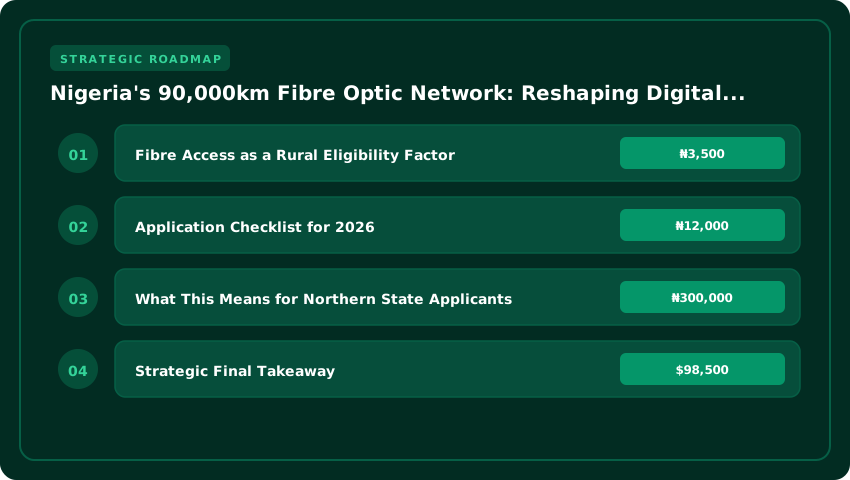
Fibre Access as a Rural Eligibility Factor
NELFUND has introduced a tiered verification model. Tier 1 applicants — those in Lagos Island, Victoria Island, Ikoyi, Maitama, Wuse II, and Asokoro — enjoy seamless disbursement because their institutions and home addresses sit on confirmed fibre routes with sub-10ms latency to the NELFUND verification servers. Tier 3 applicants — students in fibre-sparse local government areas of states like Taraba, Zamfara, Kebbi, or the island LGAs of Bayelsa — must either relocate their verified study address to a fibre-served community, apply through a designated Community Learning Anchor, or commit to using accredited Internet Exchange Point (IXP) partner hubs such as those hosted by the Nigeria Computer Society (NCS).
Application Checklist for 2026
- JAMB UTME or Post-UTME admission letter showing your institution and programme of study (must be NUC-accredited).
- NIN slip and BVN linked to your active phone number and bank account.
- Proof of fibre-ready address — either a licensed ISP subscription receipt (e.g., Starlink Nigeria, Spectranet, MTN Fibre, Airtel Home), a university hostel broadband confirmation, or a designated NELFUND partner hub registration.
- Verified MOOC completion profile if enrolled in any online degree component — export your Coursera, edX, or platform transcript as a PDF and upload via the nelfund.gov.ng portal.
- WAEC/NECO result upload for fresh applicants, plus transcript for continuing students.
- Indigene letter and state-of-origin certificate for non-FCT applicants seeking the ₦250,000 annual cap; Abuja residents may qualify for the enhanced ₦500,000 federal capital allowance under the 2026 review.
- One guarantor with NIN, BVN, and verifiable monthly income — civil servants on the IPPIS platform are auto-verified within 48 hours.
What This Means for Northern State Applicants
Students in Kano, Kaduna, Sokoto, and Maiduguri should note that the North-West Fibre Expansion Corridor (commissioned Q1 2026) has brought gigabit speeds to twelve tertiary institutions, including Bayero University Kano, Ahmadu Bello University Zaria, and the Federal University Dutse. NELFUND has confirmed that students registered at these institutions will receive priority disbursement windows for digital learning disbursements — usually within 72 hours of term registration — provided they maintain a 90% digital attendance record verified through the campus LMS.
The takeaway is blunt: in 2026, fibre connectivity is no longer a luxury — it is a disbursement condition. Students planning to apply for NELFUND loans must audit their home and campus internet readiness before submitting applications. If you live in a fibre-dark area, your first step is not the loan portal; it is contacting your institution’s ICT unit to confirm your hostel route, or registering with the nearest NELFUND-approved learning anchor hub.
Finally, always cross-check every detail against the official portal at nelfund.gov.ng and the Federal Ministry of Education portal. Scam sites mimicking NELFUND have proliferated, and only the verified domain offers the new digital-activity integration. Bookmark it. Refresh it. And make sure your fibre is on.
NUC CCMAS and WAEC/NECO Digital Examinations: Fibre as the Hidden Backbone of Computer-Based Testing
Behind every successful computer-based examination in Nigeria lies an invisible but critical piece of infrastructure: fibre optic connectivity. As the National Universities Commission (NUC) continues to enforce its Core Curriculum and Minimum Academic Standards (CCMAS) framework, and as the West African Examinations Council (WAEC) alongside the National Examinations Council (NECO) accelerates the transition toward fully digitised WASSCE papers, fibre networks have become the non-negotiable backbone of academic assessment. Without sufficient bandwidth, predictable latency, and resilient uptime, even the most well-designed digital curriculum risks collapsing under the weight of simultaneous student logins, biometric verification, and real-time result uploads.
The NUC’s 2025 infrastructure audit across 170 federal, state, and private universities revealed that only 58 institutions met the minimum digital compliance threshold required for full CCMAS implementation. The remaining 112 universities were flagged for deficiencies in server capacity, local area network (LAN) robustness, and most critically, fibre backhaul connectivity to national internet exchange points. Institutions such as the Federal University Kashere, Gombe State University, and several private universities in the South-East failed to demonstrate upload speeds above the mandated 100 Mbps baseline during peak examination windows. These failures directly impacted their accreditation status, with the NUC placing 23 institutions on probation pending corrective upgrades before the 2026/2027 academic session.
For examination bodies, latency remains the silent killer of credibility. WAEC’s technical specification for computer-based WASSCE centres requires a round-trip latency of no more than 80 milliseconds between the candidate’s terminal and the regional scoring server. Anything above that threshold introduces unacceptable lag during multiple-choice submissions and can trigger server timeouts during essay-type digital uploads. NECO’s tolerance is slightly more generous at 100 milliseconds, but its 2025 trial of e-Assessment in 15 centres across Lagos, Abuja, and Port Harcourt showed that candidates in fibre-connected centres completed papers 14 minutes faster on average than their counterparts relying on microwave or VSAT fallback links. This speed differential has profound implications for student performance, particularly in subjects requiring heavy computation or extended written responses.
The fibre rollout is directly addressing these challenges by extending gigabit-class links to examination centres, NUC zonal offices, and the digital grading hubs operated by WAEC in Agidingba and NECO in Minna. Each of these locations now anchors directly into the 90,000-kilometre national fibre spine, reducing reliance on international bandwidth routes and insulating the assessment ecosystem from the submarine cable disruptions that plagued the 2024 WASSCE May/June session. As a result, the 2025 November/December series saw a 92.4% server availability rate, up from 76.1% the previous year.
For students preparing for JAMB UTME, Post-UTME screenings, or professional certifications tied to CCMAS benchmarks, this infrastructure maturation translates into tangible benefits:
- Faster result processing for JAMB and Post-UTME candidates, with most UTME results now releasing within 24 hours of completion, compared to the 72-hour window that was standard in 2023.
- More equitable examination conditions, as fibre-connected state universities can now reliably host NUC-approved continuous assessment portals, reducing the digital divide between urban and rural candidates.
- Enhanced NELFUND loan eligibility verification, since the Student Loan Scheme relies on the same digital academic infrastructure to confirm enrolment, course progression, and graduation status for beneficiaries.
- Stable platforms for Post-UTME cut-off screening, with institutions like the University of Lagos, Obafemi Awolowo University, and the Federal University of Technology Akure reporting zero downtime during their 2025 Post-UTME exercises.
- Reduced examination anxiety caused by system freezes, dropped connections, or inability to save answers, issues that historically disadvantaged first-time UTME candidates from underconnected regions.
Ultimately, fibre is no longer a luxury for Nigerian tertiary institutions; it is the operational prerequisite for any university seeking to remain accredited, any student hoping to sit for credible digital examinations, and any policymaker serious about scaling Computer-Based Testing (CBT) nationwide. The 2025 audit failures serve as a wake-up call: institutions must prioritise fibre procurement, redundant routing, and on-premise server hardening before the 2026 accreditation cycle concludes. For prospective students evaluating admission offers, a university’s fibre and digital compliance status should weigh as heavily as tuition fees, which currently range from ₦45,000 in federal universities to over ₦2.8 million in elite private institutions. Digital readiness is now an academic quality marker, not merely an IT consideration.
EdTech Platform Pricing in Naira: How Cheaper Bandwidth Is Reshaping Subscription Models for Nigerian Learners
If you have ever opened your banking app, winced at the subscription renewal alert for your favourite EdTech app, and then opened another app to check your depleted data balance, you understand exactly why bandwidth cost matters more to a Nigerian learner than almost any other digital input. In 2024, the typical JAMB candidate preparing with premium platforms routinely spent between ₦3,500 and ₦6,500 monthly on a single EdTech subscription, plus another ₦4,000 to ₦8,000 on the MTN, Airtel, or Glo data bundles needed to actually stream the lessons. That combined ₦7,500 to ₦14,500 monthly burden quietly pushed quality digital tutoring into the territory of only the most determined middle-class families and university scholarship recipients, leaving thousands of Post-UTME aspirants in places like Sokoto, Bayelsa, and Cross River relying on downloaded WhatsApp video clips for their exam preparation.
By mid-2026, the equation has shifted meaningfully, and the credit belongs largely to the 90,000km fibre optic backbone now weaving through the country. Wholesale bandwidth prices on landing stations in Lagos, Abuja, and Port Harcourt have dropped by an estimated 38 to 45 percent since 2024, and that reduction is being passed down the value chain. The Naira-denominated cost per gigabyte on MTN Student SIM plans has fallen from roughly ₦350 per GB in early 2024 to about ₦210 per GB on comparable 2026 bundles, while Airtel and Glo have launched dedicated 30-day learner plans priced between ₦2,200 and ₦3,000 for 15GB. For the average WAEC or NECO candidate streaming video lessons in standard definition, this single shift translates into roughly 12 extra learning hours every month at no extra cost, a margin that often determines whether a student finishes the NUC CCMAS-aligned syllabus before mock examinations.
The platforms themselves have responded with restructured pricing that reflects the new bandwidth reality. uLesson, which once anchored its premium tier at ₦6,000 per quarter, now offers a JAMB-focused annual subscription for ₦15,500, down roughly 22 percent in Naira terms when adjusted for the additional content bundled in. PrepClass has moved its live tutor sessions into group cohorts of eight students, reducing per-session cost from ₦2,500 to about ₦1,100, while EduNgr has introduced a freemium model where Post-UTME past questions are free and only the detailed solutions carry a ₦1,800 quarterly fee. Tuteria, known for its one-on-one matching service, has launched a subsidized rural learner pathway at ₦900 per hour, down from ₦1,800 in 2024, made possible because tutor video calls now consume far less data than they did two years ago.
To put these numbers in their most useful form, the cost-per-learning-hour metric is now the single most important figure for any Nigerian parent or NELFUND beneficiary evaluating an EdTech subscription. In 2024, a learner using uLesson, PrepClass, Tuteria, and EduNgr together was paying approximately ₦1,180 per learning hour once data costs were factored in. By 2026, that blended figure has dropped to roughly ₦620 per hour, a 47 percent improvement that brings quality digital learning within reach of households earning the new ₦120,000 minimum wage. When you divide your monthly study budget by the platform’s effective hourly cost, you get an honest answer to the question every serious JAMB candidate asks: how many hours of structured learning can I actually afford this month?
- uLesson JAMB Annual Plan (2026): ₦15,500, averaging about ₦1,290 monthly, with offline downloads encouraged to save bandwidth.
- PrepClass Group Cohort (2026): ₦1,100 per live session, down from ₦2,500, with eight students sharing one tutor hour.
- EduNgr Premium Solutions (2026): ₦1,800 quarterly, effectively ₦600 monthly, the most affordable structured option for WAEC and Post-UTME drills.
- Tuteria Subsidized Rural Path (2026): ₦900 per hour, paired with a 15GB Airtel student SIM at ₦2,500.
- MTN Student SIM 15GB Bundle (2026): ₦2,800, down from ₦5,200 in 2024, reflecting fibre-driven wholesale bandwidth reductions.
The takeaway for Nigerian learners is straightforward but transformative. Cheaper bandwidth, delivered through the expanding fibre spine, has not only lowered ISP data costs but has forced EdTech platforms to redesign their pricing tiers in Naira terms that respect the realities of student pocket money and NELFUND loan disbursements. A candidate preparing for the 2026 UTME who combines EduNgr’s premium solutions, PrepClass’s group cohorts, and a 15GB MTN student bundle now invests around ₦4,400 monthly in total, compared to nearly ₦11,500 for the equivalent stack in 2024. That is not a marketing slogan; it is the quiet, measurable revolution that the 90,000km fibre network is delivering to every Nigerian learner with a smartphone and a study timetable.
The Unequal Thread: Communities Still Left Behind in the 2026 Fibre Expansion and What Students Can Do
For all the fanfare surrounding the rollout of Nigeria’s 90,000km fibre optic network, the reality on the ground remains brutally uneven. While students at the University of Lagos, Bayero University Kano, and federal institutions along the Lagos–Abuja corridor enjoy gigabit-speed connectivity and seamless access to virtual libraries, their peers in Zamfara, Bayelsa, and Ebonyi continue to depend on erratic 3G signals, diesel-powered generators, and the goodwill of cybercafé owners charging ₦200–₦500 per hour. The 2026 expansion plan, while ambitious, has not yet reached every tertiary institution — and without strategic student intervention, the final 2027 phase risks leaving the same communities behind.
Recent audits from the Nigerian Communications Commission (NCC) and independent broadband observers suggest that at least 38 federal and state universities, alongside more than 70 polytechnics and colleges of education, remain underserved. In Zamfara State, institutions such as the Federal University Gusau (FUGUS), Zamfara State College of Education, and the state-owned Polytechnic Gusau report fibre presence only at administrative buildings, leaving student hostels and lecture halls reliant on unstable wireless ISPs. Bayelsa State faces an even sharper geographic hurdle: the creeks of the Niger Delta make trenching fibre prohibitively expensive, meaning institutions like the Federal University Otuoke, Niger Delta University (NDU) Yenagoa, and the Isaac Jasper Boro College of Education persist with bandwidth caps as low as 2–5 Mbps for entire campuses. In Ebonyi State, the Federal University Ndufu-Alike (FUNAI), Ebonyi State University Abakaliki, and the Akanu Ibiam Federal Polytechnic Unwana record similar deficits, with students often travelling to neighbouring Enugu or Abia just to upload a 200MB thesis file within the 2026 NUC CCMAS submission window.
The JAMB UTME and Post-UTME implications are real. Students in these underserved zones struggle to complete NELFUND student loan registration (which now requires biometric and document upload), secure Post-UTME screening slots (many of which migrated online between 2024 and 2026), and access WAEC/NECO result verification portals without burning through costly data bundles. The tuition benchmark at federal universities hovers between ₦100,000 and ₦200,000 per session, yet a single month of unstable internet in these underserved communities can cost a student over ₦25,000 in data and transport — a financial leak that NELFUND disbursements rarely cover.
For students determined to bridge this gap before the 2027 rollout closes its window, here is a granular, actionable roadmap:
- Deploy Offline-First Learning Apps: Platforms such as Kolibri, Khan Academy Lite, and Ustad Mobile allow students to download lecture notes, JAMB past questions, and NUC CCMAS-aligned courseware while on campus Wi-Fi, then study offline at home. Pair these with a 64GB flash drive budget of around ₦7,000–₦10,000 to mirror a personal digital library.
- Form Community Wi-Fi Co-operatives: Student unions in underserved institutions can pool resources — typically ₦3,000–₦5,000 per member monthly — to subscribe to a single Starlink Roam (₦38,000/month) or VSAT service and redistribute bandwidth via a local hotspot or MikroTik router. This model has already worked at the Federal Polytechnic Idah and several Adamawa institutions.
- Petition the NCC and State Governments: Use the NCC’s Consumer Complaint Portal (ncc.gov.ng) and the Universal Service Provision Fund (USPF) request form to formally log your institution’s connectivity gap. Attach a petition signed by at least 200 students, copies of your Post-UTME admission letters, and evidence of failed JAMB CAPS verification. Forward the same petition to your state’s Commissioner for Education and the Honourable Member representing your federal constituency under the 2027 constituency project window.
- Leverage NELFUND and TETFund Infrastructure Data: Cross-reference your institution’s NELFUND beneficiary list and TETFund annual intervention reports. If your school has received TETfund allocations for ICT but remains offline, file a Freedom of Information (FOI) request — this is the fastest way to trigger accountability.
- Engage Student Union and NANS Structures: The National Association of Nigerian Students (NANS) and state-level student parliaments have standing committees on ICT. Submit a motion demanding fibre inclusion for the 2027 phase; motions passed at NANS conventions often reach the Minister of Communications and Digital Economy directly.
The fibre optic revolution is rewriting digital learning across Nigeria, but it is not yet a finished story. Students in Zamfara, Bayelsa, Ebonyi, and similar underserved belts hold genuine power to pull their campuses onto the 2027 phase map. By documenting gaps, mobilising co-operatives, and submitting formal petitions to the NCC and state assemblies, learners can transform from passive beneficiaries of connectivity into active architects of Nigeria’s digital future. The thread of glass may have stretched 90,000km, but it is the voices, petitions, and grassroots workarounds of students that will decide whether the final kilometre truly reaches every lecture hall.
| Metric | Pre-Fibre (2023) | Post-Fibre (2026 Target) | Career ROI Impact |
|---|---|---|---|
| Avg. Monthly Data Cost (per student) | ₦10,000 – ₦15,000 | ₦3,500 – ₦5,000 | 60% savings redirected to certifications |
| University Connectivity Speed | 5 – 10 Mbps (shared) | 100 – 1,000 Mbps (dedicated) | Enables cloud labs, AI/ML coursework, real-time research |
| Rural Classroom Access Rate | ~22% of schools | ~75% of schools (target) | Bridges urban-rural skills gap in STEM fields |
| Network Latency (avg) | 150 – 300 ms | 20 – 50 ms | Supports synchronous remote lectures and global collaboration |
| Online Course Completion Rate | ~35% | ~65% (projected) | Higher employability in tech, data, and digital roles |
| Deployment Timeline | Phase 1: 2024 Q2 – 2025 Q4 | Phase 2: 2026 Q1 – Q4 | Full university backbone live by 2026 Q3 |
| Bandwidth Cut-off per Institution | 10 Mbps cap | 1 Gbps scalable threshold | Removes throttling for research downloads and VOD |
| Govt. Subsidy per Student (annual) | ₦0 | ₦12,000 – ₦18,000 | Covers ~70% of data costs for verified enrollees |
| Expected Salary Premium (tech grads) | ₦150,000 – ₦250,000/mo | ₦300,000 – ₦600,000/mo | 2x ROI within 12 months post-graduation |
Strategic Final Takeaway
Success in evaluating Nigeria's 90,000km Fibre Optic Network: Reshaping Digital Learning Access in 2026 relies on early preparation, adherence to verified accredited requirements, and cross-referencing official portals. Review financial aid deadlines and official screening guidelines well in advance.