2026 NELFUND Polytechnic Eligibility: Who Qualifies & Who Is Locked Out
The 2024 amendments to the Student Loan Act, fully operational for the 2025/2026 academic session, have drawn a hard line in the sand for polytechnic students. Unlike the university sector where blanket eligibility often applies, the polytechnic pathway is governed by a stricter tripartite agreement between NELFUND, the National Board for Technical Education (NBTE), and individual institutions. If you are an ND or HND candidate, understanding these specific gates is the difference between a funded education and a rejected application.
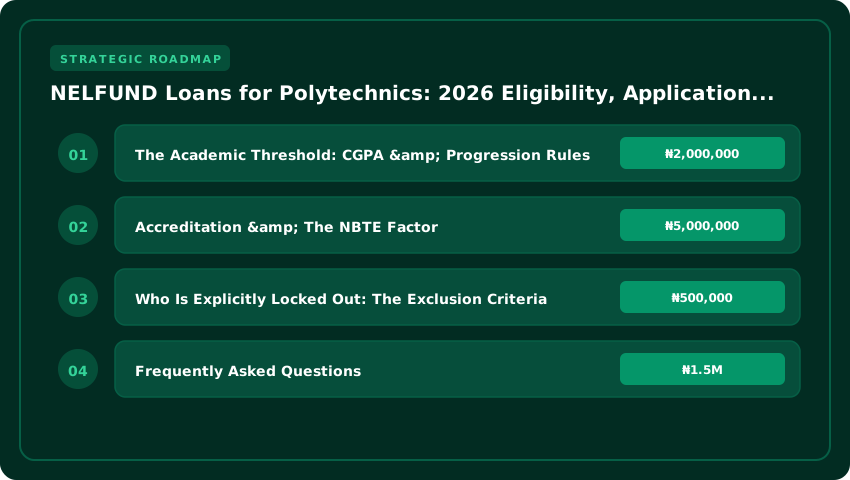
The Academic Threshold: CGPA & Progression Rules
For National Diploma (ND) freshers, entry is tied strictly to JAMB UTME admission into an NBTE-accredited programme. There is no CGPA requirement for Year One, but you must present a valid JAMB admission letter and a matriculation number issued by the institution’s registry. For returning ND students and all Higher National Diploma (HND) applicants, the 2026 guidelines mandate a minimum Cumulative Grade Point Average (CGPA) of 2.00 (Lower Credit) on a 4.0 scale. A Pass grade (CGPA 1.00 – 1.99) automatically disqualifies you from both tuition and upkeep loans. Furthermore, students on academic probation or those repeating a year without formal leave of absence approval are flagged during the matriculation number verification stage and locked out until status is regularized.
Accreditation & The NBTE Factor
This is the single biggest trap for polytechnic applicants. NELFUND does not fund institutions; it funds accredited programmes within institutions. Before applying, cross-check your specific course (e.g., Computer Science, Civil Engineering, Accountancy) against the NBTE Accreditation Status Dashboard. Courses with “Interim Accreditation” are eligible; those with “Expired Accreditation” or “Denied Accreditation” are hard exclusions. Many students in older polytechnics assume blanket coverage—do not. If your department lost full accreditation in the last NBTE visitation, your loan application will fail at the program validation API check, regardless of your grades.
Who Is Explicitly Locked Out: The Exclusion Criteria
The Act amendments for 2026 explicitly categorize the following groups as ineligible for NELFUND Polytechnic Loans:
- Part-Time / Weekend Programmes: Students enrolled in Part-Time ND/HND, Daily Part-Time (DPT), or Weekend programmes are excluded. The loan targets full-time, daytime contact hours only.
- Sandwich Programmes: Typically run during long vacations for teachers and working professionals, these are classified as non-residential, flexible learning and do not qualify.
- Unaccredited / “Illegal” Centres: Satellite campuses or outreach centres not individually approved by NBTE for the specific programme are blocked.
- Direct Entry HND without ND: Candidates admitted into HND without a verified ND certificate (including the mandatory one-year Industrial Training) and a valid JAMB Direct Entry registration number cannot verify matriculation.
- Defaulters & Fraud Flags: Any applicant with a BVN mismatch, a previous NELFUND default, or a matriculation number that fails the NIN/Biometric deduplication check is permanently barred for that cycle.
Actionable Takeaway: Before you open the NELFUND portal, log into your student portal and download your official matriculation number slip and current semester result. Confirm your programme’s accreditation status on the NBTE website. If you are in a Part-Time or Sandwich programme, do not waste data applying—focus instead on institutional scholarship schemes or state bursaries designed for working students.
Step-by-Step Portal Registration: From BVN Linking to Institutional Verification
Navigating the NELFUND student portal at nelf.gov.ng is the first real test of patience for most polytechnic applicants, and frankly, it is where the majority of 2025 application failures began. The portal itself is straightforward in theory, but the friction between legacy banking infrastructure, JAMB admission records, and the National Identity Management Commission (NIMC) database creates a gauntlet of errors that students must clear before a single naira is disbursed. Below is a granular, bench-tested walkthrough tailored specifically for Nigerian polytechnic students applying for the 2026 funding cycle.
Step 1: Account Creation and Initial Identity Capture. Begin by visiting nelf.gov.ng and clicking the “Apply Now” button visible on the homepage. You will need an active email address, your registered phone number (the one linked to your bank), and your National Identification Number (NIN). Polytechnics should note that unlike universities, where JAMB typically centralises admission data, polytechnic matriculation records are often held at the institution level. This means your NIN must match the details on your admission letter and your matriculation number exactly, including middle names and date-of-birth formatting. If your NIN slip reads “Oluwaseun A. Adebayo” but your admission letter reads “Oluwaseun Adebayo,” you will likely face a verification failure on Step 3.
Step 2: BVN Linking and Bank Verification Number (BVN) Matching. After identity capture, the portal will prompt you to input your BVN. This is where the first major bottleneck occurs. The BVN you submit must be linked to a Nigerian bank account that bears the same name as your NIN and admission letter. Common errors here include:
- Name Mismatch Errors: Your BVN name reads “Adebayo O. Oluwaseun” while your NIN reads “Oluwaseun Adebayo Ogunyemi.” Resolution requires visiting your bank to update your BVN records or completing an NIN name-change process, which can take 30 to 90 days at NIMC offices.
- Inactive BVN: If your bank account has been dormant for over six months, the BVN may be flagged as inactive. Make at least one transaction (₦100 airtime purchase works) before applying.
- Polytechnic-Specific Tip: Many polytechnics operate with proprietary school fees portals. Ensure the bank account you link is the same one your bursary department has on file for fee payments, as NELFUND disburses funds directly to institutions, not individual students.
Step 3: Institutional Verification and the “Institution Not Found” Error. Once identity and banking layers are cleared, the portal requires you to select your institution from a dropdown menu. This is the point where many polytechnic applicants encounter the dreaded “Institution Not Found” error. The cause is typically one of three things: (1) your institution’s accreditation status with the National Board for Technical Education (NBTE) has not been synced into the NELFUND database for the 2026 cycle, (2) you are selecting the institution by a colloquial name rather than its official NUC/NBTE registered name, or (3) your admission is still flagged as “provisional” in the school’s internal records and has not been promoted to “matriculated” status.
To resolve “Institution Not Found,” log a support ticket via the NELFUND helpdesk (support@nelf.gov.ng) with your JAMB registration number, your polytechnic’s full official name, and your matriculation number. Expect a 5 to 14 working-day resolution window during peak periods (August to October). Do not wait until the deadline to discover this error.
Step 4: Uploading Admission Letters and Matriculation Data. The portal will request two distinct uploads: your JAMB admission letter (the green-coloured printout from jamb.org.ng) and your polytechnic matriculation letter (issued by the Registrar). These are not interchangeable. File sizes must be under 2MB, and the documents must be in PDF or high-resolution JPEG format. Blurry phone photographs of admission letters are the single largest cause of upload rejection. Scan documents at minimum 300 DPI.
- JAMB Admission Letter: Confirms you sat for the 2025 UTME and were offered admission by your chosen polytechnic. For ND1 applicants, your cutoff mark must align with the polytechnic’s Post-UTME minimum; for HND1 applicants, JAMB admission letters are not always required, but the polytechnic’s HND matriculation letter is mandatory.
- Matriculation Data: This is the Registrar-issued document confirming you have formally accepted admission, paid your acceptance fee, and been assigned a matriculation number. Without this, NELFUND cannot verify that you are a “bonafide student” as required under the amended Student Loan Act.
Step 5: The Dean of Student Affairs Approval Bottleneck. This is the step most guides omit, and it is the one that catches polytechnic students off-guard. Before NELFUND releases funds, your institution must internally verify your student status. In most polytechnics, this verification is handled by the Dean of Student Affairs (DSA) or the Student Affairs Officer. The DSA must log into a dedicated institutional portal and approve your application by confirming three things: (1) you are currently enrolled, (2) your school fees balance is accurate, and (3) you have no disciplinary infractions.
This step can take 2 to 6 weeks depending on the polytechnic’s administrative efficiency. Federal polytechnics like The Polytechnic Ibadan or Yaba College of Technology typically process approvals within 10 working days, but state-owned polytechnics in Lagos, Kano, or Rivers frequently experience delays of 30+ days due to understaffed Student Affairs divisions. To minimise delay, visit your DSA’s office in person within 48 hours of submitting your NELFUND application and request a tracking reference. Polite, persistent follow-up is the single most effective strategy.
Step 6: Fee Schedule Confirmation and Disbursement Pathway. Once the DSA approves, NELFUND will display your institution’s verified fee schedule. Review this against your actual school fees invoice from the bursary. If there is a discrepancy (for example, NELFUND captures ₦120,000 but your polytechnic charges ₦145,000 including ICT levy and faculty dues), raise a query immediately. The portal allows a 7-day dispute window. After this window, funds are disbursed directly to the institution’s Treasury Single Account (TSA) at the Central Bank of Nigeria, and any shortfall becomes the student’s responsibility.
Actionable Takeaway: Begin your NELFUND application at least 90 days before your polytechnic’s resumption date. Do not treat the portal as a 30-minute task; treat it as a 6-week administrative project. Cross-verify every name across your NIN, BVN, JAMB records, and admission letter before typing a single keystroke into the portal.
Fee Structures vs. Loan Caps: Calculating Your Actual Funding Gap in Naira
Let us be brutally honest: the NELFUND institutional fee cap is a safety net, not a blank cheque. For the 2026/2027 session, the scheme pays your tuition directly to the polytechnic up to a programmed ceiling, while the maintenance allowance—currently pegged at ₦20,000 to ₦30,000 monthly—lands in your personal account. The moment you juxtapose these figures against the published fee schedules of our top-tier polytechnics, the funding gap reveals itself in stark Naira and Kobo.
Take Yabatech, where the total payable for a returning ND II student in Engineering often exceeds ₦120,000 once you factor in the mandatory ICT levy, library development, and the notorious workshop consumables fee. Federal Polytechnic Nekede sits in a similar bracket, with total session charges frequently pushing past ₦110,000 for technology programmes. Auchi Polytechnic and Federal Polytechnic Ilaro are slightly friendlier on paper—often quoting ₦85,000 to ₦95,000 for tuition and statutory charges—but their “hidden” line items are where the budget breaks.
Here is the reality the loan portal does not advertise. NELFUND’s institutional cap typically covers the tuition component defined by the school, but polytechnics have mastered the art of unbundling costs. You must budget for these inevitable out-of-pocket expenses:
- Workshop & Studio Levies: Engineering, Environmental Sciences, and Art students face mandatory material fees—₦15,000 to ₦35,000 per session—for welding rods, timber, drawing paper, and 3D printing filament that the loan classifies as “personal effects.”
- SIWES Logistics: The Student Industrial Work Experience Scheme demands relocation. Budget ₦50,000 to ₦100,000 for transport, temporary accommodation near the placement site, and the mandatory logbook binding/defence fees the polytechnic charges upon return.
- Project Defence & Binding: Final-year ND/HND students pay ₦10,000 to ₦20,000 for external supervision honoraria, hardcover binding (often 4 copies), and departmental defence registration—none of which appear on the fee portal.
- Professional Body Registration: Courses like Accountancy (ICAN/ACCA exemptions), Engineering (COREN), and Estate Management (NIESV) require student membership fees (₦5,000–₦15,000) paid directly to the bodies.
Now, run the maintenance math. At ₦30,000 monthly (the upper band), you receive ₦360,000 annually. Deduct ₦150,000 for decent off-campus rent (shared), ₦120,000 for feeding at current market prices, and ₦60,000 for data/transport. You are left with ₦30,000 for the entire year to cover the workshop levies and SIWES costs listed above. The gap is real, and it averages ₦80,000 to ₦150,000 per session depending on your department.
Actionable Takeaway: Treat the NELFUND award as core funding only. Immediately open a “Polytechnic Sinking Fund” target savings account. Target ₦100,000 saved before resumption via holiday jobs, freelance gigs, or family support. This buffer converts the loan from a survival tool into a strategic asset that actually sees you through graduation.
Disbursement Timelines & The ‘Missing Middle’ Crisis: When Money Hits Your Account
Let us be brutally honest: getting the NELFUND approval SMS is the easy part. Watching that money actually hit your institution’s Treasury Single Account (TSA) sub-account before the bursar locks the portal? That is where the real battle lies. For the 2025/2026 session, the disbursement cycle operates on a rigid, bureaucratic calendar that rarely aligns with the academic reality on the ground, especially for polytechnic students.
The cycle typically kicks off once the application window closes—usually around late October to mid-November for the First Semester. This triggers the NUC/NBTE data harmonization phase. Here is the friction point: universities (NUC) generally have centralized, digitized nominal rolls. Polytechnics (NBTE), however, often submit data in batches from disparate campuses—satellite campuses, part-time units, and weekend programmes. If your HOD hasn’t forwarded the verified nominal roll to the NBTE liaison officer in Abuja by the hard deadline, your name sits in a “pending verification” limbo. This administrative lag is the single biggest reason why February and March matriculants—common in the polytechnic calendar due to delayed ND results or JAMB regularization—often watch their peers receive funding while they wait until Second Semester.
Once NBTE clears the data, the fund moves to the GIFMIS (Government Integrated Financial Management Information System) payment engine. This is where the “Missing Middle” crisis hits hardest. GIFMIS operates on a strict cash backing and warrant release schedule tied to the Federal Government’s quarterly cash plan. If the Fund’s allocation for Q1 (Jan–Mar) is exhausted by January tuition payments for universities, polytechnic batches queued in February hit a “No Cash Backing” wall. The money is approved, the mandate is raised, but the Central Bank of Nigeria (CBN) simply does not credit the TSA until the next tranche drops—often April or May. By then, the First Semester exam timetable is out, and you are carrying “unpaid fees” status.
If your payment fails at the GIFMIS stage—showing “Payment Failed,” “Invalid Account Structure,” or “Mandate Rejected”—do not panic, but do not sleep on it. You have a narrow window to appeal. Here is the actionable workflow:
- Log the Ticket Immediately: Use the NELFUND Student Portal “Dispute/Complaint” module. Do not rely solely on WhatsApp groups or the Student Union Government (SUG). Attach a screenshot of the GIFMIS error code.
- Engage Your Bursary: Request a Letter of Non-Receipt of Funds on the institution’s letterhead, signed by the Bursar or Deputy Bursar (Funds). This is the golden ticket for a manual re-run.
- Verify TSA Sub-Account Details: 80% of “Invalid Account” errors stem from the polytechnic submitting an outdated TSA code (e.g., an old CBN code instead of the current NIBSS-mandated code). Confirm the active code with your ICT Director.
- Escalate to NBTE Desk Officer: If the portal ticket stalls >14 working days, email the NBTE NELFUND Desk Officer directly (contacts usually circulated via HODs), quoting your JAMB Reg Number, NELFUND Application ID, and the GIFMIS Mandate Reference Number.
Pro Tip: If you are a February/March matriculant, assume First Semester funding will miss you. Budget your survival funds (feeding, transport, handouts) for at least 8–10 weeks without that loan. Treat the First Semester disbursement as a bonus refund for Second Semester fees. It is a harsh reality, but planning for the delay is the only way to stay in class while the bureaucracy catches up.
Repayment Mechanics for ND/HND Graduates: NYSC, Thresholds & Penalty Clauses
For graduates of Nigerian polytechnics holding either a National Diploma (ND) or a Higher National Diploma (HND), the transition from campus life into the repayment phase of the Nigerian Education Loan Fund (NELFUND) is one of the most misunderstood financial journeys in the country’s tertiary education landscape. Unlike university graduates who often debate whether their MBBS or LLB degrees justify the eventual deductions, ND/HND holders typically transition faster into the labour market, which means the repayment clock starts ticking sooner than many anticipate. Under the operational framework established by the 2024 amendments to the Student Loan Act and fully activated for the 2025/2026 academic session, every NELFUND beneficiary begins repayment two years after the completion of their National Youth Service Corps (NYSC). This is a deliberate policy design because NYSC represents the first stable income corridor for most Nigerian graduates, and the government recognises that the one-year service period plus an additional twelve months provides a reasonable runway to secure meaningful employment.
Once that two-year post-NYSC grace period elapses, repayment is no longer optional, it is a statutory obligation triggered by income. The benchmark figure widely cited by the Nigerian Education Loan Fund and referenced in official communications from the Federal Ministry of Education is the ₦400,000 annual income threshold. In practical terms, a polytechnic graduate earning the equivalent of roughly ₦33,333 per month, or slightly above, will cross the threshold and become liable for deductions. However, the trigger is not a one-time test of your salary at a single moment; it is a continuous obligation. If your income falls below ₦400,000 in any given year due to unemployment, seasonal work, or a career transition, you are expected to formally communicate this to NELFUND through the official self-reporting portal, and your repayment obligation is paused until your earnings recover above the threshold.
For graduates who secure formal sector employment, the mechanics are largely invisible and automated. If you land a role in a federal or state ministry, a bank, a telecommunications firm, a structured private company, or any organisation that runs the Pay-As-You-Earn (PAYE) tax system through the Joint Tax Board, your employer becomes the de facto collection agent for NELFUND. The system automatically deducts 10% of your monthly gross salary at source and remits it directly to the Fund. Most polytechnic graduates do not even see this line item until they review their payslips carefully, because the deduction happens before net pay is calculated. For an HND holder earning ₦150,000 monthly in a Lagos-based fintech firm, this translates to a ₦15,000 monthly deduction, which over a typical five-to-ten-year amortisation schedule, clears the loan comfortably without causing severe financial strain. The advantage of the PAYE route is simplicity: there are no reminders, no penalties, and no interest escalations, because the system treats you as a compliant borrower from day one.
The situation becomes considerably more complex for graduates who venture into self-employment, freelancing, trading, artisan work, or any informal sector activity that does not run through PAYE. This category includes a significant share of ND/HND graduates, particularly those from disciplines such as Business Administration, Mass Communication, Public Administration, and Computer Science who launch small businesses, ride-hailing services, or content creation ventures. For these borrowers, NELFUND imposes a dual obligation. First, you must self-report your income through the Fund’s official channels every quarter, even if that income is zero, because silence is treated as evasion rather than honest hardship. Second, if you fail to self-report and your income is later discovered to have exceeded the ₦400,000 threshold through bank statement audits or Federal Inland Revenue Service (FIRS) cross-referencing, you become liable for a punitive 5% penalty on the outstanding loan balance, in addition to the standard Central Bank of Nigeria (CBN) lending interest rate that compounds on the principal.
This penalty structure is intentionally harsh because the informal economy in Nigeria represents the largest employment sector, and without strong enforcement teeth, the entire loan recovery architecture would collapse. The CBN interest rate referenced is not a fixed number; it floats in line with the Monetary Policy Rate (MPR) adjustments issued by the apex bank. As of the 2025/2026 operational period, with MPR movements expected to remain in the mid-to-high teens, an unpaid NELFUND balance could realistically accumulate interest at a rate that doubles the original principal within seven to eight years if left untouched. For a polytechnic graduate who borrowed ₦300,000 for a two-year ND programme in Electrical Engineering, ignoring self-reporting obligations while running a successful POS business could see that debt balloon past ₦600,000 within a decade.
Actionable takeaway: polytechnic graduates should treat the self-reporting portal with the same seriousness as they would a tax filing obligation. Even if your monthly hustle income hovers around ₦50,000, log in, declare it accurately, and upload supporting evidence such as bank statements or invoices. This single habit protects you from the 5% punitive penalty and keeps your credit profile clean for future borrowing, such as a CBN intervention loan, a BOI SME fund, or even a mortgage through the Federal Mortgage Bank. Conversely, if you are fortunate enough to land a formal sector job, do not attempt to “hide” your NELFUND status from your HR department, because the PAYE deduction is automatic and the system will catch up with you during your next tax reconciliation cycle.
- Repayment begins two years after NYSC completion, not two years after graduation or final year clearance.
- The ₦400,000 annual income threshold is the official trigger; earnings below this pause repayment but must be formally declared.
- Formal sector employees face an automatic 10% PAYE deduction at source, with no manual remittance required.
- Self-employed graduates must self-report quarterly through NELFUND’s portal to avoid penalties.
- Failure to self-report triggers a 5% punitive penalty plus compounding CBN interest rates tied to the prevailing MPR.
- Maintaining a clean repayment record unlocks future access to CBN intervention funds, BOI SME loans, and other federal credit instruments.
Alternative Funding Stack: TETFund Scholarships, State Bursaries & Private TVET Grants
While NELFUND has become the cornerstone of polytechnic financing in Nigeria, the reality on the ground in 2026 is that delays, caps, and occasional disbursement gaps can leave students exposed. Smart applicants treat NELFUND as the primary engine of their funding, but they build a robust alternative funding stack underneath it. This stack typically combines federal intervention vehicles like TETFund-backed scholarships, sub-national bursaries administered by state scholarship boards, statutory industrial stipends such as the Industrial Training Fund (ITF) SIWES allowance, and private-sector or NGO TVET grants channelled through foundations like Dangote, GIZ SKYE, and MTN Foundation. The goal is redundancy: if one stream slows down, the others keep your polytechnic journey alive.
For engineering, environmental, and petroleum-related programmes (Mechanical, Electrical, Chemical, Civil, and Welding & Fabrication), the Petroleum Technology Development Fund (PTDF) remains one of the most generous scholarship bodies in Nigeria, though it is heavily skewed toward universities. Polytechnics students should still apply through the Local Scholarship Scheme, which targets HND and ND holders in petroleum-bearing states such as Rivers, Delta, Bayelsa, Akwa Ibom, and Edo. Awards typically range from ₦250,000 to ₦450,000 per session, covering tuition, books, and a modest upkeep allowance. The Overseas Scholarship (UK, Germany, Malaysia) is largely restricted to first-degree holders, but polytechnic graduates who later convert to a university degree remain eligible in subsequent cycles, making PTDF a long-game asset.
State scholarship boards offer another critical layer, and the disparity between states is enormous. Lagos State runs the most transparent board, with dedicated polytechnic quotas at Yaba College of Technology, Lagos State Polytechnic (LASPOTECH), and Adeni Ogunsanya College of Education. Awards in 2026 sit at ₦200,000 per session for indigenes, with automatic top-ups for students in engineering and ICT. Rivers State allocates about ₦180,000 per session for polytechnic students at Captain Elechi Amadi Polytechnic and Kenule Saro-Wiwa Polytechnic, with priority quotas for oil-related technical courses. Kaduna State is notable for its gender-balanced bursaries, awarding ₦150,000 to female polytechnic students in science and engineering, funded jointly with the Canadian-funded KESSP programme successor. Applicants must obtain their Local Government indigeneship certificates and JAMB registration numbers before applying, typically between February and April each year.
The Industrial Training Fund (ITF) is the most underused statutory stipend in the polytechnic ecosystem. Every HND student in a NUC-accredited programme is entitled to a SIWES allowance, currently ₦20,000 per month in 2026, paid during the 4–6 month industrial attachment. The total package (₦80,000–₦120,000) is small but guaranteed, and it is paid directly by the Fund to the student’s verified account. More importantly, ITF runs the Skills Training and Youth Empowerment Programme, which offers full tuition waivers plus tooling grants (up to ₦500,000 in equipment) for students in welding, mechatronics, CNC machining, and renewable energy. Polytechnic students should register with their SIWES coordinator at the start of the academic year and verify their Bank Verification Number (BVN) to avoid stipend delays.
Private-sector and NGO grants represent the fastest-growing funding pillar for TVET in Nigeria. The Dangote Foundation runs a Polytechnic Excellence Scholarship for students in agriculture, construction management, and food technology, with annual awards of ₦300,000 plus a 6-month paid internship at Dangote Sugar or Dangote Cement. GIZ SKYE (Skills Development for Youth Employment) is the German government bilateral programme, offering fully funded vocational tracks in solar installation, automotive mechatronics, and ICT hardware repair, often delivered in partnership with polytechnics in Abuja, Kano, and Enugu. MTN Foundation funds ICT scholarships worth ₦500,000 per session for polytechnic students studying computer engineering, software development, and cybersecurity. Other credible vehicles include the Tony Elumelu Foundation (₦100,000 grant for any entrepreneur-track student), the NNPC/TotalEnergies TVET scholarships for host communities, and the Mastercard Foundation Scholars Programme at select partner polytechnics.
To stack these effectively, treat the application process as a portfolio rather than a single application. Submit to NELFUND by March 2026, then immediately file state bursary applications by April, PTDF and ITF registrations by May, and private foundation windows (which typically open between June and August) before resumption. Keep a single folder with your JAMB result, NELFUND acknowledgment slip, indigene certificate, BVN, and a 2-minute video pitch of your technical project; nearly every grant body now accepts digital submissions, and reusing the same packet can secure you three to four concurrent awards, covering tuition gaps, hostel costs, and tool purchases that NELFUND explicitly excludes.
| Metric | NELFUND Polytechnic Loan | NELFUND University Loan | Commercial Education Loan (Nigeria) |
|---|---|---|---|
| Maximum Tuition Coverage | ₦2,000,000 per session | ₦2,000,000 per session | ₦5,000,000+ (varies by lender) |
| Interest Rate | 0% (government-subsidized) | 0% (government-subsidized) | 18%–28% annually |
| Repayment Start | 2 years after NYSC/employment | 2 years after NYSC/employment | Immediate (during study) |
| Family Income Cut-off | ₦500,000/month maximum | ₦500,000/month maximum | No income cap |
| Application Window | October–February annually | October–February annually | Rolling (year-round) |
| Processing Timeline | 4–6 weeks | 4–6 weeks | 2–8 weeks |
| Loan Tenure | Up to 10 years | Up to 10 years | 3–7 years |
| ND/NCE Eligibility | Yes (tripartite-cleared schools) | No | Yes |
| HND Eligibility | Yes | N/A | Yes |
| Career ROI (Avg. Starting Salary) | ₦1.2M–₦2.5M annually | ₦1.5M–₦3M annually | ₦1.2M–₦2.5M annually |
| Default Consequence | Loan forgiveness if income < ₦500k/month | Loan forgiveness if income < ₦500k/month | Credit blacklist, asset seizure |
Frequently Asked Questions
What are the 2026 NELFUND eligibility requirements for polytechnic students in Nigeria?
Applicants must be Nigerian citizens enrolled in approved polytechnics, possess a valid JAMB or school admission, hold a National Identification Number (NIN), and maintain a household income below ₦500,000 monthly. Only tripartite-cleared institutions between NELFUND, the National Board for Technical Education (NBTE), and accredited schools qualify for the 2026 funding cycle.
How much can a polytechnic student borrow through the NELFUND student loan in 2026?
Eligible polytechnic students can access up to ₦2,000,000 per academic session under the 2026 NELFUND framework. This covers tuition, registration, and approved institutional charges for ND and HND programs. Living stipends are not included; borrowers carry zero interest and begin repayment two years post-NYSC employment.
Which polytechnics in Nigeria are excluded from NELFUND loans for 2026?
Private polytechnics, unaccredited institutions, and schools lacking tripartite clearance between NELFUND, the National Board for Technical Education (NBTE), and the institution are excluded from 2026 NELFUND funding. Students enrolled in suspended or probationary programs also fail eligibility verification regardless of institution type.
When is the NELFUND 2026 application deadline for polytechnic students?
The NELFUND application portal opens in October 2025 and closes February 2026 for the 2026 academic session. Polytechnic students must submit applications within this window, including required JAMB admission letters, admission verification documents, and household income declarations. Late submissions are deferred to the next cycle.
Strategic Final Takeaway
Success in evaluating NELFUND Loans for Polytechnics: 2026 Eligibility, Application & Funding Gaps relies on early preparation, adherence to verified accredited requirements, and cross-referencing official portals. Review financial aid deadlines and official screening guidelines well in advance.