Key Takeaway: TETFund has restructured both the National Research Fund (NRF) and Institution-Based Research (IBR) cycles for 2026, with sharper alignment to NUC CCMAS priorities and a revised allocation formula that directly favours federally-funded universities. If you are a researcher at a Nigerian tertiary institution, this is your roadmap to securing research capital this cycle.
2026 TETFund National Research Fund (NRF) & Institution-Based Research (IBR) Cycles
The 2026 research funding landscape under TETFund has shifted significantly. The TETFund Online Portal (TOP) is now the single entry point for all NRF and IBR applications, and the submission window is tightly managed through the agency’s revised calendar. Understanding the thematic alignment and allocation changes is no longer optional — it is the difference between a funded project and a rejected application.

NRF Thematic Areas Aligned with NUC CCMAS 2026 Priorities
For the 2026 NRF cycle, TETFund has tightened its thematic focus to mirror the National Universities Commission’s Curriculum Content Development and Monitoring System (CCMAS) 2026 strategic pillars. Proposals must now fall within these priority areas:
- STEM and Applied Technology Innovation — targeting solutions in renewable energy, agricultural technology, and digital infrastructure.
- Health and Biomedical Research — aligned with Nigeria’s emerging disease surveillance and pharmaceutical self-sufficiency goals.
- Environmental and Climate Resilience — including water resource management and sustainable land use research.
- Entrepreneurship and Industry-Academia Linkages — projects that demonstrate direct pathways to commercialisation or local enterprise development.
Proposals outside these thematic zones face near-certain rejection at the preliminary screening stage. Each application must explicitly reference the relevant CCMAS 2026 benchmark to be considered eligible.
IBR Allocation Formula: Federal vs State Universities
The 2026 IBR cycle introduces a bifurcated allocation formula. Federally-funded universities receive a baseline institutional grant of approximately ₦150 million per institution, distributed across competitive research clusters. State universities now access a pooled IBR fund of roughly ₦80 million per institution, with disbursement tied to demonstrated research output and institutional readiness. This revision reflects TETFund’s push to incentivise research productivity at the state level while maintaining higher capital thresholds for federal institutions.
Step-by-Step Application via the TETFund Online Portal (TOP)
Navigating TOP for the 2026 cycle requires precision. Follow these steps:
- Step 1: Visit the official TETFund Online Portal and create or verify your institutional researcher profile. Ensure your TETFund ID is linked to your NUC-recognised institution.
- Step 2: Select the appropriate fund stream — NRF or IBR — and download the 2026 proposal guidelines specific to your institution’s category.
- Step 3: Prepare your research proposal using the mandatory TOP template. Include a budget breakdown in Naira, a CCMAS 2026 alignment statement, and evidence of institutional ethical clearance.
- Step 4: Upload all documents through the portal’s structured upload module. Incomplete submissions are automatically disqualified.
- Step 5: Submit before the published deadline and retain the transaction confirmation receipt. Track application status through the TOP dashboard, where screening results and revision requests are communicated directly.
Do not wait until the final days. Portal congestion has historically caused last-minute failures, and TETFund does not extend deadlines for technical difficulties. Plan your submission at least two weeks ahead and have your institution’s research office verify every document before upload.
International Collaborative Grants Accessible to Nigerian PIs in 2026
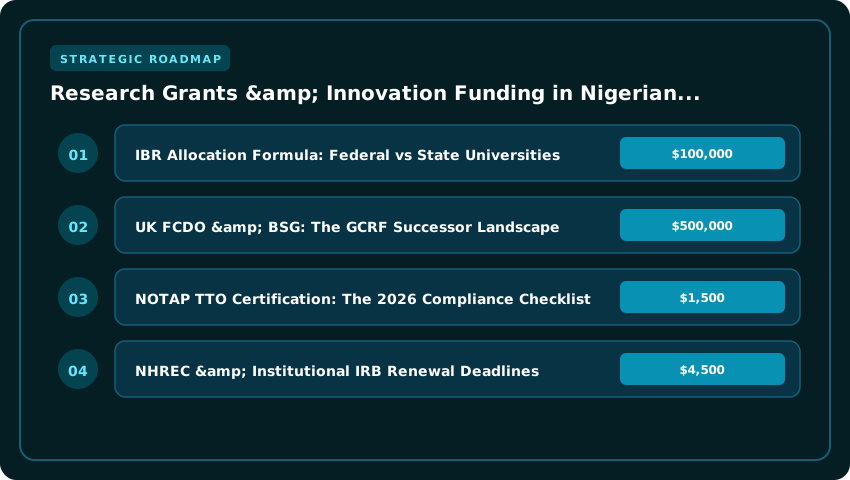
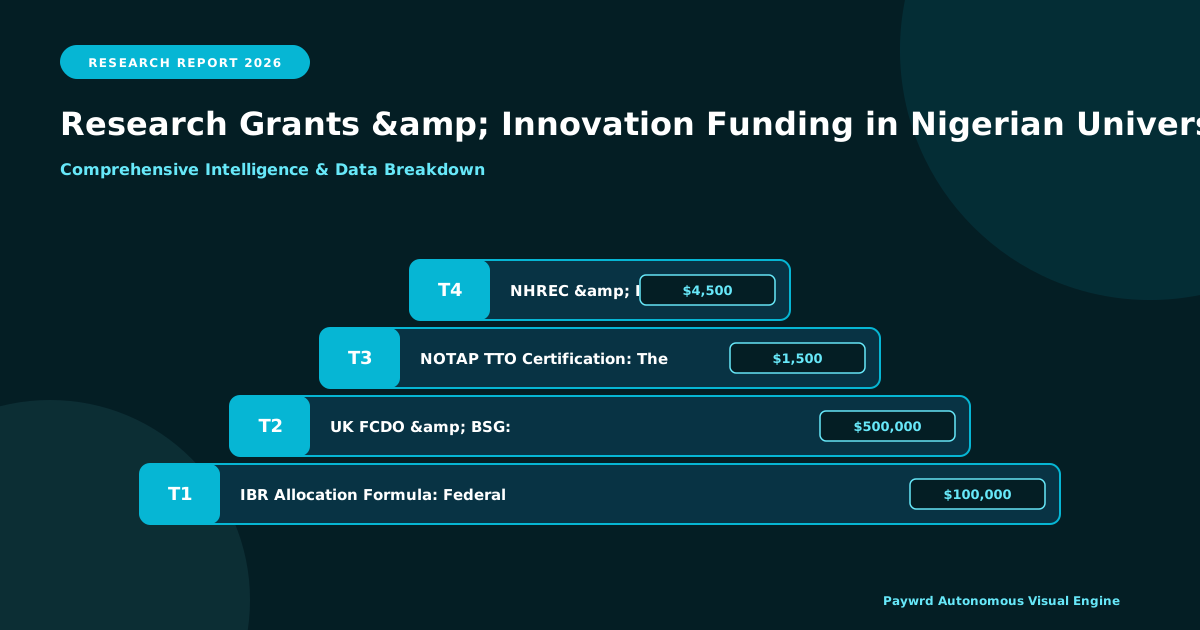
Securing foreign currency funding remains the most effective hedge against naira volatility for Nigerian research groups. In 2026, three major international streams are open to Principal Investigators (PIs) based in Nigerian universities, but each demands rigorous consortium building and, critically, valid National Health Research Ethics Committee (NHREC) clearance before the first disbursement.
UK FCDO & BSG: The GCRF Successor Landscape
The Global Challenges Research Fund (GCRF) has formally transitioned. For 2026, the Foreign, Commonwealth & Development Office (FCDO) and the British Academy/BSG are channelling ODA (Official Development Assistance) money through the International Science Partnerships Fund (ISPF) and the ODA Research & Innovation for Development calls. Nigerian PIs cannot apply as sole leads; you must be a Co-PI on a UK-led proposal or lead a “Global South Partner” work package. The 2026 ISPF “Clean Energy” and “Resilient Health Systems” windows close in Q3 2026 (typically September). Budget your Nigerian work package realistically—UKRI overheads are capped at 8% for international partners, so negotiate direct costs (fieldwork, local lab consumables, PhD stipends at ₦250k–₦350k/month) upfront. Mandatory: Upload your institution’s NHREC registration number (format: NHREC/XX/YY) on the UKRI Grant Management System at submission.
African Academy of Sciences (AAS) & Grand Challenges Africa 2026
The AAS, via the Alliance for Accelerating Excellence in Science in Africa (AESA), runs the Grand Challenges Africa (GC Africa) Round 15/16 cycles in 2026. These are among the few schemes where a Nigerian PI can serve as the Lead Applicant without a Northern co-lead. Focus areas for 2026 include Climate-Resilient Agriculture, AI for Maternal Health, and Antimicrobial Resistance (AMR) Surveillance. Awards range from $100,000 to $500,000 USD over 18–24 months. The 2026 deadline is historically March 31 for Concept Notes, with full proposals by invitation only in June. A hard requirement: Your institution must hold a current Federal Wide Assurance (FWA) or valid NHREC Institutional Review Board (IRB) certification. Without this, the AAS Grants Management System will auto-reject the application at the eligibility check.
EU Horizon Europe: Nigeria’s “Associated Country” Status & Consortium Strategy
Nigeria remains a “Low & Middle Income Country” (LMIC) eligible for automatic funding in Horizon Europe 2026 Work Programmes—we are not an Associated Country. This means Nigerian partners receive 100% funding rates for eligible costs (personnel, travel, equipment, subcontracting) but cannot coordinate the consortium (Coordinator must be EU/Associated Country). Target Cluster 1 (Health), Cluster 6 (Bioeconomy/Food), and the EIC Pathfinder/Transition calls. The 2026 deadlines are mostly two-stage: Stage 1 in January/February, Stage 2 in September. Consortium building is non-negotiable: you need at least three independent legal entities from three different EU/Associated Countries. Start negotiating your “Letter of Commitment” and budget annexes with EU coordinators now. Ensure your university’s PIC (Participant Identification Code) is validated on the EU Funding & Tenders Portal and that your NHREC ethics clearance covers the specific human/animal data protocols described in the EU Ethics Self-Assessment.
- Currency Hedge: All three streams pay in GBP, USD, or EUR—insulate your lab from FX shocks.
- Ethics First: NHREC clearance is not a formality; it is a gatekeeper. Renew expired IRB certificates before January 2026.
- Admin Support: Engage your Directorate of Research Innovation (DRI) early; they must sign off on financial reporting templates for UKRI, AAS, and EU portals.
Private Sector & Industry-Sponsored Innovation Funds (Telecoms, Oil & Gas, Fintech)
If you are tired of waiting eighteen months on a TETFund cycle to hear back, the private sector offers a genuinely faster path. Corporate-backed innovation funds in Nigeria have matured significantly by 2026, with clearer terms, dedicated university liaison officers, and disbursement timelines that often beat government grants by months. The trade-off? You are signing away certain rights to your research output, and you will likely have an industry attachment baked into the agreement. Understand the fine print before you apply.
MTN Foundation & Airtel Africa 2026 University Innovation Challenge
Both the MTN Foundation and Airtel Africa are running their 2026 University Innovation Challenges with a sharper focus on STEM solutions that address real-world Nigerian problems. MTN typically allocates up to ₦5 million per winning project, while Airtel Africa’s programme caps individual grants around ₦3.5 million but adds mentorship access across their East and West African markets. Applications open through each foundation’s official portal, and eligibility is restricted to full-time researchers or final-year undergraduate teams at accredited Nigerian universities.
- IP ownership: The sponsoring foundation retains co-ownership of intellectual property generated. Your university typically keeps non-exclusive licensing rights, but commercialisation without the sponsor’s sign-off is blocked.
- Industry attachment: Winning teams must complete a minimum eight-week attachment at the sponsor’s R&D or innovation unit before funds are fully released.
- Disbursement: First tranche (60%) releases on contract signing; remainder follows a verified milestone report due within six months.
NNPC/SPDC JV University Research Grants: Host Community Obligations
The Nigerian National Petroleum Corporation and its Shell Petroleum Development Company joint venture continue to fund university-level research directly tied to oil and gas innovation. What makes these grants distinct in 2026 is the binding host community engagement clause. Researchers based in institutions within Niger Delta host communities must demonstrate active collaboration with local stakeholders, including documented community advisory board input and shared benefit agreements. Grants range from ₦2 million to ₦8 million depending on project scope and alignment with NNPC’s strategic research priorities.
- IP ownership: NNPC/SPDC holds first-refusal rights on patents arising from the research. Commercial exploitation requires joint approval.
- Host community obligation: A signed memorandum of understanding with the relevant host community development committee is mandatory before application shortlisting.
- Industry attachment: Principal investigators must spend at least four weeks embedded within an NNPC or SPDC technical unit during the grant period.
Flutterwave & Interswitch Academic Research Partnerships for FinTech/AI
Flutterwave and Interswitch have moved beyond corporate social responsibility into genuine academic co-investment by 2026. Both companies now sponsor targeted research partnerships focused on payments infrastructure, algorithmic fairness in African financial data, and AI-driven credit scoring models. These partnerships typically fund postgraduate researchers and postdoctoral teams, with Flutterwave’s academic programme offering grants up to ₦6 million and Interswitch’s university collaboration grants averaging ₦4 million per project.
- IP ownership: The fintech firm owns all IP generated from the research. Universities receive a licence-back for non-commercial academic publication only.
- Industry attachment: Co-supervision by a designated industry data scientist is required, and the researcher must submit quarterly technical reports directly to the sponsor’s engineering leadership.
- Disbursement: Faster than most government routes, with initial funds typically released within four to six weeks of contract execution.
Leveraging NELFUND & Tertiary Education Trust Fund Synergies for Postgraduate Research
Smart researchers in 2026 are treating funding not as isolated pots but as a stacked capital structure. The NELFUND Postgraduate Loan and TETFund Scholarship for Academic Staff (SSAS) are no longer just tuition or salary support—they are strategic bridge financing tools for the hidden costs that kill otherwise winning grant proposals.
NELFUND Postgraduate Loan as Bridge Funding for Grant Co-Financing
Most NRF and IBR calls now require evidence of institutional commitment or counterpart funding—often 10% to 20% of the total budget. If your departmental vote is frozen, the NELFUND Postgraduate Loan (capped at ₦3 million per session for tuition and upkeep) can be partially redirected, with proper documentation, toward co-financing line items like specialized reagents, local fieldwork logistics, or software licences. The trick is timing: draw the loan disbursement in Q1 2026 to front-load your fieldwork, then refund the “upkeep” portion from the first tranche of your TETFund grant when it hits your institution’s TSA account. Always confirm with your Directorate of Research Administration that the expense codes align with NELFUND’s allowable “living expenses” definition to avoid compliance flags on the NELFUND portal.
TETFund SSAS 2026 Selection Metrics: What the Panel Actually Scores
The 2026 SSAS cycle has tightened its scoring rubric. Beyond the mandatory PhD and three years of teaching experience, the Selection Committee now weights Research Output Visibility (30%) and Grant Attraction History (25%) heavily. If you are applying for SSAS sponsorship to pursue a PhD or Postdoc abroad, your application must demonstrate a clear “Return on Investment” for the university. Prepare a Data Management Plan (DMP) and a Re-integration Research Proposal targeting a specific NRF thematic area (e.g., Food Security or Renewable Energy). Candidates with verified ORCID profiles showing Q1/Q2 publications indexed on Scopus/Web of Science since 2026 are clearing the cut-off marks comfortably. Check the TETFund portal for the updated SSAS Guidelines 2026 PDF—do not rely on 2026 templates.
Budgeting for Article Processing Charges (APCs) in Q1 Journals
This is the silent budget killer. Top-tier journals (Elsevier, Springer Nature, IEEE) now charge APCs ranging from ₦1.2 million to ₦3.5 million ($1,500–$4,500) at current CBN rates. Neither NRF nor IBR budgets automatically cover these unless you explicitly line-item them under “Dissemination Costs” during the proposal stage. For 2026 proposals, build a ₦2.5 million APC buffer per target paper (minimum two papers per grant). If the grant is already awarded without this line, use your SSAS “Research Allowance” (if awarded) or negotiate a Waiver/APC Discount via your university’s library consortium agreements (many federal universities have Read-and-Publish deals via NULIB/COAL). Pro tip: Submit your manuscript to the journal before the grant financial year ends (December 2026) so the APC invoice falls within the current audit cycle.
- Action Item: Map your NELFUND disbursement schedule against your TETFund grant milestones in a Gantt chart; present this to your Dean for “Counterpart Funding” sign-off.
- SSAS Hack: Attach a letter of invitation from a host lab with Impact Factor > 5.0; it adds 15 points to your SSAS score under “International Collaboration Readiness.”
- APC Strategy: Target journals with institutional APC waivers for Low-and-Middle-Income Countries (LMICs)—verify eligibility on the publisher’s site using your university IP range.
Intellectual Property Commercialization & TTO Readiness for 2026 Funding
Securing the grant is only half the battle in 2026; proving you can protect and monetize the output is what unlocks the next tranche. TETFund and private venture partners now mandate a functional Technology Transfer Office (TTO) as a prerequisite for high-value innovation grants. If your institution’s TTO exists only on paper, your proposal dies at the due-diligence stage.
NOTAP TTO Certification: The 2026 Compliance Checklist
The National Office for Technology Acquisition and Promotion (NOTAP) has tightened the certification rubric. For the 2026 cycle, evaluators are verifying three non-negotiables before releasing commercialization-linked funds:
- Gazetted IP Policy: Your university must have a Senate-approved, gazetted Intellectual Property Policy that explicitly defines revenue-sharing ratios (minimum 60:40 inventor:institution split per Start-up Act guidelines) and conflict-of-interest protocols.
- Dedicated Budget Line: Evidence of a distinct budget line for TTO operations (patent filing fees, prior art searches, legal retainers) in the 2026 appropriation—not lumped under “General Administration.”
- Qualified Personnel: At least one registered Patent Agent or IP Attorney on the payroll, plus a dedicated Technology Licensing Officer with demonstrable industry negotiation experience.
Without the NOTAP TTO Certificate of Compliance uploaded to the TETFund portal, your NRF “Innovation Track” application is automatically disqualified.
MTA & NDA Frameworks for Industry-Funded Clinical Trials
Industry partners (pharma, agri-tech, med-tech) will not sign collaboration agreements with universities running on generic templates. For 2026 clinical trial funding, your TTO must deploy customized Material Transfer Agreements (MTAs) and Non-Disclosure Agreements (NDAs) that address Nigerian regulatory realities:
- NAFDAC Alignment: MTAs must reference NAFDAC Good Clinical Practice (GCP) guidelines and specify liability for Investigational Product (IP) importation permits.
- Data Sovereignty: NDAs must clause data residency—raw patient data stays on Nigerian servers (NITDA compliant) unless explicit ethical approval for export is granted by NHREC.
- Background/Foreground IP: Clear delineation of pre-existing university IP (Background) vs. trial-generated IP (Foreground), with first-refusal licensing rights for the sponsor at fair market value (FMV) determined by an independent valuer.
Valuing University IP for Equity Stakes: Start-up Act 2026 Compliance
The Nigeria Start-up Act 2026 Implementation Framework now provides the legal backbone for universities taking equity in spin-offs instead of upfront license fees. DVCs Research must prepare for this shift:
- Independent Valuation: Engage a SEC-registered Capital Market Operator or FRC-registered Valuer. “Rule of thumb” percentages are rejected by the Corporate Affairs Commission (CAC) during incorporation of the Spin-off vehicle.
- Equity Cap: Institutional equity is capped at 20% pre-Series A to avoid “dead equity” concerns that scare off VCs. The TTO must model dilution waterfalls to Series B.
- Tax Clearance: Ensure the university obtains a Pioneer Status Certificate (if eligible under the Industrial Development Act) for the spin-off to maximize the 3-5 year tax holiday, making the equity stake exponentially more valuable.
Bottom line: Funders in 2026 are buying commercialization capacity, not just research ideas. If your TTO cannot produce a NOTAP certificate, a signed MTA template, and a valuation methodology memo today, you are not ready for the big money.
Proposal Writing Mechanics: Budgeting in Naira (₦) Amid 2026 FX Volatility
Building a research budget in 2026 Nigeria demands more than arithmetic. It requires strategic financial modelling that anticipates Naira depreciation, satisfies TETFund’s revised overhead structures, and survives the forensic scrutiny of both local auditors and international review panels. Here is your practical toolkit.
Hedging USD-Denominated Grants Through CBN EFEM Window Rates
If your grant budget includes foreign currency components—whether from Newton Fund, UKRI, or World Bank-backed interventions—you must price your ₦ equivalents using transparent exchange rates. The CBN EFEM (Excess Foreign Exchange Monitoring) window has become the de facto benchmark for legitimate USD-to-Naira conversion in research proposals. As of early 2026, EFEM window rates hover around ₦1,500–₦1,650 per USD, significantly higher than the I&E window rates but far more stable than parallel market spreads.
Do not mix rate windows within a single proposal. Auditors flag this immediately. Choose one reference rate, document its source, and apply it consistently across all line items. For multi-year projects, build in a 10–15% FX buffer on imported inputs and cite the CBN EFEM rate explicitly in your budget justification narrative.
Allowable Overhead Rates: TETFund vs International vs Private
Overhead allocation is where many Nigerian researchers lose points—or funding. The three frameworks you will encounter in 2026 are:
- TETFund: A flat 5% overhead on total direct costs, automatically applied in NRF and IBR submissions via the TETFund Online Portal. This is non-negotiable and requires no separate justification.
- International funders: Typically 8–15% indirect costs, depending on the agency. UKRI allows 80% full economic cost recovery on direct expenses; the World Bank approves up to 12–15% for infrastructure-heavy projects.
- Private institutions: Often demand 10–15% overhead, sometimes deducted upfront from the disbursed grant rather than added on top.
Match your overhead rate to the funder’s framework precisely. Inflating indirect costs to “cover losses” signals poor financial planning to reviewers and can trigger audit flags before your project even begins.
Capital Equipment: Import Justification vs Local Fabrication (EO 005)
President Tinubu’s Executive Order 005 on Public Procurement Reform remains operative in 2026, mandating preference for locally fabricated equipment where specifications permit. When proposing capital equipment purchases, you must explicitly justify why imported alternatives are necessary—citing performance benchmarks, warranty availability, or absence of Nigerian manufacturing capability for the specific instrument.
For budgets exceeding ₦50 million in equipment, TETFund now requires a Local Content Impact Statement alongside the standard procurement plan. This statement should quantify expected skills transfer and maintenance capacity built into the local fabrication option.
Use these frameworks as your financial backbone. A proposal that prices correctly, hedges transparently, and respects procurement law is a proposal that gets funded in 2026.
2026 Compliance Calendar: Ethical Clearance, Annual Reports & Audit Trails
Securing a TETFund grant is only half the battle. The other half is staying alive on the compliance register. In 2026, TETFund, NHREC, and FIRS have tightened their filing windows considerably. Miss one deadline and your multi-year grant faces suspension or outright termination. Here is your month-by-month map to keeping your research funding intact.
NHREC & Institutional IRB Renewal Deadlines
Any multi-year grant that involves human subjects must carry a valid ethical clearance from both the National Health Research Ethics Committee (NHREC) and your institution’s Internal Review Board (IRB). NHREC renewals for 2026 open on 15 January and close 31 March. Do not wait until February like most researchers do — the portal slows down dramatically as deadlines approach. Your institutional IRB must also re-affirm approval before NHREC submission, so factor in at least three weeks for internal review.
- NHREC renewal portal: nhrec.gov.ng
- Institutional IRB: submit internal application by 31 January 2026 at the latest
- Keep signed consent forms and protocol amendments on file — TETFund now requests these during mid-cycle audits
TETFund Quarterly Progress Report (QPR) Template Updates
TETFund released a revised QPR template for 2026 on its official portal in December 2026. The new template introduces a dedicated section on intellectual property disclosures and requires itemised expenditure against the original budget line items. Q1 reports are due 31 March 2026, Q1 Q2 by 30 June, Q3 by 30 September, and the annual report by 31 December 2026. Each QPR must be endorsed by your Head of Department and the institution’s Deputy Vice-Chancellor (Research) before upload to the TETFund Online Portal.
Failure to submit any single QPR triggers an automatic hold on your next disbursement tranche. Two consecutive missed reports place your project on the blacklist watchlist.
FIRS Withholding Tax (WHT) on Research Consultancy Fees
Under the 2026 FIRS compliance directive, all research consultancy fees paid to external advisors, data analysts, or fieldwork contractors attract a 10% Withholding Tax. The employing institution must remit this to FIRS within 21 days of payment. Researchers who personally receive consultancy retainers above ₦500,000 annually must also file individual income tax returns through the FIRS e-Filing portal.
- WHT remittance deadline: 21 days post-payment
- File quarterly FIRS returns on 31 March, 30 June, 30 September, and 31 December
- Retain tax clearance certificates — NUC CCMAS verification now cross-references FIRS compliance records
Stay ahead of these dates. Set calendar reminders, duplicate your filings, and never let administrative slippage cost you a grant you have already earned.
| Funding Stream | Max Grant Ceiling (₦) | Primary Eligibility (2026) | Application Portal | 2026/2027 Cycle Window | Thematic Alignment | Disbursement Model |
|---|---|---|---|---|---|---|
| TETFund National Research Fund (NRF) | ₦150,000,000 per cluster | Federal Universities, Poly/COEs (Lead PI must be Prof/Reader) | TETFund Online Portal (TOP) | Concept Note: Q1 2026 | Full Proposal: Q2 2026 | NUC CCMAS Priority Areas: STEM, Agri-Tech, Health, Digital Economy | Tranched: 40% Mobilization, 30% Mid-term, 30% Completion |
| TETFund Institution-Based Research (IBR) | ₦50,000,000 per institution/year | All Public Tertiary Institutions (Federal & State) | TETFund Online Portal (TOP) | Rolling Submission: Jan – Oct 2026 (Institutional Batch) | Institutional Strategic Plan aligned to CCMAS | Annual Allocation: 50% Upfront, 50% on Utilization Report |
| PTDF Overseas/In-Country Scholarship (Research Component) | ₦20,000,000 (In-Country PhD) / $60,000 (Overseas) | Nigerian Academics in Federal/State Universities (Oil & Gas relevance) | PTDF e-Application Portal | Advert: Q1 2026 | Close: Q2 2026 | Energy Transition, Petroleum Engineering, Renewable Energy | Direct Tuition/Stipend Payments; Research Grant paid to Supervisor |
| NITDA Research Grant (NIRDA/STARTUP) | ₦10,000,000 – ₦30,000,000 | Faculty & Students in IT/CIS Departments (All Universities) | NITDA Grant Management Portal | Call Opens: Q2 2026 | Close: Q3 2026 | AI, Blockchain, Cybersecurity, Digital Innovation Hubs | Milestone-based: Prototype, Pilot, Scale-up phases |
| International Grants (TWAS, Royal Society, Gates) | $50,000 – $500,000+ | All Nigerian Researchers (Strong Pub Record + Ethics Clearance) | Funder Specific Portals (e.g., TWAS OAS, Flexi-Grant) | Variable 2026 Deadlines (Typically Feb–Sept) | Global Health, Climate Resilience, Capacity Building | Direct to PI Institution (Overhead 10-15% standard) |
Frequently Asked Questions
What is the 2026 TETFund NRF application deadline for Nigerian universities?
The 2026 TETFund NRF cycle mandates Concept Note submission via the TETFund Online Portal (TOP) by March 31, 2026. Shortlisted clusters must submit full proposals by June 30, 2026. Late entries are automatically rejected under the revised calendar; ensure your Vice-Chancellor endorses the institutional cover letter before the portal closes.
How does the 2026 TETFund allocation formula differ for Federal vs State universities?
The 2026 revised formula allocates 65% of the National Research Fund (NRF) envelope exclusively to Federal universities, citing infrastructure readiness. State universities access the remaining 35% plus the full Institution-Based Research (IBR) allocation. Private universities remain ineligible for direct TETFund capital grants but can partner as Co-PIs on Federal-led NRF clusters.
What are the mandatory CCMAS thematic priorities for 2026 TETFund research grants?
For the 2026 cycle, TETFund requires strict alignment with NUC CCMAS priority clusters: Food Security & Agricultural Innovation, Digital Economy & AI Applications, Energy Transition & Renewable Systems, Health Security & Pharmaceutical Development, and Climate Resilience & Environmental Management. Proposals outside these five pillars face automatic technical disqualification during TOP screening.
How do I apply for the 2026 TETFund IBR grant via the TOP portal?
Log into the TETFund Online Portal (TOP) using your institutional credentials. Navigate to 'IBR Application,' download the 2026 template, and complete the Research Plan, Budget (max ₦50M), and Ethics Clearance. The Director of Research must submit the consolidated university batch before the October 2026 cutoff; individual lecturer submissions are not accepted.
Can a lecturer in a Nigerian State University lead a 2026 NRF Cluster Grant?
Yes, a Senior Lecturer or Professor in a State University can lead a 2026 NRF Cluster Grant, but the cluster must include at least one Federal University as a collaborating partner to meet the 2026 'Federal Anchor' eligibility rule. The Lead PI retains intellectual ownership, but the Federal partner administers the 40% mobilization tranche disbursement.
Strategic Final Takeaway
When evaluating Research Grant And Innovation Funding Opportunities At Nigerian Universities 2026 in 2026 and beyond, base your decisions on accredited institutional standards, verified return on investment (ROI), and up-to-date official guidelines. Always verify specific dates and requirements through official regulatory portals.