Official 2026 JAMB UTME Cut-Off Mark for Babcock University
If you are preparing for admission into Babcock University for the 2026/2027 academic session, the first number you need to lock in is the general minimum JAMB UTME score. As of 2026, Babcock University adheres to the standard private university baseline of 180 in the JAMB Unified Tertiary Matriculation Examination. This is the absolute floor that qualifies your profile for consideration during the Post-UTME screening exercise. However, scoring exactly 180 does not guarantee admission — it merely opens the door to participate in the screening process.

The distinction between the JAMB-set minimum and Babcock’s internal competitive threshold is where serious candidates must pay close attention. While the Joint Admissions and Matriculation Board sets 180 as the broad eligibility mark for private institutions, individual universities retain the right to set higher internal cut-offs for sought-after programmes.
Competitive Course Thresholds at Babcock
For programmes that attract heavy competition, Babcock University typically sets its internal benchmark well above the 180 baseline. Based on recent admission cycles and current 2026 trends, here is a practical breakdown:
- Medicine and Surgery, Law, and Engineering: Candidates are strongly advised to score 200 and above to remain competitive. In some cases, internal screening floors for these courses have hovered around 220.
- Natural and Applied Sciences, Business Administration: A score of 190 to 200 places you in a favourable position for Post-UTME consideration.
- Arts, Social Sciences, and Education: The general 180 minimum may suffice for screening eligibility, though higher scores improve your ranking significantly.
Impact of NUC CCMAS 2026 Guidelines on Private University Benchmarks
The National Universities Commission’s Continuous Curricular Monitoring and Accreditation System (NUC CCMAS) 2026 framework has introduced tighter quality assurance standards across Nigerian universities, including private institutions like Babcock. Under CCMAS 2026, private universities are expected to maintain rigorous admission standards that align with programme-specific learning outcomes. This effectively pushes competitive institutions to raise their internal cut-offs beyond the bare minimum, not because JAMB mandates it, but because accreditation compliance demands demonstrable academic quality in admitted cohorts.
What this means for you practically is that Babcock’s Post-UTME screening in 2026 is likely more selective than in previous years. The university must demonstrate that admitted students meet the academic benchmarks required under CCMAS audits. Do not rely solely on the 180 minimum — treat it as a starting point, not a target. Aim higher, especially if your programme of choice is in high demand.
Departmental Cut-Off Marks & Aggregate Calculation Formula 2026

Scoring 180 in UTME gets your foot in the door for the Post-UTME screening, but it will not secure a seat in Babcock’s high-stakes programmes. Under the current NUC CCMAS 2026 framework, departmental cut-offs are dynamic, driven by the competitiveness of the applicant pool and the carrying capacity of each faculty. Based on the 2026/2027 admission cycle trends and the updated quota system, here are the estimated merit benchmarks you should target for the 2026/2027 session.
Estimated 2026/2027 Departmental Merit Cut-Offs
These figures represent the Composite Score (not raw JAMB score) typically required for merit list consideration. Candidates from catchment areas (Ogun, Lagos, Oyo, Osun, Ondo, Ekiti) or those claiming Educationally Less Developed States (ELDS) status may access slightly lower thresholds, often 5–10 points lower.
- Medicine and Surgery (MBBS): 78 – 82+
- Nursing Science: 72 – 76
- Law (LL.B): 70 – 74
- Engineering (Civil, Mechanical, Electrical, Computer): 65 – 70
- Pharmacy: 74 – 78
- Medical Laboratory Science / Radiography: 68 – 72
- Accounting / Finance / Computer Science: 62 – 66
- Mass Communication / International Relations: 60 – 64
- General Agriculture, Education, Humanities: 50 – 55
How Babcock Calculates Your Composite Score
Babcock University uses a weighted aggregate formula that prioritizes your Post-UTME performance over raw JAMB figures. This is where many high JAMB scorers lose out—they underestimate the screening exam. The standard weighting for 2026 remains:
- JAMB UTME Score: 50% (Divide your JAMB score by 8 to get the percentage contribution)
- Post-UTME Screening Score: 30% (Raw score out of 100% multiplied by 0.3)
- O’Level Result (WAEC/NECO/NABTEB): 20% (Calculated via point grading system)
The O’Level Grading Matrix (20 Points Max)
Your five relevant SSCE subjects (including English Language and Mathematics) are converted into points. You need a minimum of 5 credits at not more than two sittings.
- A1 = 4 points
- B2 = 3.6 points
- B3 = 3.2 points
- C4 = 2.8 points
- C5 = 2.4 points
- C6 = 2.0 points
Example Calculation: A candidate with JAMB 280, Post-UTME 75%, and O’Level grades (A1, B2, B3, C4, C5) calculates as follows: JAMB (280/8 = 35) + Post-UTME (75 × 0.3 = 22.5) + O’Level (4 + 3.6 + 3.2 + 2.8 + 2.4 = 16) = 73.5 Composite Score. That score clears Law and Engineering comfortably but falls short of Medicine’s merit line. The math is unforgiving: every mark in the Post-UTME hall is worth 0.3 aggregate points, while every 8 JAMB marks equals just 1 aggregate point. Prepare for the screening like your admission depends on it—because it does.
Babcock Post-UTME Screening: 2026 Registration, Dates & CBT Format
If you scored 180 and above in the 2026 JAMB UTME and are eyeing Babcock University, the next critical gate is the Post-UTME screening. This section walks you through everything from portal registration to the exact CBT structure so you can prepare with precision. Do not wing this process — every step matters.
Step-by-Step Portal Registration via babcock.edu.ng/admissions
Babcock University opens its Post-UTME registration exclusively through the official admissions portal at babcock.edu.ng/admissions. Here is the sequence every applicant must follow:
- Visit babcock.edu.ng/admissions on a working browser and click the Post-UTME registration link.
- Enter your JAMB registration number and surname as displayed on your JAMB result slip to generate your screening profile.
- Upload a passport photograph that meets Babcock’s specified dimensions (recent, white background, JPEG format under 200KB).
- Proceed to the payment section and pay the screening fee of ₦2,000 via the integrated Remita gateway using a valid Nigerian bank card.
- After successful payment, download and print your screening acknowledgment slip. This document is mandatory for verification on screening day.
Registration typically opens in May and closes in July 2026, but do not wait until the deadline. The portal can get congested, and any technical hiccup near closing time can cost you a slot.
Required Documents for Screening Day
Arrive at the screening centre with the following originals and photocopies:
- Printed screening acknowledgment slip
- JAMB UTME result printout
- O’Level results (WAEC, NECO, or NABTEB — at least five credits including English and Mathematics)
- Valid government-issued ID card
- Birth certificate or age declaration
CBT Format & Syllabus Focus
The Babcock Post-UTME is administered as a Computer-Based Test (CBT) at approved centres across Nigeria. The exam runs for approximately 60 minutes and covers three core areas:
- English Language: Comprehension passages, grammar correction, vocabulary in context, and idiomatic expressions. This is non-negotiable — every programme requires strong English proficiency.
- General Paper: Current affairs, Nigerian governance structures, basic science literacy, and logical reasoning. Treat this as your broad-knowledge accelerator.
- Subject Combination: Questions drawn from your specific JAMB subject pairing. If you are applying for Engineering, expect Physics and Mathematics-heavy items. For Accounting or Business, focus on Economics and Government-based prompts.
The CBT questions are randomized from a centralized Babcock question bank, meaning no two candidates receive identical paper sequences. Scores are scored automatically, and results are usually released within two to three weeks after the screening exercise. Prepare using past Post-UTME questions from Babcock specifically, because the university tends to recycle conceptual patterns even when exact questions change.
O’Level (WAEC/NECO) Subject Combination & Sitting Rules 2026
Your UTME score gets you through the gate, but your O’Level result determines if you actually get a seat. For the 2026/2027 session, Babcock University maintains a non-negotiable baseline: five (5) credit passes at not more than two sittings. Those credits must include English Language and Mathematics, plus three other subjects relevant to your proposed course. This applies whether you are presenting WAEC (May/June or GCE), NECO (June/July or GCE), or a verified combination of both.
The “Two Sittings” Reality Check for Competitive Programmes
Here is where many candidates trip up. While the university statute allows two sittings for general admission, the College of Health and Medical Sciences (Medicine, Nursing, Anatomy, Physiology, Public Health) and the School of Law operate under stricter professional body regulations. The Medical and Dental Council of Nigeria (MDCN) and the Council of Legal Education effectively require a single sitting for professional licensing down the line.
In practice, Babcock’s admission committee for Medicine & Surgery (MBBS) and Law (LL.B) heavily prioritizes candidates with one sitting. If you present two sittings for these programmes, you are not automatically disqualified by the university portal, but you are placed at a significant disadvantage during the departmental ranking. For 2026 entry, treat a single sitting as the de facto requirement for Medicine, Nursing, and Law. If you are awaiting a GCE result to combine with a deficient WAEC, pivot your course choice to a less restricted programme or plan a gap year to rewrite properly.
Faculty-Specific Subject Requirements
Beyond the universal English and Mathematics, the “other three subjects” are where faculty gates close. Get these wrong and your 280 UTME score means nothing.
- Engineering & Technology (All Departments): Physics, Chemistry, and either Further Mathematics, Technical Drawing, or Biology. Physics and Chemistry are mandatory; the third slot is flexible but Further Maths gives an edge for Computer/Electrical Engineering.
- Computing Sciences (Computer Science, Cybersecurity, Software Engineering): Physics, Chemistry, and either Further Mathematics, Biology, or Economics. Physics is non-negotiable here.
- Health Sciences (Medicine, Nursing, Medical Lab Science, Pharmacy): Biology, Chemistry, and Physics. This is the classic “Pure Science” trio. No substitutions accepted.
- Basic Medical Sciences (Anatomy, Physiology, Pharmacology): Biology, Chemistry, and Physics.
- Law: Literature in English is mandatory. The other two credits typically come from Government/History, CRS/IRS, Economics, or any other Arts/Social Science subject. Mathematics credit is still required by the university even if Law faculties elsewhere sometimes waive it.
- Management Sciences & Social Sciences (Accounting, Economics, Mass Comm, IRPM): Economics is usually mandatory. The remaining two from Government, Commerce, Accounting, Geography, or CRS/IRS.
- Education (Science Options): Must meet the requirements of the teaching subject (e.g., Physics/Chemistry for Physics Education). Education (Arts/Social Science) requires the relevant Arts/Social Science credits.
Pro Tip: Verify your exact combination on the JAMB IBASS portal or the Babcock admission brochure before you register for Post-UTME. A “Pass” (D7/E8) in a core subject like Physics for Engineering or Literature for Law is an automatic screen-out, regardless of your aggregate score. Ensure your names match exactly across JAMB, O’Level, and NIN records — discrepancies are the silent killer of 2026 admissions.
Direct Entry (DE) Requirements: JUPEB, A’Levels & NCE 2026
If you already hold an advanced qualification, Babcock University’s Direct Entry (DE) route remains the fastest track into the 200 Level for the 2026/2027 session. The university adheres strictly to the NUC CCMAS 2026 benchmarks, but they layer on their own faculty-specific filters. You cannot simply present a certificate; your grades must meet the departmental weighting for your intended course.
Accepted Qualifications & Minimum Benchmarks
For the current cycle, the Senate has ratified the following entry thresholds. Note that meeting the minimum does not guarantee admission — competitive programmes like Law, Nursing, and Engineering often demand higher aggregates.
- JUPEB: A minimum of 10 points from three relevant subjects. For high-demand faculties (Law, Medicine, Engineering), a realistic target is 13–15 points.
- IJMB: Minimum of 10 points across three ‘A’ Level subjects. Two ‘A’ grades and a ‘B’ (13 points) positions you strongly for competitive slots.
- NCE: Merit Pass overall (minimum 10 points aggregated from major teaching subjects). Education courses accept Merit; non-Education courses often require Distinction/Credit combinations.
- HND / OND: Upper Credit (3.50 CGPA on a 5.0 scale) for HND holders. OND holders need Upper Credit for 200 Level entry; Lower Credit may only qualify for 100 Level via UTME.
- First Degree: Minimum of Third Class Honours from a recognised university for graduates seeking a second degree.
Mandatory O’Level Foundation
Regardless of your advanced qualification, the O’Level requirement is non-negotiable. You must possess five (5) credit passes in relevant subjects — including English Language and Mathematics — at not more than two sittings (WAEC, NECO, or NABTEB). Combining WAEC and NECO is accepted; awaiting results are not entertained for DE screening.
DE Screening Process & 200-Level Placement
Babcock does not conduct a separate written aptitude test for DE candidates. Admission is processed via the JAMB CAPS portal after you register for the JAMB Direct Entry Registration (₦3,500 + ₦500 centre charge) and select Babcock as First Choice. The workflow for 2026 is:
- Complete JAMB DE Registration and upload credentials (JUPEB/IJMB/NCE transcripts, O’Level results, Birth Certificate).
- Babcock downloads the candidate list from CAPS and runs internal verification against faculty quotas.
- Departments rank candidates by points/grades. If you clear the departmental cut-off, you receive a Provisional Admission Letter on CAPS.
- Accept the offer on CAPS, pay the Acceptance Fee (approx. ₦150,000 – ₦200,000 depending on faculty), and proceed to physical clearance at the Ilishan-Remo campus.
Critical Placement Note: All successful DE candidates enter at 200 Level. You will be exempted from 100 Level general studies (GST) courses but must register for any 100 Level core courses your department deems prerequisite — common in Engineering and Sciences where foundational lab work differs from A’Level syllabi. Ensure your transcript is uploaded to the JAMB portal before the August 2026 deadline; missing transcripts are the number one reason qualified candidates lose their slots.
Tuition Fees, Hostel Costs & NELFUND Loan Eligibility 2026
Planning finances for admission into Babcock University requires a realistic picture of what you are actually paying. As a private institution, Babcock does not receive the same government subsidy as public universities, so the cost burden falls directly on families. Here is what the 2026/2027 session looks like financially.
Tuition Fees by Faculty (2026/2027 Session)
Babcock University categorises its programmes into three broad fee tiers. These figures cover tuition only and exclude additional charges such as development levies, examination fees, and library contributions:
- Faculty of Natural & Applied Sciences / Engineering: Tuition ranges from approximately ₦2.4 million to ₦3.2 million per session. Laboratory-intensive programmes carry the highest cost.
- Faculty of Business & Social Sciences: Expect tuition between ₦2.0 million and ₦2.8 million per session. This includes programmes in Accounting, Economics, and Political Science.
- Faculty of Arts, Education & Theology: The most affordable tier, running from roughly ₦1.8 million to ₦2.3 million per session.
Beyond tuition, budget for a mandatory development levy of around ₦150,000 to ₦250,000 per session, plus faculty-specific charges that vary by department.
Hostel & Accommodation Costs
Babcock operates an on-campus hostel system, though availability is not guaranteed for every admitted student. Costs break down as follows:
- Single room (self-contained): ₦350,000 to ₦600,000 per session, depending on block and condition.
- Shared room (two or three per room): ₦200,000 to ₦380,000 per session.
- Off-campus boarding houses: ₦120,000 to ₦250,000 per session, though this excludes the convenience and security of on-campus housing.
Feeding costs on campus typically run ₦80,000 to ₦150,000 per session if you rely on cafeterias. Students who cook independently spend significantly less.
NELFUND Loan Eligibility: The Current Reality
The Student Loan Act 2026, signed into law under President Tinubu, established the Nigeria Education Loan Fund (NELFUND) to provide interest-free or low-interest loans to Nigerian students. The critical question for Babcock applicants is simple: are private university students covered?
The Act explicitly covers students in accredited public and private universities across Nigeria. In theory, Babcock students qualify. In practice, the situation is more complicated:
- NELFUND requires that the applicant’s parent or guardian earns below ₦500,000 per annum (minimum threshold) to qualify for the basic loan tier.
- Applications are processed through the official NELFUND portal, and participating institutions must be fully integrated into the system.
- As of mid-2026, NELFUND disbursement has been gradual. Some private universities report full integration, while others are still completing documentation.
Parents should not assume automatic loan access. Verify directly with Babcock’s admissions office and the NELFUND portal before making financial plans based on loan availability.
Faith-Based Admission Criteria: Character Reference & Lifestyle Compliance
Scoring 180 or even 250 in UTME only gets your foot in the door at Babcock University. Unlike public universities where admission is largely a numbers game driven by JAMB CAPS rankings, Babcock adds a mandatory qualitative layer: verified character and lifestyle alignment with Seventh-day Adventist (SDA) principles. For the 2026/2027 session, the Registrar’s office has tightened the verification process for these non-academic prerequisites. You cannot complete your clearance or receive a matriculation number without satisfying them.
Pastor/Imam Recommendation Letter: 2026 Specifics
The era of generic “To Whom It May Concern” letters is over. For the 2026 screening, the Character Reference Form (downloadable from the Babcock admission portal post-UTME) must be completed by a recognized religious leader—an ordained Pastor for Christians or a Chief Imam for Muslims—who has known the candidate personally for a minimum of two years. The referee must provide a verifiable church or mosque letterhead, a functioning phone number, and an official stamp. Babcock’s Student Affairs Division now conducts random callback verifications; if the referee cannot confirm the candidate’s active participation in worship activities or moral standing, the admission offer is placed on hold indefinitely. Parents or relatives serving as clergy are explicitly disqualified from acting as referees.
Adventist Lifestyle Undertakings
Every admitted student signs a Lifestyle Compliance Undertaking during physical clearance. This is a binding contract for the duration of your studentship. The three pillars are non-negotiable:
- Sabbath Observance (Friday Sunset – Saturday Sunset): Academic activities, examinations, and mandatory assemblies are scheduled around this window. You are expected to refrain from secular work, sports, entertainment, and commercial transactions. The university provides worship services and fellowship programmes; attendance is tracked via biometric scanners at the University Church and designated halls. Consistent absence flags your record for counselling or disciplinary review.
- Dress Code & Modesty: The 2026 Student Handbook enforces a “Corporate Modesty” standard. For ladies: skirts/dresses must fall below the knee; sleeves must cover the shoulder cap (no spaghetti straps, off-shoulder, or transparent fabrics). For gentlemen: trousers must be worn at the waist (no sagging); shirts must have collars for formal academic functions; dreadlocks, dyed hair, earrings, and facial jewelry are prohibited. Compliance is enforced at gate entries, lecture halls, and the cafeteria by Student Marshals.
- Health Principles (The “Health Message”): Babcock operates a strict zero-tolerance policy on alcohol, tobacco, cannabis, and illicit substances on and off campus. The cafeteria and campus shops do not sell caffeinated energy drinks, pork products, or unclean meats as defined by Leviticus 11. Random drug testing occurs at the University Health Centre; a positive result triggers immediate suspension pending a Disciplinary Committee hearing, often leading to withdrawal.
These requirements are not suggestions—they are the operational DNA of the institution. Candidates uncomfortable with this level of behavioral regulation should factor this into their choice of institution before accepting the admission offer on JAMB CAPS.
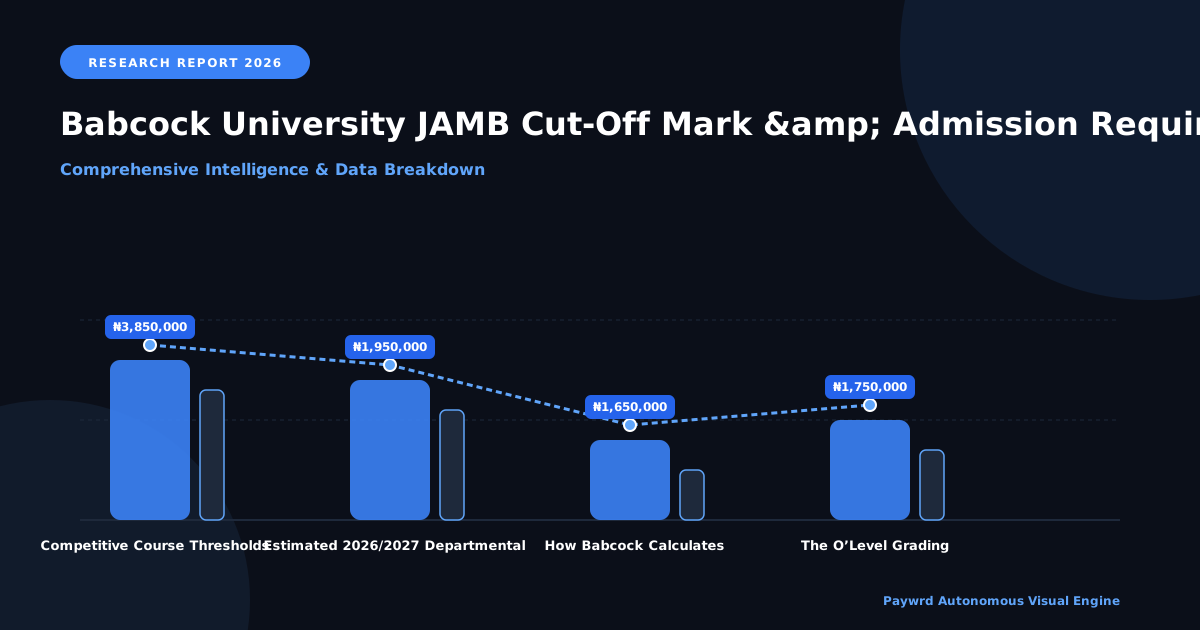
| Faculty / Programme Cluster | 2026/2027 JAMB Cut-Off Mark | Post-UTME Weight (%) | Programme Duration | Estimated Annual Tuition (₦) |
|---|---|---|---|---|
| Medicine & Surgery (MBBS) | 270+ | 40% | 6 Years | ₦3,850,000 – ₦4,200,000 |
| Law (LL.B) | 240+ | 30% | 5 Years | ₦1,950,000 – ₦2,150,000 |
| Engineering (All Disciplines) | 220+ | 30% | 5 Years | ₦1,650,000 – ₦1,850,000 |
| Nursing Science (BNSc) | 230+ | 35% | 5 Years | ₦1,750,000 – ₦1,950,000 |
| Computer Science / IT | 200+ | 30% | 4 Years | ₦1,250,000 – ₦1,450,000 |
| Management & Social Sciences | 180+ | 30% | 4 Years | ₦1,100,000 – ₦1,300,000 |
Frequently Asked Questions
What is the official JAMB cut-off mark for Babcock University 2026/2027?
The official baseline JAMB cut-off mark for Babcock University 2026/2027 admission is 180. However, competitive programmes like Medicine (270+), Law (240+), and Nursing (230+) require significantly higher UTME scores to qualify for Post-UTME screening under the NUC CCMAS framework.
How is the Babcock University Post-UTME aggregate score calculated for 2026?
Babcock University calculates the 2026 aggregate score using a weighted formula: JAMB UTME score (60-70% weight) plus Post-UTME screening score (30-40% weight). O'Level grades (WAEC/NECO) are screened for eligibility (5 credits including Math/English) but typically do not carry numerical weight in the final aggregate computation.
What are the O'Level requirements for Babcock University 2026 admission?
Candidates must possess five (5) O'Level credit passes in WAEC, NECO, or NABTEB obtained in not more than two sittings. Credits must include English Language, Mathematics, and three other subjects relevant to the chosen course of study as specified in the 2026 JAMB Brochure.
When does Babcock University Post-UTME registration start for 2026/2027?
Babcock University Post-UTME registration for the 2026/2027 session typically opens in July 2026, immediately after JAMB releases UTME results. Eligible candidates (180+ JAMB score) must register via the university's admission portal, pay the screening fee (approx. ₦10,000), and sit for the CBT screening before the August deadline.
Does Babcock University accept second choice candidates for 2026 admission?
No, Babcock University strictly admits candidates who selected it as their First Choice institution during JAMB 2026 registration. Second-choice candidates are not considered for admission into any programme for the 2026/2027 academic session, regardless of UTME score.
Strategic Final Takeaway
When evaluating Babcock University JAMB Cut Off Mark And Admission Requirements 2026/2027 in 2026 and beyond, base your decisions on accredited institutional standards, verified return on investment (ROI), and up-to-date official guidelines. Always verify specific dates and requirements through official regulatory portals.