Key Takeaway: While JAMB sets a national UTME minimum of around 200 for Medicine & Surgery, the real competitive barrier at Nigeria’s top federal universities sits between 275 and 300+. Aiming for 200 alone will not get you into MBBS at UNILAG, UI, or OAU in 2026.
Official 2026 JAMB Minimum Benchmark vs University Departmental Cut-Offs for MBBS
Understanding the gap between JAMB’s national baseline and individual university departmental requirements is critical for any 2026 UTME candidate serious about studying Medicine & Surgery. JAMB typically sets the general minimum UTME score for medical programmes at approximately 200. This is the threshold that qualifies you to participate in post-UTME screening at most accredited Nigerian universities. Think of it as the entry ticket — not the finish line.

The reality, however, is far more demanding. At elite federal universities, actual departmental merit lines for MBBS are set dramatically higher. Consider these typical competitive ranges for 2026 admission cycles:
- University of Lagos (UNILAG): 280 – 300+
- University of Ibadan (UI): 275 – 300+
- Ahmadu Bello University (ABU): 275 – 295+
- University of Nigeria Nsukka (UNN): 270 – 290+
- Obafemi Awolowo University (OAU): 275 – 295+
These institutions receive tens of thousands of applications for limited MBBS seats, and admissions committees use post-UTME results, O’Level grades, and JAMB scores in composite calculations that push effective thresholds well above the national floor.
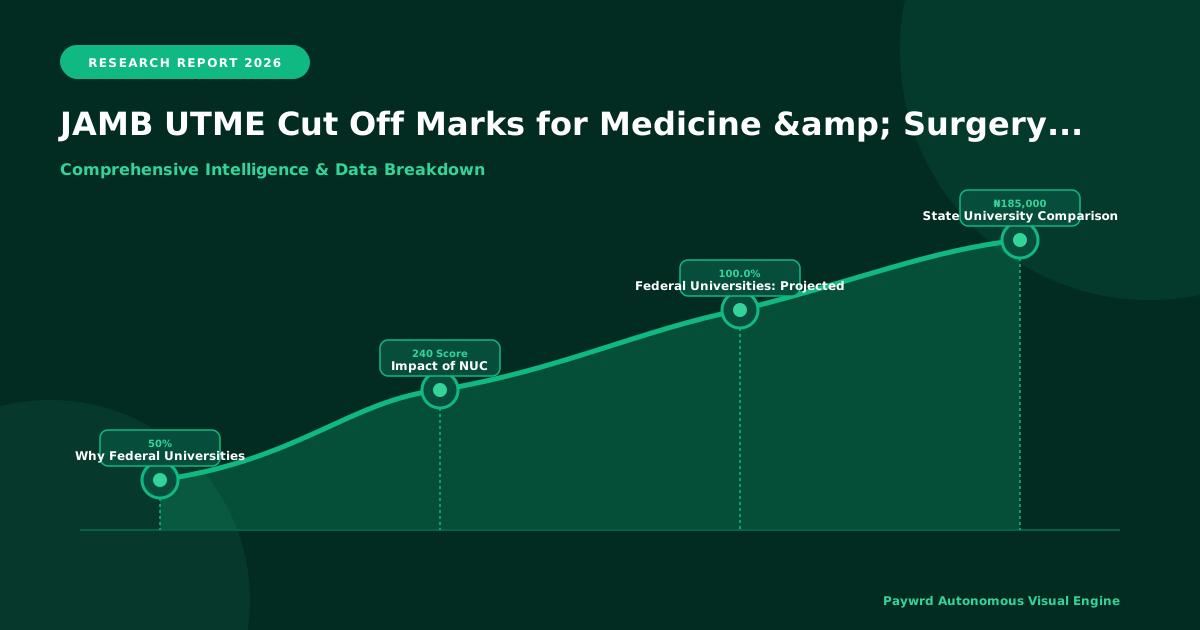
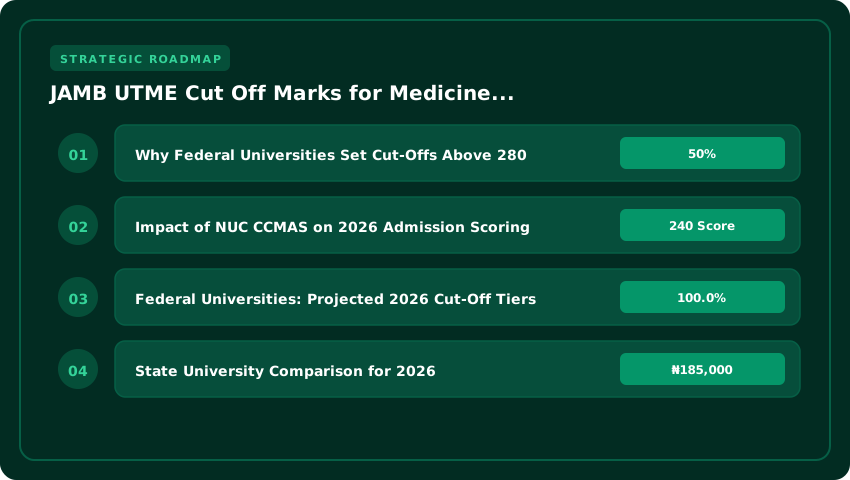
Why Federal Universities Set Cut-Offs Above 280
Federal universities bear the reputation of producing a significant share of Nigeria’s medical professionals. This prestige drives intense competition. UNILAG’s College of Medicine, for instance, consistently attracts top scorers from across all six geopolitical zones. When demand vastly outstrips supply — with only a few hundred MBBS slots available against thousands of qualified applicants — departments have the leverage to raise their cut-off marks. A score of 200 may technically meet JAMB’s benchmark, but it places you well below the competitive median at these institutions. State universities and newer medical programmes may accept lower scores, but the top federal tier remains ruthlessly selective.
Impact of NUC CCMAS on 2026 Admission Scoring
The NUC’s Continuous Competency Monitoring and Assessment System (CCMAS) is reshaping how Nigerian universities evaluate candidates. Under CCMAS guidelines, universities are increasingly weighting academic performance across multiple assessment dimensions rather than relying solely on the UTME score. For 2026 admissions, this means your O’Level results, post-UTME aptitude test performance, and structured interviews may carry heavier scoring influence than before. The result is that a high JAMB score alone no longer guarantees admission into MBBS programmes at top-tier universities. Candidates must prepare holistically, treating the UTME as one component within a broader competitive portfolio. Always verify updated cut-off marks through the official JAMB CAPS portal and individual university admissions pages before finalising your application strategy.
2026 Medicine & Surgery Cut-Off Marks: Federal Universities League Table (UNILAG, UI, UNN, ABU, OAU, UNIBEN)
If you are chasing MBBS in 2026, knowing where the real competitive line sits matters more than the JAMB national minimum. While the Joint Admissions and Matriculation Board sets a baseline around 200 for Medicine & Surgery, that number alone will not earn you a seat at any of Nigeria’s elite federal teaching hospitals. The actual departmental cut-offs at top federal universities range from 250 to 300+, and the gap between merit, ELDS, and catchment lines can make or break your shortlist. Here is the data-driven breakdown every 2026 candidate needs.
Federal Universities: Projected 2026 Cut-Off Tiers
The University of Ibadan (UI) remains the gold standard for clinical training in Nigeria. For the 2026 session, UI’s College of Medicine is projected to set its merit cut-off at 290+, with ELDS candidates needing a minimum of 275 and catchment applicants still requiring at least 265. The University of Lagos (UNILAG) College of Medicine follows closely, with merit projections hovering around 285+, ELDS at 270+, and catchment lines near 260. Historical trends show UNILAG rarely drops below 270 for any admission category in Medicine & Surgery.
- UI — Merit: 290+ | ELDS: 275+ | Catchment: 265+
- UNILAG — Merit: 285+ | ELDS: 270+ | Catchment: 260+
- OAU — Merit: 270+ | ELDS: 255+ | Catchment: 245+
- UNN — Merit: 265+ | ELDS: 250+ | Catchment: 240+
- ABU Zaria — Merit: 260+ | ELDS: 245+ | Catchment: 235+
- UNIBEN — Merit: 250+ | ELDS: 235+ | Catchment: 225+
Notice the pattern: ELDS candidates need roughly 15 to 20 marks fewer than merit candidates, while catchment applicants still face a floor well above the JAMB national minimum. University of Nigeria Nsukka (UNN) and Ahmadu Bello University (ABU) Zaria have shown steady cut-off increases over the past three admission cycles, reflecting growing competition. UNN’s 2026 projection sits roughly 10 points higher than its 2026 baseline, and ABU’s departmental line has climbed by approximately 8 points since 2026.
State University Comparison for 2026
State universities offer a more accessible but still competitive pathway. Lagos State University (LASU) projects a merit cut-off around 255 for Medicine & Surgery, with ELDS at 240 and catchment at 230. Lagos State University Teaching Hospital (LASUTH) and Ebonyi State University (ESUT) typically run slightly lower, with merit lines near 240 and 235 respectively. These figures still demand strong performance in Biology, Chemistry, and Physics.
Your 2026 strategy should be simple: score 275+ to keep all federal options open, target 250+ for state university safety nets, and always verify final departmental lines on the JAMB CAPS portal when post-UTME registration opens.
Post-UTME Screening Aggregates: Calculating Your 2026 Composite Score for Medical Admission
Getting past the JAMB UTME cut-off is only half the battle. The real action happens when universities combine your UTME score, Post-UTME screening result, and O-Level grades into a single composite figure. In 2026, every federal university running Medicine & Surgery uses a slightly different weighting formula, but they all follow the same structural logic: UTME carries between 50% and 60%, Post-UTME contributes 30% to 40%, and your O-Level results account for the remaining 10% to 20%.
Breaking Down the Formula
The most common 2026 weighting at top-tier federal universities splits the composite as follows: UTME at 50%, Post-UTME at 30%, and O-Level at 20%. Some institutions, like UNILAG, push the UTME share to 60% while reducing O-Level to 10%. Understanding your specific university’s formula is not optional—it is the difference between knowing you are competitive and wasting money on a Post-UTME form you cannot win.
How UNILAG, UI, and UNN Handle O-Level Grades
In 2026, the three most competitive universities for MBBS use a standardized grade-point system for O-Level results. An A1 earns 6 points, B2 earns 5 points, and B3 earns 4 points. UNILAG typically requires five relevant O-Level credits including English, Mathematics, Biology, Chemistry, and Physics, then converts those grades into the composite. UI weights O-Level performance slightly more conservatively, rewarding candidates with strong science results. UNN, running its screening through its dedicated portal, applies the same grade-point conversion but adjusts how heavily those points feed into the final aggregate.
For example, a candidate with A1 grades in all five relevant subjects enters the O-Level component with a maximum possible grade-point contribution, giving them a measurable edge over someone sitting on B3 and C4 combinations.
Strategies for Borderline UTME Scorers (260-280)
If your UTME score falls between 260 and 280, your Post-UTME performance becomes your lifeline. Here is how to maximize it:
- Aim for 70%+ in Post-UTME: At most federal universities, a Post-UTME score above 70% can compensate for a UTME score that sits just below the departmental cut-off.
- Study past screening questions: Universities like UNILAG and UI recycle question patterns. Invest in official or reliable past Post-UTME question papers for 2026 preparation.
- Strengthen your O-Level profile: If you have pending or retaken O-Level exams, clear them before screening. Universities verify results during aggregate calculation, and missing credits can disqualify you regardless of your UTME score.
- Apply strategically: Do not pay for Post-UTME forms at more than three universities simultaneously. Focus your budget on institutions where your composite probability is realistic.
Before you pay a single Naira for a Post-UTME form in 2026, calculate your projected composite using the university’s published weighting formula. If your combined score falls below the historical departmental cut-off for Medicine & Surgery at that institution, redirect your resources toward a more strategic option.
WAEC/NECO O-Level Subject Combination & Grade Requirements for 2026 MBBS Admission
The Non-Negotiable Five Credit Passes
Every 2026 UTME candidate chasing MBBS must secure a minimum of five credit passes at O-Level, and these are strictly fixed: English Language, Mathematics, Biology, Chemistry, and Physics. No substitutions are accepted. Whether you write WAEC or NECO, the grade requirement is at least a C6 (or equivalent Grade C). University senates across Nigeria treat this as a baseline eligibility gate, and failing even one of these five subjects automatically disqualifies your application regardless of your JAMB score. This rule applies to all federal and state universities offering Medicine and Surgery.
One Sitting vs Two Sittings Policy
The debate between one-sitting and two-sitting candidates remains relevant in 2026. While JAMB itself does not officially discriminate based on the number of sittings, many top-tier universities still favour candidates who obtained their five credits in a single examination sitting. Universities like the University of Ibadan (UI), Ahmadu Bello University (ABU), and the University of Lagos (UNILAG) have historically indicated preference during their Post-UTME screening processes. If you are writing in two sittings, ensure your combined results meet the five-credit requirement before you begin JAMB registration. Some institutions may reject applicants whose two-sitting results span more than two examination cycles, so plan your WAEC or NECO dates strategically.
NMC Nigeria’s Stance on Combined WAEC and NECO Results for 2026
The Nigerian Medical Council (NMC) has maintained a firm position: candidates combining WAEC and NECO results for 2026 MBBS registration eligibility must present all five required credits across both certificates. The NMC does not accept partial results from a single examination body if credits are missing. This means if you scored credits in English, Mathematics, Biology, and Chemistry in WAEC but lacked Physics, you cannot substitute Physics with a NECO credit unless the NMC explicitly approves cross-body combinations for the current registration cycle. Always verify your eligibility through the NMC registration portal before committing to JAMB.
Handling ‘Awaiting Results’ During 2026 JAMB Registration and Post-UTME Screening
Many 2026 UTME candidates face the “Awaiting Results” dilemma, particularly those sitting for WAEC or NECO alongside JAMB. Here is what you need to know:
- JAMB allows candidates to register with an “Awaiting Results” status, but this does not guarantee admission.
- Universities conducting Post-UTME screenings will require proof of O-Level credits before final admission offers are made. An “Awaiting Results” candidate who fails to produce the required five credits by the screening deadline risks automatic disqualification.
- Keep monitoring the WAEC Result Checker via the WAEC e-Registration portal and the NECO result verification page to confirm your status well ahead of Post-UTME exercises.
- Do not wait until JAMB CAPS admission rounds close. Secure your O-Level results early and upload them where possible to avoid last-minute bottlenecks.
Meeting these O-Level requirements is not optional, it is the foundation upon which every other step in your 2026 MBBS admission journey rests. Treat your WAEC or NECO preparation with the same seriousness as your UTME studies.
Medicine vs Allied Health: 2026 Cut-Off Comparison for Pharmacy, Dentistry, Nursing & Physiotherapy
If you scored between 250 and 280 in the 2026 UTME and just missed the MBBS merit list, you are not out of options. Several allied health courses at Nigeria’s top universities offer strong career prospects with slightly lower competitive thresholds. Understanding these score gaps is essential for strategic JAMB CAPS registration and preference filling.
MBBS vs BDS: The Gap at Top Universities
At most federal universities, Dentistry (BDS) sits 5 to 15 marks below Medicine & Surgery. At UNILAG, MBBS typically demands 280+ while BDS caps around 265-270. UI runs a similar pattern, where MBBS candidates need 275+ but BDS admits around 260-265. At UNN and ABU, the gap widens slightly, with MBBS cutting at 275+ and BDS hovering near 255-265. These margins give strong 250-280 scorers a realistic shot at dentistry if they prioritise BDS during CAPS allocation.
Pharmacy and Nursing Science: High-Score Alternatives
B.Pharm programs at UNILAG, UI, and ABU generally require 250-270, making them accessible to candidates who fall just short of MBBS benchmarks. Nursing Science at federal universities typically sets departmental cut-offs between 240 and 265. Both paths lead to professionally regulated, high-demand careers. The Nigerian Pharmacists Council and Nursing Council registration processes are rigorous, but the earning potential and job security rival MBBS graduates, especially in hospital and pharmaceutical industry settings.
Emerging Competitive Courses: 2026 Benchmarks
Medical Laboratory Science, Radiography, and Physiotherapy are gaining fierce competition in 2026. MLS cut-offs at UNILAG and UI now sit around 245-260, reflecting growing interest in diagnostic science careers. Radiography programs at ABU and UNN demand approximately 240-255, while Physiotherapy thresholds range from 235-255 across these same institutions. These courses are ideal for candidates who want clinical, hands-on healthcare roles without the extreme MBBS pressure.
For any candidate in the 250-280 bracket, the key is strategic preference ordering on the JAMB CAPS portal. Place your MBBS choice first, but follow immediately with BDS, B.Pharm, or MLS depending on your career interest. Monitor the NELFUND portal for loan eligibility once admission is confirmed, and ensure your O’Level results are uploaded through WAEC e-Registration before CAPS begins. Checking NUC CCMAS for accredited programme status at your chosen institution will also protect you from unrecognised degrees.
- MBBS at top universities: 275-300+ (extremely competitive)
- BDS: 5-15 marks below MBBS across UNILAG, UI, UNN, ABU
- B.Pharm: 250-270, strong alternative for high scorers
- Nursing Science: 240-265, regulated and in high demand
- MLS, Radiography, Physiotherapy: 235-260, rapidly gaining competition
Your 250+ score is genuinely competitive. The question is not whether you can enter healthcare at a top university, but which programme aligns best with your goals and willingness to adapt your first choice.
From Admission to Practice: NMC Registration, Housemanship & NYSC Pathway for 2026 Intake
Getting into a Nigerian medical school is only the first battle. The real journey spans seven years of rigorous training before you hold a license to practice independently. Here is the honest roadmap every 2026 MBBS intake should understand.
Provisional NMC Registration Timeline
Once you matriculate into an accredited MBBS program, the Medical and Dental Council of Nigeria (MDCN) begins tracking your progress from day one. Provisional registration becomes available after you complete your basic medical sciences and pass the MDCN screening examination. For the 2026 intake, this typically falls around your second or third year, depending on your university’s academic calendar. Full provisional registration is granted upon completion of the 6-year MBBS program, clearing the path for the mandatory 1-year Housemanship internship. Do not mistake JAMB clearance for licensure readiness. The council has strict stage-gate requirements that run parallel to your academic timeline.
- 2026 Matriculation: Begin 6-year MBBS program at an MDCN-accredited faculty
- Year 2-3: Sit for the MDCN Basic Medical Sciences examination
- Year 6: Complete MBBS and apply for full provisional NMC registration
- Post-MBBS: Commence 1-year Housemanship at an accredited teaching hospital
Accreditation Status Check
Not every faculty offering Medicine & Surgery in Nigeria holds current MDCN accreditation. Before you chase a JAMB score of 275+, verify that your target university’s medical faculty appears on the MDCN’s official accredited institutions list. Visit the MDCN website or the NUC CCMAS portal to confirm standing. A degree from a non-accredited program means your qualification will not be recognized for licensure regardless of your performance. This single check saves careers from derailing at the finish line.
Cost Breakdown & Financial Planning
Training as a medical doctor in Nigeria carries significant financial weight. For the 2026 academic year, expect these estimates:
- Tuition: Federal universities charge approximately ₦50,000 to ₦150,000 per year for MBBS, while private institutions range from ₦800,000 to ₦2,500,000 annually
- Clinical rotation logistics: Transport, uniforms, and consumables during hospital postings add roughly ₦80,000 to ₦200,000 per session
- MDCN licensing fees: Registration and examination fees total approximately ₦35,000 to ₦60,000 across all licensing stages
For financial relief, 2026 medical students should explore the NELFUND loan portal. Eligible students can access education loans to cover tuition and essential academic costs. Check the official NELFUND portal for updated 2026 eligibility thresholds and application windows. Remember, Housemanship salaries at federal teaching hospitals currently range around ₦180,000 to ₦350,000 monthly, which helps offset accumulated debt. Plan early, verify accreditation, and build your financial strategy before matriculation.
2026 JAMB Change of Course/Institution Strategy: Pivoting Into Medicine After UTME Results
If your 2026 UTME score is solid—say 260 and above—but you initially applied for Biochemistry, Physiology, or Nursing, the JAMB Change of Course/Institution window is your only legal route into Medicine & Surgery. For the 2026 cycle, JAMB typically opens this portal on the efacility.jamb.gov.ng platform immediately after results are released, usually keeping it active for 4 to 6 weeks before the Central Admissions Processing System (CAPS) hardens. You must log in, pay the statutory ₦2,500 service charge via Remita, and select your new preferred institution and course code (usually 1101 for MBBS) before the deadline slams shut. Miss this window, and you wait another full year; there are no extensions, regardless of network glitches or portal traffic.
Why the Big Three (UNILAG, UI, UNN) Are Effectively Closed
Let’s be brutally honest: pivoting into Medicine at the University of Lagos, University of Ibadan, or University of Nigeria Nsukka via Change of Course is statistically near-impossible in 2026. These institutions operate on a strict Quota System enforced by the Medical and Dental Council of Nigeria (MDCN). They fill 95–100% of their MBBS slots during the primary admission merit list. Even if you scored 295, the departmental quota is often exhausted by candidates who listed the school as First Choice and met the specific Post-UTME screening aggregate. JAMB CAPS will simply reject the change request because the “Admission Quota Full” flag is triggered. Do not waste your ₦2,500 and precious time targeting these as a backup pivot.
Realistic Targets: Accredited State & Private Universities
Your strategy must shift to institutions with accredited MBBS programs that historically retain vacancies after the first merit list. For 2026, focus your Change of Institution application here:
- Afe Babalola University (ABUAD), Ado-Ekiti: Consistently accredited, large quota (150+ slots), and runs a transparent Post-UTME. A UTME score of 240–250+ with a strong Post-UTME performance gives you a genuine shot.
- Babcock University, Ilishan-Remo: Faith-based, high capacity. They prioritize candidates who meet the JAMB minimum (200) and pass their internal screening. Change of Course applicants are treated fairly if slots remain.
- Gregory University, Uturu: Often has the most flexibility for late entrants. Accreditation is current; verify on the NUC CCMAS portal before applying.
- State University Alternatives: Check LASU (if quota permits non-indigenes), DELSU, or COOU. These occasionally have residual slots, but indigeneship policies heavily influence the final CAPS ranking.
Before paying for the change, verify the 2026 MDCN Accreditation Status on the NUC website—provisional accreditation means you risk graduating without a license. Once confirmed, execute the change on JAMB eFacility immediately, print the new admission letter, and prepare rigorously for the new institution’s Post-UTME. This is your pivot play; make it count.
| University | Ownership | JAMB National Minimum (2026) | Projected Dept. Cut-Off 2026/2027 | Post-UTME Weight | Competitiveness Tier |
|---|---|---|---|---|---|
| University of Ibadan (UI) | Federal | 200 | 290 – 310+ | 50% | Extreme |
| University of Lagos (UNILAG) | Federal | 200 | 285 – 305+ | 50% | Extreme |
| Obafemi Awolowo Univ (OAU) | Federal | 200 | 280 – 300+ | 50% | Very High |
| Ahmadu Bello Univ (ABU) | Federal | 200 | 260 – 285+ | 40-50% | Very High |
| University of Nigeria (UNN) | Federal | 200 | 265 – 290+ | 50% | Very High |
| Lagos State Univ (LASU) | State | 200 | 270 – 290+ | 50% | High |
| Delta State Univ (DELSU) | State | 200 | 250 – 275+ | 40-50% | High |
| Babcock University | Private | 200 | 240 – 260+ | Screening Based | Moderate-High |
| Afe Babalola Univ (ABUAD) | Private | 200 | 230 – 250+ | Screening Based | Moderate |
| Gregory University | Private | 200 | 200 – 220+ | Screening Based | Accessible |
Frequently Asked Questions
What is the JAMB cut-off mark for Medicine and Surgery in UNILAG for 2026?
For the 2026/2027 session, UNILAG's projected departmental cut-off for Medicine & Surgery is 285–305+. While the JAMB national minimum is 200, UNILAG historically requires scores above 285 combined with a high Post-UTME score (50% weight) to secure admission.
Can I study Medicine with a JAMB score of 250 in Nigeria in 2026?
A score of 250 meets the JAMB 200 minimum but falls short for top federal universities (UI, UNILAG, OAU) where cut-offs exceed 280. In 2026, 250 may qualify you for some state universities or private institutions like Babcock or ABUAD, provided you excel in their Post-UTME screenings.
Which Nigerian university has the lowest cut-off mark for Medicine in 2026?
Private universities typically have the lowest 2026 cut-offs for MBBS, often accepting scores between 200–230 (e.g., Gregory University, Madonna University). Among federal universities, newer or less subscribed institutions may dip near 240–250, but accreditation status must be verified for 2026 entry.
How is the aggregate score calculated for Medicine admission in 2026?
Most federal universities (UI, UNILAG, OAU, UNN) use a 50:50 formula for 2026: (JAMB Score / 8) + (Post-UTME Score / 2) = Aggregate. A candidate needs roughly 75–80% aggregate. State universities vary; LASU uses 50:50, while some private universities rely solely on JAMB + O'Level screening.
What are the O'Level requirements for Medicine & Surgery in 2026 UTME?
The 2026 requirement remains five (5) SSCE credit passes in one sitting or two sittings including English Language, Mathematics, Physics, Chemistry, and Biology. Results must be from WAEC, NECO, or NABTEB. Awaiting results candidates can apply but must upload verified certificates before 2026 admission closes.
Strategic Final Takeaway
When evaluating JAMB UTME Cut Off Mark For Medicine And Surgery For All Nigerian Universities 2026 in 2026 and beyond, base your decisions on accredited institutional standards, verified return on investment (ROI), and up-to-date official guidelines. Always verify specific dates and requirements through official regulatory portals.