Understanding NELFUND’s Refund Policy vs. Loan Disbursement
Let us clear the air immediately: the Nigerian Education Loan Fund (NELFUND) is a disbursement engine, not a refund processing agency. When your loan is approved, NELFUND transfers the tuition component directly to your institution’s designated account—often via the Remita platform—and pays the upkeep stipend to your personal bank account. Once that money leaves NELFUND’s wallet, the Fund considers the transaction closed. If you subsequently withdraw, defer admission, or secure a scholarship that covers your fees, NELFUND does not issue a “reverse transfer” to your pocket. You must approach your university’s bursary department.
Loan Cancellation vs. Tuition Refund: The Operational Gap
Students often confuse loan cancellation with a tuition refund. Cancellation occurs before disbursement—perhaps you declined the offer on the NELFUND portal or failed to submit your matriculation number in time. In that scenario, the funds never left the treasury. A refund, however, implies the school already holds the cash. Under the current NELFUND operational guidelines, the Fund has no mandate to claw back money from a Vice-Chancellor’s account. That is a contractual matter between you and the institution, governed by the school’s specific refund policy, which varies wildly between federal, state, and private universities.
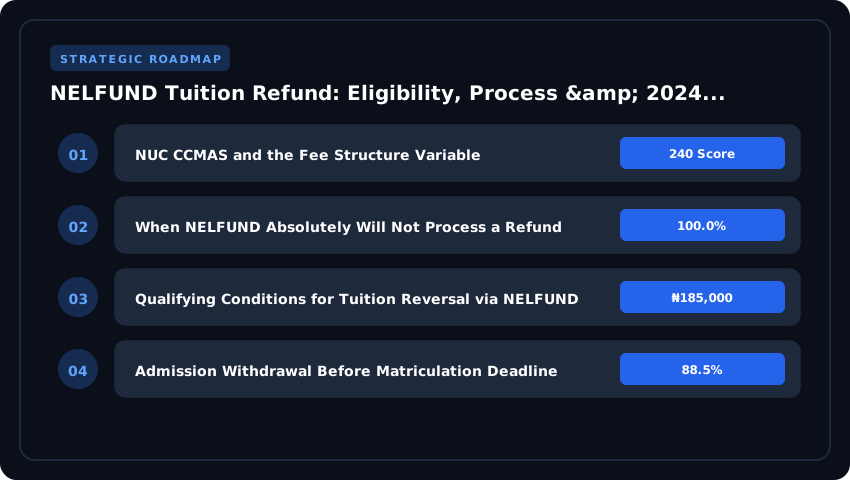
NUC CCMAS and the Fee Structure Variable
The National Universities Commission’s (NUC) Core Curriculum Minimum Academic Standards (CCMAS) has reshaped how programmes are costed. Because CCMAS unbundles courses into distinct credit units with practical components, fee schedules are now more granular. A refund calculation today isn’t a flat “return 50%.” It depends on whether you attended lab sessions, accessed the LMS, or sat for continuous assessment. If your school adopts a pro-rata model based on CCMAS credit completion, your refundable amount might be significantly lower than the lump sum NELFUND paid. Always demand a breakdown of utilized vs. unutilized credits from the faculty officer before filing a bursary claim.
When NELFUND Absolutely Will Not Process a Refund
- Post-Disbursement Withdrawal: If you collected the upkeep allowance (₦20,000–₦25,000 monthly) and then withdrew, that money is spent. NELFUND treats it as a lived expense.
- Institutional Non-Remittance: If your school confirms receipt but refuses to refund citing “administrative costs” or “session commitment,” NELFUND will not intervene. Your remedy is the institution’s Governing Council or the NUC grievance channel.
- Data Mismatch: If your JAMB registration number on the NELFUND portal differs from the school’s nominal roll, the disbursement might hit a “suspense account.” This isn’t a refund issue; it’s a reconciliation error requiring your ICT director’s intervention.
Bottom line: Treat NELFUND as the sender and your university as the holder. Keep your payment receipts (RRR codes), admission letters, and withdrawal/deferment approval letters in a single folder. When you walk into the bursary, you are negotiating a refund, not asking NELFUND for a favour.
Qualifying Conditions for Tuition Reversal via NELFUND
The Student Loan Act 2024 is explicit: NELFUND does not issue refunds directly to students. The Fund disburses tuition to the institution. Therefore, a “tuition reversal” is legally a refund from your university, polytechnic, or college of education back to NELFUND’s recovery account—or in rare overpayment cases, back to your source wallet. Understanding the exact triggers saves you from arguing with a bursar who has zero obligation to refund a student who simply “changed their mind” after matriculation.
1. Admission Withdrawal Before Matriculation Deadline
This is the cleanest qualifying scenario. If you accept a JAMB CAPS admission offer, NELFUND pays your tuition, but you formally withdraw before the institution’s official matriculation ceremony or the published matriculation deadline, the school holds funds for a student who never legally enrolled. Under the Act, the institution must reverse the specific tuition component to NELFUND. You must present your formal withdrawal letter (signed by the Dean of Student Affairs or Registrar) and proof that your matriculation number was never activated. Without that paper trail, the bursary will classify the funds as “spent on administrative processing.”
2. Overpayment Due to JAMB/Post-UTME Screening Errors
System glitches happen. Common triggers include:
- Double Payment: NELFUND disburses twice for the same session due to a portal sync error between JAMB CAPS and the school’s portal.
- Wrong Programme Fee: You applied for Education Biology (₦65,000) but the system posted Medicine & Surgery fees (₦150,000) because of a Post-UTME screening upload error.
- Ghost Admission: JAMB CAPS shows “Admitted,” but the department never ratified the list; NELFUND paid based on the CAPS status.
In these cases, the refund obligation is mandatory. The institution’s ICT/Bursary reconciliation team must verify the overpayment against the approved fee schedule for your specific programme code and initiate a reversal to NELFUND’s designated TSA sub-account within 30 working days.
3. Deferment or Withdrawal After Loan Disbursement
This is the grey area where most students lose money. If you matriculate, attend lectures for three weeks, then secure a deferment (leave of absence) or voluntary withdrawal after the matriculation deadline, the Act does not guarantee a full refund. Most Nigerian tertiary institutions operate a “no refund after matriculation” policy for tuition, retaining funds to cover administrative costs, identity card production, and exam processing already incurred.
However, a partial reversal is possible if you can prove the loan covered only tuition and the school has a pro-rata refund policy gazetted in their student handbook. You must negotiate this directly with the Dean of Faculty and the Bursar—NELFUND will not intervene. Always demand a “Fee Breakdown Schedule” before accepting the loan; if the loan covered hostel or acceptance fees, those components are rarely reversible once the bed space is allocated or the acceptance letter printed.
Step-by-Step: Initiating a Refund Request on the NELFUND Portal
Let us be clear: you cannot click a Refund
button on the NELFUND dashboard and expect an alert on your phone. The portal is built for disbursement, not reversal. However, the Loan Management section is where you formally flag the discrepancy so the Fund knows the money did not sit where it was supposed to. Log in at nelf.gov.ng using your NIN and registered phone number. Once inside, ignore the Application Status
tab—you are past that. Head straight to Loan Management > Disbursement History. Locate the specific academic session where the overpayment or withdrawal occurred. Click View Details
to expose the Transaction Reference ID; copy this. You will need it for every email, WhatsApp note to the bursar, and physical letter you write.
Uploading Your Evidence Pack
The portal allows document uploads under Supporting Documents, but the file validator is strict: PDF only, maximum 2 MB per file. Do not upload blurry cam-scanner photos; they get rejected by the automated OCR check. You need three crisp PDFs:
- Official Withdrawal/Deferral Letter: Signed by your Dean or HOD, stamped by the Registry, showing the effective date.
- Bursary Receipt of Overpayment: If you paid cash on top of the loan, the school’s receipt must show
NELFUND Top-up
orExcess Tuition
with the exact Naira amount. - Current Admission Letter: The JAMB CAPS admission letter or the institution’s re-printed letterhead version—this proves your identity matches the disbursement record.
After upload, the status flips to Pending Verification.
Do not refresh obsessively; the system batches these for the institution’s ICT unit once daily, usually around 2:00 AM WAT.
The Verification Bottleneck: Bursary vs. ICT
Here is where most students lose weeks. The NELFUND portal does not approve refunds; your institution does. Two offices must shake hands digitally:
- Bursary Department: They confirm the money actually hit their ledger and that you owe nothing else (hostel, damages, library fines). They raise a
Refund Memo
on their internal ERP. - ICT / MIS Unit: They log into the NELFUND Institutional Portal (separate from the student portal) and mark the Transaction Reference ID as
Reversal Approved.
If the Bursary signs off but ICT forgets to click the button—or vice versa—your status stays Pending
indefinitely. Pro tip: walk into the Bursary with a printed copy of your Disbursement History screenshot. Ask for the Refund Memo Reference Number.
Then march to ICT (or email the Director of ICT with that number in the subject line) and demand they action the reversal on the NELFUND Institutional Portal. Only when ICT hits Submit
does the Fund queue the credit back to the source wallet. Expect 10–15 working days post-ICT action for the funds to reflect in the institution’s account, ready for your next session or withdrawal processing.
What Happens If the University Already Spent the Funds?
This is the “nightmare scenario” for many students: you’ve successfully processed your withdrawal or deferment, but when you approach the Bursary Department, you are met with a shrug and the claim that the funds have already been “absorbed” into the university’s operational budget. Let’s be very clear—this is not a valid legal or financial excuse.
In accounting terms, tuition fees paid in advance for a semester the student does not attend are classified as unearned revenue. The university cannot legally claim these funds as profit or operational expenditure if the service (education) was not rendered. The Bursary Department remains liable for these funds, regardless of whether they have already been spent on campus infrastructure or staff salaries.
The Recovery Mandate: NELFUND vs. The Institution
NELFUND does not simply “gift” money to universities; it disburses loans on behalf of the student. If a university refuses to refund a student who is no longer eligible for the loan, they are essentially holding funds that belong to the Federal Government of Nigeria. NELFUND possesses a strong recovery mandate to ensure these funds are not misappropriated. Institutions that consistently default on refunds risk:
- Suspension of further disbursements: NELFUND can freeze the flow of loan payments to a specific institution until the refund discrepancy is resolved.
- Audit Queries: The Fund can trigger a financial audit of the institution’s student loan account.
- Reputational Damage: Being flagged as a “non-compliant institution” on official portals.
The Escalation Path: How to Get Your Money Back
If the Bursary Department insists that the money is gone, do not stop at the school gate. You must escalate the matter through the proper regulatory channels to put pressure on the administration. Follow this specific hierarchy:
- Step 1: NELFUND Helpdesk: Log a formal complaint via the NELFUND portal. Provide your application ID and the official letter of deferment/withdrawal from your school.
- Step 2: National Universities Commission (NUC): If the school remains stubborn, report the matter to the NUC. As the regulatory body for Nigerian universities, the NUC has the power to sanction institutions that mishandle student finances.
- Step 3: Central Bank of Nigeria (CBN): Since NELFUND operates within a broader financial framework involving government guarantees, extreme cases of institutional fraud or refusal to refund can be escalated to the CBN’s consumer protection department.
Remember, the university is the custodian of the funds, but NELFUND is the owner of the loan. When the custodian refuses to pay, the owner has the power to compel them.
Impact on Loan Balance, Interest & Future Disbursements
One of the most common anxieties for Nigerian students is whether a refund—triggered by a course change, deferment, or overpayment—will “mess up” their financial standing with the Fund. The short answer is no, provided the refund is processed correctly through your institution’s bursary and credited back to the NELFUND account. When a refund is successfully reconciled, it doesn’t just vanish; it fundamentally alters the mathematics of your debt.
Principal Adjustment and Interest Accrual
The most immediate benefit of a processed refund is the reduction of your loan principal. In the NELFUND model, interest typically does not accrue while you are in school, but the total amount disbursed forms the “principal” you will eventually repay after graduation and a grace period. If ₦200,000 is refunded from your tuition, that amount is deducted from your total debt ceiling. This means you aren’t paying back money you didn’t actually use, and more importantly, any future interest calculations will be based on this lower, adjusted principal.
Effect on Subsequent Session Funding
Many students fear that requesting a refund or experiencing a disbursement error will flag them as “high risk” or disqualify them from funding in the next academic session. This is a misconception. Your eligibility for future disbursements is tied to your academic standing (CGPA) and your continued enrollment status, not the refund history of a previous semester. As long as you remain a bona fide student of a recognized Nigerian tertiary institution and meet the NUC or NBTE guidelines, a tuition refund will not cap your funding limits or trigger a rejection on the NELFUND portal for the following year.
Credit Bureau Reporting and Financial Integrity
While NELFUND is a social intervention program, it operates with professional financial rigor. The Fund shares data with credit bureaus to ensure loan sustainability. If a refund is due but remains sitting in a school’s suspense account without being returned to the Fund, it remains a liability on your record. Ensuring the refund is finalized protects your creditworthiness. Once the refund is credited back, the credit bureau reporting reflects a lower debt burden, which is critical for your financial health when you eventually enter the Nigerian labor market and may seek personal or business loans.
- Principal Drop: Refunded amounts are subtracted from the total loan balance immediately upon reconciliation.
- Interest Freeze: You avoid paying future interest on funds that were returned to the Fund.
- Funding Continuity: Refunds do not negatively impact your eligibility for next session’s tuition or upkeep loans.
- Credit Safety: Proper reconciliation prevents “ghost debts” from appearing on your credit profile.
Common Rejection Reasons & How to Appeal a Denied Claim
Getting a rejection notice from NELFUND can feel deeply frustrating, especially when you are counting on the loan to stay enrolled. However, most denied claims are not arbitrary—they stem from specific administrative gaps that are entirely fixable once you know what to look for. Below are the three most frequent rejection scenarios and exactly how to escalate your case when things do not go smoothly.
Missing Clearance Certificate from HOD or Dean
This is the single most common reason NELFUND flags a claim. Before your tuition is disbursed, your institution requires a signed Clearance Certificate from your Head of Department or Dean confirming that you have no outstanding academic or financial obligations. If your application reaches NELFUND without this document attached to your institutional record, the claim is automatically rejected. Fix: Visit your HOD or Dean’s office immediately, request the clearance, and ensure your school’s bursary re-submits the updated documentation through the NELFUND portal. Do not assume your department remembers—follow up in writing or via email so you have a trail.
Discrepancy Between JAMB Admission Status and School Portal
NELFUND cross-references your admission data against the Joint Admissions and Matriculation Board (JAMB) database. If your JAMB status shows something different from what your school’s portal displays—perhaps a pending admission, a mismatched registration number, or an updated catchment area—the system flags the inconsistency and halts processing. Fix: First, log into the JAMB CAPS portal and confirm your admission status is accurately reflected. Then visit your school’s admissions office to verify that your records match. Once both sides align, request that your institution’s bursary re-submit your claim with corrected data through the NELFUND portal.
Filing an Appeal via the NELFUND Dispute Resolution Committee
When your claim is rejected and the fixes above do not resolve the issue, you have the right to a formal appeal. NELFUND operates a Dispute Resolution Committee specifically designed to hear contested decisions. To file, visit the official NELFUND portal at nelfund.gov.ng and navigate to the Dispute Resolution section. You will need your original claim reference number, a written statement explaining why you believe the rejection was erroneous, and any supporting documents—receipts, clearance certificates, or JAMB confirmation letters. The committee typically reviews appeals within 14 to 21 working days. You can also raise your concern through the NELFUND helpline or by visiting their Abuja headquarters directly.
Keep every confirmation receipt and email correspondence. Patience and documentation are your strongest tools when navigating NELFUND disputes. Most students recover their claims within one appeal cycle once the correct paperwork is in order.
| Scenario | NELFUND Role | Institution (Bursary) Role | Student Action Required | Fund Recovery Timeline |
|---|---|---|---|---|
| Standard Disbursement | Pays tuition directly to school via Remita; pays upkeep to student account. | Receipts tuition; issues payment confirmation to student portal. | Accept loan offer on portal; verify school receipt. | Instant (Tuition) / 24-48hrs (Upkeep) |
| Voluntary Withdrawal / Dropout | Transaction closed; zero refund obligation. | Holds tuition; processes refund per internal policy (often pro-rata). | Apply to Dean/Bursary; submit withdrawal letter. | 4-12 Weeks (Institution dependent) |
| Deferral of Admission | No clawback; loan remains disbursed for that session. | May credit tuition to next session or refund per policy. | Secure deferral approval; notify Bursary & NELFUND. | Session-based (Next Academic Year) |
| External Scholarship Award | No automatic reversal; loan status remains ‘Paid’. | Refunds duplicate tuition payment to student/source. | Present scholarship letter; request fee reversal. | 2-8 Weeks (Bursary processing) |
| Overpayment / Duplicate Payment | Investigates only if system error flagged. | Primary resolver; verifies ledger & initiates Remita reversal. | Flag discrepancy with payment receipts (RRR). | 1-4 Weeks (Remita reversal cycle) |
Frequently Asked Questions
Can I get a tuition refund directly from NELFUND if I drop out?
No. NELFUND does not process tuition refunds. Once the Fund disburses tuition to your institution via Remita, the transaction is closed. You must negotiate any refund directly with your school's bursary department, as they hold the funds.
What happens to my NELFUND upkeep allowance if I defer admission?
The upkeep stipend paid to your personal bank account is yours to keep; NELFUND does not claw back disbursed upkeep. However, future session disbursements pause until you resume studies and re-validate your status on the portal.
Who do I contact for a NELFUND tuition refund in Nigeria?
Contact your institution's Bursary or Student Accounts Division, not NELFUND support. The school controls the tuition ledger. Submit a formal application with your withdrawal/deferral letter and Remita Retrieval Reference (RRR) for processing.
Does NELFUND refund money if I win a scholarship after loan disbursement?
NELFUND does not refund the tuition component. Since the school already received payment, your institution's bursary must reverse the duplicate credit. Provide your scholarship award letter to the school to initiate a refund to you or the sponsor.
How long does a NELFUND-related tuition refund take from a university?
Refund timelines vary by institution but typically range from 4 to 12 weeks. Federal universities often require Senate/Bursary approval cycles. Private universities may process faster (2-6 weeks). Always obtain a written acknowledgment from the Bursary.
Strategic Final Takeaway
When evaluating Can I Get A Refund For My University Tuition Through NELFUND?, base your decisions on accredited institutional standards, measurable return on investment (ROI), and up-to-date official guidelines. Always verify specific dates and requirements through official regulatory portals.