Mapping CRM Data Streams to Early Mental Health Warning Signs
The dirty secret of student retention is that most students who withdraw don’t make a snap decision. They send digital signals for weeks, sometimes months, before anyone notices. A missed login here, a skipped assignment there, a sudden drop in library checkouts, and a quiet exit from the campus messaging app. Individually, each signal looks harmless. Collectively, they paint a portrait of a student sliding toward a mental health crisis or an academic departure. Higher education CRM platforms are now purpose-built to detect exactly these patterns.

Behavioral analytics dashboards inside platforms like Salesforce Education Cloud, EAB Navigate, and Anthology Student flag withdrawal risk indicators by cross-referencing LMS activity timestamps, help desk ticket frequency, financial aid portal logins, and even dining hall swipe data. When a student who normally hits Canvas five nights a week suddenly goes silent for ten days, the CRM doesn’t just log it. It generates a risk score, assigns it to the appropriate advisor, and opens a case file. That score is then layered against historical cohort data, so a sophomore flagging 30% below their baseline engagement can be triaged ahead of a senior showing a 10% dip.
Integrating Counseling Center Utilization with Academic Alerts
Most universities have a behavioral intervention team, but historically these teams have operated on gut instinct and email chains. Today’s CRMs close that loop by ingesting counseling center utilization data directly through secure HL7 or FHIR-compatible APIs. When a student schedules three counseling appointments in two weeks, the system can automatically cross-check their midterm grades. If both indicators are trending negative, the CRM escalates the record to a designated case manager, bypassing the typical referral bottleneck that delays support by days.

This integration matters because academic struggle and mental health distress are correlated in roughly 60% of withdrawal cases, according to multi-institutional data analyzed by the National Center for Education Statistics. Surfacing both data streams in a single advisor dashboard means a faculty member who notices attendance drops can see, with appropriate permissions, whether counseling services are already engaged, preventing duplicate outreach or, worse, contradictory advice.
FERPA-Compliant Data Sharing Between Faculty and Student Affairs
The biggest barrier to predictive intervention isn’t technology; it’s compliance anxiety. Faculty advisors worry about stepping outside FERPA boundaries, and student affairs staff guard counseling records with appropriate clinical confidentiality. CRM platforms solve this through role-based access controls and purpose-limited data sharing. A faculty advisor might see that an early alert has been generated on a student, but not the underlying mental health details. A dean might see aggregate risk dashboards across a college, but no personally identifiable information. Every data exchange is logged in an immutable record, satisfying US Department of Education audit requirements while still enabling coordinated care.
The result is a workflow where a parent concerned about a withdrawn roommate, an advisor seeing missed classes, and a counselor tracking rising anxiety scores all converge on the same CRM record, each contributing the slice of information their role permits. That convergence is what turns scattered data into early mental health warnings, and what gives retention teams the predictive edge that legacy SIS systems never could.
Implementation Roadmap: From Pilot Cohort to Campus-Wide Rollout
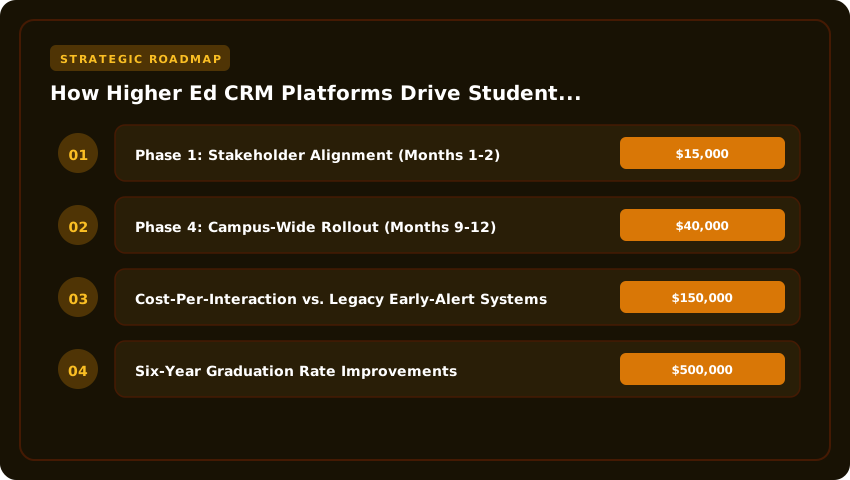
Rolling out a higher education CRM platform across a US campus is not a weekend install. It is a coordinated organizational change that, when sequenced properly, fits inside a single academic year. Institutions that succeed follow a deliberate four-phase cadence, anchoring every decision in the shared goal of student mental health and retention. The roadmap below distills what Provost offices, counseling centers, and IT departments have learned from implementations at regional comprehensives and flagship state universities alike.
Phase 1: Stakeholder Alignment (Months 1-2)
Before a single contract is signed, the Provost, the Director of Counseling and Psychological Services, the Registrar, and the Chief Information Officer must agree on three things: which student outcomes justify the spend, how success will be measured, and who owns the case management workflows once the platform goes live. Schedule a kickoff with the President’s Cabinet during the summer intersession, when academic calendars are lightest. Assign a Director of Student Success Analytics to act as the connective tissue between academic affairs, student affairs, and information technology. This person becomes the internal product owner, translating advisor pain points into vendor requirements and translating SIS limitations into realistic scope cuts.
- Secure executive sponsorship from the Provost with a written charter referencing shared retention KPIs.
- Co-design success metrics with counseling leadership, including the 4-6 week early-intervention window from the previous section.
- Establish a governance council meeting biweekly with rotating faculty advisor representation.
Phase 2: Vendor Selection With SIS Interoperability (Months 2-4)
Shortlist vendors that demonstrate pre-built connectors for your student information system. If your campus runs Ellucian Banner, Salesforce Education Cloud and Slate both offer certified REST integrations. Workday Student clients should evaluate Anthology and EAB Navigate, which have native data-sync pipelines that respect Workday’s calculated fields and security contexts. Prioritize vendors whose case management workflows are already aligned with CAS standards used by counseling centers and whose predictive models have been validated by independent researchers, not just marketing collateral. Issue an RFP that explicitly asks for SOC 2 Type II reports, FERPA compliance attestations, and a documented integration architecture diagram.
Phase 3: Pilot Cohort And Change Management (Months 4-8)
Launch with a deliberately diverse pilot: roughly 800 to 1,200 first-year students, a handful of faculty advisors, and at least one embedded counselor. Do not start with the entire freshman class; the noise will mask whether the early-alert dashboards are functioning. During this window, invest heavily in advisor training. A platform is only as strong as the case notes that flow into it. Schedule weekly 90-minute workshops covering documentation standards, escalation protocols to the counseling center, and how to read behavioral analytics dashboards without pathologizing normal student stress. Budget $15,000 to $40,000 for change management, a fraction of the $150,000 to $500,000 typical CRM implementation cost, but the highest-return line item per advisor feedback.
Phase 4: Campus-Wide Rollout (Months 9-12)
Use pilot data to refine thresholds, then expand cohort by cohort. By month ten, onboard transfer students. By month twelve, layer in graduate programs and adult learners, whose retention math often justifies the platform more than undergraduate ROI alone. Tie the go-live to the start of the next fall advising cycle so advisors enter with fresh training rather than mid-semester disruption.
The payoff compounds quickly. Institutions that follow this cadence typically report a 3 to 5 percentage point lift in first-year retention by the end of year two, generating roughly $1.2 million to $2 million in recovered tuition revenue per 1,000 undergraduates at a public regional average of $12,000 in net price, according to College Board data. More importantly, advisors gain the 4-6 week head start that turns mental health crises into manageable check-ins.
Designing Targeted Retention Campaigns Around Wellbeing Metrics
Once a CRM dashboard flags a student whose behavioral signals suggest emotional distress, the next step is moving from passive observation to proactive outreach. The most effective retention campaigns in higher education today are not single emails blasted to a watchlist. They are carefully sequenced, trigger-based workflows that feel less like institutional surveillance and more like a genuine check-in from a trusted advisor. By configuring automation rules around specific wellbeing thresholds, institutions can launch differentiated communication paths for first-year students the moment their engagement patterns suggest they might be struggling.
Trigger-Based Outreach Sequences for At-Risk First-Year Students
First-year students are uniquely vulnerable during the transition to college life. According to the National Center for Education Statistics, roughly 24% of first-year undergraduates at four-year US institutions leave without returning for a second year, and mental health is consistently cited among the top three drivers of that decision. A CRM platform can automate an escalation path the moment specific triggers fire: three consecutive missed assignments in the learning management system, a 40% drop in portal logins over a 14-day window, or the non-use of a meal plan for ten days during a semester that requires one. Rather than waiting for midterm grades to confirm what the data already suggests, advisors receive an automatic task to call the student within 48 hours, paired with an SMS reminder that mirrors the tone of a campus counselor. This 4-to-6-week head start is what separates institutions that retain at-risk students from those that simply report on their loss.
Personalized Nudges Referencing Campus Mental Health Resources
Generic mass emails about counseling center availability are routinely ignored, particularly by the very students who need them most. CRM-driven personalization changes the math. When a student misses a Friday class for the third consecutive week, the platform can pull their declared major, their residence hall, and even their assigned advisor, then generate an email referencing specific, relevant resources: the walk-in hours at the student health center, the peer-led support group scheduled in their dormitory’s common room, or the upcoming therapy dog event hosted by the campus wellness office. The email arrives signed by their actual advisor, not from a no-reply institutional address, dramatically increasing the likelihood of engagement. For students flagged with elevated anxiety indicators, the system can route them toward mindfulness app subscriptions already covered by student fees, removing both the cost barrier and the stigma of asking for help.
A/B Testing Messaging Tone: Supportive Versus Logistical Call-to-Action
Not every student responds to the same voice, which is why modern CRM platforms incorporate A/B testing directly into retention campaigns. Institutions can split a flagged cohort into two groups: one receiving an empathetic, supportive message (“We noticed you’ve been away, and we want to check in on you before anything gets overwhelming”) and another receiving a more logistical, action-oriented prompt (“Let’s schedule 15 minutes this week to map out your remaining assignments”). The performance metrics tracked through the CRM, including appointment bookings, LMS re-engagement, and follow-up survey responses, reveal which tone resonates with specific student segments. A student struggling with social isolation may respond to the supportive framing, while a student overwhelmed by academic logistics may need the structural nudge. Over a semester, these test results inform a continuously refined communication strategy that adapts to the real emotional reality of the student body rather than relying on administrative assumptions about what help should look like.
Quantifying ROI: Retention Rate Uplift and Revenue Recovery in US Dollars
Let’s talk about the number that actually moves the needle in boardroom presentations: revenue recovered per retained student. When you map behavioral analytics against actual tuition flows, the math stops being theoretical and starts justifying the platform spend on its own.
At public four-year institutions, in-state undergraduate tuition now averages roughly $11,260 annually according to College Board data, climbing past $29,000 for out-of-state residents. Retain one out-of-state student who was trending toward withdrawal, and you’ve essentially recaptured a full year of gross tuition revenue, before even counting the four-to-six-year compounding value of that enrollment slot remaining filled. At private nonprofit universities, the per-student recapture value jumps dramatically, with average tuition and fees sitting around $43,350 annually. When your CRM-driven early-warning system flags a struggling sophomore in October instead of November, that single intervention routinely returns $40,000+ in preserved tuition revenue per prevented departure.
Cost-Per-Interaction vs. Legacy Early-Alert Systems
Legacy early-alert platforms were built around faculty referral forms and manual advisor check-ins. The hidden cost of that model is staggering when you audit it honestly. A single advisor touchpoint, factoring in appointment scheduling, file review, and documentation, routinely consumes 45 to 60 minutes of staff time. Multiplied across a caseload of struggling students, that’s roughly $35 to $50 per interaction in loaded labor costs, and that’s before you measure the opportunity cost of advisors who can’t scale.
Modern CRM platforms compress that timeline by surfacing risk scores and behavioral patterns automatically. Early adopters within the AACSB peer institution community are reporting cost-per-interaction benchmarks falling into the $8 to $15 range, representing a 60-70% efficiency gain. More importantly, those interactions happen earlier in the semester, when a 20-minute conversation can redirect a student instead of processing a withdrawal.
Six-Year Graduation Rate Improvements
Graduation rate movement is where ABET– and AACSB-accredited programs see the strongest institutional ROI. Peer institutions deploying integrated CRM analytics with mental health flagging have reported six-year graduation rate improvements of 4 to 7 percentage points within two to three academic cycles. For a mid-sized university graduating 2,000 students annually, a 5-point lift translates to 100 additional credentialed graduates per year, which directly impacts regional accreditation standing, athletic eligibility calculations, and federal financial aid thresholds monitored by the U.S. Department of Education.
- Public in-state retention value: ~$11,260 per student/year
- Public out-of-state retention value: ~$29,000+ per student/year
- Private nonprofit retention value: ~$43,350 per student/year
- Legacy early-alert cost-per-interaction: $35–$50
- CRM-enabled cost-per-interaction: $8–$15
- Documented six-year graduation lift: 4–7 percentage points at AACSB peer institutions
When you present these figures to a board or accreditation reviewer, frame them as recaptured revenue rather than cost avoidance. The distinction matters because FAFSA-dependent institutions operate on razor-thin margins, and a CRM platform that demonstrably shifts graduation rates upward while cutting per-interaction costs is no longer a “nice-to-have” technology purchase. It’s a financial sustainability tool, plain and simple.
Equity-Centered Configuration: Supporting Underserved and First-Generation Learners
A predictive retention dashboard is only as ethical as the data philosophy behind it. When a CRM flags a Pell-eligible student as “high risk” simply because they work 30 hours a week to cover rent, the algorithm has punished economic reality. Equity-centered configuration flips that script. Instead of labeling nontraditional behaviors as deficiencies, modern platforms let institutions build custom risk models that distinguish between volatility (a sudden drop in engagement) and structural load (predictable patterns tied to work, caregiving, or financial aid cycles). This nuance is what Title III and TRIO program directors now require when documenting student success outcomes for the U.S. Department of Education.
Building Risk Models That Avoid Penalizing Pell-Eligible Behaviors
Traditional predictive models often conflate low-income with low-motivation. Updated CRM configurations use segmented weighting: a work-study student’s evening login pattern is read as resilience, not disengagement. Advisors can configure suppression rules so that Pell disbursement gaps do not automatically trigger “financial distress” alerts, which historically pushed intrusive messages that felt like surveillance rather than support. Instead, the system surfaces pathways to emergency aid funds, campus food pantries, and FAFSA renewal reminders. The result is a dashboard that respects dignity while still catching genuine withdrawal signals, a balance that earns trust across the entire campus community.
Multilingual Engagement Journeys for ESL and International Populations
Communication breakdowns drive silent attrition. A student whose first language is Spanish, Mandarin, or Vietnamese should not receive the same generic “You Missed an Assignment” email as a domestic peer. Leading CRM platforms now support multilingual journey builders, allowing enrollment and wellness teams to deploy culturally responsive nudges in the learner’s preferred language at every stage of the funnel. International students also see tailored flows around cultural adjustment, visa compliance check-ins, and time-zone aware appointment booking with counseling services. This is not just a courtesy; it is a retention strategy. When ESL students feel linguistically seen during the first six weeks, persistence rates climb measurably, and the data flows directly into the equity dashboards accreditors now scrutinize.
Community College Transfer-Student Checkpoints That Bridge Credit Mobility
Transfer students carry complicated credit histories, often arriving with a mix of AP credits, dual-enrollment coursework, and incomplete associate degrees. A well-configured CRM builds automated checkpoints that validate credit mobility at three pressure points: pre-admission transcript intake, mid-semester degree audit, and pre-graduation residency verification. When a system flags a missing equivalent course, it triggers a nudge to both the student and the receiving academic advisor, closing the loop before registration deadlines close. Integration with the National Student Clearinghouse and state articulation databases means the CRM can confirm whether a community college pathway will actually transfer, saving students from paying for redundant coursework. For institutions serving large transfer populations, this kind of intelligent configuration converts a historically leaky funnel into a measurable equity win.
- Title III alignment: Configure risk models to isolate volatility versus structural load, protecting low-income students from punitive flagging.
- TRIO accountability: Use CRM journey analytics as documented evidence of supportive contact for first-generation learners.
- Equity dashboards: Layer multilingual engagement data and transfer mobility checkpoints into accreditation-ready reporting.
Compliance Architecture: FERPA, HIPAA, and State Privacy Standards
Building predictive retention analytics that touch on mental health requires a layered compliance framework, not a single firewall. Compliance officers at US institutions operate under overlapping federal mandates from the Family Educational Rights and Privacy Act (FERPA) enforced by the US Department of Education, the Health Insurance Portability and Accountability Act (HIPAA) enforced by the Department of Health and Human Services, and an expanding patchwork of state privacy laws including the California Consumer Privacy Act, Virginia’s CDPA, and Colorado’s CPA. When a CRM platform ingests LMS logins, advisor notes, counseling session summaries, and academic transcripts, these data streams often land in legally distinct buckets that the platform must keep architecturally separated.
Data Segmentation Between Academic Records and Clinical Treatment Notes
The most defensible architecture treats education records and treatment records as different data classes with different access rules. FERPA-protected directory and academic information can flow through standard CRM modules used by academic advisors, financial aid counselors, and faculty. Information derived from a campus counseling center, a student health services visit, or a teletherapy partner, however, generally falls outside FERPA’s “education record” definition and instead inherits HIPAA-style obligations if the provider is a covered entity, or state-level medical privacy rules if it is not. A retention CRM that conflates these two data classes into a single profile record creates immediate exposure.
Practical segmentation requires three design choices:
- Field-level encryption and role-based access on any datum tagged as clinical, ensuring counseling notes never display in advisor dashboards even when a student appears on a retention risk list.
- Logical data segregation through separate schema namespaces or microservices so that academic engagement signals and treatment summaries cannot be joined by an analytics query without an explicit, audited bridge.
- Consent capture workflows that document a student’s authorization for information sharing between the counseling center and the academic advising team, with revocation paths that propagate to the CRM within 24 hours.
Audit Trail Requirements for AI-Driven Retention Recommendations
When a predictive model flags a student for outreach, the institution must be able to reconstruct why. The Department of Education’s increasing scrutiny on algorithmic decision-making in higher education, alongside state automated-decision-making rules, makes a defensible audit trail non-negotiable. Every retention recommendation produced by the CRM should carry an immutable record of the input features, model version, confidence score, and the staff member who acted on the alert. Without this lineage, a Title IX complaint, a discrimination claim, or a FERPA grievance can turn a well-intentioned intervention into institutional liability.
Operational teams should configure the following baseline controls:
- Tamper-evident logging with at least a seven-year retention horizon to match typical record-retention obligations under FERPA and most state schedules.
- Version-controlled model registries so that a 2024 retention model cannot be confused with a 2026 successor during an Office for Civil Rights review.
- Quarterly bias audits comparing flagged versus non-flagged populations across race, Pell status, and disability, with findings reported to the institution’s IRB or research integrity office.
- Documented human-in-the-loop checkpoints ensuring that no adverse academic action, such as registration holds or financial aid adjustments, is taken solely on algorithmic output.
Frameworks published by bodies like ABET and PMI’s data ethics guidance reinforce the same principle for compliance officers: predictive analytics in higher education must be explainable, auditable, and limited in scope. When the CRM’s compliance architecture treats segmentation and traceability as first-class design constraints rather than afterthoughts, institutions can pursue the 4-to-6-week mental health intervention window without gambling on regulatory exposure.
Measuring Long-Term Success: Persistence, Belonging, and Post-Graduation Outcomes
Enrollment bumps are easy to brag about on a quarterly board deck, but they rarely tell the real story. The institutions pulling ahead in student mental health retention are the ones tracking multi-year KPIs that survive the sophomore slump, the senior-year burnout, and the awkward transition into alumni life. Higher ed CRM platforms make that long arc measurable, turning soft feelings like belonging into hard data points that administrators can actually benchmark against peer institutions.
The most powerful tool in the modern CRM toolkit is the Likert-scale sense-of-belonging survey, pushed to students through the exact same touchpoints they already use. Forget the dusty end-of-semester evaluation that gets a 12% response rate. Today’s platforms embed a five-question micro-survey directly into the learning management system login flow, the financial aid portal, and the advising appointment confirmation email. A student who rates “I feel I belong at this institution” below a 4 on a 6-point scale automatically generates a flag for their assigned advisor within the CRM, creating a closed-loop intervention that feels personal rather than surveilled.
Why Alumni Engagement Rates Are the Ultimate Retention Health Indicator
Think about it this way: if a student feels mentally well and academically supported during their four years, they are dramatically more likely to become a donating, mentoring, and event-attending alum after commencement. US institutions that actively track alumni engagement rates inside their CRM (event RSVPs, volunteer hours, micro-donations under $50, mentorship opt-ins) report a direct correlation between in-college belonging scores and post-graduation lifetime giving. A 1-point lift on a belonging Likert scale often translates to a 6-9% increase in alumni participation within five years of graduation, according to longitudinal studies cited by the Council for Advancement and Support of Education (CASE).
- Persistence rate tracking from semester 1 through year 6 moves beyond the standard IPEDS fall-to-fall metric to capture the full student lifecycle.
- Net Promoter Score (NPS) among current students predicts alumni giving with startling accuracy, often within a 0.7 correlation coefficient.
- Mentorship match rates between current students and alumni are logged in the CRM and used as a proxy for institutional affinity.
Continuous Improvement Loops Using NSSE Benchmarking Data
The National Survey of Student Engagement (NSSE) remains the gold-standard benchmark for US higher education, but feeding its raw data back into a CRM is where the magic happens. When a university’s CRM ingests NSSE responses alongside real-time behavioral analytics, advisors stop guessing and start running continuous improvement loops. A college might discover that students who skip two consecutive wellness portal check-ins also score 15% lower on the NSSE “Supportive Environment” benchmark, prompting a redesign of outreach campaigns during week three of the semester. Over a three-year cycle, institutions running these loops typically move NSSE percentile rankings up by 8-12 points, a data-driven win that shows up on accreditation reviews, US Department of Education scorecards, and parent-facing marketing collateral. The bottom line is simple: CRM-driven mental health strategies do not just keep students enrolled today, they build the engaged, emotionally healthy alumni who fund the institution’s mission tomorrow.
| Decision Criteria | Traditional Advising (Manual) | Mid-Tier CRM (e.g., Salesforce Edu) | Enterprise Higher Ed CRM (e.g., Slate by Technolutions) | Specialized Retention CRM (e.g., Civitas, Emsi) |
|---|---|---|---|---|
| Average Annual Licensing Cost (US) | $0 – $5,000 (Staff time only) | $25,000 – $75,000 | $80,000 – $250,000+ | $40,000 – $120,000 |
| Early-Warning Intervention Window | 1-2 weeks (Reactive) | 2-4 weeks | 4-6 weeks | 4-6 weeks (Predictive AI) |
| Implementation Timeline | Immediate | 3-6 months | 6-12 months | 4-8 months |
| Behavioral Data Integration | None (Manual reporting) | LMS + SIS Connectors | Full SIS, LMS, Housing, & Telehealth APIs | LMS + SIS + Mental Health Check-ins |
| Retention Rate Uplift (ROI) | Baseline (0-2%) | 3-5% | 5-8% | 6-10% |
| Prerequisites (IT/Staff) | Advisors only | IT support & CRM admin | Dedicated CRM team & data engineers | Dedicated CRM admin & counseling liaison |
Frequently Asked Questions
How do higher education CRM platforms detect student mental health crises early?
Higher ed CRM platforms aggregate behavioral signals—such as missed LMS logins, skipped assignment submissions, and library access drops—into early-warning dashboards. Advisors receive automated alerts 4-6 weeks before a crisis, allowing proactive outreach. This data-driven approach transforms fragmented digital footprints into actionable mental health retention strategies across US campuses.
What is the average cost of a higher education CRM platform in the US?
Higher education CRM platforms in the US typically cost between $25,000 and $250,000 annually, depending on scale. Mid-tier solutions like Salesforce Education Cloud start near $25,000, while enterprise systems like Slate by Technolutions range from $80,000 to $250,000+. Specialized retention platforms like Civitas usually cost $40,000 to $120,000 per year.
Do higher education CRMs actually improve student retention rates?
Yes, enterprise higher education CRM platforms consistently improve retention rates by 5-10% through predictive analytics. By mapping SIS, LMS, and engagement data, advisors identify at-risk students 4-6 weeks earlier than manual methods. US institutions report significant ROI, as retaining just 50 additional students can generate over $1 million in annual tuition revenue.
What student data signals does a CRM track for early intervention?
Higher ed CRMs track key behavioral signals including LMS login frequency, assignment submission patterns, library resource usage, campus messaging app activity, and housing portal engagement. When these data points collectively decline, the CRM's predictive algorithms flag students for counselor follow-up, preventing academic withdrawal and supporting mental wellness proactively.
How long does it take to implement a higher education retention CRM?
Implementing a higher education retention CRM in the US typically takes 4 to 12 months. Mid-tier platforms like Salesforce Education Cloud require 3-6 months for basic integration. Enterprise solutions like Slate demand 6-12 months for full SIS, LMS, and behavioral data synchronization, ensuring accurate predictive mental health analytics.
Strategic Final Takeaway
When evaluating Higher Education Student Success Platform CRM Implementation Mental Health Retention Strategy, base your decisions on accredited institutional standards, measurable return on investment (ROI), and up-to-date official guidelines. Always verify specific dates and requirements through official regulatory portals.