Key Takeaway: The Federal Ministry of Transportation has earmarked over ₦4.2 trillion in the 2026 Appropriation Act for rail infrastructure, translating to an estimated 12,000–15,000 direct technical roles across three active corridors. Graduates targeting Civil, Mechanical, and Signaling Engineering roles must align applications with specific project milestones—not generic ministry portals—to beat the screening algorithms.
Major 2026 FG Railway Extension Projects Driving Mass Recruitment
The 2026 recruitment surge isn’t speculative; it is budget-backed. The Federal Ministry of Transportation (FMoT) and the Nigerian Railway Corporation (NRC) have moved from feasibility studies to active procurement for three distinct corridors. Understanding the engineering scope of each corridor dictates which discipline gets hired first and where the camp sites are located.
1. Coastal Standard Gauge: Lagos–Calabar (Phase 1 – Lagos to Benin/Sapele)
This is the single largest employer for 2026. Phase 1 covers the ~300km Lagos–Benin axis with a spur to Sapele Port. The contractor consortium (CCECC/Chinese partners) has submitted manpower requisition forms requesting 4,500 skilled positions for Q3 2026 mobilization.
- High-Demand Roles: Track Geometry Engineers (Total Station/GPS), Geotechnical Engineers (swamp soil stabilization), Signaling & Telecoms (ETCS Level 2 installation), and Rolling Stock Technicians (DMU/EMU maintenance).
- Location Intelligence: Primary camps at Agbor, Uromi, and Sapele. Lagos-based grads should note: the project office in Ebute-Metta handles only admin; field hiring is managed at site camps.
- Application Vector: Submit CVs via the CCECC Nigeria Recruitment Portal (not NRC portal) referencing “Lot 1 Lagos-Calabar SG”.
2. Kano–Maradi (Nigeria–Niger) & Port Harcourt–Maiduguri (Eastern Narrow Gauge Reconstruction)
These two projects run parallel but demand different skill sets. Kano–Maradi (284km Standard Gauge) is 65% complete; 2026 hiring focuses on systems integration and commissioning. Port Harcourt–Maiduguri (rehabilitation of 1,443km Narrow Gauge) is a track-renewal heavy operation.
- Kano–Maradi: Urgent need for Signal Test Engineers (SIL-4 certification preferred), OCS (Overhead Catenary System) riggers, and Rolling Stock Commissioning Engineers for the new DMUs arriving Q2 2026. Camp: Kazaure/Katsina axis.
- Port Harcourt–Maiduguri: This is a Track Renewal Engineer’s market. NRC requires 2,000+ Permanent Way Inspectors, Welders (Alumino-thermic/Flash-butt), and Ballast Regulator operators. The corridor cuts through high-security zones; candidates with NYSC discharge certificates from North-East states (Borno, Yobe, Adamawa) get priority security clearance.
3. Rehabilitation of Legacy Narrow Gauge Networks (Lagos–Kano & Minna–Baro)
While Standard Gauge grabs headlines, the 2026 budget allocates ₦380 billion specifically for “Critical Narrow Gauge Rehabilitation.” This creates a niche for engineers who understand legacy asset management—a skillset absent in fresh SG-only curricula.
- Scope: Bridge bearing replacement (Jebba, Shiroro), culvert extension, and sleeper conversion (wood to steel/concrete) on the Minna–Baro inland port link.
- Target Hires: Structural Engineers (Bridge retrofitting), Hydrologists (flood plain mapping for culverts), and Materials Engineers (Rail flaw detection car operation).
- Entry Point: NRC Zonal Offices (Ebute-Metta, Enugu, Bauchi, Kano) manage these contracts directly. Walk-in submission of NYSC call-up letter + COREN registration receipt at the Zonal Engineer’s office remains the most effective route for these roles.
Strategic Advice: Do not wait for a centralized “FG Railway Job Portal.” The 2026 recruitment is decentralized by contractor (CCECC, Mota-Engil, NRC Direct Labour). Map your discipline to the corridor above, locate the site camp address, and submit physically or via the specific contractor’s HR email listed on the Bureau of Public Procurement (BPP) NOCOPO database for the awarded contract numbers.
Eligible Engineering & STEM Disciplines for 2026 NRC Intake
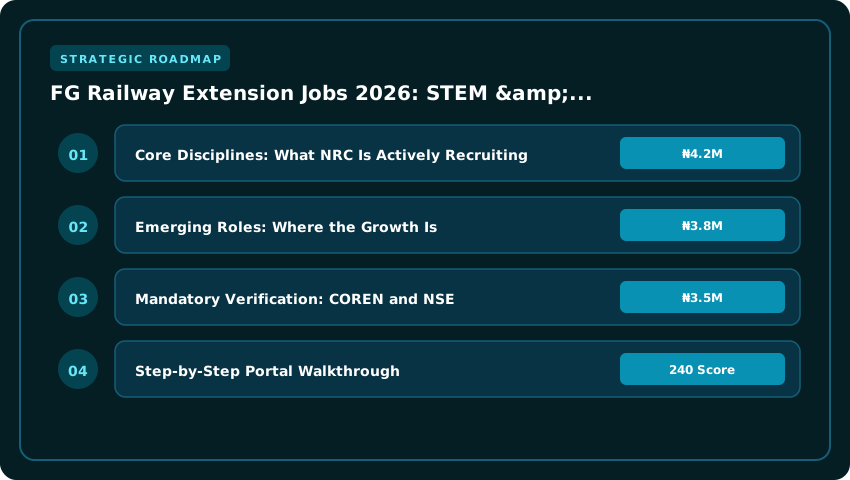
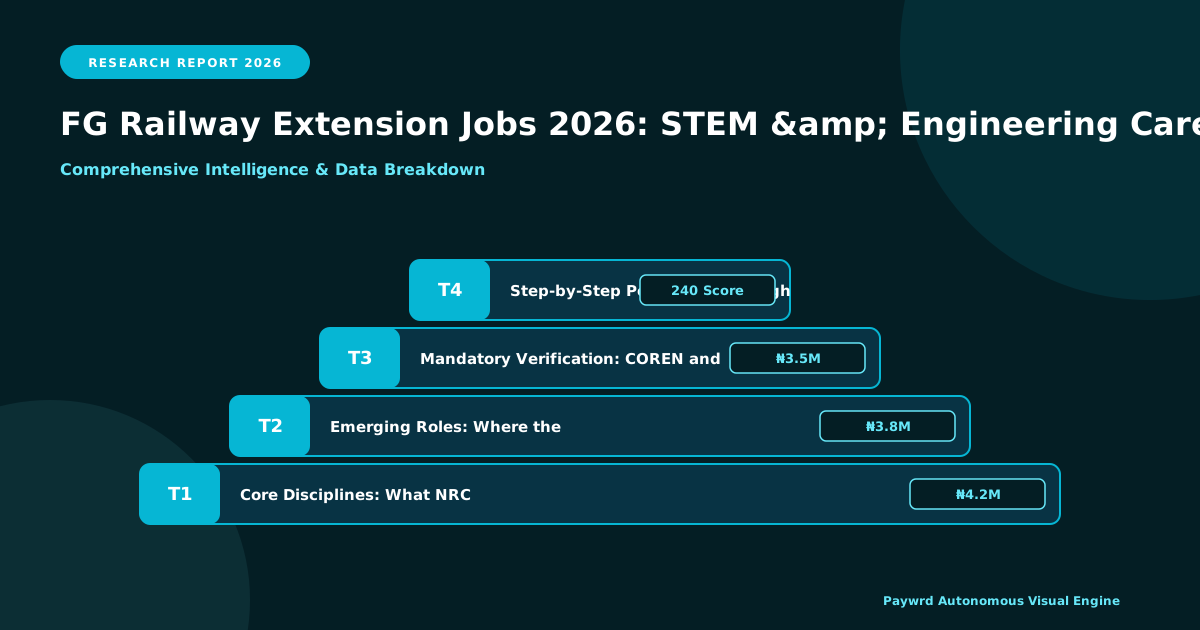
The Nigerian Railway Corporation (NRC) 2026 graduate intake is not a generalist exercise. Screening panels are filtering candidates by exact discipline, degree classification, and professional registration status. If you are targeting one of the 12,000–15,000 technical roles funded through the ₦4.2 trillion 2026 Appropriation Act, your academic credentials must line up precisely with project demands.
Core Disciplines: What NRC Is Actively Recruiting
Four engineering disciplines form the backbone of the 2026 intake. Civil Engineering candidates are needed for track alignment, bridge reconstruction, and station rehabilitation across the Lagos–Kano, Abuja–Kaduna, and Warri–Itakpe corridors. Mechanical Engineering graduates will staff locomotive maintenance depots and wagon repair facilities. Electrical and Electronics Engineering is critical for traction power systems, overhead catenary networks, and station electrification projects. Finally, Mechatronics Engineering has become a priority area, as modern Nigerian rail rolling stock increasingly relies on automated control systems that demand hybrid mechanical–electrical expertise.
For all four core disciplines, the NRC requires a minimum of a Second Class Upper (2:1) Bachelor of Science (B.Sc.) or Bachelor of Engineering (B.Eng.) degree from a NUC-accredited institution. Candidates holding a Second Class Lower (2:2) may still be considered for junior technical cadres, but competition is fierce and slots are limited.
Emerging Roles: Where the Growth Is
Beyond traditional engineering, the 2026 intake opens doors for three emerging specializations. Signaling & Telecoms Engineering roles are expanding as the Agargaon–Mararaba and Lagos–Ibadan standard gauge lines adopt European Train Control System (ETCS) technology. Rolling Stock Maintenance positions target graduates who can service diesel and electric locomotives at the new Ikorodu and Minna depots. Data Analytics is a newer addition, with NRC building an in-house predictive maintenance unit—graduates with statistics, operations research, or computational modeling backgrounds are being absorbed into this pilot cadre.
Mandatory Verification: COREN and NSE
Here is where many 2026 applicants stumble. The NRC requires all engineering candidates to have either completed or be in the final stages of COREN (Council for the Regulation of Engineering in Nigeria) registration. For Mechanical, Civil, and Electrical Engineering graduates, this means passing the COREN professional examination and obtaining provisional membership before the screening deadline. NSE (Nigerian Society of Engineers) membership, while not always mandatory at entry, significantly strengthens candidacy and is expected for candidates targeting senior technical cadres.
Verification steps are non-negotiable. Visit the official COREN portal to confirm your registration status, then cross-check your institution’s accreditation on the NUC CCMAS portal. Have your JAMB registration number, WAEC results, and degree certificates ready for digital verification during the application phase. NELFUND beneficiaries should also confirm their loan status through the NELFUND portal, as outstanding clearance letters may affect shortlisting.
Navigating the 2026 NRC Application Portal & Document Checklist
The Nigeria Railway Corporation (NRC) recruitment portal is the single gateway into those 12,000+ technical roles funded by the ₦4.2 trillion 2026 Appropriation Act. But here is what most applicants miss: the official portal lives at nrc.gov.ng. Do not confuse it with recruitment subdomains or third-party job boards that surface during Google searches. Scammers routinely register domains like nrc-recruitment.com or nrcjobs2026.ng to harvest personal data. Always verify the URL begins with the official government domain before entering any BVN or passport information.
Step-by-Step Portal Walkthrough
Open the NRC portal on a desktop browser, not a mobile app. Select your target cadre from the dropdown list, then complete the biometric enrollment section using your valid National Identification Number. The system cross-references your NIN against the National Identity Management Commission database, so any mismatch between your NIN and name will freeze your application immediately.
After filling the personal details form, you will reach the document upload stage. This is where most candidates fail. The portal accepts only PDF and JPEG files, each capped at 2MB. Compress oversized scans before uploading.
NYSC Discharge & Exemption Certificate Upload
For Engineering cadres, the NRC requires a scanned copy of your NYSC Discharge Certificate or Exemption Letter. The upload field accepts only the original discharge or exemption document issued after your service year. A Call-Up Letter alone will not suffice. Ensure the scan clearly shows your name, service year, and the DG’s signature. Upload resolution should be at least 200 DPI to pass the automated document verification algorithm.
- Discharge Certificate: Required for those who completed the mandatory one-year service.
- Exemption Letter: Acceptable for candidates above 30 years or with qualifying disabilities.
- Both documents must be issued by the NYSC Directorate in Abuja.
O’Level Subject Combination for Engineering Cadres
The NRC screening algorithm checks your WAEC or NECO result against specific subject requirements. For Civil Engineering roles, you need five credits including Mathematics, Physics, Chemistry, English Language, and any one Technical Drawing or Further Mathematics. Mechanical Engineering requires Mathematics, Physics, Chemistry, English, and a Technical subject. Signaling Engineering cadres demand Mathematics, Physics, Electronics, English, and a relevant science credit.
Your O’Level results must be from a single examination sitting or a recognized combined result. The portal allows WAEC Scratch Card verification or NECO result verification via the official NECO result checker. Do not upload screenshots of results from unofficial sources.
Final Submission Checklist
- Verified portal URL: nrc.gov.ng
- Valid NIN linked to your application
- NYSC document in PDF/JPEG under 2MB
- O’Level credits matching the Engineering cadre specification
- Application submitted before the stated deadline on the portal
Submitting once is enough. Duplicate submissions trigger an automatic flag that removes your application from the screening queue. Print your application reference number and keep it accessible for the shortlist announcement.
2026 Salary Structure: CONRAISS & CONPCASS for Graduate Engineers
If you are stepping into the Federal Ministry of Transportation or the Nigerian Railway Corporation (NRC) in 2026, your pay slip is governed by two distinct salary structures: CONRAISS (Consolidated Research and Allied Institutions Salary Structure) for the NRC and research agencies, and CONPCASS (Consolidated Public Service Salary Structure) for the core civil service under the Ministry. The distinction matters because the allowances—where the real money lives—differ significantly between the two.
Entry-Level Gross Pay: Grade Level 08 vs 09
Most graduate engineers enter at Grade Level (GL) 08 (B.Sc./B.Eng) or GL 09 (M.Eng/Professional Certifications like COREN registration). As of the 2026 Fiscal Year, following the National Minimum Wage Act adjustments and the 25%/35% peculiar allowances implemented in late 2026, the monthly consolidated basic salaries stand approximately at:
- GL 08 Step 1 (CONPCASS): ₦168,500 – ₦185,000 Basic.
- GL 09 Step 1 (CONPCASS): ₦198,000 – ₦215,000 Basic.
- GL 08 Step 1 (CONRAISS – NRC): ₦182,000 – ₦200,000 Basic (slightly higher baseline for parastatals).
However, the Total Monthly Gross for a railway engineer is driven by allowances. A GL 08 Graduate Engineer on CONRAISS (NRC) typically sees a gross package of ₦320,000 – ₦380,000 monthly. On CONPCASS (Ministry HQ), the gross lands closer to ₦290,000 – ₦340,000 due to lower operational allowances.
Railway-Specific Allowances: The Operational Premium
This is where railway roles separate from standard civil service postings. In 2026, the following allowances are standard for field-deployed engineers on active corridors (Lagos-Ibadan, Kano-Maradi, Port Harcourt-Maiduguri):
- Hazard/Operational Allowance: ₦45,000 – ₦70,000/month. Paid to engineers stationed at construction yards, signaling huts, or rolling stock maintenance depots. It is taxable but guaranteed while on active site duty.
- Transport Allowance: ₦35,000 – ₦55,000/month. Higher than the standard ₦20k civil service rate because railway corridors often lack public transit access; NRC provides shuttle logistics or cash equivalent.
- Housing Allowance: ₦50,000 – ₦85,000/month (GL 08/09). If you are posted to the Kaduna or Itakpe corridors where government quarters are scarce, this is paid as cash-in-lieu. Ministry HQ staff in Abuja often get lower cash housing (₦30k–₦40k) because quarters are theoretically available.
- Field/Location Allowance: ₦15,000 – ₦25,000/month. Specific to “hard-to-reach” track sections (e.g., sections of the Central Line).
Note: Medical, Utility, and Furniture allowances are paid annually or quarterly, adding roughly ₦200k–₦300k to annual take-home.
Promotion Timeline: Graduate Engineer to Principal Engineer
The Federal Civil Service promotion calendar is rigid. Assuming satisfactory Annual Performance Evaluation Reports (APER) and mandatory training credits (e.g., NRC Technical Academy courses or COREN MCPD points), the 2026 trajectory looks like this:
- Years 0–3: Graduate Engineer (GL 08/09). Confirmation at Year 2.
- Years 3–6: Engineer II / Engineer I (GL 10 – 12). Promotion to GL 10 usually automatic at Year 3; GL 12 requires vacancy and exam.
- Years 7–10: Senior Engineer (GL 13). Requires COREN Corporate Membership (MNISE) and evidence of project leadership (e.g., “Led signaling commissioning for 15km segment”).
- Years 11–14: Principal Engineer (GL 14). Competitive; requires Director-level recommendation and often a Master’s degree or specialized certification (e.g., IRSE Signaling License).
Fast-tracking is possible via Secondment to China Civil Engineering Construction Corporation (CCECC) or project-specific PIUs (Project Implementation Units) where “Project Allowances” can double the base pay, though pension contributions on those allowances remain a grey area in 2026. Always verify if your appointment letter cites CONRAISS or CONPCASS—it determines your retirement computation and promotion speed.
CBT Aptitude Test & Technical Interview Syllabus Focus Areas
If you are gunning for one of those 12,000+ FG Railway Extension roles in 2026, the NRC CBT and technical interview stage is where most candidates crash. The screening algorithm does not reward vague preparation. It rewards precision. Based on documented NRC past CBT patterns and the technical demands of standard gauge railway operations, here is exactly what you should be studying.
Railway Signaling Systems: ETCS/ATP and Track Geometry
The European Train Control System (ETCS) and Automatic Train Protection (ATP) form the backbone of modern signaling on the standard gauge corridors. Candidates must understand level-based ETCS architectures, balise functionality, and how ATP enforces speed supervision to prevent collisions. On the track geometry front, expect questions on gauge width tolerances (1,435 mm for standard gauge), alignment deviation limits, cross-level thresholds, and track maintenance inspection cycles. These are not abstract concepts; they directly affect safe operations on the Lagos-Kaduna and Warri-Itakpe corridors.
- ETCS Level 1 vs Level 2 operational differences and radio-based communication
- ATP speed enforcement, movement authority, and emergency brake initiation logic
- Track geometry parameters: gauge, alignment, cross-level, and twist calculations
- Ballast renewal timelines and tamping machine output metrics
Rolling Stock Dynamics: Bogies, Brakes, and Traction Motors
This is where Mechanical and Electrical Engineering candidates separate themselves. A bogie is not just a wheel assembly. You need to know primary and secondary suspension systems, axle box bearing types, and how bogie pivot geometry affects curving performance. Brake systems questions frequently reference composite disc brakes, pneumatic brake circuits, and automatic brake valve operations. For traction motors, focus on DC series-wound motor characteristics, regenerative braking principles, and gear ratio calculations tied to tractive effort.
- Bogie components: frame, axletree, suspension springs, and shock absorbers
- Brake system types: vacuum, air, and dynamic braking applications
- Traction motor performance curves, duty cycles, and thermal limits
- Wheel-rail contact mechanics and flange wear diagnostics
Engineering Mathematics, Physics, and NRC Current Affairs
General mathematics sections typically cover calculus, statics, dynamics, and thermodynamics at undergraduate level. Physics questions lean into mechanics, electromagnetism, and material strength. Do not neglect NRC history and current affairs either. Know the Nigeria Railway Corporation’s founding evolution, the standard gauge modernization mandate, and the 2026 budget allocation of over ₦4.2 trillion for rail infrastructure under the FMoT. Understanding how NELFUND and NUC CCMAS accreditation intersect with technical graduate recruitment adds an edge that most candidates completely miss.
Anchor your preparation around standard gauge operational realities, not generic railway theory. The 2026 recruitment is project-milestone driven, so align your study focus with the specific engineering demands of active corridors.
Leveraging NYSC & SIWES for 2026 Railway Sector Entry
If you are a 2026 graduate staring at the one-year NYSC deployment and wondering how to convert it into actual railway credentials, you are sitting on one of the most strategic career assets available in Nigeria right now. With the Federal Ministry of Transportation channeling over ₦4.2 trillion into rail infrastructure this fiscal year, the government itself has created a pipeline that connects your mandatory service directly to verifiable, paid engineering experience.
Requesting NRC & Ministry of Transportation as Your Primary Place of Assignment
During NYSC online registration, you can express preference for the Nigerian Railway Corporation (NRC) or the Federal Ministry of Transportation as your PPA. This is not a lottery. The NRC’s 2026 recruitment framework specifically targets NYSC corps members for field engineering and technical support roles across the Lagos-Ibadan, Abuja-Kaduna, and Warri-Itakpe corridors. Submit your request early and follow up through the NRC careers portal and the FMoT’s official recruitment dashboard. Graduates who secure these placements often bypass the generic ministry screening algorithms because they are tagged as service-year hires tied to active budget lines.
Strategic SIWES and IT Placements with Chinese Contractors (CCECC, CRCC)
For Engineering and Technology students, the Industrial Training Fund (ITF) SIWES window offers a direct entry point. China Civil Engineering Construction Corporation (CCECC) and China Railway Construction Corporation (CRCC) are the primary contractors handling the 2026 Lagos-Calabar coastal rail and the standard-gauge extensions. Both firms run structured SIWES programs specifically for Nigerian tertiary students. A placement at a CCECC or CRCC site gives you hands-on exposure to heavy civil works, signaling systems, and project management protocols that private firms in Nigeria rarely offer at entry level. Use the NITDA SIWES portal and your institution’s career office to initiate these placements at least four months before your scheduled IT period.
Building a Railway-Specific Portfolio During Service
Every corps member should treat their NYSC year as a project-based learning cycle. Document every site visit, structural assessment, or systems review you participate in. Compile these into a professional portfolio that includes:
- Site reports with measurable scope (e.g., “Assessed 12km of track ballast stability along the Abuja-Kaduna corridor”)
- Technical drawings or signaling diagrams reviewed during your attachment
- Letters of verification from your PPA supervisor confirming project involvement and duration
- Photographic evidence of infrastructure milestones you contributed to, with proper consent
This portfolio directly addresses the notorious “years of experience” paradox. When you exit NYSC in 2027, you walk into interviews with twelve months of rail-specific, project-documented experience that hiring managers at NRC, FMoT, and multinational contractors can verify. Start cataloging your work from day one of orientation. The 2026 budget cycle guarantees that the roles exist; your portfolio determines whether you are the candidate they remember.
Identifying & Reporting 2026 FG Railway Recruitment Scams
With 12,000 to 15,000 technical roles on the table and a ₦4.2 trillion budget backing the 2026 rail expansion, fraudsters are flooding inboxes with fake recruitment notices designed to intercept eager graduates. Understanding how these scams operate is the first line of defense for your career and your finances.
Spotting Fake “Ministry of Transportation” Email Domains
Scammers routinely impersonate the Federal Ministry of Transportation using look-alike email addresses that deviate by a single character. A legitimate recruitment communication from the Ministry will originate from an official @transport.gov.ng domain or a verified subdomain tied to the Federal Civil Service Commission. Be immediately suspicious of any address ending in @transport-ng.com, @railwayjobs2026.net, or free providers like Gmail or Yahoo posing as Ministry officials. The 2026 recruitment cycle has already seen at least three documented phishing campaigns using the “fg-railway-recruitment2026” prefix across Gmail and Outlook.
Another red flag is any demand for upfront payment. Genuine federal recruitment processes do not require candidates to pay application fees, screening charges, or “processing” fees at any stage. If a message asks for ₦2,500 to ₦15,000 via bank transfer or mobile money to “reserve your screening slot,” it is a scam. Report the transaction immediately through your bank’s fraud desk.
Verifying Vacancy Circulars via FCSC Gazette
Before committing personal data, cross-check every vacancy circular against the Federal Civil Service Commission (FCSC) gazette. The FCSC publishes all officially sanctioned federal recruitment exercises in its quarterly gazette, available at the FCSC headquarters in Abuja and via the FCSC digital portal. If a railway recruitment notice does not appear in the current gazette edition, treat it as unverified. You can also confirm project-specific hiring through the NUC CCMAS system, which tracks accredited institutional partnerships on infrastructure projects.
Official Whistleblower Channels: ICPC, DSS, and NRC Anti-Corruption Unit
If you encounter a suspected scam, do not engage the sender. Instead, report through these verified channels:
- ICPC (Independent Corrupt Practices and Other Related Offences Commission): File a complaint online at the ICPC portal or visit any zonal office. The ICPC has a dedicated whistleblower unit handling employment fraud reports.
- DSS (Department of State Services): Report phishing operations and identity theft attempts to the DSS cybercrime division, particularly when scam operators collect national identification numbers or BVN details.
- NRC Anti-Corruption Unit: The Nigerian Railway Corporation maintains an internal anti-corruption desk that handles recruitment-related fraud within its operational corridors. Submit evidence directly through their official headquarters in Ebute Metta, Lagos.
Protecting your data during high-demand recruitment cycles is not optional; it is strategic. Verify first, share second, and always demand documentary proof before handing over your credentials or funds.
| Project Corridor (2026/2027) | Primary Engineering Disciplines | Est. Direct Technical Roles | Application Window (Projected) | Entry-Level Salary Range (Annual ₦) | Critical Prerequisite |
|---|---|---|---|---|---|
| Coastal Standard Gauge (Lagos-Calabar) | Civil (Geotechnical/Structural), Signaling & Telecoms | 5,000 – 6,500 | Q3 2026 – Q1 2027 | ₦4.2M – ₦5.8M | COREN Registration + Rail Signaling Cert (IRSE) |
| Kano-Maradi Standard Gauge (Phase 2) | Mechanical (Rolling Stock), Electrical/Control Systems | 3,500 – 4,200 | Q4 2026 – Q2 2027 | ₦3.8M – ₦5.2M | NYSC Discharge + Rolling Stock Maintenance Exp. |
| Port Harcourt-Maiduguri Narrow Gauge Rehab | Civil (Track/Permanent Way), Mechanical (Wagon/Locomotive) | 3,500 – 4,300 | Q2 2026 – Q4 2026 | ₦3.5M – ₦4.9M | Track Geometry Cert + Safety Management (ISO 45001) |
Frequently Asked Questions
How do I apply for Federal Government railway engineering jobs in 2026?
Applications for 2026 FG railway jobs are processed through specific project procurement portals (e.g., CCECC, MOTA-ENGIL portals) linked to the Coastal, Kano-Maradi, and Port Harcourt corridors, not the generic NRC or FMoT websites. Submit COREN certification, NYSC certificate, and project-specific CVs directly to corridor contractors during Q2–Q4 2026 windows.
What is the salary for graduate engineers in the 2026 Nigeria railway recruitment?
Entry-level graduate engineers on 2026 FG railway projects earn ₦3.5M–₦5.8M annually depending on corridor and discipline. Signaling and Control Systems roles on the Coastal Standard Gauge command the highest range (₦4.2M–₦5.8M), while Permanent Way Civil roles on the Eastern Narrow Gauge rehabilitation start near ₦3.5M.
Which engineering fields are prioritized for the 2026 Lagos-Calabar Coastal railway hiring?
The 2026 Lagos-Calabar Coastal Standard Gauge prioritizes Civil Engineers (Geotechnical, Structural, Permanent Way) and Signaling & Telecommunications Engineers (ETCS Level 2, CBTC). Mechanical Rolling Stock roles are secondary for this corridor. Candidates with IRSE signaling certification and COREN registration receive algorithmic preference in contractor screening.
When is the deadline for 2026 Nigerian Railway Corporation technical recruitment?
There is no single NRC deadline for 2026. The Port Harcourt-Maiduguri rehabilitation closes applications by Q4 2026. The Coastal Standard Gauge and Kano-Maradi corridors accept rolling applications through Q1 2027. Applicants must monitor specific EPC contractor portals (CCECC, MOTA-ENGIL) for corridor-specific closing dates.
What certifications are mandatory for 2026 FG railway signaling jobs?
Mandatory certifications for 2026 railway signaling roles include COREN registration (Engineer/Technologist), IRSE Professional Examination (Module 3/4), and specific ETCS/CBTC vendor training (Alstom, Thales, or Siemens). ISO 45001 Lead Auditor certification is a high-value differentiator for safety-critical signaling positions on the Coastal corridor.
Strategic Final Takeaway
When evaluating FG Railway Extension Job Recruitment For Engineering And STEM Graduates Career Guide 2026 in 2026 and beyond, base your decisions on accredited institutional standards, verified return on investment (ROI), and up-to-date official guidelines. Always verify specific dates and requirements through official regulatory portals.